The White Lady of Shiyan

Last week, I met Ye Enling, a 70-something Shiyan native. Mr. Ye worked in Overseas Chinese affairs for over twenty years, and his current interests include calligraphy, linguistics, architectural design, and social philosophy. Of note, Mr. Ye is a Hakka and has devoted much time and energy to promoting Hakka culture by collecting Shiyan mountain songs (石岩山歌), compiling vocabulary lists, recording Shiyan history, and composing essays on diverse topics. In fact, he has published three collections and a book of calligraphy.

Below, I have translated Mr. Ye’s retelling of The White Lady’s Temple on Yangtai Mountain (叶恩麟者《闲雅集》111-2页. Online Chinese versions, here and here). I find the story interesting because it places singing within the sentimental context of gendered yearnings, which continue to shape family life and personal desire. The fact that the story continues to circulate suggests that even if most Chinese professors have opted into modern academics and concomitant specialization, traditional intellectual life and knowledge production may be fading, but are nonetheless still kicking.

I also find the story interesting because when contrasted with Shenzhen’s contemporary arts or traditional culture fairs, the White Lady of Shiyan reveals the extent to which expressive creativity has been alienated from everyday life, an ongoing lament in modernist art. The living presence of this tradition dovetails with the Municipality’s ongoing promotion of Neo-Confucian mores as a strategy of governance. I had tended to think of Neo-Confucianism’s appeal in terms of an invented nostalgia for “good old days” sans hunger, warlords or opium. However, my meeting with Mr. Ye has me thinking that there may actually be a popular basis for Shenzhen’s decision to disseminate Confucian sayings at bus stops and other public places, cultural revolutions notwithstanding.

The actual content of the White Lady story is far more disturbing and has me thinking about structural analogies between the 1920s and contemporary Shenzhen. In Diary of a Madmen, which was published a mere ten years before the white lady’s story is said to have taken place,  Lu Xun gives a chilling representation of human desperation in which the only way to survive is to eat other people; the clearest Lu Xun overlap is, of course, Medicine. Similarly, today, we keep hearing stories of illegal transplants and the shady sourcing of human organs. Less than a hundred years separate workers of the south China diaspora from the neidi migration of workers to Shenzhen. And it seems that rumors of cannibalistic medical treatments continue to emerge out of the experience. Families are fractured, bodies broken, and loved ones vanish.

The White Lady’s Temple on Yangtai Mountain

All Shiyan elders remember that there was once a small temple on Yangtai Mountain and have passed on the following story about it.

In 1928, a Ye family lived in Shiyan Market. The man had gone to Indonesia and not returned. At the time, parents arranged marriages and in his absence he was married to another Ye. A year after their parents had organized the marriage, the wife prepared to go to Indonesia to be united with the husband she had never even seen. But the sea voyage was rough and the road long, and being afraid to travel alone, she looked for a companion. The Ye woman discovered that in another Shiyan village Liguang there was a white woman whose husband was also in Sanbaolong, Indonesia. The white woman was also preparing to join her husband. This white woman had skin the color of kneaded dough, with a hint of pink. No one knew if she had Caucasian blood or a skin disease. After so many years, we no longer know what her surname was or who her people were.

The white woman didn’t have a son and her husband had been overseas for many years. She decided to build a temple on Yangtai Mountain in order to pray for her husband’s safety abroad. While building the temple, she could also stand on the mountaintop and gaze toward Indonesia. It’s obvious how much she yearned for her husband! She said she would do it and she did. The white woman bought a load of bricks. Everyday, she shouldered four bundles of bricks on a carrying pole, and made the difficult trek from Liguang Village up Yangtai Mountain.

Whenever she paused to rest, she sang a mountain song in her beautiful, high-pitched voice, “Older Brother has drifted away on the sea, and hasn’t returned the years; I know the years of time and swallow them whole, no one understands how to open my heart. Standing beneath the mountaintop pines, tears, only tears. I have only one question of Heaven: When will my man return home? (阿哥出洋漂大海,三年五载不回来,线纱打结吞落肚,无人解得崖心开,崖在高山松树下,眼泪汗水落泪花,崖向苍天问句话,崖郎几时转屋家。)

When she reached the peak, she sang in a loud voice, “No one smokes these cigarettes, no seedlings growing in these fields. Younger sister dares climb these roads, younger sister dares view these skies” (无瘾唔食这支烟,无秧唔莳这块田,阿妹敢登这条路,阿妹敢看这重天。)

When the sun set in the west of the mountain, the hope of another day was extinguished. The white lady was deeply saddened and she cried while singing, “From dusk to dawn, I think of you, and my tears endlessly role down my cheeks, they water the mountain grass and drown the people below (黄昏想郎到明天,眼泪滴滴流不停,流到山上草变绿,流到山下浸死人).”

Her melancholy songs reverberated in the mountain valleys, startling birds and causing those who heard to cry. The white lady used her songs to relieve her yearning for her husband, and in this way, day after day, without any help she forced herself to shoulder the burden of bricks, ceramic tiles, lime, sand, and beams and carry them up the mountain. Only after bringing all the necessary materials did she hire a a builder. The temple was finally completed and although it was only several meters big, it brimmed with the white lady’s hard work, blood, sweat, and tears. The white lady also placed a censor and an idol in the temple. The first and fifteenth of every month, she climbed the mountain, undeterred by inclement weather, to pray to the gods and bow to Buddha, saying, “Every 15th or 16th the moon is full, I hope my heart is the same as my husband’s. I pray that the Lord of Heaven protects my husband, insuring that Older Brother makes a fortune (十五十六月光圆,崖同情郎心相连,崖求天公来保佑,保佑阿哥赚大钱).”

The white lady’s story spread throughout Shiyan, her spirit and will-power moving villagers, and many began climbing the mountain to see and burn incense. After many years, this place became rich with incense.

Later, the Ye woman received a letter from her husband saying that she should not go to Indonesia because he was returning to Tang Mountain. Accordingly, the Ye woman changed her plans and the white lady left alone for Indonesia. The white lady’s husband waited for months on the coast, but his wife had vanished without a trace and his heart was aflame with worry. He searched for her and finally got word that his wife suffered from motion sickness on the trip. As she thrashed unconscious, an evil person took advantage of the situation to kill her for her gallbladder because he had heard that white people’s gallbladders could be used for medicine. After removing her organ, he threw her body into the ocean. On hearing what had befallen his wife, the husband was overcome with grief.

To commemorate the white lady, the named the temple she had built “The White Lady’s Temple”. Unfortunately, during the Cultural Revolution, the temple was razed. Nevertheless, the moving love story of a devoted wife continues to be told.

Exporting the Shenzhen Model

The Shenzhen Model not only shapes neidi development, but also the form and content of China’s recent push to expand and develop its international presence. Friend Jonathan Bach directed me to the article, African Shenzhen: China’s Special Economic Zones in Africa by Deborah Brautigam and Tang Xiaoyang. The article contextualizes contemporary Chinese investment in Africa, concluding that:

“These zones are using an unprecedented business model in Africa. Although there are exceptions, most economic zones in Africa, especially sub-Saharan Africa, have historically been developed and operated by governments, and the results have often been disappointing (FIAS 2008: 31). In China’s own zones, government agencies were also responsible for their development, with generally good results. However, the new Chinese zones in Africa are not being planned by government bureaucrats and given to Chinese firms to implement. Instead, they are designed and established by Chinese enterprises spontaneously according to their assessment of business feasibility. The Chinese zone developers are expected to bring future-oriented design, high-standard infrastructure and world-class professional management to help industrial investors survive the harsh market environment in Africa and facilitate their growth.

In some parts of Africa, clusters of dynamic industrial development have arisen spontaneously, as private initiatives. If the expectations for the Chinese-run zones are realised (and the jury is still out on this), these cooperation zones could form a synergistic third model, combining the market forces of existing clusters with the systematic organisation of the top-down model. If so, this would help the business sustainability of the zones. The scale and experience of the developers mean that they are less vulnerable, and better connected to networks of capital, ideas and support than Africa’s existing clusters.

These developments may yet come to naught, given the obstacles that have beset past efforts to develop economic zones in Africa. They face significant challenges of inclusion, communication, and integration with local economies. Yet the timing is right for some African countries to catch the new wave of investors coming out of China. If even some of these experiments lead to a genuine transfer of knowledge and opportunity from China to Africa, much as happened with Japan and south-east Asia in the 1970s and with Hong Kong and Mauritius in the 1980s, employment could see significant gains and, in some spots, long-delayed industrial transitions may yet be realised (CHINA’S SPECIAL ECONOMIC ZONES IN AFRICA 51-2).”

To get a sense of why export Shenzhen and not Chongqing, check out the urban distribution of China’s top 679 enterprises. Not unsurprisingly, Beijing’s national state-owned enterprises dominated the list and Shanghai came in second. However, Chongqing had a mere 18 companies in the top. In contrast, Shenzhen came in third, with 52 top company headquarters. Moreover, the Shenzhen companies tended to be in the hi-tech, financial, or service sectors, representing the highest growth in new, rather than traditional industries and are precisely the companies investing in Africa.

Shenzhen-based Huawei‘s global expansion continues to accelerate, for example. Founded in 1987 by Ren Zhengfei, is the largest China-based networking and telecommunications equipment supplier and the second-largest supplier of mobile telecommunications infrastructure equipment in the world (after Ericsson). Likewise, Shenzhen-based Tencent made Forbes Magazine’s list of Asia’s Fab 50 companies and although the company is not yet in the China 500, it is the country’s largest and most-used Internet service portal. Other top Shenzhen companies include: Ping An Insurance (finance), ZTE Corporation (telecommunications), Vanke (real estate), and OCT Group (real estate).

And yet. These rankings indicate increasing inequality between regions, also explaining the ongoing appeal of Maoism.

怀德村:virtue’s rewards

It’s been a while since I’ve summarized an episode from The Transformation of Shenzhen Villages (沧海桑田深圳村庄三十年) and so today, episode 6: The Secret of Huaide Village (怀德的秘密), which puns the village’s name and also means “the secret to cherishing virtue”.

The episode opens by telling viewers that Huaide is a revolutionary village, which contributed over 40 soldiers to the People’s Liberation Army. The connection between good Party leadership, virtuous villagers, and getting rich is then personalized through the story of Pan Baliang, a Huaide villager, who fought in the Korean War, (or the Resist American War as it is known in Chinese). However, during the Cultural Revolution he was jailed because his children were abroad, and was only to be rehabilitated in 1980, when out of gratitude for his fellow villagers continued support, he petitioned the village/ brigade if he could open a factory.

In 1988, Huaide was chosen as the location for Shenzhen’s Baoan International Airport. At the time, the SEZ decided that guannei land should be saved for urban development, rejecting a proposal to build at Baishizhou, which was then considered the suburbs and choosing instead to stimulate the guanwai economy by converting Shenzhen’s largest duck farm into an international airport. The Shenzhen airport expropriated over 1,000 mu of village land and in return Huaide received a compensation package of 3.5 million yuan. The question became: should the sum be divided evenly and distributed to each villager (as many villages had chosen to do) or should the village create a jointly held corporation and invest the money in common cause?

In 1988, guanwai New Baoan County was still rural. This meant that the village was still organized as a collective brigade, which provided the organizational infrastructure for Huaide’s subsequent development as a jointly held corporation. Huaide’s current CEO and current Party Secretary, Pan Shansen earnestly explains that Huaide Party leaders understood that unless they could correctly direct the thinking of the villagers, the village was in danger of making a collective mistake. Collective and Party leaders then went to work on villagers with dissenting opinions in order to make sure that everyone was on board with the next step — using the money for capital investment to build and manage Cuigang Industrial Park. Pan Shansen then expresses his gratitude for the previous Party leaders’ foresight in using the Airport compensation to create a strong, collective economy.

Pan Shansen describes the work of creating “a center where there was previously no center” as arduous and only possible through the cooperation of the people and their government. In addition to creating a large wholesale furniture market, in 1996 Pan Shansen established a venture capital fund that provided interest free loans to young villagers who wanted to start up companies. The fund started with 1/2 million when and grew to 2 million, and loans grew from 20-50,000 per project. In 2005, this venture capital project was expanded through collaboration with Shenzhen’s rural bank, providing low interest loans of up to 300,000 yuan to Huaide Villagers. By 2010, when the documentary was made, in addition to the villages collected holdings, over 40 families had used Village venture capital to create family businesses.

Fiscal conservatism of the defining features of Huaide Village’s success. Huaide Village has its own “constitution” that requires any private investment over 5 million yuan to be approved by the village, they set up a legal aid office for villagers to consult when writing contracts, and since 1992 have not sold any village land rights. Telling, Pan Shansen makes a point of reminding documentary viewers that Huaide Villagers are farmers — to break their ties to the land and the village is tantamount to destroying what makes them who they are, regardless of how they actually make money. Land is at the heart of Huaide’s neo-Confucian CCP virtue and unlike many Shenzhen villages that no longer have collective land, Huaide still owns almost 1/2 of the land they owned before 1980. What’s more, the Village has actively purchased land rights from other Shenzhen villages, leaving its own land for future use.

The rewards of Huaide’s virtue are a neo-Confucian-socialist hybrid capitalist success story, or as it is sometimes said, villagers washed their feet and left the paddies. In addition to its village venture capitalist fund, Huaide invested in social services and local culture. Huade provides medical insurance, education, including college scholarships, and old age activities for its 700 villagers, and in 2010, its Lion Dancing Troupe was the only village level troupe to receive an invitation to perform at the opening ceremony of Belgium’s Chinese Culture Festival. And thus, the moral to this episode tallies with Shenzhen’s ongoing campaign to promote Confucian ethics: good party cadres are at heart neo-Confucians, serving their people, who become collectively rich. In turn, inquiring minds wonder: to what extent has Huaide’s ethical sensibility extended to the organization of workers’ rights in the village’s three industrial parks?

Cultural postscript: the Lion Dance Troupe is talented and fun. Check out a performance, here.

cultural revolutionaries? bo xilai, mao zedong and populist politics in china

According to a politically savvy friend, if anyone has a chance to democratize China, it will be a leader like Bo Xilai because 1. he had the support of the people; 2. he had support within the Party; and, 3. he could have held power after the transition from a one party to a multi-party system.

The purpose of government is to distribute and justify the distribution of goods, which range from food and shelter through education opportunities and healthy living environments throughout society. Some societies use money as the primary tool to mediate the allocation of social goods, in China, however, political status — power with explicit connection to either the military or the police — is the primary social means of deciding who gets what and how it is delivered. This means that the closer one is to the Center, the more opportunities one will have to monopolize not only the allocation of social goods, but also what those social goods are and how they are produced. In short, opportunities to control and benefit from state monopolies over the means of production.

My friend explained that Chinese politics is a series of expanding circles. At the center are high officials, in the next circle their family and friends, and then lesser relatives, and then the families of friends of friends of family friends… The point, of course, is double.

First, with respect to those who have occupied the center, there are no compelling reasons to change the current structure of unequal distribution. What’s more, successfully changing the structure would entail creating political alliances that cut across all those circles in such a way as to first be able to dismantle the system and then maintain power in the new system.

Second, the one hundred surnames are so far from the center that direct appeals to the people constitute a political wild card, which can be wielded by anyone with a wide enough power base. This is frequently the case in local and regional level politics where national appointees navigate and negotiate unfamiliar terrains before they are sent to their next position. However, most national appointees do not become popular in their brief bureaucratic tenures and popular local leaders rarely convert their local appeal into national charisma.

Bo Xilai, however, was exceptional: he had widespread national appeal; he had deep support within and across the Party organization, including ties to the military and the police; and, he was savvy enough to navigate political upheavals. Indeed, he seemed particularly adept at outside-the-box responses to unexpected problems and it will be interesting to see if he is executed or ends up back at the center in ten years time.

On my friend’s reading, the insular structure of Chinese political interests  overdetermined the Cultural Revolutionary connection that linked Bo Xilai to Mao Zedong. Like Mao, Bo Xilai made highly symbolic gestures to help the people. In Chongqing, fore example, Bo set up neighborhood help systems for elderly residents whose family was working in other cities. A solitary elder could directly ring a bell that linked her to the neighborhood committee representative who would be responsible for coming to her aid. This gesture resonated across generations who have been separated as children have left home to work in other cities. Moreover, Mao and Bo’s willingness to upset high-ranking leaders when making these gestures further endeared them to the people.

Bo Xilai skated at the edge of central Party politics for many years before transmuting a minor appointment in a Dalian county into a springboard to national politics precisely because like Mao, he not only dazzled the people, but also impressed journalists and intellectuals, who in turn promoted his project. Not only journalists sang Bo’s praises, but recently closed leftist websites like Utopianet (乌有之乡) publicly supported the Chongqing Model in contrast to the Shenzhen Model, which remains a key symbol of the success of Reform and Opening.

Bo Xilai symbolized the possibility of an end to Party politics as usual and his “Sing Red, Attack the Black” campaign resonated across Chinese political classes in ways that nothing Xi Jinping or Hu Jintao or Jiang Zemin have done. Today, there are efforts to disparage the Mao-Bo connection, but none have addressed the man’s capital C charisma. In fact, I’ve heard someone say, “I don’t care who he did or didn’t kill, Bo Xilai moved me. I only saw him once, but I felt like a crazy fan, who wanted a body autograph” and this comment goes straight to my point du jour.

Weber has warned us that charismatic leaders do not necessarily overturn unpopular regimes and establish democratic governments. Moreover, the rise and fall of populist leaders in Eastern Europe and Russia have demonstrated that its difficult to uproot the Party machine from national politics. Nevertheless, Bo Xilai’s popularity despite his acknowledged crimes not only hints at just how high levels of dissatisfaction with Chinese politics as usual are, but also alerts us to how much violence is necessary to maintain the status quo.

guagua has vanished, but his older half-brother splashes across the chinese media

At this point in As Chongqing Turns, Guagua has vanished, but intrepid journalists have reported that his famously low key older half-brother, Li Wangzhi (李望知 Brandon Li) is in business with a Japanese chain selling high quality black angus steaks. More to the gossipy point of our story, Li Wangzhi gave his investment company a snarky classical name and his mother, Bo Xilai’s first wife, Li Danyu is throwing operatic slurs!

Flashback: In the rough and tumble years of the Cultural Revolution, the Bo family was out in the political cold with the rest of the 8 elders. Nevertheless, their children were intermarrying, consolidating alliances, and falling in and out of bad romance.

In 1976, Bo Xilai married Li Danyu (李丹宇), the princess daughter of the high-ranking cadre, Li Xuefeng (李雪峰), who in 1960 became the first political commissar of the Beijing Military Region and subsequently took control of the Beijing party organization after the purge of Peng Zhen in 1966. His political star fell when he supported Chen Boda during the 1971 Lushan Conference named him a Lin Biao supporter. In 1976, when his daughter married Bo Xilai, Li Xuefeng still faced another 3 years of  internal exile in Anhui province and would not be rehabilitated until 1982.

Bo Xilai was working as a manual laborer at the Bejing Number 5 Machine Repair Factory when he and Li Danyu married and had a son, Bo Wangzhi. In 1978, the college entrance exam system was re-instated and Bo Xilai was admitted to the Law Department of Beijing University where he met Gu Kailai. Princeling preferences for marrying within red circles being what they were, there were no degrees of separation between the young lovers — Li Danyu’s older brother was married to Gu Kailai’s third older sister, making Bo Xilai and Gu Kailai in-laws by marriage.

Even as Bo Xilai and Gu Kailai’s romance escalated, Li Danyu publicly accused her husband of being Chen Shimei (陈世美), the infamous adulterer from the eponymous Beijing opera. Li Danyu also tried to have Gu Kailai convicted on the “Destroying a Military Marriage” law. Nevertheless, Bo and Gu persevered and were married in 1984, when (it is said), the scorned ex-wife’s father was instrumental in having the couple run out of Beijing to Jin County, Dalian, where Bo Xilai’s political career began a Vice Secretary. Indeed, until 2003 when Li Xuefeng died and his influence over the Beijing political apparatus finally ended, Bo Xilai was unable to find a political position in the capital.

After her divorce from Bo Xilai, Li Danyu had their son change his surname from Bo to Li. Over the years, Li Danyu made sure that everyone knew of Bo and Gu’s lack of virtue, making sure that the story followed Bo wherever he was assigned.

Flash forward: Li Wangzhi grew up, graduated from Beijing University’s School of Law in 1996 and went on for a Master’s in Finance from Columbia in 2001. On returning to Beijing, Li Wangzhi set up a company called Chong’er Investment Consulting Ltd (重耳投资咨询有限公司). Inquiring minds want to know — what’s the story?

During the Spring and Autumn period, Chong’er (重耳) was the given name of Duke Jin Wen, son of Duke Jin Xian. Duke Jin Xian’s concubine, Li Pei had a child, Chong’er’s younger half-brother, Xi Qi. In order to secure Xi Qi’s future, Li Pei hatched a plot to kill Chong’er, who fled for his life. But in a what goes around comes around moment, Li Pei and Xi Qi died in court infighting and Chong’er triumphantly returned to take power.

Today, as Guagua hides and his parents remain hidden, Li Wangzhi moves forward (under the pseudonym Li Xiaobai) with his beef export business, which supplies Japanese steak aficionados with tasty, massaged Snow Dragon black angus steaks at $US 600 a kilo from ranches in — yes, its true — Dalian (雪龙黑牛股份公司).

three class theory: speculating on the scale and possibility of reforming china

A while back I heard a princeling turned Shenzhen nouveau riche (and they do surface every now and again, entrepreneurs in their late 50s and 60s, who came to the SEZ to live well below the national political radar, but nevertheless take advantage of their status to reap economic benefits in the city that launched Reform) half-mockingly challenge a lunch table of intellectuals, saying:

China has three classes — high ranking officials (高干), national intellectuals (高知), and peasants (农民). Officials need help governing and are good to those who help them, but that’s not the important issue. The real question is: do you really want to share power with peasants?

That smug question provoked self-conscious chortles because most at the table were low-level national intellectuals, not peasants, no, but certainly ecclesiastes, who Gramsci defined as the category of intellectuals “who for a long time…held a monopoly of a number of important services: religious ideology, that is the philosophy and science of the age, together with schools, education, morality, justice, charity, good works, etc. The category of ecclesiastes can be considered the category of intellectuals organically bound to the landed aristocracy.”

The a-ha moment in “three class theory” is the emphasis on political, rather than economic power. Take a look at Chinese society and what becomes obvious is that high-ranking officials are, by and large, China’s property-owning class and national intellectuals are, by and large, members of the bourgeoisie. Within each of these classes, of course, exist various opportunities to confirm and strengthen social status, as well as opportunities to transfer and exchange socially valued goods, including money, but also including housing, medical care, and other social benefits. In contrast, peasants are those organically tied to the land, with all that the status has historically entailed: providing quota grain under Maoist collectivism to fund socialist urbanization, and presently being excluded from China’s urban boom except as members of the proletariat. The point, of course, is that in Chinese society economic opportunity is a function of political and social status, rather than the reverse.

The status of peasants and their ties to land are at the center of Shenzhen’s development.On the one hand, as rural areas urbanize, the question of land comes to the fore and in it we see how officials and intellectuals cooperate to expropriate land and justify its expropriation. In this scenario, the class struggle is over the terms of proletarianization and the creation of what are called “peasant workers (农民工)”. On the other hand, to the extent that villages retain control of their land and pursue capitalist projects, we see the stability of the three class system as local systems reproduce this hierarchy, producing “local emperors (土皇帝)”.  In this parallel scenario, the struggle is over the extent to which local emperors and local intellectuals might launch themselves into national politics. Obviously, although both historical trajectories transform individual lives, it is also clear that these changes are not bringing about a more just society, but rather using previous injustices to make and legitimate power grabs and the concomitant distribution of the spoils.

As China enters its fourth decade of reform, Gramsci’s call for intellectuals to theorize and provide alternatives to the present situation still haunts us. The fact that US and Chinese leaders continue to cosy up to one another and that US and Chinese intellectuals find so much in common makes salient the compatibility of US neoliberal ideologies and Chinese ideologies of socialist exceptionalism. However, this ideological compatibility has blinded many of us to a simple truth; the quality of life for Chinese nongmin remains the standard for evaluating the scale, possibility, and social forms of Reform and Opening, not the cross-cultural comfort level of high-ranking officials and national intellectuals, whatever their passport status may be.

return of the bivalves

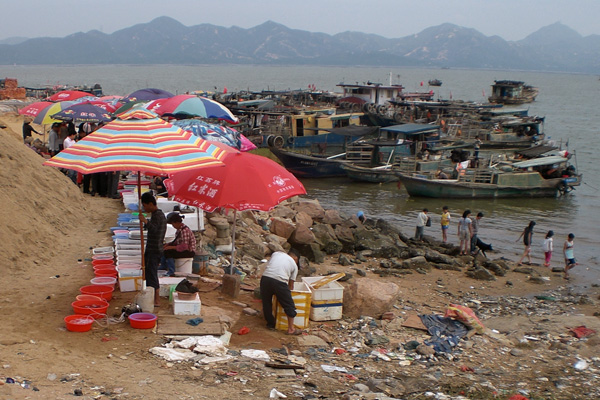
Yesterday, I walked around Dongjiaotou, which in days earlier served as a small port for building materials coming in from Foshan and other Delta cities. Pedestrians jumped the fence to get to the small strip of beach where several families were selling oysters. In 2007, Nanshan District removed all oyster cultivation and processing from the Houhai coastline, especially around the Seaworld area (pictures from 2003 and 2007, here).

This slideshow requires JavaScript.

hakka borderlands: xiawei and shiyan

On Thursday, I joined a group of architects and students from the Future Cities Laboratory on a rainy guanwai trek along Bulong Road, which parallels the second line. This particular trek interests because it hints at generations of ongoing cultural transformation both as industrial manufacturing has spread and as Cantonese and Hakka urban villages have renegotiated collectives identities over the past 150 years.

We departed from Huaqiangbei and crossed at the former Buji Checkpoint, which today has been partially cleared to make room for the Buji subway station (Longgang Line) although cars still lined up to pass through check booths. Directly north of the erxian boundary, Xiawei Village (吓围村) handshakes huddle tightly, giving the impression of an ordinary new South China village. However, the entry gate and main hall of Xiawei’s ancestral hall remain, suggesting that at some point the village had enough collective funds to erect a substantial building. According to an old worker who was organizing collected paper products in the compound plaza, villagers continue to burn incense for ancestors during the Spring Festival.

We then headed west to the precinct headquarters of Shiyan. During the Mao-era, this area also served as the headquarters of Shiyan Commune. Located between the Kowloon-Canton railroad and Guangzhou Shenzhen corridors, Shiyan has remained relatively poor when compared to precinct headquarters at Buji or Shajing, for example. Nevertheless, it has Mao-era flat housing, Reform era factories, and two generations of single-family homes and handshakes. More to today’s point about Hakka borderlands, Shiyan is also interesting because it is located along Baoan County’s traditional border between Cantonese and Hakka cultural regions. Thus, although the Ye Ancestral Hall boasts Hakka exhortations of Confucian morality, the structure itself, like many of the areas older flat buildings are Cantonese style.

Impressions:

This slideshow requires JavaScript.

borders and corridors: one interpretation of the 2010-2020 shenzhen comprehensive plan

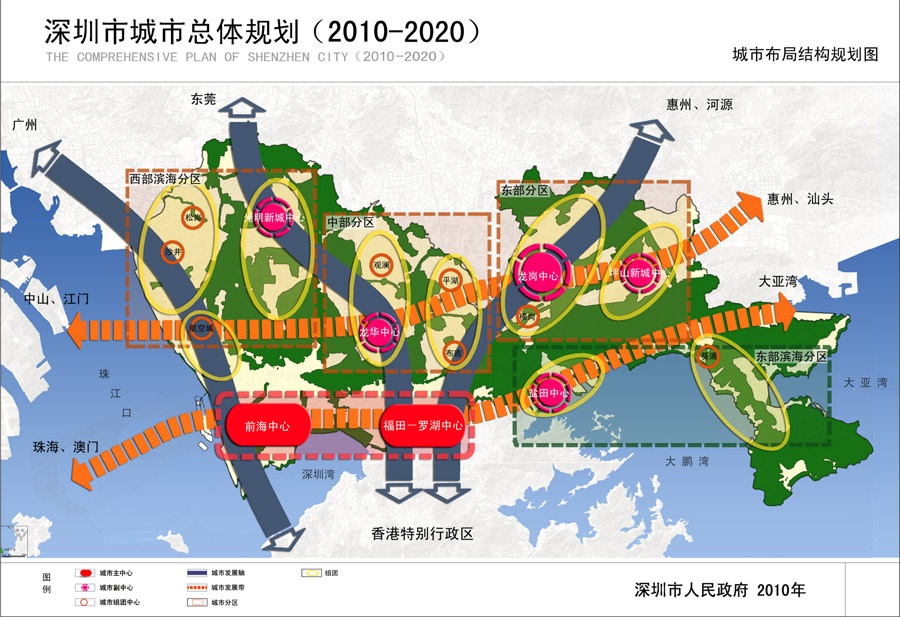
At first glance, Shenzhen’s 2010-2020 Comprehensive Plan seems a writhing mass of blue snakes and bright hotspots.

However, by simplifying the Comprehensive Plan in terms of the historical relationship between political boundaries and and early infrastructure in Shenzhen development, I came up with the following grid of borders and corridors, which explains the Plan’s horizontal flows, the connections to Hong Kong, and investment initiatives in New District hubs:

Three borders have enabled urbanization in Shenzhen: the border with Hong Kong, the second line, and the city limits, which abut Dongguan in the northwest and Huizhou in the northeast. Two economic corridors have facilitated Shenzhen’s growth: the Guangshen highway corridor and the Kowloon-Canton Railway. The Guangshen highway corridor parallels the area’s riparian trade routes, which were the means of Han expansion from Guangzhou southwardly on the Pearl River and its tributaries. The KCR, of course, was the British attempt to preempt and redirect the PRD’s extensive trade network.

This grid enters everyday conversation through place name protocols. For example, no one today refers to the “second line”, which evokes the yesteryears of early reform. In contrast, ever since the boundaries of the SEZ have been made coterminous with city limits, we now speak of guannei and guanwai, or “inside the gate” and “outside the gate”, respectively. Interestingly, however, I rarely hear people speak of the guanwai area well east of the railroad as “guanwai”, instead, it is more common to refer to that part of Shenzhen as “the east”.

In fact, the SEZ’s historically most important hubs are all located on this grid. Luohu/ Dongmen is the first stop on the Chinese side of the railroad, while Buji was the first stop on the guanwai side of the second line. Likewise, Shekou was the end of the old riparian trade network, activating Delta resources. Bao’an District government is found just over the guanwai side of the Guangshen highway corridor and Shajing Wanfeng Village, once called “the first village in the south” occupies the area just south of Dongguan on the Guangshen Highway corridor. Given the importance of political territorializations and infrastructure to development, it is unsurprising that the poorest areas in Shenzhen are either in (a) the guanwai area between the railroad and highway corridors (Shiyan and Guangming) or (b) the East. With the exception of Guangming, all of Shenzhen’s other three new districts — Pingshan, Longhua, and Dapeng — are located in the east, far from easy access to the railroad, let alone the Pearl River and riparian access to Guangzhou.

In the new Comprehensive Plan the old hubs appear renamed, but their functions unchanged. The Guangshen corridor has been resutured to the Pearl River through the Qianhai Center. The Luohu/ Dongmen railroad corridor has been interestingly diverted into two streams, one that enters guannei at Huanggang/ Lok Ma Chau and leaves guanwai through Guangming and a second that enters guannei at Luohu and then exits guanwai through Longgang. Meanwhile, Hong Kong has been absorbed/ extended into the Shenzhen administrative apparatus at both the Lok Ma Chau Loop and Qianhai Cooperation Zone, begging the question: will the next Comprehensive adjustment will be political integration of the two cities and the re-establishment of a first or second line at Shenzhen city limits? Indeed, the question doesn’t seem too far-fetched when we recall that for 5 months in 1997, the transition government for the Hong Kong Special Administrative Zone met in Shenzhen.

even the beggars don’t want hong kong dollars…

Today, an elderly beggar approached me. I reached into my purse and pulled out a two-HK dollar coin. He took the coin in a soft, fingerless hand, and I wondered what had happened. Had he had an accident or had he mutilated himself? He squinted rheumy eyes at the coin in his palm and said, “I can’t spend HK dollars.” I fished a one rmb bill out of my bag and gave it to him. He wished me well, pocketed both the 2 HK dollar piece and the rmb, pivoted on his cane and walked away.