the politics of backbiting

By now you have probably read that Shenzhen passed a new law that makes it more difficult to avoid the one-child policy by giving birth to a second child outside the country.

Between 2000-2009, it is estimated that the number of Chinese citizens having children in Hong Kong went from 709 to 29,766 annually and was still rising in 2010 and 2011. Indeed, some claim that today almost half of the children born in Hong Kong are born to Mainland families. Of this total, over 25% had Shenzhen hukou. Their children have Hong Kong identity cards, and although the parents must pay extra fees for schooling and medical care, nevertheless, they have avoided “second child fines (二胎罚款)” and other more drastic measures of enforcing the one child policy.

As of January 1, 2013, Shenzhen parents who have a second child abroad and then bring the child back to Shenzhen to raise for more than 1.5 years will be fined up to 219,000 rmb (US $35,000), which is roughly the current fine for second children born to parents with Shenzhen hukou. The fine is set each year by multiplying the average annual salary of the year before by 6 to 8 times. In 2011, the average salary was 36,505 rmb. This means that the 2012 Shenzhen penalties for second children are between 219,030 to 438,060 rmb.

This past spring, the Chinese news was full of speculation about how the government would handle the case of Olympic gold medalist Tian Liang, whose wife gave birth to a second child in Hong Kong. People wondered if Tian Liang would be fined as much as 2 million rmb and, more to the point, if he would loose his job, which is representing China in international track and field events. After all, ordinary government workers are not only fined for having a second child, but also loose their jobs. Thus, the Tian Liang case illuminated how it was possible for the wealthy and influential to avoid the consequences meted out to “common people” who gave birth to a second child in the Mainland.

Today, a friend told me about this new law as an example of the politics of backbiting, after all, it has been the rich and powerful who have taken advantage of Hong Kong hospitals to give birth to second children. Moreover, these are precisely the people who are targeted by ambitious underlings. He asked me to imagine how someone advanced within the government bureaucracy. Not on talent, but guanxi. However, when guanxi failed, it was possible to hire a private detective for 20,000 rmb to follow someone and document when and how they broke a law. He estimated that the first half of 2013 would be interesting to see how the newly pregnant rich and powerful handled the births of their second children; ordinary families became pregnant already prepared to pay second child fines.

Clearly my friend moves in nervous circles, where the law is used as a weapon of political infighting. This was, in fact, his point. Human rights and rule of law will not be established in China, he concluded, as long as careers were advanced and derailed through guanxi and/or backbiting.

“But people still accept this situation,” I commented.

He sighed, before saying, “China isn’t yet so corrupt that the people will risk their lives to overthrow the Party. There are still enough talented people in the government that society works. At some point, the balance will tip and we’ll be in revolt.”

“But now?”

“Now I’m just frustrated. I want out. But there’s nowhere to go.”

A catch-22, in fact. My friend plans to send his daughter to school abroad with the understanding that she not come back, unless it is to work for a foreign company; he believes she will be happier abroad than she could be in Shenzhen. He is not jumping, however, because he also knows the only place to earn the money necessary to launch his daughter abroad is his current, relatively high ranking position within a work unit of trusted guanxi and potential backbiters.

maillen hotel and apartments

The Architectural Review has published my review of the Maillen Hotel and Apartments by Urbanus. In the published review, I look at China Merchants’ recent push to gentrify Shekou in terms of gated communities for Shenzhen’s expatriate community. As designed by Urbanus, the Maillen Hotel and Apartments suggest the role of traditional Chinese gardens in the ideological transformation of Maoism into neoliberalism. A synopsis of the review, below; full article, here (with pictures by Sarah Cain).

Urbanus’ stated intention was to design the Maillen Hotel and Apartment with respect to both extant geographic conditions and the traditional Chinese ideas about landscape and garden design, incorporating Nan Shan Mountain into its design with an eye to realizing the aesthetic ideal of “bu yi jing yi”, a four-character expression which literally translates as “step moves landscape moves” and refers to the experience of enjoying new garden scenes with each step taken.

By incorporating the hill into its design, Urbanus took advantage of the section of Nan Shan that remains standing. Historically mountains and hills defined the South China landscape, and Shekou was no exception. However, during the first two decades of development in Shenzhen, urban planning and design prioritized speed and price over any other value, including environmental impact. The Chinese expression for land reclamation, “yi shan tian hai” or “move mountains and fill the sea” literally describes the step-by-step transformation of the Shenzhen Bay coastline. First, raze a mountain – and many Shenzhen hills no longer exist except as place names – and, second, reclaim coastal land, creating flat, relatively inexpensive building sites. The point, of course, is that as the city has prospered and natural features such as Nan Shan have been restructured, their market value has increased exponentially.

The Maillen design also invokes traditional garden design through landscape. Elegant courtyards, perennial bamboo clusters, and delicate plum blossoms evoke literati lives in Suzhou, which during the Song dynasty codified the defining features of a traditional garden. In a classical Chinese garden, stylized elements – ponds, a rock garden, trees and flowers, as well as built structures, for example – symbolized the larger world. The key point, of course, is that the garden allowed members of the Emperor’s court, classical scholars and wealthy merchants to experience themselves as being one with nature without actually having to go into a forest or sail on the ocean.

It is at the moment of exclusivity, or rather the potential to market and sell privatized pleasure that we see the appeal of classical Chinese gardens to contemporary real estate developers. Classical gardens were restricted spaces of elite pleasure, where scholarly achievement and social rank determined who was or was not permited to enjoy the elegant topiary and tranquil spaces. Today, money and status rather than scholarly achievement or social rank might determine who crosses the threshhold, but the effect is the same, the creation of a fashionable space for a select minority. With the Maillen Hotel and Apartment, Urbanus has designed a witty, elegant, and self-enclosed space of privileged consumption.

Indeed, when we architecturally cite China’s classical past, it is important to remember that we are also invoking the feudal hierarchy that the Revolution aimed to overcome.

shenzhen government online

Many readers come to this site looking for resources to learn about Shenzhen. In fact, as part of its efforts to make government more transparent, the Municipality has uploaded many of the key documents, which can be downloaded. The government’s main site is 深圳政府在线. Two of the sites that I find useful are:

深圳市规划和国土资源委员会 (for urban plans, including city and district level)

深圳统计局 (for statistics)

Also, to get a sense of what’s happening closer to ground level, the District governments all have virtual portals, which are differently helpful.

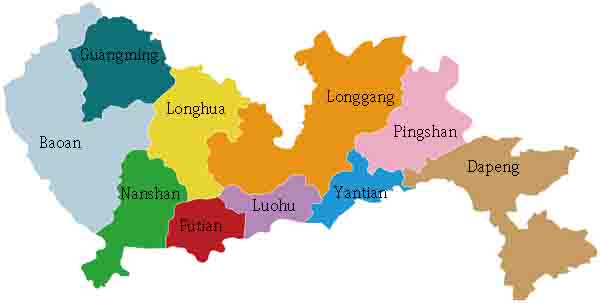
The six districts are: 盐田罗湖福田南山龙岗、and 宝安. The new districts (defined) are 大鹏坪山龙华、and 光明.

And a map of the territory:

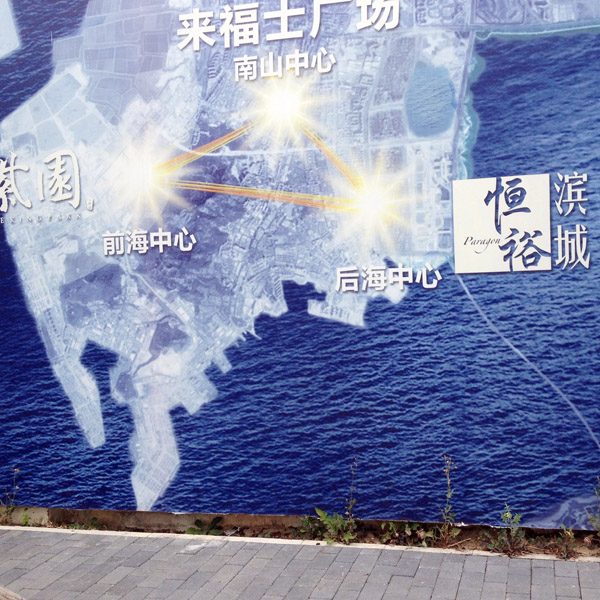
shenzhen bay coastline, oct 27, 2012

I wandered to the Shenzhen Bay Park, tracking the construction and commodification of the new coastline. Land reclamation has brought views and parks, but I noticed that children and dogs still want to get their feet wet. Impressions, below.

This slideshow requires JavaScript.

the back side of the eye

It is one of the ironies of a human life that we experience history not chronologically, but through the cultural present. This is especially true in the arts, where although painting had historically preceded photography, nevertheless most of us saw and took photographs before having seen a painting, whether oil or ink.

Moreover, with the increasing availability of digital images, there is now a generation who has probably first encountered photographic images on a cellphone or computer screen, before contemplating an actual, printed photograph, let alone having viewed a painting. Irrespective of the fact that in point of fact ink painting preceded oil painting, which in turn arose before the invention of photography, in my personal experience, the history of the image has been: photograph, oil painting, ink painting, and then digital image. Other experiential histories are also possible: digital image, photograph, ink painting, and then oil painting.

The Back Side of the Eye, a creative collaboration between photographer Martin Zeller and painter Vai Keng Sou (苏惠琼) reproduces and challenges our experiential history and culture of the image. On the one hand, the production of the images for the series reproduces experiential history, moving from the most recent image technologies toward increasingly distant (and thus increasingly shocking) techniques. Zeller’s digital photographs of Berlin winter landscapes were first viewed on a small camera screen and manipulated on a computer before being printed on rice paper; only then Sou added interpretive brushstrokes. Thus, their creative process itself formulates a question for the era: how do we bring cultural tradition into dialogue with industrial modernity?

On the other hand, viewing the images requires that the photographic and ink elements be engaged concurrently, as elements of a given whole, such that the object itself holds in tension two different aesthetics, which in turn, point to the ways in which human consciousness fabricates past and present out of experience. Indeed, the simultaneous presentation of a past created through digital photography and a past created through ink painting interrupts our appreciation of the image as an example of photography or ink painting. Consequently the result of Sou and Zeller’s collaboration reframes the question of productive process into one of receptive consumption, allowing us to ask: how might bringing cultural tradition into dialogue with industrial modernity enable viewer’s to otherwise engage what-has-been?

Consider, for example, the image “Uncertain Extension”. The underlying photograph is of a swathe of snow-covered trees and, in the background, a line of boxy housing, which evokes the streamlined precision of Cold War modernism. On top of this bleak stillness, Sou has overlaid a clouded spirit, muffled ink smear and trapped purple cloud. The image forces us to engage two past moments simultaneously, the hyper detailed what-has-been of the photograph and the ephemeral what-has-been of Chinese ink painting.

The enigma of a photograph is that a past moment – ‘captured’ on film, we say – is a product of a technological intervention, but is treated as a replica of what-has-been. In fact, no human eye sees the world with the same precision as revealed in a photograph, where details retrospectively emerge to be seen and having-been-seen, to be contemplated. Thus, in “Uncertain Extension”, as viewers note the pattern formed through the delicate wrap of snow on every branch and the rigid precision of housing blocks, we become increasingly sensitive to the atomized materiality of a winter’s day. At the same time, however, Sou’s boneless brushstrokes blur and activate the immobility imposed by photographic accuracy, enabling us to reconsider the psychological what-has-been of winter, not as snow white austerity, but rather as a time of dark sedimentation, of thick ink absorbed by paper already reshaped by printing.

Walter Benjamin asserts that the dialectical value of images, especially photographic images is that they create an analytic space in which to reconsider what has happened, “For while the relation of the present to the past is a purely temporal, continuous one, the relation of what-has-been to the now is dialectical: is not progression but image, suddenly emergent.” In contrast, Zhang Daqian scholar, Pai Tsung Jen (白宗仁) defines the yixiang (意象) of an ink painting outside of history, in terms of the intersection between interior and exterior realities, “創作者主觀意識(意),與外在客觀物象(象)”. In other words, the photographic what-has-been intentionally distances the viewer from the past, while the ink what-has-been purposefully sutures the viewer to the past.

Within their respective traditions, both photography and ink painting denote a particular moment in space and time. However, they emphasize different aspects of that moment. Photography makes the what-has-been relentlessly material, flattened into surfaces that can be endlessly reconsidered. In contrast, ink painting creates yixiang (意象), a sense of being in the world that is shared by both the artist and the viewer. Consequently, the juxtaposition of artistic techniques destabilizes the viewer’s culturally intuitive sense of the nature of what-has-been. Is what-has-been as meticulously concrete as represented in Zeller’s photography? Or is what-has-been as fluidly transient as realized through Sou’s brushstrokes?

The Sou and Zeller collaboration reminds us that although the dialectical contours of the what-has-been may be created and experienced through techniques such as photography and ink painting, nevertheless we use these techniques to make value judgments about what it means to contemplate the past. This is important because how we create the past and its relationship to the present defines who we are as historically and culturally situated people. For Benjamin, photographic pasts were deployed to critique an unjust present. For the ancient literati, ink brushed pasts recorded continuities between external and internal worlds, past and present.

Unlike Benjamin or Pai Tsung Ren, however, we live in an era where although digital images have gone global, nevertheless aesthetic conventions for understanding the relationship between the what-has-been and the present are radically different between  historical generations, let alone different cultures. We need different ways of thinking about the past in order to create a common present. The images brought together in The Back of the Eye beautifully hold the contradictory tension between pasts we create through modern technology and the pasts we create through more ancient forms of human creativity, offering one model for using art to bridge our different approaches to the past.

Their most recent collaboration New Gardens will be exhibited at the Goethe Institut Hong Kong, November 13 through December 18, 2012.

architectural thinking — from the nanjing sun yat-sen memorial to luohu train station

One of the highlights of the XLarch Masterplanning the Future Conference was Wang Yun (王昀)’s keynote speech that periodized the development of Chinese style architecture, arguing for an internationalist approach to architecture, rather than an ideologically charged use of architectural symbols.

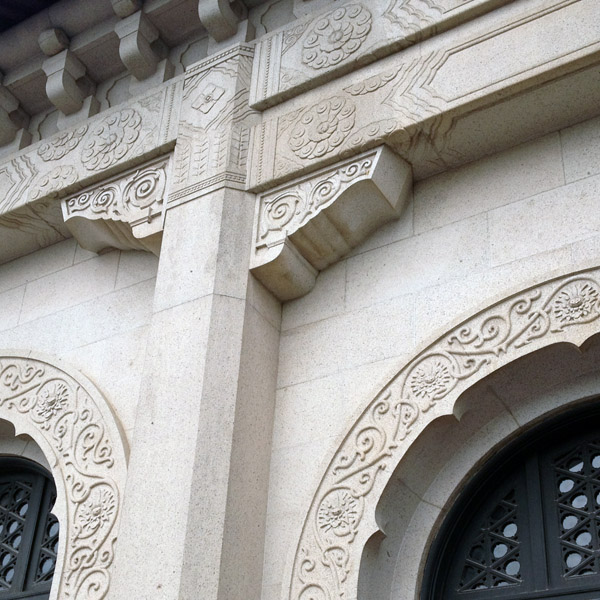
As an architectural style, Chinese classicism was invented by western trained architects who upon returning to Nationalist China received commissions to build “Chinese style (中华风格)” buildings during the decade of 1927-1937. These buildings had large, Chinese style roofs, windows and decorative details, and sometimes included stylized gardens. The Nationalist capital, Nanjing was the location of some of the most important examples of this style as well because commissions not only represented individual client preferences, but also the determination of government leaders to create a recognizable Chinese public architecture.

One of the most important examples of Chinese classicism is the Nanjing Sun Yat-sen Memorial, which was designed by one of China’s first starchitects, Lv Yanzhi (吕彦直). Lv also also designed the Guangzhou Sun Yat-Sen Memorial before his untimely death in 1929. The Nanjing Memorial reinterprets traditional themes through choice of material (reinforced concrete and mosaic tiles) and through the secularization of traditional symbols (animals become geometric shapes, for example). In addition, the Memorial layout abstracts and represents Nationalist China as the difficult realization of Dr. Sun Yat-sen’s three principles of the people (三民主义) — nationalism, democracy, and public welfare. To reach the Memorial proper, for example, there are 392 steps going upward, each step representing one million Chinese, and together representing the population of nationalist China. These steps are broken by eight flat platforms, which represent the fragmentation of China by warlords and civil war. However, when one looks back on the stairs, all one sees is a flat surface, an optical illusion that promises national unification.

The Nanjing Sun Yat-Sen Memorial provides a lexicon for understanding Chinese Classicism during the Nationalist era, including the reference to the Lincoln Memorial (1920) by way of the seated figure of Dr. Sun (1926-29). Not unsurprisingly, perhaps, the Lincoln statue also dominates a neo-classical building, albeit through references to Greek architecture. Indeed, both the Sun Yat-sen and Lincoln Memorials use the respective classicism of their countries to assert timeless governance, even as they commemorate leaders who governed countries divided by civil war.  I show the following images of the Nanjing Memorial with the caveat that they are not architectural — an architectural photo has amazing resolution, geometric composition, and absolutely no people, unless, of course, the figure contributes to architectural exegesis. My snaps, however, aim to emphasize just how popular this site is and thus how it continues to shape the visceral experience of being in “China” through a particular architectural style.

This slideshow requires JavaScript.

How does the Nanjing Memorial relate to Shenzhen?

This architectural lexicon has been picked up, tweaked and redeployed throughout Shenzhen, but as a private rather than public source of architectural symbols. The Luohu Train Station is the only exemplar of public Chinese Classicism that has been built in Shenzhen in the Reform Era. The other large example of post Reform classicism is the Hongfa Temple in Fairy Park, which is arguably political in its adamant denial of any political message. Certainly, in its assertion of the reintroduction of official religion to civic life, Fahong was as ideologically charged as the train station, which signaled China’s opening to capitalist countries. However, with the exception of these two buildings, Chinese Classicism in Shenzhen is limited to decoration in urban villages, where many handshakes have tiled roofs, restaurants, and the odd sculpture, such as Nvwa Holding up the Sky in Shekou, which is a socialist realist rendering of a mythic theme.

All this is interesting because given the explicit modernism of Shenzhen’s public architecture, the rediscovery or explicit use of Chinese tradition and roots are often used in neoliberal arguments for alternative forms of architecture and historic preservation. Chiwan comes to mind as do struggles for some form of preservation in urban villages. These efforts contextualize the design and construction of key civic architecture, including the Civic Center and central axis, which has the ideological expression of Reform and Opening (here, here, and here). Importantly, both the relentless modernization of Reform era public buildings and the alternative movement to construct a classical past for Shenzhen ignore Maoism, which nevertheless continues to inform the built environment.

tianmian celebrates 20 years of incorporation

Yesterday evening, Tianmian Industries Ltd (田面实业股份有限公司) celebrated 20 years of incorporation, simultaneously confirming the group’s new status as a corporation and the corporation’s status as the continuation of Tianmian Village. The celebration achieved this sense of historic continuity through the sequencing of socialist and traditional customs, including the presentation of and speeches by Tianmian, Fuhua Precinct, and Futian District leaders, which was followed by singing and dancing performances, a demonstration of Bruce Lee style kongfu by one of Bruce Lee’s students, and pencai, a local specialty that is only eaten at collective ceremonies. The speeches and performances took place on a stage in the vip area, while two large LED screens had been set up throughout the common area so that guests could watch the entertainment while eating.

Another important ceremonial function was to demarcate borders both within Tianmian and between Tianmian and outside communities. The 137-table event occupied  most of the main road into the village (directly off Shennan Road) as well as adjacent public areas, dividing Tianmian into two sections: the ceremony area and the rest of the neighborhood. Importantly, only Tianmian Ltd has the authority to cordon off public areas for private ceremonies. The ceremony area itself was subdivided into a vip area for leaders, their families and guests and a common area for Tianmian stockholders, their families and guests. Tianmian guards prevented non-guests from passing the red cordons.

Rituals such as these and the concomitant right to occupy public space are perhaps why we continue to speak of Tianmian Village as a village. In point of fact, we were celebrating the dissolution of Tianmian Village and its reconstitution as Tianmian Ltd. In ritual terms, however, the celebration clearly established Tianmian Village as the host and hegemonic subject of this territory and Tianmian Ltd as the contemporary manifestation of the village. What’s more, throughout the evening the gaze of outsiders — many of whom live in Tianmian housing stock — reinforced the sense of Tianmian as a vibrant and recognizable collectivity.

These rituals are particularly important in Tianmian because the corporation has not built traditional village buildings, such as an ancestral hall or a temple. In obvious contrast to Tianmian’s appropriation of public space, when larger village-corporations hold pencai ceremonies, they set their tables in designated village plazas that are surrounded by traditional buildings. In Xiasha, for example, the large village plaza includes an ancestral hall, a temple, a public theater, a traditional garden, and a path to the Xiasha Museum. Consequently, where Xiasha relies not only on ritual, but also on the built environment to reinforce communal solidarity, Tianmian’s village identity remains as such primarily through what is commonly called “non-material culture (非物质文化)”, or rituals.

It will be interesting to see, say in twenty or fifty years, how strong Tianmian’s sense of village solidarity remains and to compare that solidarity to that of a village like Xiasha, where the construction of village architecture sets the stage for village rituals. In other words, although Shenzhen has been seen as a laboratory for economic and social experimentation, we might specify further, and watch the ongoing reconstruction of traditional solidarities despite and within the maelstrom of modernization. Impressions from Tianmian’s 20th anniversary celebration, below.

This slideshow requires JavaScript.

the chief eats a fish

So a translation of a story making the rounds, again. The Chief Eats a Fish first appeared at the end of 2011 and keeps circulating. Fish, of course, is a common pun for “extra, or too much”. Of note are the different ways that each of his subordinates addresses Chief Yu and the way that puns function, making the social body out of different parts of the fish. Nevertheless the satire speaks for itself.

 The Chief (局长) Eats a Fish

The weekend had come and as was their custom, the work unit staff gathered to dine. According to Chief Yu this activity was “going deeply into the lowest levels of society (深入基层)” and the best shortcut for connecting with the masses.

Chief Yu loved to eat fish, which was of course on the menu. They had drunk three rounds of wine and five different dishes when the fish was served. The waitress knew Chief Yu and so she made sure that the fish head was directly facing him. Without waiting for anyone’s input, he immediately drank three cups of wine (fish head wine is a colloquialism which means “delicious wine”). When he had put down his wine cup, Chief Yu began to allocate the fish.

Chief Yu used his chopsticks to pluck out the fish’s eyeballs with practiced ease. He gave an eyeball each to the people on his left and right. He said, “this is known as the far-seeing eye. I hope the two of you will act in concert with me.”

The two vice-chiefs smiled and gave the Chief their heartfelt thanks, saying, “Chief Yu we will not let you down and will completely support the work you have begun.”

Chief Yu removed the fish skull and presented it to the Head of Accounting, saying, “this is known as the axial column. You are the key worker in our department so of course I’m giving it to you.”

The Head of account was surprised to be treated so well, but said, “Thanks, boss.”

Chief Yu gave the pretty mouth to his “young cousin”, saying, “The lips and the mouth rely on each other (唇齒相依)”, which is a traditional proverb to express the idea that two people cannot get along with each other.

The Chief’s “young cousin” shot him a flirty glance and said, “Thank you older brother Yu.”

Chief Yu gave the fishtail (wei 尾) to the office manager, making a pun on the expression, the committee takes responsibility (wei 委以重任). The office manager was completely grateful and said, “Thank you, elder.”

Chief Yu gave the fish stomach to the assistant (fu 副) head of the planning department, again making a pun, “this is called treating others with sincerity (推心置腹 – fu is also the character for stomach).” The assistant head dipped his head and replied formally, “Thank you Chief.”

Chief Yu gave the fins to the administrative director, saying “open your wings an fly. You are the nearest to our Chief and so will definitely go higher everyday.”

The administrative director a huge smile saying, “I hope that the Chief will give me the necessary support.

Chief Yu gave the fish buttocks (ding 腚) to the union chair and said, “If you hold the course, there will be happiness in the end (ding 定有後福).”

At the end of the allocation, all that was left was a picked over slab of meat. Chief Yu smiled bitterly and shook his head, saying, “I should probably take care of the leftovers, after all that’s what a Chief does.”

More Princeling drama: Guagua returns and possible public appearance by Bo Xilai

Yesterday, Epoch times reported that the FBI repatriated Bo Xilai and Gu Kailai’s son, Bo Guagua. Why should we care?

Before the 18th National People’s Congress opened, the Party had stripped Bo Xilai of his Party standing and his post, which is called “double removal (薄熙来双开)” and sentenced Gu Kailai to death, with a two-year probationary period. So one would think that the Congress would open and the folks at the top would get on with sentencing Bo Xilai and making official appointments. However, the 18th NPC has opened and we still don’t know what exactly is happening.

We can speculate, however, that with the repatriation of Guagua, apparently the United States has decided to help Hu Jintao and Xi Jinping do whatever it is they’re doing behind closed doors. It may be that Gu Kailai was actually poisoned, and Guagua needs to give evidence. It may also be that he knows something about his parents’ affairs. More importantly, whatever the legal reasons for dragging Guagau back home, the fact of his return seems to indicate that Hu Jintao and / or Xi Jinping have decided to break with Deng Xiaoping’s famous decision to spare Zhao Ziyang’s children from prosecution in the post Tian’anmen era.

Common wisdom holds that given the decision to deploy the military to squash the protests in 1989, Deng Xiaoping had no other option than placing Zhao Ziyang under house arrest. Nevertheless, he expressed his solidarity with his former protege by announcing that investigations into Tian’anmen would not include the children of prominent leaders. In fact, in the post-1989 era, Zhao Ziyang’s daughter, Wang Yannan (王雁南) has been active campaigning for the rehabilitation of her father and other leaders.

Deng Xiaoping’s decision to spare Zhao Ziyang’s four sons, let alone his wife and her family reflected a modern understanding of the family. Traditionally, when high-ranking officials were sentenced, the victims included “executing the nine branches of a lineage (灭门九族)”. Chinese kinship traditionally reckons lineage through the father-son relationship (agnatic descent-家族), but also distinguishes branches within the lineage through mother-daughter-and sister marriages (嫁). The nine kinship branches (九族) are:

  1. Father’s family, four kinship branches — self (kinship branches counted from eldest and other sons), married paternal aunts and cousins, married sisters and sisters’ children, married daughters and grandchildren;
  2. Mother’s family, three kinship branches — mother’s father’s family, mother’s mother’s family, and mother’s sister’s family;
  3. Wife’s family, two kinship branches — father-in-law’s family and mother-in-law’s family.

Obviously, contemporary Princeling court dramas are different from the Confucian first, second, third, and fourth wife scenarios a la Raise the Red Lantern (movie and book). This is why Bo Xilai’s first wife, Li Danyu could gossip with New York Times reporters about Bo-Gu family intrigue, while her and Bo’s eldest son Li Wangzhi can continue cattle farming. However, more colloquially, Guagua maybe be one of the implicated (株连) simply because his father has no other weakness and has yet to admit that he was wrong. After all, Gu Kailai did confess; Bo Xilai has made no public apologies or admissions of error.

Speculation du jour, if Princelings benefit from family connections, perhaps they can also be used against each other, especially against those like Bo Xilai, who might not otherwise bend. Bo Xilai will be sentenced in Guizhou, Guiyang. So to speculate even further, weibo has it, that on Monday, Oct 15, Bo Xilai will appear publicly in Guizhou, and inquiring minds want to know: how is this appearance connected to his younger son’s return?

the new face of shenzhen homelessness?

Yesterday evening, I walked from the Peninsula housing estate along Wanghai Road, which winds around the back of Shekou Mountain through a new section of reclaimed land. I passed the walled off and abandoned construction site in the bit of land that belongs to the military policy (武警) and paused to look at the remaining  fishing boats and tangled nets that hug the remaining bit of coast, before making a left onto Houhai Road. After 8 p.m., small trucks are permitted on Houhai Road, and a line of pick up trucks backed up from the new coastline all the way to Old Shekou Road at the Shekou Oil Depot. Dirt filled the open backs and floated into the air, as the trucks trundled into a new reclamation area. I also saw a family living in a van. The lettering on the outer body of the van announced small repairs, however, the sliding side door was opened to reveal a makeshift bed, a mother rocking a child, and a man fixing an appliance of some kind. It’s not uncommon for neidi wives and children to join working husbands on construction sites, however, this was the first time that I have seen the interior of a service car remodeled for family life. So it seems that Shenzhen’s homeless are paradoxically richer because they have a car and tools for making a living and yet more isolated because the more “traditional” — if I can use the term — Shenzhen homeless families squatted in tent settlements under lychee trees, or more recently have occupied the edges of the reclamation projects, which of course, is where my walk began.