tea time stories

Old Sui makes starkly whimsical woodblock prints the old fashioned modernist way — by hand, alone, and in a studio that is open to friends who drop by for tea and chats. He has collected over 1,000 teapots that when individually shelved and arranged seem oddly menacing. Not a first mind. At first, one sees artistry in the smooth lines and soft glow of each pot. However, as Old Sui opens a drawer to show part of the collection, and then another, and then says that the majority of the collection is elsewhere, the care and time necessary to make and care for a teapot gives way to numbers games and ranking; here are 50+ teapots, here are several dozens, the top  twenty or so have been displayed on a shelf that stretches around the room.

And the rest?

In a room at home.

I know the feeling of insatiable desire. I also enjoy aesthetic displays of objects. But. I am not a collector. Learning that Old Sui has set aside a room for private delectation? The intimacy of this knowledge startles me and my eye settles on a teapot crafted in black clay with flecks of golden sand. Continue reading

shenzhen new year’s flower market

Shenzhen’s largest and oldest new year’s flower market is located on Aiguo Road, which has been closed for the bustling street fair. For a good quarter mile, several hundred venders hawk fresh and artificial flowers, Brazilian turtles, Chinese medicine, and plastic bubble hammers that read “Diaoyu Island belongs to China”. To join the festive multitudes, take the Third Line Subway to  the Cuizhu Station and exit onto Yijing Road. Follow the crowds one block to the Main Gate, where photo opportunities abound. So go and get your snake on! Portraits, below:

This slideshow requires JavaScript.

double bind urbanization

At dinner last night a friend asked me, “If you had to choose between living in a 50 story building or an urban village walk-up, where would you live?”

This question illustrates the kind of double bind thinking that current debates about urban villages generate. As posed, the question compels us to choose between either high end futurism or unsanitary crowded settlements. But all too often the question itself becomes rhetorical justification for ignoring other examples of more successful urbanization. What’s more, the question also blinds us to what we can learn from the  tight organization and convenience of the villages, while using high tech knowledge and skills to imagine low-rise, more environmentally friendly settlements. Continue reading

luohu culture park: the antidote to mall-burbia

DSCI0079 I prefer early Shenzhen urban planning to the rush to mall-burbia that is the current trend. Early planning assumed small scale, low cost urban living that promoted street life. In contrast, mall-burban developments raze central areas of the city to build large scale, high cost gated communities and attached mall, where security guards keep out the riff raff, effectively suburbanizing densely populated urban areas.

Luohu Culture Park (罗湖文化公园) exemplifies the latent urbanity of early Shenzhen planning. The 2,000 sq meter park includes underutilized cultural infrastructure, a lake, and my favorite kind of public art — a sculpture that children can easily appropriate. Continue reading

population number games

There are three resident statuses in Shenzhen: Shenzhen hukou, long term residence permit (常住证), and illegal residents or the floating population (流动人口). In turn, these different statuses are reflected in two kinds of population statistics: the long term population (常住人口) and the administrative population (管理人口).  The long term population is divided into those residents with hukou and those with permits. The administrative population refers to the number of renters who have been registered at a local police station. In practice, the difference between the long term and administrative populations provides insight into how large the floating population is.

Here’s the rub: Cities and districts usually only release population statistics, even though the actual population is on record via individual precincts, which report their statistics to the District. In turn, reporting practices vary widely between districts, making it difficult to ascertain how many people actually live and work in a district, let alone in an urban village. Continue reading

street life, baishizhou

Xintang and Shang Baishizhou lie northwesterly to Tangtou within the larger Baishizhou neighborhood. Where the allies widen into roads, a vibrant, bustling urbanity hints at unexpected encounters. The Baishizhou Pedestrian Commercial Street, the Baishizhou Christian Church, and inadvertent plazas, for example, speak to the social possibilities that high density street life creates.

This slideshow requires JavaScript.

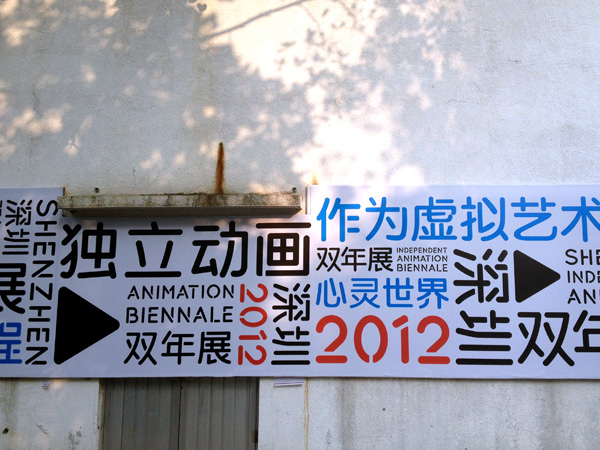
digital soul: the 2013 independent animation biennale

Actually it’s called The World of the Soul: A Virtual Art Engineering Project (心灵世界:作为虚拟艺术工程) and it’s the first Shenzhen Independent Animation Biennale. Interestingly, in addition to the usual OCAT sponsors, Southern Weekend and Youku, two leaders in China’s youth culture also contributed to the event, which includes lectures in Beijing and Guangzhou.

Curators Wang Chunchen, Zhang Ciaotao, and He Jinfang provide viewers with a smorgasbord of videos that range from short shorts through mid-length pieces to feature films. They have also selected styles that include virtual reality avatars, hand drawn characters, and experiments with Chinese ink painting. So, if you have a leisurely afternoon, a stroll through the exhibition offers much to sample. What’s more, if you decide to watch the longer pieces, you may decide to return for a second or third time.

In addition to the exhibition, the biennale offers a series of monthly lectures. On January 22, artist Lei Lei (雷磊) gave a talk on free and easy animation. Just after the Chinese New Year on February 26, artist Sun Xun (孙逊) will discuss “Animation is a Layer of Skin”. Clearly, animation is a way of life and digital soul as earnest as painterly counterparts.

Venue: B 10 Gallery, OCAT Loft North

Dates: Dec 22, 2012 through Mar 22, 2013

Time: 10:00 to 17:50 on weekdays; 10:00 to 20:00 Saturday and Sunday

This slideshow requires JavaScript.

the yaopi float glass factory

The Yaopi float glass factory hovers at memory’s edge, abandoned to ideology and chance encounters.

In 1987, the Shekou factory represented the highest level of float glass technology production in China. Today, it evokes nostalgia for the heroic romance of early industrial manufacturing. And that’s the rub. Even before it was built, the technology and mode of production used at the factory had been downgraded in terms of added value. In terms of global competitive advantage, Yaopi had been outdated even before it was built. Perhaps more telling of the ideological structure that ranks advanced and backward nations with respect to production capacity, the Yaopi factory elicits comparison with the Terracotta soldiers in Xi’an. This unhappy comparison relegates Shenzhen’s modernization efforts to the ancient past, even as it confers uncanny modernity on the First Qin Emperor’s army, which of course was mass produced on low-tech, but large-scale assembly lines.

This slideshow requires JavaScript.

orange tubes

This morning while touring an abandoned factory in Shekou, I encountered massive orange tubes. By themselves somewhat uninteresting, yet arranged beneath a banyan tree suddenly transformed into art. And that seems the way of it. As a new friend commented recently, “In a city, despite the buildings, ultimately the trees speak to the human soul.”

This slideshow requires JavaScript.

suzhou garden, huanggang, shenzhen

Visited the Suzhou style garden in Huanggang Village today. The Village axis runs from the arch on Fumin Road via a main street and the central plaza to the ancestral hall and temple. The garden is located behind the ancestral hall.

Also of note: in the main plaza, the village has crafted a self representation that mimics Shenzhen billboards, in which key buildings symbolize the strength and unity of the group. Nevertheless, unlike the municipal central axis, the village central axis runs east – west. Indeed, that’s the rub. If the central axis were opened up through the convention center, it would split Huanggang and plow through the garden.

Impressions, below.

This slideshow requires JavaScript.