cultural smog

I am in Tianjin where the smog is thick. It creates grey on grey cityscapes and irritates eyes and throats. My niece, a lovely and talented young woman jokes that, “Chinese people have iron lungs,” instantly showing up the dystopian anxieties that animate cyberpunk and urban fantasy (as popular literary genres, not simply as lifestyle choices).

I remember similarly edged jokes from my mother’s relatives and friends when we went back to the UP, where iron mining and tree harvesting for the paper mills had reshaped the wild north. “That,” they said with a half apologetic laugh when they glimpsed our pinched noses, “that is the smell of money.” Continue reading

international community. china?

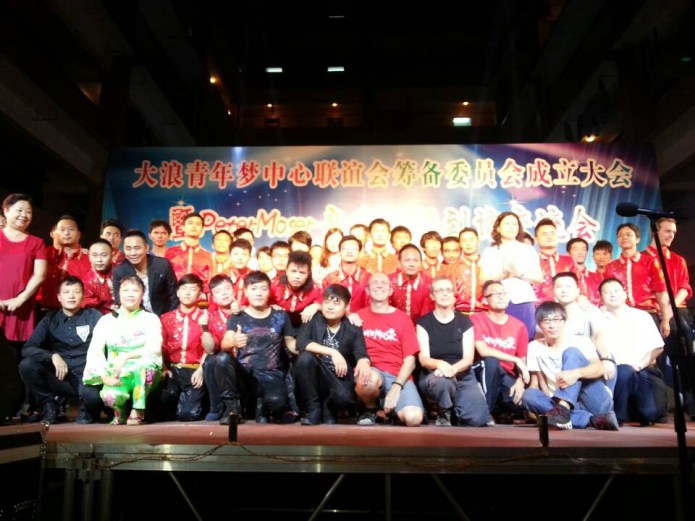
Over the weekend CZC curated a cultural exchange between the Dalang Street Office and Peter Moser of more music. A talented and inspirational music facilitator, Pete asks questions that go to the heart of community work — why this, why here? And the ever vexed question for moi (especially in light of the Hong Kong protests) — where do we draw the line between doing our work and our work becoming complicit with Party goals of social control at the expense of democracy and economic justice? Continue reading

the center besieged…

In several of my WeChat circles, an excerpt from the snarky classic, Fortress Besieged (围城) by Qian Zhongshu has been activated by those sympathetic to the Hong Kong students. It is however not unequivocal support, after all Fang Hongjian was not so much a hero, as a first generation off the farm urbanite caught between competing value systems, not quite at home in either China or the West. Conflicted and going about causing conflicts, intentionally and not, as he tries to live his life in Republican Shanghai. I have roughly translated the passage below: Continue reading

my white wall compulsions: paint it black (I)

On Friday, October 3 at Handshake 302, we held the first salon for My White Wall Compulsions (墙迫症), “Paint It Black”.

The artist team for the first wall comprises Liu He (刘赫) and Wu Dan (吴丹), both under 25 and both curious about art and its possible articulations with and through society. Liu He is a second generation Shenzhener, whose parents came to build the SEZ before he was born. Wu Dan came to Shenzhen last year, a first generation migrant just out of college. During their first salon, Liu He talked about his anti-inspiration for “Paint It Black”.

This past summer, Liu He took time off from work to travel to some of the less travelled neidi cities. In one of the cities, he decided to take a job at a karaoke bar in order to see what it would be like to do day work (打工). He got a job as a procurer of Karaoke Bar princesses (and at the bar where he worked, hostesses who worked private rooms were so-called). The job included a three-day training session, in which the trainer was as enthusiastic and self-determined as a multi-level marketer. And in fact it turns out that procuring worked a lot like multi-level marketing–the more young, pretty women the procurers brought in, the more money they made.

Liu He left after a few days without recruiting any young women because “he couldn’t get past the moral issue”. Of the 30+ young men who had joined him for training, 12 decided to stay and work the job. Of that twelve, three were 16 years old. According to Liu He, the trainer insisted that once he stopped worrying about ethics, he could talk to pretty women and get rich. In fact, that seems to have been the point of the training: to overcome the young men’s repugnance to pimping and replace it with self-justifying desire for money and everything it buys.

The story ignited debate about what it means to leave one’s hometown and make one’s way in the world. There were two main positions, both pulsing with anger, sadness, and faintly, despair. The younger participants wanted a more honorable way of making a living, to live in such a way that they wouldn’t have to make the kind of choice that Liu He walked away from. The older participants, especially those who had worked their way out of a rural area, expressed that young people didn’t understand what was necessary in order to secure a better life for one’s children.

These two positions took a different relationship to the young pimps. The young people saw themselves and their choices in the decision to procure princesses. The older people saw the choices they had made so that their children would be protected from making those choices. No one saw themselves as a princess, a blind spot that not only hints at how gendered inequality shapes job opportunities in China, but also how difficult it is to truly see the most oppressed. After all, the young men’s decision to pimp or not to pimp still implied some kind of agency. It would have been more difficult to focus on the conditions that make young, rural women the cheapest and most convenient labor in manufacturing and service throughout the economy, even as women are markedly absent from positions of social influence and power.

Friday, October 10 at 19:00 the conversation continues when Liu He and Wu Dan present their finished wall.

This slideshow requires JavaScript.

occupy central: confessional moment

Many of the English language news reports coming out of Hong Kong highlight the antagonism that the SAR’s Mainland residents feel about the protests. The articles draw attention to vapid consumers (usually women) distraught because barricades have made it inconvenient to go shopping and/or self-righteous colonizers (usually men) who are angry that by making students are making China look bad. The rhetorical point is straightforwardly simplistic; brainwashed Mainlanders don’t understand what everyone else in the world gets — oppressive Communist Party acts again, this time against unarmed students.

It’s easy to get hooked by this way of thinking because there are no false statements. There are Mainlanders upset because they can’t go shopping in Central. There are Mainlanders who think that Hong Kong students specifically and Hong Kong people in general should accept Mainland authority. And yes, the CCP is up to familiar tricks of the anti-democratic trade.

And yet.

The only one of these statements I would believe without asking for contextualization is that the CCP is up to its nasty, manipulative authoritarian ways and once again working with triads to achieve its ends. But even that idea eventually breaks down if examined too closely because there are factions within the Party and divisions within the government. (Unfortunately in Shenzhen I have seen that more often than not the nasty and manipulative overcome the resistance of their more progressive colleagues and steamroll society.)

I begin my thoughts on these stereotypes of discord with a confession; until the students’ protests and Occupy Central with Peace and Love’s demonstrated commitment to non-violence I didn’t like Hong Kong. I am a member of the Kwan Um School of Zen which has a temple and retreat center there. I have friends who live in Hong Kong, and some of them are from Hong Kong, and I have participated in academic art events there. But.

Over my twenty year sojourn in Shenzhen, I have repeatedly and consistently had to deal with Hong Kong contempt for Mainlanders in general and Shenzhen people in particular. This has ranged from academics asking me how I could possibly feel safe in Shenzhen to watching Hong Kong waitstaff and others in the service industry treat me (white American woman) very differently from how they treat one of my dearest friends (Beijing woman). I was once at an award ceremony for public service and one of the Hong Kong awardees took the time to lecture me (in precise UK inflected Engish) on why I should find another place to work and not waste my time and talents in Shenzhen. This ongoing prejudice coupled with the fact that Hong Kong men have set up second wives in Shenzhen, come over to pay for sex, and have often been the managers of sweat shops hasn’t made me love Hong Kong.

I offer this confession to highlight how my experience predisposed me not to take a Hong Kong protest seriously. When Mainland friends complain that Hong Kong people treat them with disdain, I believe them. When Mainland friends doubt that the SAR’s Tiananmen commemorative protests have become self-serving means of discrediting China, I don’t totally agree, but I do see their point. And when Mainland friends express concern that Beijing is influencing or will manipulate the Hong Kong students because they don’t understand the Mainland, I am sympathetic because I have engaged in similar arguments.

Here’s the point: the students’ non-violent, collective action has helped me reflect on my lazy habits of thinking about Hong Kong.

I was predisposed not to take the protests seriously because people in Shenzhen and throughout the Mainland have treated me with kindness. In contrast, although Hong Kong people have also treated me well, they have not always shown the same courtesy to my husband and friends. I took sides even before I knew anything about the situation. This point returns me to media insinuations of Mainlanders being brain-washed, and the rest of “us” seeing the situation clearly: we all participate in and collude with inaccurate and hurtful stereotyping because of conditions and experiences in our everyday lives. I suspect that many Mainlanders who might otherwise be predisposed to support the students made up their minds years ago in other situations, just as the Western reporters who continue to exacerbate Mainland-Hong Kong misunderstanding and resentment also made up their minds once upon a time in a faraway place.

It is my hope that the students’ courage not only touches the hearts of Westerners who have benefitted from Hong Kong people’s prejudices, but also softens the minds of Mainlanders who have been hurt and shamed by those prejudices. May we all see what is actually happening and not fall into mind traps and misunderstanding.

shen kong: hoodlum governments

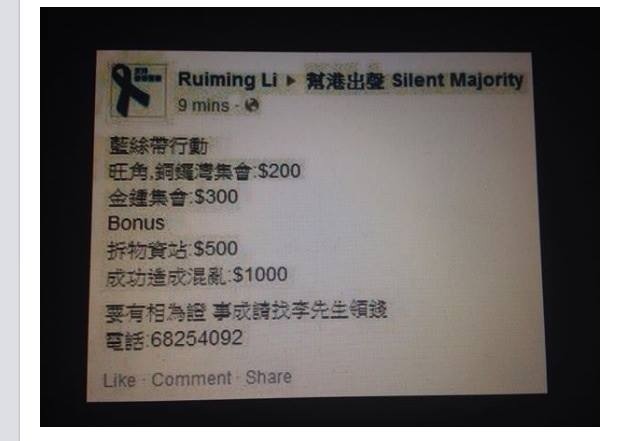
The price of a night of sanctioned thuggery: image

This post from the anti-Occupy Central Blue Ribbon Organization offers HK$ 200 to meet up in Mong Kok and Causeway Bay and HK$ 300 to meet up in Admiralty. Also on offer are HK$ 500 bonus to dismantle supply stations and HK$ 1,000 to create chaos, which presumably means “incite students to violence so police can justify retaliation”. To receive payment, there must be documented proof. Those interested in the job can call Mr. Li at the listed number.

The scale of the October 2 attacks indicate that the thuggery was not only organized, but also condoned by the Hong Kong police. Indeed, tweets, Facebook posts and next day news reports agree that Hong Kong police watched while thugs attacked students. In response, the students held their positions even as leaders urged the to leave the site and keep safe.

The government’s decision to partner up with thugs rather than meet with students to discuss their concerns reveals how unrepresentative the administration is, demonstrating an ugly lack of good faith. More generally, the decision also reveals the foundational violence of states–in choosing not to protect students from thugs, the police reminded everyone that they have the authority to both oppose and sanction violence against unarmed citizens.

In Shenzhen, the ongoing news blackout about Hong Kong protests does more than create an ignorant populace (愚民政府). The Shenzhen news blackout serves the same purpose as Hong Kong police complicity with thugs. The blackout reminds the public (who in fact know about the protests and in general support the students) that the government has unequal access to weapons (informational, economic and military).

In Shenzhen it doesn’t matter what we know to be true because the official account has been set through the blackout–nothing is happening. After all, not just the specter of Tiananmen haunts us. We also know that this show of media dominance is a statement of intent: a government that is willing to suppress information is also willing to use violence to secure its goals. Thus, although we know the official story is a deliberate lie, we do not break it, becoming complicit in the lies and violence against the Hong Kong students, even though we are also being attacked. And thus talk of support protests is effectively stymied.

The logic of informational violence is clear: Shenzhen people know about the protests, but accept the news blackout as inevitable. This acceptance is a demonstration of government power. The blackout is a deployment of informational violence against the people because it indicates that the government is willing to deploy weapons to insure compliance.

Indeed, in Shenzhen as in Hong Kong, the government is acting to isolate people from each other, creating vulnerable individuals and ultimately creating targets. As Beijing lawyer activist Bao Tong (鲍彤) pointedly asks in an opinion piece circulating on We Chat, “who exactly is responsible for blocking peaceful resolution of the universal suffrage question?”

Meanwhile, on October 1, Anonymous, a group of hacker-activists declared virtual war on the Hong Kong government, including the very scary threat to post private information of functionaries.

occupy central: impressions

This year marks the 25th anniversary of the Tiananmen Democracy movement and fateful crackdown on June 4, 1989. Annual commemoration protests have continued in Hong Kong since then. Perhaps 25 years of organized resistance to the violence of the Chinese State against unarmed protestors and commemorating student courage nurtured the soil for Occupy Central, nevertheless this year young Hong Kong people found voice and civil form for their own cause–truly democratic elections and autonomy in education, the media, and social organization. Indeed, if this level of civil disobedience is the result, all our children should grow up with the fine example of commemoration protests. And patience for our just seeds to bear fruit.

Beijing has already confirmed its support of Leung Chun Ying, the SAR’s unpopular Chief Executive, and crony of folks in Beijing. Unfortunately, the more cynical of us on this side of the border may be correct in supposing that as far as Beijing leaders are concerned what matters about the protest how it impacts Beijing.

Anyway, yesterday my husband and I crossed at Shenzhen Bay to Hong Kong, taking a bus directly to Sheung Wan. We arrived around 3 pm. The streets near the Macau Ferry Terminal drop-off point were quiet. As we followed the second floor walkway that winds from the terminal to Central and Wanchai, we passed several hundred Filipina and Indonesian maids, who occupied half the walkway. Like the students students, they sat on flattened cardboard boxes and plastic sheets, chatting, playing cards, and snacking, their umbrellas positioned to protect them from sunlight and rain. In fact, for over three decades, the guest workermaids have been occupying Hong Kong’s elevated walkways and public parks on their one day a week off. Arguably, it’s possible that the maids have taught the students something about how to make oneself at home on concrete.

The protest itself stretches about 6 kilometers. Without the cars, crowds, and noise of an open for business Central, the city’s amazing 3-dimensionality it becomes suddenly apparent. There are overpasses and walkways, underpasses and roads that split and curl into the air. The pristine glass and steel of Honk Kong’s iconic buildings shimmers into mythic forms. In the afternoon small groups of students sat on cardboard or plastic sheets chatting. Some had formed larger groups to listen to and and join conversations about the movement and the importance of securing social justice through civil disobedience. And yes, the reports are true. Hong Kong’s young people have put civility into civil disobedience.

A map of occupied area:

image

You can learn about the movement, their ideals and tactics at Occupy Central, a blog that keeps one abreast of the situation from a student perspective. You can also download the Chinese manual for peacefully occupying Central, 和平占中 which was published several days before the students began their collective action. As Sedna Popovic and Tori Porell argue in their article over at Slate, it’s the curtesy and non-violence that makes the Hong Kong protests formidable.

In solidarity with the students, impressions of an afternoon of peace and love for Hong Kong:

This slideshow requires JavaScript.

白鼠笔记/Village Hack PDF!

After several months of hard work and time off for summer vacation, the 白薯笔记/Village Hack PDF is available for download. Wu Dan designed the layout, each of the hackers reflected on their experience, and many friends contributed images to make the PDF a wonderful introduction to Baishizhou lived otherwise. The village hack was about discovering possibilities, both one’s own and those of the urbanized village. Enjoy!

白鼠笔记

constructing the countryside: kaihua, zhejiang

On Sept 17, I joined members of the Shenzhen based NGO, 观筑 (ATU Architectural Development Communication Center) on a one-day five village tour of Kaihua County (开化县) in Zhejiang. Kaihua is relatively underdeveloped with respect to the economic powerhouses, Hangzhou, Wenzhou, and Ningbo, which are all located in Zhejiang. With respect to Shenzhen, Kaihua like much of rural Zhejiang has been a source of migrant labor. In addition, the Shenzhen Zhejiang Merchants Association is active, and Zhejiang people to be found across the class and professional spectrum of immigrants.

The purpose of the trip was to deepen a conversation between the Kaihua Government and ATU about how to better pursue what is know as 乡村建设 (construction of the countryside). Kaihua is developing leisure tourism for families and yuppies from nearby Shanghai and Hangzhou. ATU has offered to provide a sustainable and relatively low-capital investment plan for the County.

A few notes about the trip.

1. The connection between Kaihua and Shenzhen happens at two levels. First, one of the ATU members is from Kaihua and was elementary school classmates with the current Party Secretary of Kaihua. However, the actual project will be institutionally mediated.

2. The conversation about constructing the countryside is a huge issue in Shenzhen, and taking shape in diverse forms that range from documentary film-making to the ATU project.

3. A Hong Kong professor and students provided a basic design principle for one of the villages, and it seemed the most ready for tourists seeking a leisurely rural excursion.

4. The villages aren’t obviously materially deprived because 30 years of remittances have paid for the construction of new homes. In turn, the villages seem, at first uncontextualized glance, to resemble US American Mac-mansions in an underpopulated suburb.

5. In point of fact, one of the impulses behind the leisure tourism plan is ongoing outmigration. The majority of Kaihua residents are grandparents and young children who have not yet or cannot (for whatever reasons) join their parents in one of the coastal cities.

6. One of the attractions of leisure tourism is 农家乐 (happy at the farmer’s home), where farmers provide guests with fresh, often organic meals. Kind of B&B with Chinese characteristics. As with American B&Bs, the point is a rural excursion without actual agriculture. Successful farmers now farm for themselves and their guests. Indeed, the point is to wash one’s feet and leave the paddy (洗脚上田), further marginalizing agricultural work and those who cultivate the rice, produce, and meat that we eat.

7. The villages are connected by a river and stretches of national forest, which may in time be connected through walking trails. But in the meantime, Kaihua might prove an interesting destination for folks with a motorcycle and curiosity about how the Chinese countryside is changing.

Below is a meander through five villages. The tour begins at a newly built resort in the national forest.

This slideshow requires JavaScript.

Book Review: Good Chinese Wife

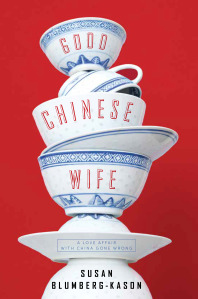
A fellow Shenzhen expat has reviewed Susan Blumberg-Kason’s memoir, Good Chinese Wife. I am also a 中国媳妇 and find myself distressed by the suffering and self doubt that characterized her relationship with her ex-husband. In fact, Blumberg-Kason’s anxieties and willingness to give her husband the benefit of the cultural doubt resonated uncomfortably. I believe that one of the biggest challenges for women abroad is to find the confidence to trust our experience and say, “No more of this shit.” Another Shenzhen expat, Rose writes about her experiences navigating the gendered cultural divide is , who blogs at China Elevator Stories.

Ray's avatarRay-Comics

 Cover

szdaily.sznews.com/html/2014-09/16/content_3005971.htm

“GOOD Chinese Wife” is a new memoir published by Sourcebooks, and is a poignant tale expats should enjoy about the overlap of China and the West. Susan Blumberg-Kason details her unfortunate marriage to a Chinese music scholar, as they meet while studying in Hong Kong and then travel to his hometown in Hubei Province before eventually settling in San Francisco, California.

The central question posed by their troubled relationship is whether their differences were due to culture or personality. Interracial marriages may have some problems, but are certain individual defects masked by the excuse of culture?

As their relationship begins, Blumberg-Kason appreciates her future husband’s background. She studies Mandarin as a postgraduate in Hong Kong in the early 1990s, and stays there through the time of the handover in 1997, and for a reader familiar with South China it can be very interesting to compare that time with…

View original post 559 more words