distracted

image

Came across this advertisement: in the future your body will be in a meeting your mind will be in the front row of a fashion show

How to think about this figuring (and I use the word deliberately) of body/mind split?

I have, of course, attended meetings where the point is to show one’s face rather than to actually participate in organized discussion aimed at coordinating action toward some shared goal. In fact, most meetings veer into the irrelevant for all too many participants. I have also watched participants answer their phones during a meeting. That said, however, this is the first time I have seen an advertisement that advocates overcoming the inevitability of meetings through better virtual connections someplace else. After all, I assume that the mind at the catwalk is fantastically dressed, rather than actually clothed in haute couture.

Today, I’m distressed by the idea that distraction is presented as an acceptable way of supplementing/ making bearable the gendered division of labor. Let me count the ways:

1) distraction okay because female admins not part of the meeting;

2) distraction inevitable because there are no alternatives to shaping meeting attendance and participation offered;

3) distraction defined through watching rather than participating in design or wearing a dress elsewhere;

4) distraction facilitated by technologies that allow one to go virtual shopping, which in turn keeps one in debt and less able to refuse alienating work.

Question du jour: how beneficial are technologies that intensify human tendencies to distraction? This advertisement seems uncannily like using a television to babysit. But worse. Sigh.

墙迫症–my white wall compulsions

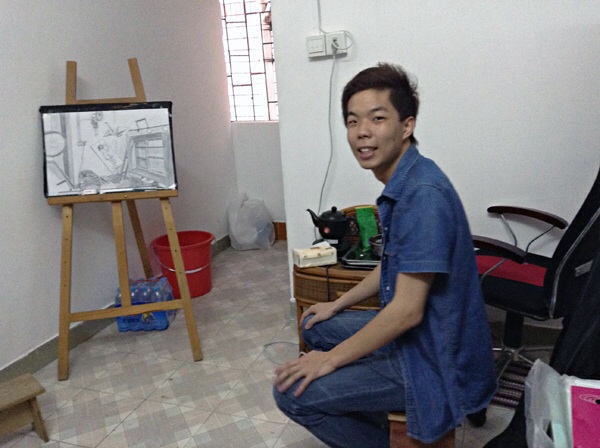
302 will start a new project–my white wall compulsions. The title is a pun: 强迫症 means obsessive compulsive disorder, while the characters for strong (强) and wall (墙) are homonyms.

The project itself is quite simple. 302 is a one room efficiency with four white walls. We’re looking for four individuals and or teams to transform one wall in the way they have always fantasized. And you know who you are. Staring at a white wall imagining all sorts of paint and bas-relief interventions! The project begins September 27 and ends with a party on November 21. Right now we’re accepting project proposals. We will also provide 500 rmb to pay for materials. If you’re interested in claiming your white wall compulsions and in Shenzhen contact me.

For those who’ve been wondering what’s up with community art in Shenzhen, the pictures below are from an August 29 performance in Shuiwei. The workshopped performance piece “feeling stones to cross the river” was part of the opening ceremony for the Futian International Images Festival, which celebrated documentary images and films.

This slideshow requires JavaScript.

one day

Yesterday evening I went to a screening of 有一天 (One Day), a series of vignettes about children with learning disabilities and handicaps, their parents and struggles. The film itself features some of China’s biggest stars and the vignettes tackle some of the county’s most pressing issues, including recognition of and support for missing children (who have kidnapped, maimed, and forced into begging), blind and deaf children, and children with Aspergers, Down syndrome, and attention deficit hyperactivity disorder. A heavy list indeed, and each case receives roughly 7 minutes.

The Shenzhen premiere was organized by the Shenzhen Association for Children with Learning Disabilities (深圳市学习困难关爱协会), the first organization of its kind in China. The guest of honor was Shenzhen Women’s a Association Chairwoman, Ma Hong, who had approved the establishment of Shenzhen LDA in 2013. Also present was the Vice Director of the Nanshan District Bureau of Education, over 100 Nanshan teachers, twenty-odd elementary student volunteers, and special guests. The screening was so successful that a second public screening was scheduled for this morning.

Just a few observations about the evening, Shenzhen LDA, and the burgeoning Shenzhen interest and participation in and passion for philanthropy.

1) The “one day” of each vignette occurred when a child acted “normally”. In fact, there was no “happy end” that was consistent with a child’s disability. So the stolen child was returned home, the deaf sang, and a blind girl painted. The case of the Down syndrome child who learned to bake bread came close, but even then the happy resolution was that the boy could traverse Beijing with bus changes alone, even though he could neither read signs, nor clearly articulate his destination. Moreover, in each case, outsiders selflessly intervened and saved the child, providing the parental care the parent–for whatever reason–could not. I found this ideological position most disturbing in the missing children section because the child was not handicapped at birth, but had been criminally maimed, begging the questions: why can’t rural parents protect their children from urban predators? and, in what moral world is predation on children the logical equivalent of giving birth to a child with Down syndrome or Aspergers, let alone one with a club foot or weak eyesight?

2) The film clearly sympathized with parents who don’t have the tools to help their children and the distress children feel when they cannot meet parental expectations. Indeed, in each case, the solution was ebetter ducation. Likewise, speakers acknowledged the stress disabilities cause in light of both the one child policy and the cultural expectation that “sons become dragons, and daughters become phoenixes” through education. And I agree with the idea that we help children through more humane pedagogy. And yet. Despite the inspiring motto: there’s no inability, only difference (没有不行,只有不同), the dream that permeated the movie and the talk was the discovery of previously obscured genius, a la Einstein. In other words, the “solution” to each “problem” was not a change in parental and social expectations, but rather more effective means to groom children to meet and exceed those expectations. So a question of emphasis: in special needs education do we start from unquestioned social goals and figure out what needs to be done to change a child, or do we understand each child as the inspiration for other social possibilities?

3) Throughout Shenzhen people are turning to philanthropy to address social needs and issues that the government is unable or unwilling to meet. Of these issues, education is one of the most vibrant areas of participation. Other areas include architecture (as a site for reimagining urbanism) and art as a site for stimulating creativity. The characters for philanthropy are 公益, literally “public benefit or welfare” which speaks to the political importance of the philanthropy movement, broadly understood and whatever one’s position on how a particular issue has been articulated.

policy, policy, policy: real estate with chinese characteristics

For those of you who wonder, what’s great in Dongguan–and you know you’re out there because Dongguan has gotten really bad press–I’ld like to suggest Guanyin Mountain National Forest in Tangxia, Zhangmutou Township (东莞市樟木头镇塘厦观音山). The forest occupies 18 sq kilometers, of which most is beautiful forest and hiking trails. This may come as a surprise because Zhangmutou was one of the industrial centers that sprung up along the Kowloon-Guangzhou Railway in the late 80s and 90s. In fact, the area was once known as “Little Hong Kong” because many Hong Kongers vacationed and bought homes there.

From the mountain viewing stations one can see the village and township industrial parks of early reform, as well as the recreational facilities (including golf courses and upscale hotels) where Hong Kongers went for the weekend indulgence and the late 1990s housing that truck drivers and the SAR’s mobile poor bought. One can also see more recent upper middle class developments by Vanke and China Resources which aim to attract buyers from neighboring Shenzhen. In fact, Tangxia is closer to downtown Shenzhen than is Longgang District. In addition to beautiful trails and fresh if muggy semi-tropical air, the park also offers views of how industrial urbanization with South Chinese characteristics reshapes the land, reminding us that we are not talking of “location, location, location”, but more precisely, “policy, policy, policy”.

Each of these areas exists because of a change to or promulgation of Chinese policy. The village and township industrial parks came about as a result of the responsibility system, while the resorts and entertainment industry that catered to a Hong Kong clientele depended upon laws that made it illegal for mainland truckers to cross the border and deliver containers from local factories to Hong Kong logistics companies. The present shift to upscale housing developments for Shenzhen and neighboring elites is also a manifestation of policy: crackdowns on the sex industry and push toward higher value added production in the area.

Of course, the construction in Tangxia has also depended upon the establishment of a bourgeoisie in Guangzhou and Shenzhen, where first houses have been paid off and costs of education met. However, more importantly, Vanke and China Resources have taken up the call to build in Tangxia because the Shenzhen metro will soon connect the area to the SEZ. They hope that the relative low cost of housing will attract young Shenzhen families to move to Dongguan and commute to Shenzhen. In the meantime, however, the people I spoke with in Tangxia were not buying a primary home, but rather a home for their retired parents. After all, they like nearby developers are waiting for Dongguan Municipality to build schools and hospitals, integrating Tangxia into the urban grid because the geographic effects of policy are as visible in their absence as they are in their presence.

what is a nuclear family?

This past week, I joined a wedding tour to Bali, which brought the immediate families of the bride and groom, as well as several friends together on a four-day tour. The wedding was held at the Bulgari Villas, where the bride and groom stayed while the rest of us stayed at a nearby golf club. Apparently, given the high cost of wedding photos, many newly weds choose to combine their honeymoon with a proffessional shoot. What I didn’t realize was that a shoot could also include a wedding ceremony and invited guests.

Of random note: (1) we were not the only such tour, and a multiple sites encountered well-dressed and manicured brides with their respective posses; (2) there were other Chinese tours taking the same route as we did. In fact, the majority of tourists at all the sites we visited we Chinese, and many of the Balinese staff had learned some Mandarin; (3) friends I have told about the trip commented that it was expensive, but agreed that it was difficult not to spend an exorbitant amount on a wedding; (4) traveling together gave the two families an opportunity to get to know each other and take delight in the couple’s happiness; and (5) the distance between the two generations was clear.

The 30-something couple clearly enjoyed Bali, its exotic locales, and the frisson of non-Chinessness. In contrast, the parents seemed somewhat bewildered by this format. They understood a honeymoon and photos, but not quite how the intentional reworking of tradition had become so popular. I’m speculating that these more private weddings represent and deepen the ongoing nuclearization of Chinese families that is so prominent in Shenzhen.

In the US we understand the nuclear family to comprise two generations–parents and children. In China generally, and Shenzhen particularly, the nuclear family comprises three generations–grandparents, parents, and children. In other words, the the rationalization of the family unit points to the historic organization of paid and unpaid labor in the US and China, respectively. In the ideolized US, fathers worked and mothers kept house. This trend was explicit in the forced redomestication of women in the post WWII era, when a man’s income was expected to provide for his dependents. In contrast, in idealized China grandparents provide childcare and housekeeping services while both parents work. This is necessary because individuals (except in the case of the uber-rich) can’t afford to purchase a house, needing combined incomes to meet mortgage payments. In a chicken egg moment of cultural difference, US American families emphasize the bond between husbands and wives, while Chinese families emphasize the bond between parents and children.

Though du jour, Americans highlight sexuality as an important foundation of family life because sleeping together secures the primary bond of the US nuclear family. Similarly, Chinese celebrate eating as an important foundation of family life because dining together reinforces the primary bond of the Chinese nuclear family. This difference can be read as “cultural” and some, like my friend and her husband are deploying “western culture” (i.e honeymoon and romance) to re-imagine the ties that bind the “traditional” Chinese family.

PS: This past month I have been busy over at Village Hack, the latest project at Handshake 302. The last Hacker was Yin Xiaolong, an artist who does most of his work online, through social media documentation of social concerns. While at 302, he engaged in copy painting, photography, and a leave-taking performance piece that included shaking hands with neighbor/strangers. Meanwhile, the concession grows that our three young neighbors are the most interesting and interested of our interlocutors.

the kids really are all right

Last night I had dinner with Joe, a gen-90 recent college graduate. He and several friends have a start-up that helps businesses expand through the powers of we chat and Tencent’s remarkable level of cross platform integration. Very contemporary marketing firm. In his downtime, Joe organizes summer programs that teach creative thinking, collaboration, and courage of independent thought to other young Shenzheners.

Our conversation and Joe’s passion, like last week’s trip to Beijing reminded me that there are new ideas and start ups perculating throughout Shenzhen. Green Mango is a group of young mothers trying to change the education system. Bean is a Seattle-based group of volunteers who contribute to community projects. ECSSZ is a group of street artists who engage in community beautification projects. Not to mention the young hackers in residence at Baishizhou.

It is all too easy to dismiss these small and idealistic efforts as unrealistic. In fact, Chinese parents like their American counterparts complain that their children are “不现实.” But that’s not point du jour. Today I’m thinking, wow. Just. Wow.

mapping Chinese creativity–shenzhen vis-a-vis beijing

Several weeks ago, Shenzhen hosted the Maker Faire, bringing tech savvy makers together to explore, discuss and extend hardwire creativity and innovation. This past week, Beijing has hosted Social Innovation Week, bringing changemakers together to explore, discuss and extend social creativity and innovation. In Chinese one character separated the two events. The Shenzhen hosted 创客 or “maker guests” while in Beijing the guest list comprised 创变客 or “make change guests”.

Inquiring minds might paraphrase Gregory Bateson and ask: is this a difference that marks an important cultural difference between the two cities?

As in English, the Chinese shift from the vocabulary of “hacker” to “maker” has signaled the increasing respectability of the techno-nerds. The Chinese is even more explicit in this respect. To my knowledge, the earliest translation of “hacker” was 黑客, literally “black guest”. The term highlighted the outlaw romance of hacking at (at least) two levels. First the obvious 黑 which describes renegades and their possibly illegal activities as in the expressions “mafia (黑社会)”, “no hukou child (黑户)”, and “black heart (黑心)”. Second, 客 refers not only to guests in the modern sense of the term, but also clients in the medieval sense of the term, the dependents on a lord who would provide service in return for protection. Unlike, the English, however, the expression “changemaker” is more obviously related to the hacker movement because the word is made (!) by inserting the character 变 or change into the net-popularized expression 创客.

The more pertinent question, however, seems to be: Almost a decade after China began promoting creative industries, do the respective localizations of these two events tell us anything interesting about how Beijing and Shenzhen function within the Chinese cognitive mapping of creativity and innovation?

The pomp and circumstances of the two events did not differ radically–both were located in marginal spaces (Anhuili and Shekou, respectively) that are nevertheless within the city center, broadly defined. The demographic of the organizers was similar, with generations 80 and 90 running the show, and a shared emphasis on networking nationally and globally. The staging of talks was different. Beijing opted for TED style talks, with speakers having 15 minutes to share their projects. This was supplemented by round table discussions. In contrast, Shenzhen opted for more traditional keynotes, with salon style question and answer sessions.

The important difference seems to coalesce around funding sources and industry support. Beijing garnered support from not-for-profits and international foundations. In contrast, Shenzhen had industry support, generally through China Merchants, which is rebranding Shekou and specifically through Shenzhen based companies and international think tanks that focus on techno innovation. In other words, while young people of both cities deployed creativity to claim a space for and to legitimate the status of Generations 80 and 90, the Beijing event constituted itself with respect to society broadly defined, while Shenzhen defined society with respect to entrepreneurship narrowly defined.

Impressions from opening events, below.

This slideshow requires JavaScript.

voice of the people?

It’s been a while since I’ve had an interesting conversation with a cabbie, but this morning Song Shifu impressed with his convictions, social analysis, and desire to share. 

On the reason for China’s environmental problems: Song Shifu hails from Zhejiang, one of the core industrial areas. Throughout his home county, the rivers stink and smoke clogs the sky. These factories produce goods for European and North American countries. These countries have taken advantage of their strength to unload the contaminating industries on China.

When I asked about Mao Zedong and if there was a need for Revolution, Song Shifu had mixed feelings. The destruction of traditional values has not been good for the country. However, under Mao China stood up for itself. Now China doesn’t dare use it’s army because all the US has to do to influence China’s foreign policy would be to freeze the bank accounts of the Princelings and their children. Moreover, he wouldn’t fight against the United States, after all there was no animosity between the US and China. Contaminating industries notwithstanding. But Japan. He would volunteer to fight Japan. 

the first hack

image

Liu He took up the challenge of hacking Baishizhou, April 27- May 3. Although raised in Shenzhen, Liu He has never lived in an urbanized village. Instead, his parents came from Dongbei to join a Shenzhen work unit, and so he lived in subsidized housing that his family subsequently bought.

Liu He asked: what would it take to move into Baishizhou? He discovered that contrary to his expectation of chaos, danger, and inconvenience, Baishizhou was easy to settle into. At 8 a.m. Liu Hu joined the morning rush to the subway station, stayed at work all day, and ate dinner at his office canteen before returning home at 9ish. He played his guitar or sketched at night, leaving the door open, but no one poked their head through the door. The only problem was finding parking. So after receiving his first ticket, he left his car at home. In fact, should his parents ever kick him out of their downtown condo, he’ll simply move to Baishizhou.

Over the course of the residency, Liu He grew increasingly curious about other residents. He noticed the rotation of street hawkers and their carts. In the late morning through the afternoon, vegetable and small goods vendors occupied the alley. Then from 5 to 10, the stir fry and steamed clay pot vendors took over the space. Lamb kabob and beer vendors took the last shift, from 10 pm to 2 or 3 am. Liu He wanted to follow pet owners home to see their living conditions because he saw several expensive and pedigreed animals. Moreover, many people walked more than one dog, and seemed to have them regularly groomed in a pet salon. The number of couples also intrigued Liu He. He wondered if they had hooked up in Baishizhou or if they had come as couples. Monthly wages in service seemed to average around 1,200 yuan a month, while clerical jobs were around 3,500 and high end salaries reached 6,000.

Liu He observed a smooth curtesy between residents in the building and throughout Baishizhou. People could stand shoulder to shoulder watching a television program, for example, but not acknowledge each other. If he asked directions, his interlocutor responded to the question, but didn’t ask anything personal. Indeed, Liu He mentioned that the happiest residents were the children who played together or came up to the room to hang out because they made friends.

Liu He concluded that Baishizhou was just a place to sleep, unless you had a family. His main social life unfolded outside Baishizhou. In contrast, the neighborhood schools provided children and their families with a social structure through which they were integrated into the community. Moreover, children needed care, which created networks among caregivers who regularly frequented the same public areas. Liu He attributed the lack of deeper conversation and community feeling in Baishizhou to temporary inhabitation. People come and go, so there was no motivation to make friends. But this kind of in habitation was only suitable for singletons moving through; families and long-term residents would need a social network.

For more images and to read Liu He’s journal, please visit the 白鼠笔记/ Village Hack blog.

czc: six months in baishizhou

Here’s the link to CZC–Six Months in Baishizhou, an introduction to Handshake 302 and our projects there. The pamphlet includes a brief cultural history of the relationship between Baishizhou and Overseas Chinese Town.