drone-fare

When I first saw the above advertisement for DJI, one of the world’s leading producers of drones, I balked. It seemed to me to be a picture that celebrated spying on the private and unaccessible mansions of the all-too-rich. So, given the unreliability of my American gut reactions in China, I asked the young women standing next to me, “What do you see in that advertisement?” She responded, “a pretty landscape.” I was like, “What about the dock? The big mansion? The coastline that resembles Newport’s?” She looked at the advert again, nodded, and then tentatively added, “We see things differently because of cultural difference.” Continue reading

the artron art centre / book wall

Today I joined the opening for the Atron Art Centre, which boasts the largest book collection / book display in the world. Still under construction, the building glitters, as do Atron’s ambitions to promote and propagate knowledge and culture. Impressions, below.

This slideshow requires JavaScript.

Innovation and Cockroach Parts In Shenzhen, China

ongoing insights into Shenzhen’s creative ecology: and cockroach parts! who knew?

ideal subject positions (by the numbers)

The current stock market frenzy has people dreaming about more than free lunches. The following adverts are from Money Daddy (钱爸爸), an online trading / investment platform based in Shenzhen. Of note? In addition to the pyramid scheme promises of rapid wealth, the site address plays with both “rich daddy, poor daddy” ideology and Cantonese numerology, where the number 8 is a homophone for the character for father and can also represents the character for “get rich”.

Translations of Money Daddy advertisements show “ideal” middle class Shenzheners enjoying their high returns. The underlying anxiety point is actually quite simple: if you’re earning an honest living in any of these jobs (including an ordinary bureaucrat), you’re not earning enough for carefree spending. And carefree spending is, of course, the site where the self is being constructed as “macho”, “successful”, “loving”, “sexy”, and “independent”, respectively. Continue reading

the dalang graffiti festival

Today we held the design workshop for the Dalang graffiti festival. 27 people attended the workshop, which involved creating designs for manhole covers. With the exception of one individual, none of the participants admitted to having taken any art classes outside of school; none admitted to sending their children to art classes. All were immigrants and during their self introductions, they mentioned their hometowns; one made a joke that her hometown was “too small to have English names”. Next week, participants will take their designs and begin painting manhole covers at a workers’ dormitory, a neighborhood, and a school.

Continue reading

impressions, futian

The other day, I walked from Huaqiangbei through Gangxia and Xinzhou, where I hooked back to Shuiwei via Huanggang Park, a wonderfully unexpected urban oasis. Today, I’m uploading impressions of the diverse complexity that characterizes Futian Distict, which is home to Huaqiangbei, the central business district, and some of the most well-planned urban villages in the city.

This slideshow requires JavaScript.

Shenzhen, China as an Electronics Ecosystem

Notes from Huaqiangbei and its ongoing integration into global consciousness.

it’s international labor day, 2015

and I’m listening to music by 张广天, whose music simultaneously evokes revolutionary times and postmodern desires. Zhang Guangtian is considered one of the first figures of Shanghai’s 1980s rock and independent music scene. In 1990, he moved to Beijing, where he has collaborated with both theater practitioners and film makers, most notably with the National Experimental Theatre’s Meng Jinghui. In 2000, Zhang Guangtian burst into national consciousness with Che Guevera (切·格瓦拉), which he wrote and directed. However, today it is the vexed lyrics of Mao Zedong that have me feeling bittersweet about the Chinese Revolution and the aftermath of Reform. The song was written for the 110th Anniversary of Mao Zedong’s birth–how resplendent he was, Zhang Guangtian nostalgically sings–and although the lyrics allude to the need for revolution the images firmly tie Mao to the Party’s purposes. And the idolization. Simultaneously compelling and disturbing, I find it difficult to turn away from the Great Helmsman (below).

public intellectuals we be

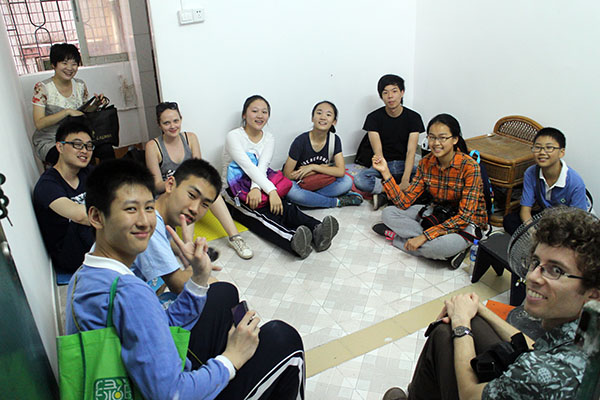
Last Friday evening, Yang Qian, Chen Hongjuan (Melon), and I participated in a public talk on “Designing Escapist Experiences”. The event was the first in a four-part series on experience design that is co-produced by the OCT A3+ space and the Baptist University of Hong Kong, Master’s of Visual Arts in Experience Design. As with many talks in currently salon obsessed Shenzhen, the talk quickly exceeded its proscribed limits, this time steering into discussions of whether or not art was by definition “escapist” or if it constituted an opportunity to re-imagine the world, with particular reference to the every changing utopian project of the PRC. Also as with many of these discussions, commerce came in, guns blazing: was it really so horrible to pay for the delights of Disney princesses or to imagine oneself as middle class if only for a few moments? Indeed, it is an exciting time to be in Shenzhen where public debate–especially minjian debate–is enjoyed and well-attended. Young and old, well educated Shenzheners and recently arrived professionals, everyone wants to learn and is eager to share “true thoughts” with receptive interlocutors. After two hours of intense conversation, we took a group photo and went home, refreshed and somewhat hopeful in the lingering delights of conversation.

This slideshow requires JavaScript.

handshake with the future

Handshake 302’s latest project is moving along. This past weekend we met with middle school students (on Saturday) and Guangdong Xin’an Polytechnic students (on Sunday) to think about how their experiences and acquired knowledge about Baishizhou might be put to the interesting work of making art.  Continue reading