do you want to buy a house next to singapore?

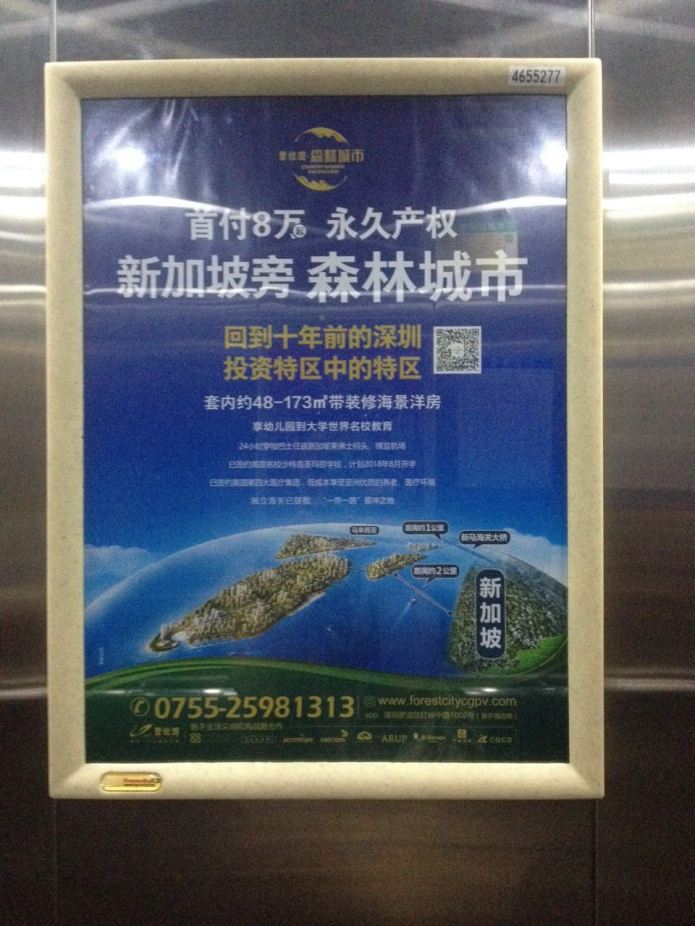
Just saw this poster advertising the opportunity to purchase a house on a small Malaysian island next to Singapore. The houses are relatively large and the agent is conveniently located in Shenzhen. The appeal? One can “[R]eturn to Shenzhen ten years ago, and invest in the Special Zone of a Special Zone.”

Here’s the rub. I saw this in an apartment complex in Dalang, at least twenty minutes from the nearest subway station. Everyone wants to by a house, and even places as relatively remote as Dalang are no longer viable options for migrants, even if they have a job, and even if they have savings.

On my way from said subway station to the elevator where this advert was posted, the cabby explained that since Lift (didi) and Uber had come to Shenzhen, it was no longer profitable to drive a cab. He planned on going back home to Jiangxi. When I mentioned that it seemed more and more people were leaving the city, he agreed, saying “there noticeably less people on the street.”

bitou, or the spatial consequences of deindustrialization

In the early spring, I arrived at the Songgang bus stop, “under the bridge”–a pedestrian overpass on the G107 expressway. The stop teemed with migrant workers and motorcycle cabbies, who screamed, “Where are you going?” Continue reading

emptied out / true emptiness

Last week, I participated in the “真空” art week. 真空  means emptied out or true emptiness. The curatorial statement (translated below) emphasizes how urban renewal is “emptying out” the villages and what remains is neither this, nor that. Almost buddhist, except we’re still yearning and true emptiness alludes us.  Continue reading

Under the Flamboyant trees: An afternoon in OCT, Shenzhen

Recently, Mukta Naik of Ramblinginthecity has turned her gaze on Shenzhen. Her curiosity and eye for detail situate the experience.

Our first few hours in Shenzhen were a gentle transition into the city’s messier spaces, its urban villages, which were the staple fare for our week-long exploration.

Source: Click-click under the Flamboyant trees: An afternoon in OCT, Shenzhen

for more.

Entrails

I am a freckled and pinkish, slightly overweight female. I have soft hands and I play at manual labor rather than work to earn a living. However, I am increasingly aware that this body does not obey. It aches and bursts, creams desire, flinches, hungers, sweats and thirsts. This body itches and yearns, screams and wobbles, swells and grows lumpy. It grumbles and leaks and trundles forward. But, it does not obey. Fortunately my bathroom door hides the work necessary to appear as if I were an ethereal, delicate being unencumbered by the body’s needs and its (increasing) failures. I close the door, drop my pants, piss and wipe, scour away grime and smooth my eyebrows as I squint at the face in the mirror; clear eyes, small ears, heavy cheeks, and wrinkled neck. I straighten my blouse and return to the party. Continue reading

thoughts on the spatial distribution of shenzhen’s population

How many people actually live in Shenzhen? The numbers vary. Current Shenzhen Party Secretary Ma Xingrui says 20 million. However, the administrative population supposedly hovers at 18 million, while the city itself has never admitted to more than 15 million. Rough estimates suggest only 4 million people have Shenzhen hukou, another 8 million have permanent residency, and another 5-8 million “float” unofficially within the city

These statistics obscure how Shenzhen’s urban villages spatially organize these three administrative classes. For example, Shi’ao (石凹) Villagehas a local population of 4 to 500 people and a renter population of 20,000, making the ratio of local to renters residents 1:40. The ratio of local to renter populations in Baishizhou is an astonishing 1:77. Moreover, it is clear that renters–even floaters–aren’t actually leaving the city. Instead, they are finding newer (and often) narrower niches within the village.

Much like US American suburbs which manage inequality through distance, Shenzhen’s urban villages do the hard (and socially productive) work of managing inequality within the city. The majority of floaters and a large percentage of permanent residents live in the villages and tend to work in service and the semi- and informal economies, while hukou residents and wealthier permanent residents occupy “official” housing estates and tend to work in the formal economy.

Continue reading

join us in baishizhou!

握手302驻村招募 The Handshake 302 Urban Village Artist Residency

Disciplines: Drawing and Painting; Film; Literature; Media art; Music and sound art; Performing arts; Sculpture

Founded: July 2016

Duration: 1 to 2 months

Description: The Handshake 302 Baishizhou Artist Residency program invites artists and writers to explore Baishizhou, a large, centrally located urban village in Shenzhen. The idea behind the residency is simple: Handshake 302 has been working in Baishizhou since October 2013. To date, many of our projects have taken place inside our space. Now, we’re turning the space into an efficiency apartment—an urban village launchpad—for artists who would like to come and create site-specific works in Baishizhou. In addition to producing one site-specific work or performance, we also ask that visiting artists hold weekly salons to meet with local residents, artists, and curious Shenzheners.

Paid by host: Handshake 302 provides visiting artists with an efficiency apartment in Baishizhou and a monthly stipend that is sufficient to meet daily living expense. There are limited funds for materials, which will be distributed based on availability.

Paid by artist: Visiting artists pay for transportation to and from Baishizhou.

Application guidelines: to apply for the Baishizhou residency, please submit the following materials via email to: handshake302@126.com.

1. Letter of interest

2. Project proposal

3. Curriculum vitae

4. Work samples

About Handshake 302: “Handshake 302” is located at 302, Building 49, Shangbaishi Block 2 in Baishizhou. “Handshake” buildings stand so closely together that it is possible to shake hands through the windows of adjacent buildings. In fact, “Handshake 302” is a repurposed, 12.5 m2 efficiency apartment on the third floor of a sterwotypic “handshake building”. It has a kitchen and a bathroom. There are 9 rooms on this floor. Handshake 302 is an independent art space. A core group of five people curates the space, but participation in any project is open to anyone through public announcements. Project participation ranges from using the space ans an exhibition space to living quarters. Since its opening in October 2013, Handshake 302 has curated 8 exhibitions and over 75 public events. We believe that art belongs to everyone who contributes to our city.
tangtou, baishizhou,may 23, 2016

Today while walking Baishizhou, I stumbled upon surveyors from the Nanshan District government. The were beginning the measurements for compensations and consequently for the first time in roughly two years the buildings were open.

Continue reading

china in africa

The China*Africa Research Initiative at Johns Hopkins has just published results of three years of research on how Chinese Investment in Africa is Not What You Think. The site is a great jumping off point for thinking about new forms of globalization and China’s increasing international presence.  Shenzhen keeps showing up in all of this as the desired result…

bashizhou, may 20, 2016, dusk

Baishizhou in the early evening: buying vegetables, walking home, waiting for the demolition of the old industrial area, which will begin after the elementary schools have closed and children relocated…

This slideshow requires JavaScript.