Here’s the link to CZC–Six Months in Baishizhou, an introduction to Handshake 302 and our projects there. The pamphlet includes a brief cultural history of the relationship between Baishizhou and Overseas Chinese Town.
Category Archives: CZC特工队
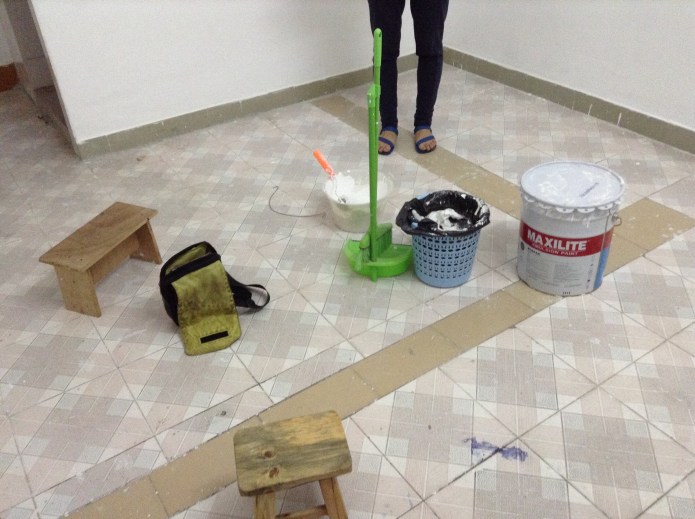
revved up and ready…
Handshake 302 has been transformed into a dormitory for the Village Hack Artist Residency. Tomorrow, our first hacker Liu He moves in for a week of exploring architectural forms in Baishizhou. Below, impressions of the new room.
Handshake 302 “Village Hack” Artist Residency
The Handshake 302 “Village Hack” residency program invites artists, writers, scholars, and curious citizens to explore Baishizhou, a large, centrally located urban village in Shenzhen.
We’re calling this program “Village Hack” because we hope to encourage a fresh group of artists and scholars to take a new look at how Baishizhou lives and works and even plays.
Each resident asks and answers a simple question over the course of their one- or two-week stay in Handshake 302. For example, a Village Hacker might ask the question, “What do my neighbors do for fun?” or “Can I live in Baishizhou without air conditioning?” Each day, the “village hacker” post the results of their experiment on the group blog “白鼠笔记 / Village Hack”. The last day of their stay, the resident holds an open house, when friends and guests can learn see, hear, smell, touch and perhaps taste the results of hacking Baishizhou. The findings might be a series of photographs, a poem, or a reading of a stream of consciousness free write.
The initial period of the experiment is May through June. If you are interested in signing up for a one or two week residency, please contact me to discuss your particular hack.
We look forward to learning what your hack reveals about everyday life in Baishizhou!
paper crane tea #4 online!
This edition of Paper Crane, Animal City Rights looks at how abandoned cats and dogs are treated in Shenzhen, including the efforts of SZCat, a community organization that actively promotes animal welfare. In fact, just yesterday, CZCat protested at the Futian hospital because a security guard had abused an abandoned cat. The episode was recorded but the administration ignored it. So SZCat occupied the SARS monument plaza in front of the hospital, generating TV coverage of the plight of abandoned pets and urban feral cats.
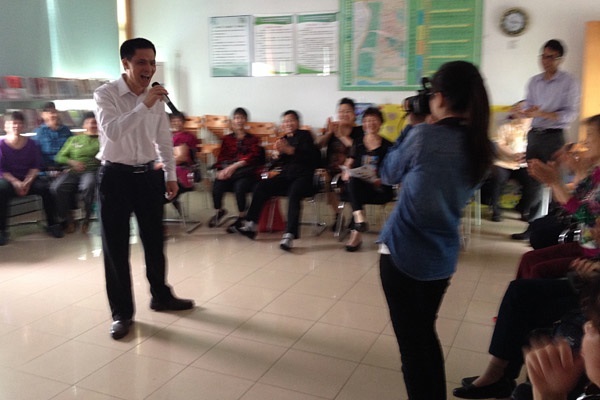
resolutely believing in the party
This morning I observed the Baishizhou Culture Station in action. Two groups of aunties were singing. The first group was singing Mandarin karaoke, the second group was singing an original Hakka composition entitled, “Resolutely Believing in the Party”. Later that morning the new Shahe Party Secretary came by, singing a karaoke song (“The Northern Spring”) and enjoyed the performance by the Xintang Hakka Mountain Song Chorus. Handshake 302 also presented our work to date.
The morning of community culture, including a Party Secretary karaoke moment reminded me that so much of Chinese political culture is making and maintaining good relationships between Party representatives and the represented. The pictures show the lyricist, the singing Secretary, and the Culture Center’s documentation of the event.
So here are the translated lyrics of “Resolutely Believing in the Party”. Note the definition of xiaokang–a basic material standard of well being. Note also in the picture that the lyrics have been written by hand.
Spring brings the fragrance of one hundred flowers, one hundred flowers
Everyone has a car and building, a house, a building and a house
Every kind of furniture
Three healthy meals a day, nutrition and health
Summer comes and the heat is hard to bear, the heat is hard to bear
Everyone has a fan or air conditioner, installed an air conditioner
No need to roast and sweat
We have electric slow cook pots for traditional soup, traditional soup
Fall comes and it turns cool, it turns cool
We wear fashionable clothes, fashionable clothes
Everyone carries a cell phone
Each home has internet and is linked to the world, linked to the world
Winter brings snowflakes to the mountain, snowflakes in the mountain
Reform and Opening is the promise of Spring, the promise of Spring
Resolutely believing in the Party
Beauty and happiness with the realization of xiaokiang, we’ve realized xiaokang
paper crane 3 online!
And here’s the link, “Arrival Shenzhen”, episode 3 in the series.
paper crane tea #2 is online
For the curious. “So why do foreigners go to urban villages?” is online. Please check it out and grow the conversation about Baishizhou and why it matters. For all of us.
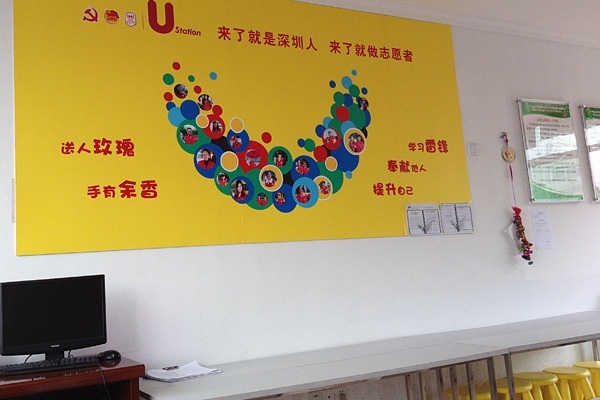
volunteerism and possible civic identities in shenzhen
In the Summer of 2011, Shenzhen hosted the Universiade. At the time, we complained about the face projects and cost there of. In retrospect, it seems, however, that one of the more lasting effects of hosting what is basically an Olympics for college students was that volunteerism and u-stations took root and flourished.
U-stations can be found throughout the city, and are staffed by young friendly and sufficiently bi-lingual folk, who hand out bike maps to the city and introduce nearby attractions. All wear the highly recognizable Shenzhen volunteer vest. In fact, this new emphasis on volunteer citizen participation may also have contributed to an interesting renaming–Shenzhen migrant workers are now officially called “those who have come to build Shenzhen”. The phase reworks the Shenzhen volunteer slogan, “if you come, you are a Shenzhener”. The Chinese wordplay is from 来了就是深圳人 to 来深建设者.
Several days ago, I met with the director of the Baishizhou Culture Center. We spoke in a comfortable, well lit library which was also a u-station! Other programs run by the Center included an after school program, which is staffed by those young and friendly red-vested volunteers. We were in the station to talk about opening a community learning center under the auspices of this collaboration between multiple levels of government. We would be another NGO sponsored by some level of government to work in Baishizhou.
This is where the administrative structure gets interesting. The culture station is housed in the Baishizhou Five Village corporation, which represents locals’ interests and manages Baishizhou properties, electrical, sanitation, and other municipal services. However, the culture station is funded by the street government, which is responsible for implementing district policy. The volunteers are a municiple level NGO.
So here’s the a-ha moment: u-stations and volunteers have permeated even urban village regulatory structures and may have an important role in redefining citizenship and the role of the city in financing not-for-profits.
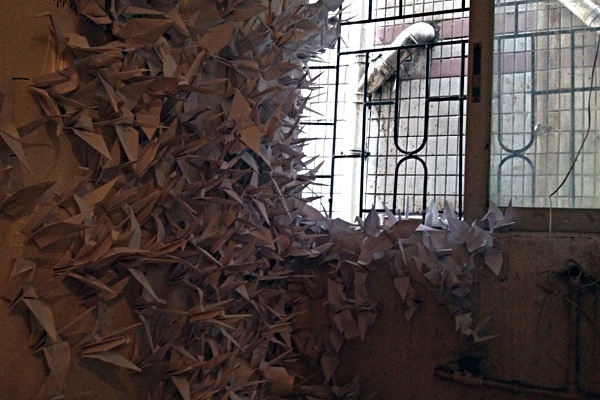
paper cranes
The inspiration for Paper Crane Tea came from Wan Yan, an architecture student by way of the fine arts. Below, her statement on the current installation at Handshake 302:
We’ve probably all heard about paper cranes; if you fold 1,000 they will take flight and help you realize your aspirations. Children believe this story, but for adults it is. Nothing more than a pipe dream. And that transition–from hope to resignation and simultaneously from ignorance to understanding–is the journey of a human heart.
The repetitive task that is folding 1,000 paper cranes symbolizes an important truth about being human. We are constantly repeating some task to achieve some goal; in order to graduate, we memorize and review coursework; to earn a living, we go to work from 9 to 5; to master a new skill, we practice, practice, practice. Each of these repetitions is like folding 1,000 paper cranes–it embodies the hope and determination necessary to realize a particular goal.
In an urban village handshake building, renters come and go, but the spirit that haunts each cramped rental unit remains–the recurring struggle to realize a dream. Indeed, achieving a a goal by diligently repeating he same activities is like folding one’s life in order to realize the crane of freedom. And there is something exuberantly childlike in that image. However, there is no unambiguous desire. In an era of heterogeneous values, different desires and ambitions will create fierce conflicts and mental confusion. Hope can be simple and even pure, but to realize an ambition requires unavoidable complexity and sufficient flexibility.
The first time I came to Handshake 302, in addition to feeling how cramped and narrow it was, I also thought about the repetitive suffering and struggles that every inhabitant would have to undergo in order to move into a “respectable” home. I also thought about how difficult it would be to find oneself (as the expression has it) in that vexed space between desire and it’s realization. But ultimately, each of us must inhabit that mental crucible where relentless economic and social pressure smelt perseverance, inner voices, and anxiety into “me”.
Handshake 302 is our stage, where members of Urban Village Special Forces perform stories of and about Baishizhou and it’s 140,000 residents. For some people, however, Handshake 302 symbolizes he cage they are trying to escape, or the long ago first stop on thei Shenzhen sojourn. In this space, 1,000 folded paper cranes take on new meanings, not only drawing our attention to what it means to be human, but also reminding us that we strive to achieve our humanity in specific contexts.
And photos of the Paper Cranes Fly installation at Handshake 302.
what’s the good of public art…
…in an urban village?
This was the topic of the first Paper Crane Tea 2014.03.09. I’m posting the link because my VPN isn’t fast enough to tunnel video over or under the great firewall. Will upload next time I’m in Hong Kong. Sigh.
 Shenzhen Noted