Happy to share the videos from “Unidentified Acts of Design,” curated by Brendan Cormier and Luisa Mengoni. Enjoy this great intro into Shenzhen design. The first is on the painters of Dafen Village.
Author Archives: Mary Ann O'Donnell

mom and pop opportunities: yet another reason the villages matter
The distribution of villages throughout Shenzhen once afforded opportunities for low capital, small scale businesses to pop up within the urban center. It also meant that workers could find affordable housing within walking distance or short rides to their jobs. In this sense, villages were not simply gateways to the city, but also platforms that gave low-income and working class families economic opportunities that are not available outside the city center. Continue reading
shuiwei: qingming treats
The women of Shuiwei continue to make the village, one treat at a time. For Grave Sweeping Day (清明节), they gathered in the village kitchen to make a variety of traditional snacks. The treats are steamed and vegetarian. What’s not to love?

israel horowitz in shenzhen!
Playwright and screenwriter, Israel Horowitz is visiting Shenzhen in conjunction with the Fat Bird premiere of his play, Line, which has been performed at the 13th Street Repertory since 1974. We’re excited!
On Saturday, Israel will be giving a free talk about over fifty years creating for the stage and screen. Venue: OCAT B Gallery; Time: 15:00. If you’re in Shenzhen, don’t miss this chance to meet a theater great!
The play will be performed in Chinese on April 5 through April 8, 2016. Venue: Nanshan Cultural Center, small theater. Tickets can be purchased through WeChat or at the door.

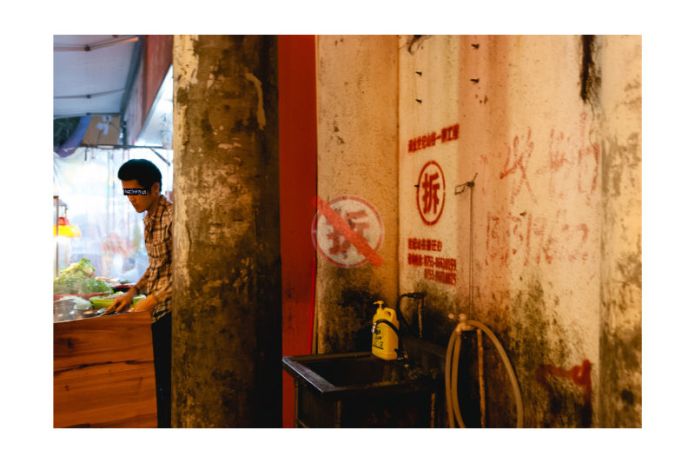
baishizhou demolition scheduled
The demolition of the Shahe Industrial Park, Baishizhou (located west of Shahe Road) has been scheduled for April 30, 2016. The six-story factories are owned and managed by Shahe Enterprises and occupied by mid-size business owners. This area is the easiest to raze because it has a single property owner.
The image is from the ongoing “Don’t Raze Baishizhou Photography Exhibition” which meets every Saturday to photography Baishizhou’s residents and garner attention for the call for more equitable redevelopment.

finding samuel lowe…in shenzhen
How have our parents’ and grandparents’, and their parents’ and grandparents’ sojourns–some forced, some voluntary, and some taken on a whim–shaped the people we have become? It is a quintessentially American question, and yet it resonates in Shenzhen where almost everyone of the city’s 20 million people have migrated here from somewhere else. It also resonates because before the establishment of the Special Zone, emigration–rather than immigration, departure rather than arrival–informed family trajectories. Continue reading
thinking tech/ thinking shenzhen
Some links to some blogs that provide insights into the way technology shapes and is shaped by Shenzhen’s creative / shanzhai eco-system as well as insight into the organization of labor that has facilitated all this growth:
88 Bar which always helps me think about technology with Chinese characteristics.
Anna Greenspan’s website that includes links to her publications on technology in both China and India.
Digital China provides the scholarly antidote to chinaSMACK‘s addictive presentation of the Chinese internet.
Ethnography Matters for great insights into how people think about big data (and how ethnography helps us do that thinking).
Factory Stories is just that, a website about working conditions in the Pearl River Delta.
Hacked Matter, one of the first Western research initiatives into Chinese maker spaces.
Institute for the Future has been delving into the techinological futures of human beings for at least a decade. IFTF researcher (and good friend), Lyn Jeffrey got me interested in the Shenzhen scene!
Silvia Lindtner’s website that includes downloadable PDFs of her wonderful papers on shanzhai production.
That’s What Xu Said provides occasional posts and analysis into what’s going on in Chinese social media.
Tricia Wang’s website is a trove of insight into digital China and connects you to all the great work she does.
There’s more out there. Please let me know so I can update my reading.

Digging a Hole in China
This afternoon I had the pleasure of attending the opening of the Digging a Hole in China (事件的地貌) exhibition, curated by Venus Lau. the exhibition features a range of works that were produced from the mid-1990s forward, roughly a decade after the idea of land art had been picked up by Chinese artists and only a few years after Deng Xiaoping’s 1992 Southern Tour, where he confirmed that China would continue to liberalize its economy. The stated goal of the exhibition, which positions itself between China and the West is,
[T]o expose and analyze the discrepancies between this genre of work and ‘conventional’ land art understood in the Western-centric art historical context, thereby probing the potential of ‘land’–as a cultural and political concept–in artistic practice.

post-industrial villages
Last year, the last of Foshan’s famous pottery kilns was decommissioned, leaving the city poised at the edge of a complete renovation–from a dense network of markets, township and village owned industrial parks, and new villages into something bright and shiny, an amalgamation of high-rises, offices, and malls, where products that are no longer produced in Foshan can be purchased by people who suddenly find themselves positioned to become a next generation of “urban village” landlords. Continue reading
shenzhen population, 2015
It’s official, at least 20 million people live in Shenzhen. According to Shenzhen Secreatary, Ma Xingrui, the city’s population (as of December 2015) stats were: population with Shenzhen hukou =3.67 million; population with long-term residency = 10.77 million, and; administrative population = 20 million.
 Shenzhen Noted