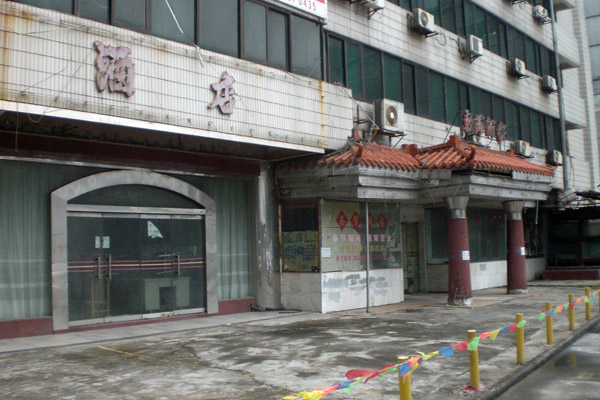
anthropologizing

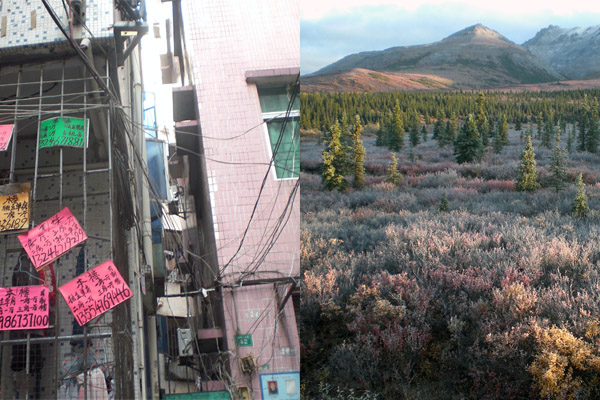
So, a juxtaposition of Baishizhou and Denali, which may be achieved through visual flattening, but as lived required movement through time and space — from Shekou to Hong Kong international by way of Shenzhen Bay checkpoint to SeaTac and then on to Anchorage and passage on the Alaskan Railroad.

I look at snapshots taken here and there, searching for commonalities, for what we might call human universals, which Donald Brown has defined as “those features of culture, society, language, behavior, and mind that, so far as the record has been examined, are found among all peoples known to ethnography and history.”

There is, of course, the eye of the beholder — mine — which seems drawn (here, at least) to pink, but all this does is raise the question of whether or not what I experience in each of these places is what other people also experience. In Chinese poetics, this common — unquestionably and recognizably human — response would be called yijing (意境), which literally means “idea scape” and denotes the moment of union between interior and exterior states of being.  意, for example, is composed of characters meaning “sound (音) and heart (心)”, while 境 is composed of characters for “earth as soil or land (土)” and “final or complete (竟)”, which here functions as a sound marker for jìng.

What are the respective yijing‘s of Baishizhou and Denali? And can we confidently generalize our responses to say, “Just so and how could it be otherwise?”

These questions matter because both Baishizhou and Denali are the focus of conservation efforts, albeit of a different ilk. Both discussions assume a common response to a particular environment. Moreover, in both discussions, one’s response to the environment is taken as an expression of one’s humanity and there, of course, is where the debate rages.

At Baishizhou, the current discussion of how to raze and rebuild an urban village focuses on the experience of mass urbanization and the need for access to housing, food, and transit networks. The debate has two assumes. First, the debate assumes that inequality is a defining feature of human life and that the purpose of social life is to ascertain that level and take measures to insure that people do not live in inhuman conditions. In turn, the content of the debate is over where to draw the line between human, subhuman, and inhuman living conditions. Second, the debate also assumes that urban living is a desirable form of life because it results in access to cultural goods, such as medical care and education by way of intentionally crafted environments, such as hospitals, schools, restaurants, and entertainment districts. As debated, these two assumptions are hierarchically ranked into the Maslovian categories of “basic needs” and “higher needs”. Thus, as one debates, one is not simply drawing lines between this life and that, but also and more importantly, revealing one’s humanity as a function of social responsibility.

Likewise, at Denali a general assumption and its implementation shape debate, but here over the nature and value of wilderness. On the one hand, the debate assumes that the experience of wilderness reveals and cultivates the wild, untamed spirituality that makes us human and that the purpose of social life is to maintain and create spaces where people can realize this spirituality. In turn, one’s love of wilderness functions in this debate as a marker of one’s spirituality. On the other hand, the debate also assumes that wilderness occurs in the absence of human settlements, such that in order to build human settlements one must transform wilderness. As debated, these two assumptions are also ranked hierarchically in terms of what is essentially human (nature) and acceptable transformations of wilderness (culture). Thus, as one debates, one is not simply drawing lines between this life and that, but also and more importantly, revealing one’s humanity as a function of wild spirituality.

It is possible to note the Chineseness of the Baishizhou debate (all that Confucianism going down), just as it is easy to remark on how much Emerson and Muir continue to shape American understandings of our place in the world. And therein lies the challenge of cross-cultural debates about what it means to be human in a world where Baishizhou and Denali cross paths, so to speak. The question is not so much either / or — which is a more accurate definition of what it means to be human: social being or wild spirituality, but rather the question seems to be: what might the Baishizhou debate teach us about the cultural place of wilderness, and what might Denali remind us about the limits to human settlements?

下沙陈杨候王庙: mapping the transition of property rights in shenzhen

Dedicated to Chen and Yang, a scholar and general, respectively, the Xiasha Houwang Temple 候王庙) is worth a visit and not only because these kings-in-waiting represent the Confucian ideal of uniting literary and military talents in governance, but also because they remind us that the contemporary figures of “high intellectual (高知)” and “high cadres (高干)” have historical president. What’s more, a glance at the plaque of sponsors suggests the extent to which reinvented traditions have been incorporated into Shenzhen’s urban village renewal projects. In addition to Xiasha Village Holdings Limited CEO, Huang Chaoying, CEOs from the various companies involved in Xiasha renewal also donated to temple construction, including Chen Hua (CEO Kingkey – 3 million yuan); Huang Chulong (CEO Galaxy – 2 million yuan); Huang Kangjing (Lvgem – 2 million): and Huang Guangmiao (CEO Centralcon– 2 million).

These four Shenzhen based conglomerates have a been major players in the implementation of the Municipality’s post 1996 urban plan, with investments that began either as a joint venture with an urban village or winning a bid from the government. Over time, these conglomerates have emerged become active in larger projects, participating in this second “village urbanization” effort and thus extending their holdings through collaboration with other Shenzhen urban villages as well as extended holdings throughout neidi. Kingkey, of course, is best known for the KK 100 in Caiwuwei, but also built the upscale mall, KK Baina in the reclaimed Hongshuwan area. It began as a Luohu developer, most notably the Jingdu Hotel, near the train station. Within the past decade, Kingkey has also expanded to open branches in Tianjin, Beijing, and Zhejiang.

The three other developers also followed this path – from developing buildings or housing complexes in a particular district (Kingkey began in Luohu, while Galaxy, Lvgem, and Zhongzhou had their start in Futian)  through urban village renovation (negotiating to lead the renovation of entire urban villages) to national player. All were formed in the early 90s, when Shenzhen began dismantling the State’s benefit housing system. The key point about the rise of real estate developers is that they are all less than twenty years old, profit(eer)ing from the Chinese State’s decision to discontinue public housing for middle class workers (For more details, see Historic Footnote, below).

Less than fifteen years after the end of public housing, the fact that four Shenzhen real estate developers are collaborating with Xiasha isn’t surprising. After all, the only remaining land to be developed in Shenzhen is under the control of Village Community Limited Corporations. Indeed, much of what is currently glossed as “renovation” is in fact, a process in which land rights transfer from the Village Holding Company to the Municipality by way of a developer, who sells buildings but not land. What is interesting, however, in how these developers are working with Xiasha to create a recognizably traditional and Confucian identity. In other words, Xiasha is being presented as a viable form of upgraded urban village that explicitly references tradition, rather than Communist history and the establishment of New China. Significantly, renovation at Xiasha not only marks the convergence of Village Community and Enterprise interests, but also reveals the ideological form of this convergence as an upscale urban village. What remains to be seen is whether or not Xiasha Limited can expand as the real estate companies have, or if it will remained tied to its traditional land.

Below, impressions caught on a walk from Chegongmiao to Xiasha. Several notes. 1. Chegongmiao was a mid-80s industrial park. It is now being renovated with restaurants and office space, but it does save the older urban layout as well as benefit housing stock. Thus, the area offers middle class workers relatively affordable and convenient housing. 2. Just across the street, Xiasha will soon boast a major KK skyscraper, which will make the urban village prime real estate. 3. I finished my walk by having my fortune told, by a Tianjin grandma, whose hand-written notebook reminds us that popular religion is not simply about respecting social hierarchy (as in the Chen-Yang Temple), but also manipulating fate to get ahead.

This slideshow requires JavaScript.

Historic Footnote: The Privatization of Work Unit Housing and the Creation of Shenzhen’s Housing Market

Before the 1992 Southern Tour, housing in Shenzhen was typically of two kinds — either work unit housing, which was built by state work units for their staff or rental properties in the urban villages. Accordingly, state work units and independent crews were responsible for most housing design and construction. After the Southern Tour, however, Shenzhen began extensive housing reform (房改), which entailed both privatizing extant housing and creating commercial housing stocks. Until 1999, when the last work unit developments had been approved, Shenzhen had three kinds of housing — benefit housing (福利房), small profit housing (微利房), and commercial housing (商品房). Benefit housing belonged to the work unit, which assigned housing to staff by calculating such factors as seniority, tenure and hukou status. Small profit housing was just that, work unit housing whereby the unit building the housing was able to earn a small profit. Commercial housing was just that, housing that was developed with an eye to making a profit.

During the 1990s, most middle class Shenzhen residents lived in either benefit or small profit housing. In order to make their housing attractive to people who might otherwise settle for benefit or small profit housing, nascent real estate development groups sold life styles, the most popular of which was known as “European style”. Many middle class workers who already had a benefit or small profit home invested in commercial housing. However, most middle class workers aspired to either benefit or small profit housing. Nevertheless, housing reform transformed this system and by the end of the 90s and especially first years of the new millennium, commercial housing stocks had become the most common option for middle class migrants, who arrived in the city after benefit and small profit housing had been discontinued. For the next five years, work units allocated the last of benefit and small profit housing. Then, in mid 2007 – early 2008, Shenzhen’s real estate market took off, with housing and building prices abruptly doubling within one calendar year.

land reform, again.

An Old Shenzhener once complained to me that since the 1989 Crackdown, in Shenzhen “reform” has been too often interpreted to mean “refining the state system”, rather than actually reforming society. His point was simple. During the first decade of Reform, people had an opportunity to participate in and even direct the direction of development in Shenzhen. The fact of widespread participation made Shenzhen “special”. In contrast, after June 4th, Shenzhen became increasingly bureaucratized – like Beijing – and participating in social transformation was no longer possible for the common people. Instead, the Government had become the key social force and thus, social agency meant “works under the guidance of government bureaus” for the benefit of government officials and their cronies.

The Municipality’s latest “land reform (土改)” program illustrates the problem that aggrieved my friend. Last week, the government released three documents that legislate the scope and direction of land reform: The Comprehensive Plan to Reform Shenzhen Land Administration (深圳市土地管理制度改革总体方案), The Immediate Short Term Plan (2012-2015) of the Comprehensive Plan to Reform Shenzhen Land Administration, (〈深圳市土地管理制度改革总体方案〉近期实施方案(2012~2015年), and Notification of the Establishment of the Shenzhen Land Administration Reform Guiding Committee (关于成立深圳市土地管理制度改革领导小组的通知). Together these documents determine the target of reform, the method of reform, and the people who will interpret and implement land reform. Moreover, even a cursory reading the documents indicates that at stake in these documents is (1) finalizing the transfer of outstanding land rights from village holdings to the Municipality and (2) determining the status of informal property rights in urban villages so that (3) developers can more easily realize the goals outlined in the Municipality’s Comprehensive Master Plan, 2010-2020.

And there’s the rub: During the 1980s, villagers and various entrepreneurs collaborated to build the urban villages. My friend understood this situation be “true” or “ideal” reform because ordinary people could realize projects outside the purview of government plans. At the time, none of those projects were “informal” or “illegal” because the villages held legal land rights. He also thought that this freedom to develop land was the precondition for true social reform. He didn’t think that all villages had done a good job with the opportunity, but nevertheless believed that the idea of small-scale development and common participation was the point of reform. However, once the villages had been incorporated into the Municipal apparatus, that first round of development could be reinterpreted in terms of illegal buildings and informal property rights, alienating villagers and unofficial developers from participating in future development projects except as recipients of compensation packages.

Shenzhen property rights are a muddle that the Government needs to handle carefully to avoid aggravating extant (and growing) inequality. On the one hand, by incorporating village lands into the state apparatus and compensating villagers and independent landlords for their extant holdings, the Government creates ill will on two counts. First, people without hereditary land rights or informal property rights have no chance to benefit from this process. Second, with the exception of farmers, the process enriches government officials and corporate executives, which is the common sense definition of “corruption”. On the one hand, if the government were to reform property laws to allow for individuals to develop land, this would mean completely restructuring the state apparatus and concomitant property rights. This is what my friend would like to see – capitalist opportunities for individuals, rather than for government officials and large corporations. But this seems more a definition of “revolution” than “land reform” as it would mean redistributing rights to high-rises, shopping malls, neighborhoods, housing estates, and industrial areas.

Guanwai village lands were not only extensive, but also remain underdeveloped. Consequently, the experimental target of overall land reform in the 2012-2015 short term plan is Pingshan New District, while the experimental targets of “second round development (第二次开发)” are be Gonghe Community, Shajing Precinct, Baoan and Shanxia Community, Pinghu Precinct, Longgang.

because not all villagers were created equal…

The stereotype of the second generation of Shenzhen villagers being “rich, lazy, mah johng playing, playboys (who might also do drugs)” is not only predicated on the idea that all of Shenzhen’s original inhabitants are rich, but also that their children have grown up aimless. However, Bao’an County’s original 300,000 residents and their children were not all created equal. What’s more, they increasingly find themselves belonging to antagonistic economic classes, while their children come of age grappling with problems that none of their parents imagined facing. Some second generation SZ farmers must look for wage labor in factories that (rumor has it) do not hire locals, preferring instead to hire migrant workers, even as other second generation SZ farmers are the first in their family to gone to college, and still others are, yes, struggling with too much wealth.

The inequality among locals has been created through reform era legislation and urban development projects, which have built upon and elaborated historical inequalities and traditional norms. In an earlier post, I charted the borders and corridors that have shaped economic possibility and subsequent patterns of urbanization in the SEZ, arguing that three borders have enabled urbanization in Shenzhen: the border with Hong Kong, the second line, and the city limits, which abut Dongguan in the northwest and Huizhou in the northeast. Two economic corridors have facilitated Shenzhen’s growth: the Guangshen highway corridor and the Kowloon-Canton Railway. The Guangshen highway corridor parallels the area’s riparian trade routes, which were the means of Han expansion from Guangzhou southwardly on the Pearl River and its tributaries. The KCR, of course, was the British attempt to preempt and redirect the PRD’s extensive trade network.

Not unexpectedly, proximity to a border or corridor has been a condition of reform era riches. Villages near the nexus of these borders and corridors have had disproportional opportunities to build and manage industrial parks and real estate developments. The earliest villages to get rich, for example, were all located along the Shenzhen-Hong Kong border at corridor checkpoints — Shekou (Fishing 1 and Wanxia) and Luohu (Hubei), first, but then Huanggang (Huanggang, Shuiwei, Xiasha, and Shangsha). However, guanwai villages retained land rights a full 12 years longer than did guannei villagers, with the result that largest and wealthiest village joint stock companies are now primarily located along the Pearl River Delta (Shajing and Huaide) and KCR corridors (Nanling near Buji). Consequently, many villages have remained “stuck” in between these two different modes of production, neither farming nor investing in manufacturing, let alone transitioning to the new creative economy. Areas of relative poverty include many Longgang District Villages as well as villages in Gongming and Guangming.

However, proximity to the borders and corridors has not in itself created the conditions for villages to transition from lives based on rural production to lives based on urban industrial manufacturing. In addition to the construction of infrastructure, differences in Mao-era administrative designation have also shaped current inequalities among villagers. First, successful villages have operated as collectives, rather than relying on individual efforts. These villages not only inherited Maoist organization, including management experience, but also inherited common ancestry. Thus, single surname (一姓) villages, which have renovated ancestral halls and promoted traditional rituals have generally been more organized than random surname (杂姓) villages, which were created during the Maoist era for production purposes. Second, successful villages have had traditional land rights, which were extensive. Indeed, most traditional villages have made their fortune through land deals. In contrast, fishing villages (渔村) and overseas Chinese villages (桥村) had foundation rights (宅地), but not land development rights. This meant individual villagers could build private homes, but that villages could not collectively invest in industrial parks or real estate developments. Moreover, villages did not benefit from compensation deals between developers and nearby traditional villages. Third, as recent events in Wanfeng demonstrate, some village heads have been less corrupt than others, while the success of Huaide, Nanling, Huanggang, and Xiasha Villages has been directly attributed to the foresight of the incumbent leader.

It is an open secret that legislation has been the source of Shenzhen’s competitive advantage, both for outside investors and for indigenous Bao’an villagers. What’s more, this legislation did provide the framework for many local villages and individual villagers to become rich. Indeed, when Deng Xiaoping died in February 1997, Shenzhen villagers openly wept and brought funeral wreathes to the statue at Lianhua Park and his Shennan Road billboard. Nevertheless, the emergence of class differences within and between villages directs our attention to the ways in which Shenzhen has displaced Bao’an as “the local”. Within this new locale, hometown status no longer provides a viable identity because locals have been segregated into urban classes that have disrupted traditional rural relations, even as they learn to navigate a hometown that is no longer theirs, assimilate the mores and customs of urbanites, and speak standard Mandarin, rather than local Cantonese or Hakka dialect. And in this new world ordering, poor Baoan locals embody a poignant form of global tragedy.

渔一村:of old men and the landfilled sea

Yesterday’s bloggy romance with the sea continues and although I have shifted my gaze from Cuba to Shekou, it is worth mentioning that the writers’ emphasis on masculine conquest continues; today, in episode 8 of The Transformation of Shenzhen Villages (沧海桑田:深圳村庄三十年), Chen Hong tells the story of Fishing Village 1 (渔一村), Shekou. Again, the story begins in a village, but this is also where similarities between the two narratives end. Hemingway figured human life through the isolated figure of an old man navigating the Caribbean on a rickety skiff and superstition. In contrast, Chen Hong figures humanity through the construction of ports, trading ventures and the world-making connections that they enable, suggesting that the opportunity to launch one’s skiff is itself a political decision which once made determines the fate of villagers. For those who remember the 1988 television documentary, River Elegy (河殇) which linked China’s decline and ultimate humiliation to the Ming decision to ban maritime activity, a not-so-subtle critique of Maoist isolation, Chen Hong’s passion for the sea and the [free trade] world it symbolizes is self-evident.

Episode 8 opens by juxtaposing images of Ming and Qing trade centered on Guangzhou with pictures of the construction of Shekou, reminding viewers that Zheng He (郑和) set forth from or loaded supplies at Chiwan Port at least five times. Lest the viewer forget the consequences of isolation, the opening sequence ends with bleak, black and white footage of a backwater port, overgrown and clogged with weeds, small wooden boats berthed in stagnant waters. Boom! The first explosion opens the door to new world order, which is also, new village order.

Traditionally, the villagers of Fishing 1 weren’t actually villagers but individual fishing families who lived on boats, coming onshore to sell the day’s catch. Families came from all over the Pearl River Delta forming a community through their livelihood, rather than through ancestry or even a common version of Cantonese. However, in 1959, the political decision was made to organize them as a brigade (生产大队). They were 90 households with a total population of 450 people and settled as four small production teams (小队) in Nantou, Gushu, Neilingding Island, and Shekou. The Fishing Brigade worked to modernize the fleet and in 1978 during a meeting on scientific production, Hua Guofeng actually gave the brigade a first place award. Indeed, at the beginning of Reform, the Brigade had 69 ocean fishing vessels, 72 transport ships, and 18 oxygen boats that fished the South China Sea and Pearl River Delta bringing in fresh seafood for Cantonese dishes and by 1992, had accumulated enough capital to invest in modern industrial deep sea fishing vessels.

From 1978 through 1986, the Fishing Brigade lived the socialist dream, which was a traditional Chinese dream; the men fished, going as far away as Guangxi, the women kept house, children went to school and had medicine, and all ate in a common canteen, where the work team provided delicious food, including squid and shrimp. The system was called the 8 provisions (八包). However, by the late 80s early 90s, the scale of urbanization and land reclamation meant that traditional fishing areas had been contaminated and fish breeding grounds buried, and it was impossible to continue living from the sea. Suddenly, the advantages of the sea declined as property values soared and Fishing 1 faced a contradiction that many other villages would eventually face — what to do when urbanization decimated the conditions of traditional livelihood?

Once the sea was gone, Fishing 1 had no way of making a living because it did not have any land, except for that which the government had given it for housing in 1959, including a section on Neidingling Island, which Fishing 1 decided to develop as a resort and in 1992 as part of the guannei rural urbanization movement, the Fishing Brigade became the Fishing 1 stock holding corporation. However, after Fishing 1 had already invested their accumulated capital and borrowed against the development, Shenzhen and Zhuhai began a court case over who actually owned the island. Traditionally, the Island belonged to Zhuhai. However, in 1955, the Center had assigned Neidingling to Baoan, but no one could actually prove whether or not the transfer had gone through until 2002, when a copy of 1955 decision was found. In 2009, the Guangdong Provincial government finally ruled in favor of Shenzhen’s claim to Neidingling Island. However, the case raged long enough to impoverish Fishing 1 as the joint stock corporation/ fishing brigade/ village could no longer fish and except for Neidingling had no other traditional land rights. Indeed, by 2009 when the case was settled, Fishing 1’s deep sea fishing rights had already been bought out by China Merchants, which in turn sold them to Wanxia, one of Shekou’s original land-based villages.

And so here’s the neoliberal twist in Chen Hong’s story of old men and their vanishing sea: Fishing 1 re-entered Shenzhen urban planning as part of the Together Rich Project (同富裕项目), and over the past decade restructured and invested elsewhere: an industrial park in guanwai Gongming and fish breeding farms in Zhanjiang, for example. In addition, the Municipality organized training for fishermen to learn new skills. Nevertheless, the members of Fishing 1 have not only been proletarianized over the past 30 years, but are still paying off one of the debts that fueled Shekou’s growth. After all, Fishing 1 had no rights to any of the coastal property developments that enriched both China Merchants and neighboring Wanxia Village. Instead, Episode 8 ends with exhortations — from the Municipality and from the filmmaker — for individual development and initiative, ironically and inexorably returning us to Hemingway’s sea, where old men struggle feed themselves because they have been isolated by .

For more on my obsession with Houhai Land reclamation, more entries, here. A wander through the earliest Shekou landmarks, including the Shekou and Neilingding fishing families settlements, below:

This slideshow requires JavaScript.

The Value of Urban Villages

US American real estate developers chant, “location, location, location.” In Shenzhen, primary locations open for development are actually urban villages slated for old village renovation — redevelopments that involve the final transfer of village held property to the Municipality.

In a Jingbao article on the future of Nanshan District, Li Xiaogan, recently appointed Nanshan District Secretary, noted for example, “In constructing a global district and promoting urban renovation, Nanshan District will have several advantages over the next few years. First, the largest urban renovation project in Guangdong Province – Dachong Urban Village, with a total project area of 683,000 square meters; second, the urban renovation project for the five villages of Baishizhou in Shahe, which is currently being planned, also has an area of over 650,000 square meters, and is again one of the largest in the Province; third, located in the north of the District, the three Shuiyuan villages are within the water conservation and ecological conservation red lines, and are thus relatively backward, however, they are also now in the planning stage of development; forth, the old Xili Market, which we are planning to convert to an urban complex; fifth, the banks of the Shahe River, where we will take international bids to create an ecological cultural corridor, and; six, Nanshan Old City, which with everyone’s support we hope to return to its status as Shenzhen’s historical and cultural root, by resituating all residents and completely rebuilding.”

Recent impressions of Baishizhou, below:

This slideshow requires JavaScript.

怀德村:virtue’s rewards

It’s been a while since I’ve summarized an episode from The Transformation of Shenzhen Villages (沧海桑田深圳村庄三十年) and so today, episode 6: The Secret of Huaide Village (怀德的秘密), which puns the village’s name and also means “the secret to cherishing virtue”.

The episode opens by telling viewers that Huaide is a revolutionary village, which contributed over 40 soldiers to the People’s Liberation Army. The connection between good Party leadership, virtuous villagers, and getting rich is then personalized through the story of Pan Baliang, a Huaide villager, who fought in the Korean War, (or the Resist American War as it is known in Chinese). However, during the Cultural Revolution he was jailed because his children were abroad, and was only to be rehabilitated in 1980, when out of gratitude for his fellow villagers continued support, he petitioned the village/ brigade if he could open a factory.

In 1988, Huaide was chosen as the location for Shenzhen’s Baoan International Airport. At the time, the SEZ decided that guannei land should be saved for urban development, rejecting a proposal to build at Baishizhou, which was then considered the suburbs and choosing instead to stimulate the guanwai economy by converting Shenzhen’s largest duck farm into an international airport. The Shenzhen airport expropriated over 1,000 mu of village land and in return Huaide received a compensation package of 3.5 million yuan. The question became: should the sum be divided evenly and distributed to each villager (as many villages had chosen to do) or should the village create a jointly held corporation and invest the money in common cause?

In 1988, guanwai New Baoan County was still rural. This meant that the village was still organized as a collective brigade, which provided the organizational infrastructure for Huaide’s subsequent development as a jointly held corporation. Huaide’s current CEO and current Party Secretary, Pan Shansen earnestly explains that Huaide Party leaders understood that unless they could correctly direct the thinking of the villagers, the village was in danger of making a collective mistake. Collective and Party leaders then went to work on villagers with dissenting opinions in order to make sure that everyone was on board with the next step — using the money for capital investment to build and manage Cuigang Industrial Park. Pan Shansen then expresses his gratitude for the previous Party leaders’ foresight in using the Airport compensation to create a strong, collective economy.

Pan Shansen describes the work of creating “a center where there was previously no center” as arduous and only possible through the cooperation of the people and their government. In addition to creating a large wholesale furniture market, in 1996 Pan Shansen established a venture capital fund that provided interest free loans to young villagers who wanted to start up companies. The fund started with 1/2 million when and grew to 2 million, and loans grew from 20-50,000 per project. In 2005, this venture capital project was expanded through collaboration with Shenzhen’s rural bank, providing low interest loans of up to 300,000 yuan to Huaide Villagers. By 2010, when the documentary was made, in addition to the villages collected holdings, over 40 families had used Village venture capital to create family businesses.

Fiscal conservatism of the defining features of Huaide Village’s success. Huaide Village has its own “constitution” that requires any private investment over 5 million yuan to be approved by the village, they set up a legal aid office for villagers to consult when writing contracts, and since 1992 have not sold any village land rights. Telling, Pan Shansen makes a point of reminding documentary viewers that Huaide Villagers are farmers — to break their ties to the land and the village is tantamount to destroying what makes them who they are, regardless of how they actually make money. Land is at the heart of Huaide’s neo-Confucian CCP virtue and unlike many Shenzhen villages that no longer have collective land, Huaide still owns almost 1/2 of the land they owned before 1980. What’s more, the Village has actively purchased land rights from other Shenzhen villages, leaving its own land for future use.

The rewards of Huaide’s virtue are a neo-Confucian-socialist hybrid capitalist success story, or as it is sometimes said, villagers washed their feet and left the paddies. In addition to its village venture capitalist fund, Huaide invested in social services and local culture. Huade provides medical insurance, education, including college scholarships, and old age activities for its 700 villagers, and in 2010, its Lion Dancing Troupe was the only village level troupe to receive an invitation to perform at the opening ceremony of Belgium’s Chinese Culture Festival. And thus, the moral to this episode tallies with Shenzhen’s ongoing campaign to promote Confucian ethics: good party cadres are at heart neo-Confucians, serving their people, who become collectively rich. In turn, inquiring minds wonder: to what extent has Huaide’s ethical sensibility extended to the organization of workers’ rights in the village’s three industrial parks?

Cultural postscript: the Lion Dance Troupe is talented and fun. Check out a performance, here.

three class theory: speculating on the scale and possibility of reforming china

A while back I heard a princeling turned Shenzhen nouveau riche (and they do surface every now and again, entrepreneurs in their late 50s and 60s, who came to the SEZ to live well below the national political radar, but nevertheless take advantage of their status to reap economic benefits in the city that launched Reform) half-mockingly challenge a lunch table of intellectuals, saying:

China has three classes — high ranking officials (高干), national intellectuals (高知), and peasants (农民). Officials need help governing and are good to those who help them, but that’s not the important issue. The real question is: do you really want to share power with peasants?

That smug question provoked self-conscious chortles because most at the table were low-level national intellectuals, not peasants, no, but certainly ecclesiastes, who Gramsci defined as the category of intellectuals “who for a long time…held a monopoly of a number of important services: religious ideology, that is the philosophy and science of the age, together with schools, education, morality, justice, charity, good works, etc. The category of ecclesiastes can be considered the category of intellectuals organically bound to the landed aristocracy.”

The a-ha moment in “three class theory” is the emphasis on political, rather than economic power. Take a look at Chinese society and what becomes obvious is that high-ranking officials are, by and large, China’s property-owning class and national intellectuals are, by and large, members of the bourgeoisie. Within each of these classes, of course, exist various opportunities to confirm and strengthen social status, as well as opportunities to transfer and exchange socially valued goods, including money, but also including housing, medical care, and other social benefits. In contrast, peasants are those organically tied to the land, with all that the status has historically entailed: providing quota grain under Maoist collectivism to fund socialist urbanization, and presently being excluded from China’s urban boom except as members of the proletariat. The point, of course, is that in Chinese society economic opportunity is a function of political and social status, rather than the reverse.

The status of peasants and their ties to land are at the center of Shenzhen’s development.On the one hand, as rural areas urbanize, the question of land comes to the fore and in it we see how officials and intellectuals cooperate to expropriate land and justify its expropriation. In this scenario, the class struggle is over the terms of proletarianization and the creation of what are called “peasant workers (农民工)”. On the other hand, to the extent that villages retain control of their land and pursue capitalist projects, we see the stability of the three class system as local systems reproduce this hierarchy, producing “local emperors (土皇帝)”.  In this parallel scenario, the struggle is over the extent to which local emperors and local intellectuals might launch themselves into national politics. Obviously, although both historical trajectories transform individual lives, it is also clear that these changes are not bringing about a more just society, but rather using previous injustices to make and legitimate power grabs and the concomitant distribution of the spoils.

As China enters its fourth decade of reform, Gramsci’s call for intellectuals to theorize and provide alternatives to the present situation still haunts us. The fact that US and Chinese leaders continue to cosy up to one another and that US and Chinese intellectuals find so much in common makes salient the compatibility of US neoliberal ideologies and Chinese ideologies of socialist exceptionalism. However, this ideological compatibility has blinded many of us to a simple truth; the quality of life for Chinese nongmin remains the standard for evaluating the scale, possibility, and social forms of Reform and Opening, not the cross-cultural comfort level of high-ranking officials and national intellectuals, whatever their passport status may be.

tianmian update

Has been a while since I last visited Tianmian. In the interim, the biggest changes have been to the relentlessly upgrading lay of the land. In the north, renovations to the outer factories have been completed and there are now higher end restaurants and several chains. In the west, the border between New Tianmian Village and the City of Design has been eliminated so that people now pass freely from one section to the other, even though the aesthetics suggest a clear distinction between office workers in Design and New Villagers. To the east, the former red line of the 1980 SEZ at the Shanghai hotel continues to transform itself higher and bigger as Tianmian rents remain higher than service wages in neighborhoods diners, convenience shops, and beauty parlors.

This slideshow requires JavaScript.

Shajing Wanfeng Community learns from Wukan

Weibo reports that on the afternoon of April 8, 5-600 Wanfeng (万丰社区) community members/ villagers took to the street to protest Community Secretary and  Wanfeng Ltd CEO, Pan Qiang’en selling off collective lands for private profit. The protests began February 17, when 20-30 elder villagers gathered outside village offices and have continued until today.This afternoon, Epoch Times reported on the event, noting that villagers are calling for an accounting of the past twenty years. Currently, Wanfeng Community has an area of 6.8 sq km and a population of 2,067. Most are surnamed Pan. It is estimated that over 50,000 migrant workers also live in Wanfeng.