what’s on display and who can see it?

This past week, in addition to participating in large public culture events, I also had the opportunity to visit two privately organized cultural spaces. The first was a private collection of shoushan stone carvings (寿山石) and the second was a community museum.

So some preliminary thoughts about what these spaces suggest about post COVID culture in Shenzhen.

Continue reading

material and spiritual traditions. thoughts?

Long ago and far away, I wondered when History would enter Shenzhen’s bildungsroman. And now that it has, it’s interesting to see how deeper settlements have emerged as roots for contemporary Shenzheners. The original SEZ–now the inner districts (关内)–especially Luohu (Dongmen) has become the city’s connection to Hong Kong. Indeed, it is still where you go if you want to speak Hong Kong Cantonese and eat delicious Cantonese and Chao-Shan style foods. In the outer districts, “Longgang” (and I’m using it in its circa 1990 designation, rather than picking through the new districts) is home to Hakka traditions, which are housed in the area’s great compounds (围屋、世居). In Bao’an (and yes, as a cultural homeland, we’re talking about the sliver of villages that stretch north-south between the reclaimed west coast (now Qianhai) and Bao’an Boulevard), ancestral halls are flourishing and traditions like lion dancing have been elevated to national immaterial culture status (上川黄连胜星狮舞). The Huang alliance comprises eight troups, extending from Shanghe to Fuyong.

What I’ve noticed is that this geographic distribution assumes different historical subjects which are all mushed together into some kind of “Shenzhen” identity. The implicit subject of history in Luohu, for example, are the cross-border entrepreneurs (个体户 mainly from Chao-Shan area) and their Hong Kong clientele (many who also originally hail from Chao-Shan). This first generation came in the early 1980s and transformed the old market into a gritty cross-border playground a la Tijuana. In Bao’an, the villages (now communities under a street office) have cultivated and paid for the continuation of their traditions, including pencai (盆菜) banquets, the birthdays of divinities and founding fathers, and celebrations at various scale. In contrast, in the Hakka areas, various levels of government have assumed responsibility for the compounds and are using them to promote new kinds of high culture. Pingshan Art Musuem, for example, includes the Dawan Compound (大万世居) as a satellite exhibition hall, while Longgang District has transformed the Hehu Compound (鹤湖新居) into the base of its cultural think tank, hosting outdoor lectures underneath shade trees.

So, thoughts du jour are more random associations that still make a kind of sense. Shenzhen’s culture and history are being reworked in ways that both deploy local cultural geographies and map along the city’s historic interest in establishing a new material and spiritual culture. In Luohu, the early Special Zone is re-emerging in new forms of (admittedly cleaned up) cross-border consumption; Bao’an is emerging as the locus of South China Sea diaspora connections (the lion dance, for example, is a major competition in the region), and Longgang compounds form a material platform for high end civilization, where the city’s “new guests” can strut their cultural stuff.

coastal walk, anchorage

This slideshow requires JavaScript.

day tripping: deception pass

This slideshow requires JavaScript.

impressions of dali

The aftermath of vacation: unpacking suitcase, downloading last of pictures, writing a to do list that starts tomorrow. Also thinking that I love a local story of how Guanyin transformed herself into an old Bai woman, who carried a rock by roping it to her head and then used it to stop an invading army. Yes!

This slideshow requires JavaScript.

lotus east: the horse gang village

Half an hour outside Weishan, Lotus East Village (莲花东村) stands apart from the surrounding villages, both historically and culturally. Unlike mountain villages, like those around Lushi, which cultivated Yunnan Red (滇红茶), Lotus East once supplied the horses and guards for the caravans that moved tea and other goods along the Tea and Horse Route (茶马道). Although small, the village was powerful and relatively wealthy. In fact, during the Nationalist era, the clan heads – brothers Ma Shiji, Ma Shiqi, and Ma Shixiang – were aligned with Long Yun, the former Party Secretary of Yunnan Province.

Culturally, the residents were and remain Muslims, who elegantly synthesized elements of Han and Bai traditions within the context of Islam. The couplet that graces the entrance to the village mosque exemplifies the hybrid cultures of Southwestern China. In Mandarin, the word for “mosque” is literally “clear truth temple (清真寺)”.  The author has taken those two characters and used them as the opening characters of a Mandarin style couplet:

清升浊沉万教终归一统

真诚不二宇宙同赞阿拉

The pure rises, the polluted sinks, ultimately 10,000 teachings return to one

Truth and piety are not different, the entire universe praises Allah

Today, the Mosque and former homestead of the Ma brothers are open to the public, as is a small museum that introduces horse caravan culture (马帮文化 – literally “horse gang culture”) and the cross cultural breadth of China’s southwestern trade in tea, horses, and other luxury items. Impressions, below:

This slideshow requires JavaScript.

daoist china: weibaoshan

Another commercial center on the Tea and Horse Route, Weishan (巍山) is located about 75 minutes from Dali. Weishan was the first capital of the Nanzhao, but was soon replaced by Dali, which has a more temperate climate because located on the banks of Lake Erhai (洱海).

One of the main Weishan tourist sites is Weibaoshan (巍宝山), which literally means “Treasure Mountain Wei”. The mountain has been designated a national park and walking paths that thread from and between Daoist temples have been laid. Contemporary Daoists have occupied many of these temples and it is possible to stay the night there for a donation. However, the architectural treasure is the Long Spring Retreat (长春洞) which was constructed between 1779 and 1799 and is dedicated to the Jade Emperor, the Lord of the Underworld.

Sites like Weibaoshan vex me. I studied Chinese language and history in order to experience places like Long Spring Retreat, as if the poetry and philosophy of classical China still animated everyday life. However, 17 years in Shenzhen have taught me that even if the contemporary cultural mix includes Daoism, nevertheless capitalist forms and modern desires more obviously structure human relationships and desires in China.

And yet, if not for capitalist forms, I could not have visited Long Spring because I not only needed to purchase a ticket to enter the park, but also get myself from Shenzhen to Dali, Dali to Weishan, and then from Weishan to the mountain. Alas, none of those plane rides and car trips  manifest the Daoist virtue of regulating my life by according to natural rhythms. Instead, they more properly manifest the US American virtue of satisfying individual desires through post-industrial convenience.

The point seems to be remembering to take time to reflect on our place in the world, not only as individuals, but also as a species. What does it mean to be human? What does Long Spring Retreat teach that we cannot learn through Shenzhen’s rush to reproduce and exceed the material wealth of North America?

Impressions below.

This slideshow requires JavaScript.

sunny day, lushi

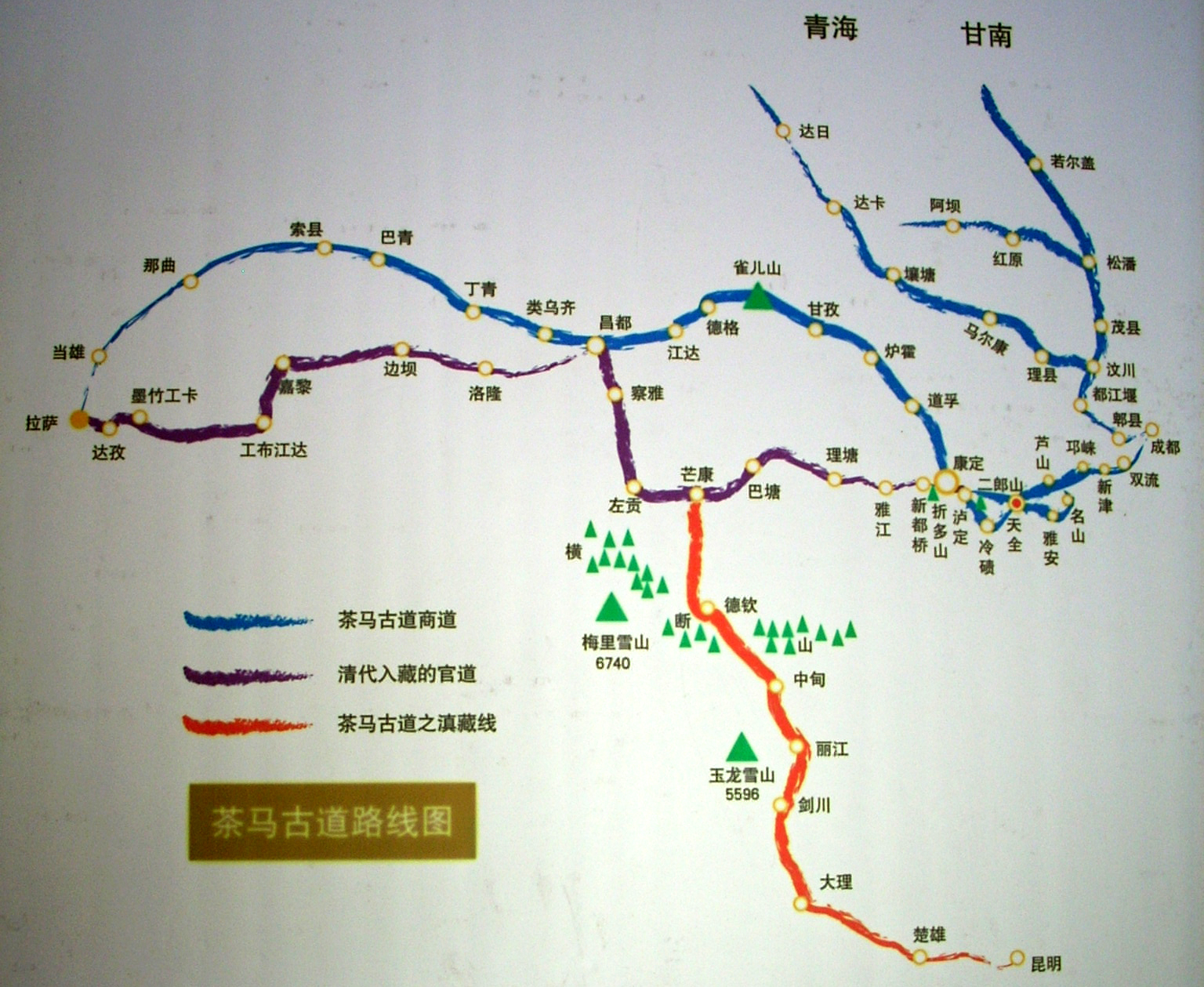
Although less famous than the Silk Road, the Tea and Horse Route (map) had three branches: the commercial route (Lhasa to Chengdu), the official route into Tibet (Lhasa to Kangding, where it reconnected with the commercial route), and the Yunnan-Tibet route (Mangkang to Kunming), which threaded through the Lincang mountains until it met up with the official route in Kangding. A small commercial center on the Yunnan-Tibet route, Lushi was located at the nexus trails that threaded through the Lincang Mountain Range.

Local farmers continue to live in villages along those ancient trails and still use pack mules to bring supplies from the town to surrounding villages. Mrs. Zhang discovered us wandering on one of the partially cemented trails that led to the river and invited us into her family compound for tea.

Mr. Zhang’s grandfather built the first building in the in the 1930s. Each subsequent generation added to the complex, and today the compound has three main buildings and a separate section for farm stock, a kitchen, and solar panels for heating water. With the family responsibility system, the Zhangs obtained several mu (666 2/3 sq meters) of land, where they have planted feed corn, walnuts, and vegetables. Their daughter has moved with her husband to Kunming and their son has opened a small shop in Lushi. One of the three buildings is for him and his girlfriend upon their marriage. The Zhangs earn between 10-20,000 rmb ($US 1,750 – 3,500) a year, which has been almost completely invested in building the house and their children’s education.

We chatted about their lives and in turn, they asked about ours. After half an hour, we took our leave and headed back toward Lushi. I remarked on the difference between walking in Lushi and Shenzhen, where I have been stopped by guards when trying to climb Jingshan Mountai in Shekou, let alone invited in for tea. My friend replied that the more commercialized a village or town, the less hospitable the residents.

This experience has me thinking about the potential and paradoxes of hospitality. In Lushi, if a door was open, we could walk into the compound and expect to be welcomed. The previous day, for example, Old Mr. Zhang (same surname as the village Zhangs) sat with us for 40 minutes, chatting about local history. We offered to continue the conversation by sending photos to the qq accounts of younger family members, who are online. At the same time however, when deflected through tourism, hospitality slips from a social practice into a commercial strategy. During this trip to Dali and its hinterland, we have stayed at hotels where our hosts are friendly, helpful, and pleasant and yet we do not feel obliged to grow the relationship.

Today I am wondering about hospitality in globalizing times. Social hospitality remains an important means of transforming strangers into acquaintances, even as commercial hospitality has expanded with the growth of tourism. The difficulty, of course, is that many of us travel hoping to encounter social hospitality and end up frustrated by differing expectations about the obligations of commercial hospitality. So just what do hosts and guests owe each other when the bill can be paid in full and yet we now live in a global village?

This slideshow requires JavaScript.

rainy day, lushi

We drove about eight hours from Dali to Lushi (鲁史), a market town (镇) in the Lincang Mountains (临沧山). The last 80 kilometers covered a narrow road, which twisted through dramatic slopes and was, in places, covered in thick mud and rocks from a rainstorm the night before. The trip and the unreliability of the roads created a sense of distance from my everyday life; lack of access to internet reinforced this sense that I was far from the modern world. Moreover, I found it difficult to understand local Mandarin, let alone the local language.

And yet.

The layout and size of the old city area remind us that Lushi was once a vibrant center of mountain life. Peasants packed mules with tea, walnuts, and palm leaves and then set out on narrow trails to sell their goods in seasonal markets in Fengqing (凤庆), Nanjian (南涧), and Weishan (巍山). Old Mr. Zhang told us that during WWII, national forces from Guangdong and Hunan stationed at Lushi. In the not so distant past, Lushi was more prosperous than Fengqing, which only rose to local prominence as a county seat during the Mao era.

Moreover, this was not a trip that placed me beyond the reach of gaokao results (all 42 members of the graduating class of 2012 found places at university), Olympic broadcasts, and packaged snacks. We stayed at a clean motel and ate regional specialities, including jizong mushrooms in spicy oil (油鸡枞) and broad beans stir fried with local pickles. There were telephones and high heels, motorcycles and cigarettes, angry bird balloons and electronic toys scattered through out the crumbling buildings and old stone walkways.

The restructuring of the relationship between Chinese cities and their hinterlands that began during Maoist collectivization and intensified with post Mao industrialization not only favored coastal cites, but also disenfranchised rural China. Today, Lushi is a painful contemporary to Shenzhen precisely because the mountain town has been so obviously positioned at the underdeveloped edge of the modern world and not because that’s what it once was.

Impressions of a rainy day in Lushi, below:

This slideshow requires JavaScript.

west lake, dali

This slideshow requires JavaScript.