czc entr’acte

The entr’acte between a thriving urban village and its gentrification into mall-burbia occurs as developers scramble to get the last hold outs to sign compensation packages. To ensure that noone moves into buildings that have already been acquired by the developer, windows and doors are often cemented over and 拆 the character for “raze” is painted in bright red stencil.

In Nanmendun, Buji (布吉南门墩), for example, the entr’acte has been in progress since May 26, 2011, when the Kaisa Group announced that it had begun the renovation project. According to the announcement, 18,879 people lived in 479 buildings (mostly handshakes, but some early 80’s and Mao era dormitories). Of this population, roughly 10% were Nanmendun residents and entitled to relocation and compensation. Roughly two years later, the process of getting holdouts to sign and stragglers to move on is still in progress.

This slideshow requires JavaScript.

Nanmendun is one of five renovation projects in Buji and the usual suspects — Vanke, China Merchants, Huarun, and Xinyi are also busy gentrifying the area. What the map below makes clear, however, is how extensive rural urbanization has been in Buji. Indeed, it is hard to speak of an “urban village” when handshake buildings and unregulated development have been the dominant form of urbanization for over thirty years.

Lay of the land:
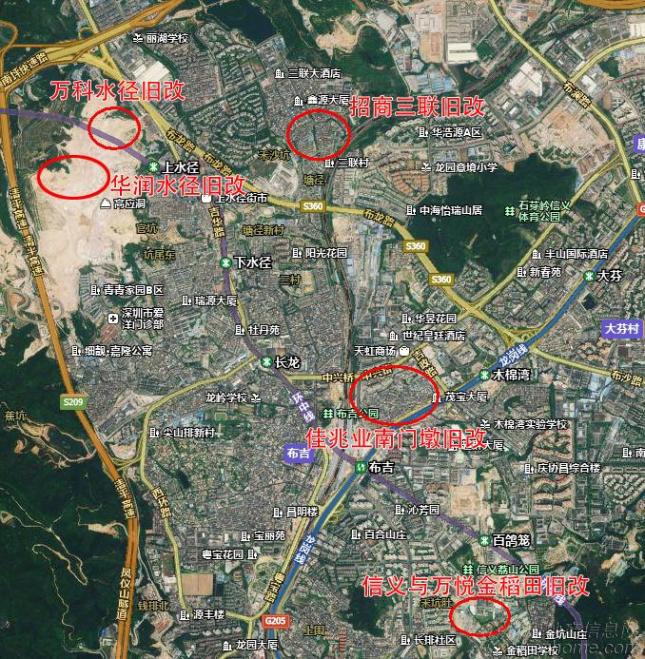
4 renovationsin buji

old trees

It’s true, there’s a category of cultural relic known as “old tree (古树)”. These old trees root the community in histories that stretch back to the late Ming Dynasty (early 1600s). Moreover, their beautiful limbs create poetic interludes throughout the remnants of Shenzhen’s old village homesteads. Buildings may decay through lack of care, but the trees grow despite threat of urban renewal.

This slideshow requires JavaScript.

the difficulty of representing shenzhen’s urban “villages”

Talking about Shenzhen’s urban villages is difficult because legally they are not villages, but “communities (社区)” that have been integrated into the urban state apparatus. Moreover, depending on their location, these neighborhoods have different social functions — slums, gateway communities, and affordable housing for both the working poor and recent college graduates.

Mark Leung‘s photo essay,  Welcome to Wuwucun, a Village in the City offers a detailed and sympathetic look at life in Wuwucun, a Shenzhen urban village and is well worth checking out. However, the images beg contextualization, illustrating the difficulty of interpreting images  in the absence of historical knowledge. Is Wuwucun poor? Are these villagers? Is manufacturing a good thing?  On the one hand, a shorter version of the same essay, for example, explained that these images showed how manufacturing in Shenzhen was providing small steps forward to improve the lives of China’s rural millions. On the other hand, these images depict one of the more peripheral villages in Shenzhen, where the level of poverty depicted justifies ongoing campaigns to raze working class neighborhoods in other parts of the city. In other words, these images can be used either to show that industrial manufacturing in Shenzhen has been good for the country or to justify the Municipality’s ongoing program of razing urban villages in the inner districts. Continue reading

Focus on China: Fat Bird on experimental performance

Mary Mazzilli interviews Yang Qian and me about work with Fat Bird. Focus on China: Fat Bird on experimental performance (1/2).

luohu culture park: the antidote to mall-burbia

DSCI0079 I prefer early Shenzhen urban planning to the rush to mall-burbia that is the current trend. Early planning assumed small scale, low cost urban living that promoted street life. In contrast, mall-burban developments raze central areas of the city to build large scale, high cost gated communities and attached mall, where security guards keep out the riff raff, effectively suburbanizing densely populated urban areas.

Luohu Culture Park (罗湖文化公园) exemplifies the latent urbanity of early Shenzhen planning. The 2,000 sq meter park includes underutilized cultural infrastructure, a lake, and my favorite kind of public art — a sculpture that children can easily appropriate. Continue reading

more community websites

Shenzhen long since gave up on “neighborhoods (居委会)” and “villages (村)”. Instead, the ruralized urban hybrids that the SEZ has spawned are legally known as “communities (社区)”. Note du jour is simply to point out that many of the sites connect landlords and renters. Soufun or “Search for a house” web, has sites that not only include rental information, but also track real estate prices. Guloucun — literally Old Lou Village Community (古楼村小区网) and Tianmiancun or Tianmian Village Community (田面村小区网), for example.

However, some community websites are more community oriented, in addition to providing a commercial forum. For the curious, checkout these community websites:

Shangsha and Xiasha Community Website (上下沙社区网)

Baishizhou Community Website (白石洲社区网)

as shenzhen razes: the baishizhou urban renewal plan online

Shenzhen developer, Lvgem Group (绿景集团) has uploaded a video of the Urban Renewal Plan for the Five Shahe Villages in Baishizhou (白石洲沙河五村旧改专项规划).

Wow. Just wow. And not in the good way.

The current built environment of roughly 580,000 square meters will increase 10-fold, to 5.5 million square meters.

The argument for razing the current settlement and replacing it with high, high rises and skyscrapers is that Baishizhou villagers live in grungy unpleasant conditions that need to be upgraded. The proposed solution is for the developers will work with villagers in order to bring them into the urbanization process.

In a nutshell,  the problem is that the video conflates the idea of “villagers” with the ruralized current residents of Baishizhou. There will be a resettlement area for “villagers”, but who counts as a villager? The actual population of Baishizhou is over 140,000, of which 120,000 do not have Shenzhen hukou. So, inquiring minds want to know: is the plan calling for ten times the space to house the 20,000 residents who do have hukou? Or does “villager” only refer to the actual members of the five villages, which means we’re talking about less than 2,000 people with resettlement rights. And if that’s the case, who will live in all this new, upgraded, hyper-modern space after the current residents have been forced to leave?

A quick visit to 58 net reveals how cheap housing in Baishizhou is relative to the surrounding area. In fact, many young office workers and professionals from neighboring Science and Technology Park (科技园) also live in Baishizhou as to designers and creative talents who work in the OCT Loft. Providing this class with livable (宜居) housing is an ongoing Shenzhen concern. Indeed, there is now an official plaque for hanging on a rental building which confirms a building’s livability.

It is estimated that over half Shenzhen’s population live in the villages, which account for roughly 10% of the area’s land. Arguably, the villages are the city, while high end housing estates and neighborhoods might be thought as wealthy suburbs, with lovely gardens and huge tracks of private spaces. Consequently, the question of who actually belongs to an “urban village” is the social, political, economic question because as Jonathan Bach has argued, the villages have been the incubators where (some of) Shenzhen’s migrant workers transform themselves into urbanites and potentially citizens.

As Shenzhen razes. Stay tuned.

xiasha plaza

This afternoon, I sat in Xiasha Plaza watching children and their caretakers. The plaza is vast and the people hug the edges, chatting in the shade. The coi pond is particularly popular.

This slideshow requires JavaScript.

on strike in longgang

According to molihua dot org, 4,000 workers at the Zhongda Printing Factory went on strike on January 10, 2013 to protest the factory’s decision to discount all years of service. Years of service are essential to calculating pensions, with this decision, workers lost all accumulated time and benefits. Moreover, the company offered no compensation for the decision.The justification given was that the factory will be changing its name and so previous time will not be credited to the “new” company.

Today, the Epoch Times followed up this story with a report that the police had entered into the conflict, preventing striking workers from marching outside the compound.Video interviews, here.

The Shenzhen Police Department’s decision to prevent the protestors from marching to the Henggang government is simple: Zhongda’s decision to unfairly deny workers accumulated time and benefits does not seem to be an isolated case. On January 2, 2013, 3,000 workers at the Chongguang Electronics factory in Shajing struck for the same reason. According to the report, On January 10, they marched on the Shajing government to protest.

The Zhongda Printing factory is owned and operated by the Neway Group Holdings Ltd, a Hong Kong firm (香港中星集团).

bureaucratic nomenclature

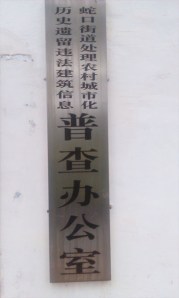
bureaucracySeriously. There is a Shekou office called the Shekou Subdistrict Census Office for Information on the Handling of Illegal Buildings Leftover from  the History of Rural Urbanization. But the signage is well balanced. And think of the cocktail party conversations this business card could spark!