what is the price of a human life?

If my friends are to be believed, doctors occupy the same hated position in China that lawyers occupy in the United States; they are the white-collar workers who represent all that is wrong with the system.

Indeed, the similarities between stereotypes are striking: Chinese doctors are said to be only working for money; if you go to a public doctor, you can expect substandard care, and; the purpose of medicine is to keep you in the system, paying for unnecessary tests and medicines. Good doctors are few; they work against a system that is stacked against them, and the common people suffer for the greed of the majority of bad doctors. Similarly, not a few Americans hold the same ideas, albeit about lawyers. Private attorneys are only in it for the money; if you have a public attorney you can expect to lose your case, and; the purpose of legal advice is to keep you in the system, paying for unnecessary hours and court appearance. Good lawyers are few; they work against a system that is stacked against them, and the common people suffer for the greed of the majority of bad doctors.

Not unsurprisingly, there are all sorts of Chinese doctor shows — both for entertainment and self-help, just as there all sorts of US American lawyer shows and call-in programs. A popular trope in both countries is the renegade who addresses the injustice of the system, dispensing healthcare and legal aid without thought for his or her personal gain. In these shows, lives are at stake and doctors and lawyers save the day in happy endings and loose the day in tragedies. Likewise, an assortment of hacks lurk in these programs and take advantage of unsuspecting or desperate folk, who have nowhere else to turn. Moreover,there is generally an implied moral entitlement: good characters should receive top medical care in China or the very best representation (in the US).

Interestingly, the contempt that common Chinese and ordinary Americans feel for their doctors and lawyers, respectively, is directly related to the fact that (unlike other white-collar workers), doctors and lawyers represent the highest political values in their country. The purpose of government in China, for example, is to provide for the wellbeing of the population. This care includes healthy food, affordable homes, and timely medical care. Indeed, it is remarkable the outrage and press coverage that these three issues consistently generate in the Chinese press, online, and now through weixin (Tencent’s We Chat app).  In the US, we hold our government accountable to protect our rights, both from each other and against corporations. In China, doctors are the last line of defence in securing wellbeing. Likewise, in the US, we turn to lawyers to secure our rights. And yes, those who break the law and get away with it repeatedly show up in the headlines, while taking on the legal system and calls for particular uses there of can turn mere pundits into talk show personalities and ordinary people into national heroes.

Speculation du jour: Chinese doctors and US American lawyers have been cast as villians and heroes in national dramas because neither system is providing the “good life” for its people. In China, wellbeing is the highest value and doctors exist to maintain this wellbeing. In the US, fairness is the highest value and lawyers exist to ensure a level playing field. However, in both countries, those in most need of healthcare or legal aid are most likely not to receive it. Moreover, Chinese doctors often can’t provide adequete healthcare without bankrupting patients, just as UA lawyers can’t provide decent representation without bankrupting clients. In both cases, systemic breakdowns break ordinary lives. Nevertheless, public anger has not (yet) led for widespread calls to change either the Chinese or American systems, but rather nasty jokes about and threats against doctors and lawyers, respectively.

Sigh.

as if it never happened…

So, after a long silence, I return to The Great Transformation (沧海桑田:深圳村庄30年) and the ongoing composition of an official history for Shenzhen’s villages.

This official history begins with poetry. Located on Shenzhen Bay coastline, Shazui Village was established over 900 years ago. Villagers were surnamed Ou and their ancestors immigrated from Pingyang, Shaanxi via Shaoguan in northern Guangdong. At first, Shazui specialized in harvesting sea salt. However, over time the water became sweeter and it was no longer possible to making a living harvesting sea salt. According to Shazui oral history, village ancestors then started fishing and expanded village holdings inland, planting lychee orchards and rice paddies. The village’s history was recorded in poetry and couplets that villagers transmitted orally. For example, a seven-line poem that traced the history of the migration guaranteed hospitality between communities that shared the Ou surname.

金陵被乱始南辕    Chaos during the Jinling era forced the southern migration

唯有祯昌百代传    Only luck has been inherited by a hundred generations

一举汀州二细滘    The first stop was Dingzhou, the second Xijiao

三子石壁四陈村    The third stop was Shibi, the forth Chen Village

自从棉圃而交广    Leaving northern cotton fields, they entered Guangdong

世起堂梁厉宗元    The ancestor re-established the family

支派不拘分欠别    And new branches were established

明溪桥内祖根源    The ancestral well is by the Ming Creek bridge

In 1943, over 40 of Shazui’s less than 400 villagers died during a drought. This history was recorded in the following verse, “Thousands remember, ten thousands remember that in the 33rd year of the Nationalist era, a dollar bought 10 grams of rice (千记万记,记得民国三十三,一元买米三钱二).”

Subsequently, the official history of the transformation from socialist to capitalist collective begins with creative appropriation of the household responsibility system. In 1978, Shazui took advantage of easing policies to introduce a hybrid form of collective production, selling surplus vegetables and fish both in Shenzhen and in Hong Kong. One person from each family could join a voluntary association of 10 people. Each group gave 100,000 rmb to the collective, and then divided the profits amongst association members. Leaders were not permitted to join an association, however, any laborer could join an association. Within five years, many Shazui villagers had become rich and by 1983, Shazui villagers had put up new homes on their 30 m2 Mao-era plats. The villagers then decided to plan Shazui New Village, putting up handshakes as well as collective property, including factories.

Building the factories further transformed village organization, as the village secretly formed a limited stock-holding company. In 1984, Shazui leaders asked each villager to invest 10,000 into the factory zone. At first, villagers refused and leaders hoped to borrow 5 million from a bank. However, at the time, banking restrictions were strict and villages did not have an opportunity to secure finance capital. Instead, village leaders went back to the village with the following proposal: each villager would invest 10,000. Over the next three years, the village could use this capital to grow its industry. Beginning in the 4th year, the village organization and village investors would split profits 40-60. In the eleventh year of operation, the percentage would reverse, with the collective receiving 60% of the profits and villagers sharing 40%. At the end of this second decade, all profits from the collective enterprise would go to the village.

As of 1985, the new village occupied an area of 6.3 km2 and had earned commendations from Shenzhen Party Secretary and Mayor, Liang Xiang. Many villagers secured plats (宅基地) of 300 m2, three times larger than the area that would be formally recognized by the Shenzhen Government in later years. Moreover, the village also had to put in roads that would be wide enough to connect the village factories to cross-border shipping points at Wenjingdu. Indeed, although Shazui was only five kilometers from the Luohu border, until the new roads were laid, it took one hour to travel from Shazui to the Luohu. And this is where the official story ends until it jumps twenty years to a village cleanup and environmental upgrade.

What happened during the twenty years that the official story skips? In the years between 1985 well into the new millennium, Shazui went from being an enterprising village to Shenzhen’s most infamous second wife village. Village investment in planning and construction meant that relative to the surrounding area, Shazui New Village was a cheap, convenient, and comfortable place to live. Investors and visitors took up residence in Shazui and villagers opened restaurants, discos and bars. By the early 1990s, the collective was itself promoting the shift to a sex-based economy building hotels, restaurants, rental properties, and spas. This history cumulated with the infamous public shaming of Shazui prostitutes in 2008.

And there’s the rub: if we are to talk about the transformation of Shenzhen’s villages from poor rural settlements into neighborhoods for the working poor, we aren’t actually talking about what the villagers alone were up to. We’re actually writing the history of global capitalism and its rebranding by ambitious governments. Suddenly, Shenzhen’s villages become the quintessential rags to riches story. Or to quote Mark Ravenhill’s observation in Shopping and Fucking: Making money is barbarous, but having money is civilization.

…a village by any other name…

Huaxin Village is not a village. Located at the intersection of Huaqiang and Hongli Roads, Huaxin was one of the earliest residential areas built in Shenzhen. It boasted 30 lowrise apartment buildings, a business office, and an office for neighborhood offices. In total, the neighborhood had 1007 homes. Walking west, the neigborhood abutted Fuhua Village and then opened into the northern section of Shenzhen’s Central Park.

To walk this area is to get a sense of the excitement and utopian discourse that permeated early Shenzhen. Huaxin literally means “China New (华新)”, Fuhua means “Prosperous China (福华)”, and Huaqiang means “China Strong (华强)”. Moreover, in the 1980s, the area north of Hongli Road was considered suburban with respect to the Dongmen and Luohu areas near the train station. Consequently, planning in this area primarily included factories and residential neighborhoods, such as Huaxin.

The layout of Huaxin  illustrates early understandings of public space and semi-public spaces. In addition to a public garden, the residential area also had a soccer field and areas for sitting and chatting. Moreover, along walkways, designers had included planters. When Huaxin housed the young SEZ’s managerial class, the ornamentals filled the planters. Over the past decade, the value of the housing stock has declined, even as property values have increased dramatically leading to a typical “urban village” phenomena: the owners have moved out and rented their homes to working families. In turn, these farmer-migrants have converted the planters to urban vegetable gardens, while first floor homes have been repurposed as shops.

Despite the value of the land, it’s not easy to raze rennovate these old, centrally located neighborhoods because the housing belongs to old Shenzheners, who — again like local villagers — are in negotiation with developers and the city to transfer the property rights. Again, compensation buy-outs are figured by square meter of housing. As early as April 15, 2009 — almost four years ago — there was news that Huaxin would be razed and the area upgraded. By 2011, DZT had published a feasibility study of how to upgrade the area inline with its position next to Shenzhen’s large electronics market, Huaqiangbei.

Of note du jour, in order to make these plans profitable, the new plans cannot include the same amount of space for urban gardening and semi-public gathering. Impressions of yesterdays walk from China Strong through China New past Prosperous China and into the northern section of Central Park, from where skyline views suggest the contours of thirty years of architectural and urban planning.

This slideshow requires JavaScript.

the shenzhen gospel

Swedish missionary, Theodore Hamberg arrived in Hong Kong on March 19, 1846. The following year, he joined what became known as the Basel Mission, focusing on converting Hakka communities to Christianity. Indeed, Hamberg was the first to draft a dictionary of Hakka into a western language. Hamberg died in Hong Kong in 1854, however, his efforts to bring the gospel to Hakka people prospered. Located in Langkou Village, Dalang Street, Bao’an District, Shenzhen — and yes, I do enjoy the dense specificity of Chinese place names — the Langkou Gospel Hall (or Church) was built twenty years after Hamberg first arrived in 1866.

The first pastor of the Langkou Gospel Hall was Charles Piton, who served the congregation from 1866 through 1884. The next few years, there was no foreign pastor at the Church. However, in 1891, the German missionary 骆润滋 (and if you know his Western name, please let me know) came to Langkou from the Hong Kong Mission. That same year, the mission also established the “Devout and Chaste” Girls School (虔贞学校), moving from Hong Kong further inland.

During the Mao era, the church and school buildings were used as schools and administrative centers. In 1984, the central government allowed for religious services and the Langkou Gospel Hall reopened as a church. In 2003, the community broke ground to build a new church on neighboring land. The school building was used until 1986 and then abandoned to squatters until recently, when the Dalang Street government decided to restore the school and church as historic buildings. Presumably construction will begin in several months and early next year, the school and former Gospel Hall will reopen as public cultural centers. The Church will continue its mission, including exhibitions that document the history of Christianity in Guangdong generally, but amongst Hakka communities specifically.

Below, impressions of a visit to pre-restored Devout and Chaste Girls School and Langkou Gospel Hall, which is currently occupied by a migrant worker family, who earn their living doing piecework for a nearby factory.

This slideshow requires JavaScript.

walls and sun

Today I walked the OCT Eastern Group buildings between meetings.

This slideshow requires JavaScript.


milk theory

Recent limitations on the quantity of milk powder that Chinese citizens can purchase in Hong Kong and bring back to Shenzhen have given rise to “milk theory”. As with the satiric pronounciations of China in the previous post, the humor of milk theory turns on a pun. Here 奶 can mean wife, mother, milk, or breasts, depending on context.

Milk Theory:

1)      Second wives can be found anywhere, but you can only bring two cans of powdered milk. 2) The meaning of one country two systems, is one country two breasts.  The greastest distance in the world is between the child one holds and the milk powder on the other coast. 3) You have high quality milk powder, we have high quality second wives. The quality of milk powder is in inverse proportion to the number of second wives. 4) Previously, we knew it was against the law to carry white powder, but only recently have we found out its also against the law to carry milk powder. 5) Milk, is a problem the government can’t solve; housing is another problem the government can’t solve. However, the government does have the means to deal with dairies [rufang also puns with a woman’s chest]. 6. Those who created poisonous milk powder never did jail time. Those who sold poisonous milk powder never did jail time. But people who bought safe milk powder are going to jail.

奶论

1)  二奶到处可以找,奶粉只能带二罐。2)一国两制的意思,就是一国两奶。这个世界最远的距离,使孩子在怀里,奶粉却在对岸。3)你有优质奶粉,我有优质二奶。奶粉的质量,跟二奶的数量成反比。4)以前知道带白粉犯法,现在才知带奶粉也犯法。5)乳,是政府解决不了的问题;房,更是政府解决不了的问题。至于乳房,政府官员有办法解决。6)做毒奶粉的不坐牢,卖毒奶粉的不坐牢,买无毒奶粉的却坐牢。

the view from the top, circa 1997

The 69th floor observatory of the Diwang Building remains an important tourist destination, albeit something of a time capsule.

The Diwang building was completed in time to celebrate the Return of Hong Kong to Chinese sovereignty. The 69th floor observatory includes a museum that commemorates Shenzhen’s history from 1980 through 1997, a kitchy “Lan Kwai Fang” bar street, and observation maps that date from 1997. The key exhibit is a wax figure installation of Deng Xiaoping and Margaret Thatcher’s iconic 1984 meeting. The installation symbolizes the ideological function of Shenzhen circa 1997 — the buffer zone between Beijing and Hong Kong, which enabled the PRC to push forward its “one country, two systems” policy.

The juxtaposition of Shenzhen then and now resonates precisely because the interior design of the museum hasn’t changed since 1997. In fact, all one has to do is look at one of the maps and compare it to the view from the observation platform to remember that in 1997 Diwang precipitated the city’s glass and steel makeover. Notably absent from the 1997 maps — the civic center, the kk 100 building, and the Binhai Expressway and Northern Loop. Obviously present in the 1997 maps — the extent to which the construction of border town urban villages such as Caiwuwei, Dengba, and Hubei had shaped urban possibility in Shenzhen . Moreover, in the 1997 images, Buji and the second line seem distant, far far away from the booming border region. Nevertheless, villages still show up in the images below — the relatively dark patches are urban villages, including the remains of Caiwuwei after the construction of the KK 100.

Visiting the museum and observatory costs 80 rmb a ticket and if memory serves (because sometimes it doesn’t), fifteen years ago the price of admission was 80 rmb.

This slideshow requires JavaScript.

shangbu

One of Shenzhen’s first administrative zones (管理区) and former commune, Shangbu (上步) disappeared from the Municipality’s administrative nomenclature during the restructuring of 1990. Nevertheless, architectural traces remain, even as the Nanyuan New Village and Badeng New Village handshakes have been creatively upgraded. Shenzhen’s Minority Work Team  is also located in the area, reminding us of the diversity of Shenzhen’d migrant population.

This slideshow requires JavaScript.

the shape of space: buji village #1

In the urban villages around the Old Buji Market (布吉墟), alleys and narrow roads wind upward, accomodating dense settlement and inadvertant public spaces. The most notable feature of the space is the proliferation of walls and determined privatization of small plots, or homesteads (宅基地). The isolating spatial organization of Buji reflects what urban planners disparagingly call “small farmer mentality (小农民意识)”. In practice, this means only investing in one’s own home, and minimal investment in public spaces and programs. Obviously, not only farmers have this mentality.  The Shenzhen Dream entails homeownership, while Tea Party populism represents one version of the US American  urge to privatize land and resources. However, the term “small farmer mentality” is usually a pretext for urban renewal programs that involve razing neighborhoods where the working poor live and replacing them with mall-burban settlements, where only the upper middle class can buy into the dream. Spaces like a Buji urban village  illustrate one of the key conundrums facing not only Shenzhen, but cities everywhere — creating livable neighborhoods for the working poor, rather than leaving urbanization in the hands of privatizing opportunists, whether they be individual farmers or employees of an urban planning board.

This slideshow requires JavaScript.

scale of gentrification, buji

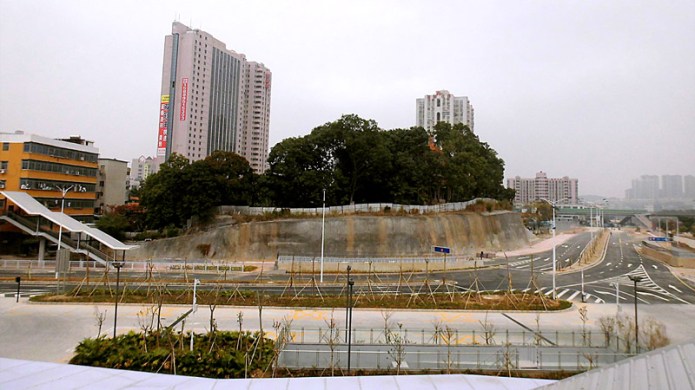
Gentrification in Shenzhen not only means displacing the working poor, but also rescaling the city. In Buji, the process has just begun and thus the palatable violence of this transformation is more visible than it is in the inner districts, where neoliberal environments have a more polished veneer. The images below highlight the extent to which the construction of massive public infrastructure effectively isolates neighborhoods and privileges car-owners.

This slideshow requires JavaScript.