audience passivity in the yan’an talks

As preparations for the Bienalle start, I have found myself thinking again about the level of censorship over literature and art in China. Yesterday, I even went so far as to re-read the Talks at the Yan’an Forum on Literature and Art (在延安文藝座談會上的講話), which Mao began on May 2, 1942. Audience passivity and the ignorance of artists and writers were two key ideological assumptions structuring Mao’s arguments about the social functions of literature and art. Below, I have taken several key phrases in order to show the way in which the Maoist politicization of literature and art was concomitantly a disempowerment of the audience or reader of a work, even as artists and writers became tools — and I use the word deliberately — of the Revolution Party.

Mao opens the talks by greeting his comrades and outlining the social-aesthetic questions he sees facing revolutionaries: the question of standpoint, the question of attitude, and the question of the object of work. Mao’s interpretation of correct standpoint and attitude are unsurprising and straight-forward. The question of correct standpoint for Party members was unambiguously defined as being the Party’s position (對於共產黨員來說,也就是要站在黨的立場,站在黨性和黨的政策的立場). The question of correct attitude was then defined with respect to three types of people — enemies, allies, and one’s own people (有三種人,一種是敵人,一種是統一戰線中的同盟者,一種是自己人). The emphasis on “one’s own people” is important because in everyday Chinese, these are the people that one can count on no matter what. Mao then further defines “one’s own people” as the masses and their vanguard (這第三種人就是人民群眾及其先鋒隊). In short, on Mao’s reading, a correct attitude involved opposing one’s enemy, criticizing one’s allies when they were wrong, and “patiently teaching one’s own people, helping them with their burdens, and to struggle with their mistaken views in order to help them make great progress (我們應該長期地耐心地教育他們,幫助他們擺脫背上的包袱,同自己的缺點錯誤作鬥爭,使他們能夠大踏步地前進).” In turn, “our” literary and artistic works describe these struggles to overcome one’s mistaken views (他們在鬥爭中已經改造或正在改造自己,我們的文藝應該描寫他們的這個改造過程). However, when Mao turns to the long discussion of “the object of work” the discussion becomes interestingly convoluted.

The discussion opens with the line, “the question of the object of work, that is the question of who the literary work will be read/seen by (工作物件問題,就是文藝作品給誰看的問題)”. As I read it, the Mandarin defines the intended audience of revolutionary works as objects (物件) who will be given something to read/see (給誰看). In many translations of the Talks, this line is translated as, “The problem of audience, i.e., the people for whom our works of literature and art are produced”. This translation not only transforms the object of literary and artistic creativity into an “audience”, but also gives the writer and artist productive agency. However, neither of these subjectivities is implied in Mao’s language, a fact which becomes more explicit several lines later.

On the one hand, Mao contends that in Yan’an, the objects of literary and artistic work are the workers, peasants, soldiers, and cadres who are the “receivers of literary and artistic work (文藝作品的接受者)”. He emphasizes that the objects of literary and artist work in Yan’an were “completely different (完全不同)” from those in Nationalist-held Shanghai, where the primary objects were students, officials, and merchants.

On the other hand, he also stresses that “our literary and artistic workers (我們的文藝工作者)” who don’t understand the workers, peasants, soldiers, and cadres have a responsibility to learn about them. One of the more interesting examples of Mao’s designation of the object of literary and artistic work comes in this discussion of literary and artistic workers’ ignorance of the lives of workers, peasants, soldiers, and cadres. Mao states, “Literary and artistic works are not familar with the their descriptive object and product-receivers (文藝工作者同自己的描寫物件和作品接受者不熟,或者簡直生疏得很)”. In this line, we see that for Mao, “workers, peasents, soldiers, and cadres” were simultaneously the object of and receiver of descriptions. In other words, the purpose of literary and artistic work was to help the masses become self-conscious of their class position, without actually teaching them critical reading skills.

The discussion then turns to the question of education for both literary and artistic workers as well as for the masses, with the Party providing correct standpoints and attitudes for this work, which is based on Marxist-Leninism. At this moment, we see the rhetorical transformation of creative workers into tools of the State because standpoint and attitude have already been defined as being in line with the Party position.

Thought du jour: as someone who engages in literary and artistic work, I agree with Mao’s contention that many of our ideals and passions are class-determined. Where I part ways with his analysis, however, is in his characterization of audiences as passive object – receivers of creative work and writers and artists as vehicles for one standpoint and attitude on any question. It’s not only that I enjoy a good dose of whimsy in my art, but also that I have more faith in a variety of standpoints and attitudes than I do in one proscribed, formulaic interpretation there of. Indeed, I find the idea that all creative work must be immediately accessible to all audiences more in keeping with Hollywood goals than with creative exploration.

And there in lies a core paradox in doing creative work in Shenzhen: while I agree with Maoist analysis that we need to take economic inequality and class differences into account if we are to create a more just world, nevertheless, as both a writer and reader, I am nourished by a diversity of perspectives and interpretations.
what is the party’s benevolence?

In news broadcasts and interviews, old peasents frequently evoke “the Party’s benevolence (党恩)” to explain their lives. Young and hip urbanites hear these interviews as more evidence that old peasents are the dupes of corrupt officials. However, when I take the time to listen to an old peasent’s life history, it’s clear that more often than not, these peasents did benefit from the establishment of the People’s Republic.

Yesterday afternoon at the Dalang Culture Center, for example, I helped conducted interviews with Uncle Chen and Aunt Zhang for an oral history project. Both Uncle Chen and Aunt Zhang were both born into peasant families in 1930 and 1940, respectively. Auntie’s family owned three single-story houses, while Uncle had left home early because his family did not have room for him. Auntie mentioned that at the turn of the last century, her grandparents went to Singapore to work. Her mother was “brought home” as a child bride for her father. In contrast, Uncle did not mention his family except when asked about how poor his family had been, he remarked that two of his sisters had been sold to strangers, but where they ended up was unclear.

As a poor man, Uncle could not afford to marry. Instead, he went to find work in Hong Kong. In 1951, Uncle became sick and returned to his hometown, where he could recieve care. In 1952, although he had a sporadic education, Uncle was able to secure the documents necessary to join the first test for admission to the Bao’an Normal School. He passed the test and was admitted to an elementary school teachers program, which was located in the Nantou High School building. Teacher Chen emphasized the extent to which his current wellbeing was a result of the Party’s benevolence. He was assigned to teach at Langkou Elementary School, where he met Auntie.

As a young girl, Auntie stayed at home and helped her parents. However, when she was 10 years old, Auntie began attending Langkou elementary school because her father asked the school principal to allow her to bring her brother. 10 year-old Auntie strapped her brother to her back and attended classes. At lunch time she fed her brother a bottle of condensed milk that had been thinned with water. Several years later, she carried her sister to school. Altogether, Auntie carried her siblings for six years. At the end of elementary school, Auntie tested into middle school, where she studied elementary education. Auntie emphasized that her teachers like her because she was a good student. Moreover, her younger siblings were well-behaved and didn’t cry during classtime.

After Auntie graduated from middle school, she married Uncle, who was still teaching at the village school. Auntie’s mother exhorted her to marrie Uncle because he “could do anything”. Uncle could not give Auntie any presents for the marriage. However, he did have housing at the elementary school, where Auntie was also hired to teach first and third grade. The school was located near Auntie’s parents’ house. Auntie did not attribute any of her life history to the Party’s benevolence, but rather emphasized her family background and her mother’s words.

Implicit in Uncle and Auntie’s simple story were the gendered contours of rural poverty in South China, where one of the most important events of a lifetime was to continue family lines through marriage and children. Uncle and Aunt were born into South Chinese villages, where bringing in wives or selling out daughters was a common practice before 1949. However, they married 10 years after the establishment of the People’s Republic, when some policies had already restructured traditional social structures. Auntie married because her family could afford to give her an education, but not to keep her at home. In contrast, Uncle had delayed marriage until he could afford a family, which was a direct result of attending teaching school. He described that opportunity — and all that followed, a job, a house, and eventually a wife and children — as an expression of the Party’s benevolence.

2013 gaokao update

I find the gaokao process daunting: so many rounds of admissions, so many different variables — including hometown and quota requirements — to consider, so many practice tests and, in the end, so few points difference between students.

That said, the gaokao season began with registration (Dec 1-10, 2012), testing to estimate admission baselines, and has just completed mock exams (April 2-20). The mock exams give students, parents, and teachers an estimate of likely test scores, which can be compared to historic results in order to decide on which program to apply. We have entered the final phase of test preparation, during which time students take tests and refine their baseline estimates. On June 7 and 8. 36,633 students will sit for the exams in Shenzhen, unless, of course they have an abnormal pre-exam medical check-up. Students with physical ailments will be permited to take make-up exams on June 17-18.

edgy map

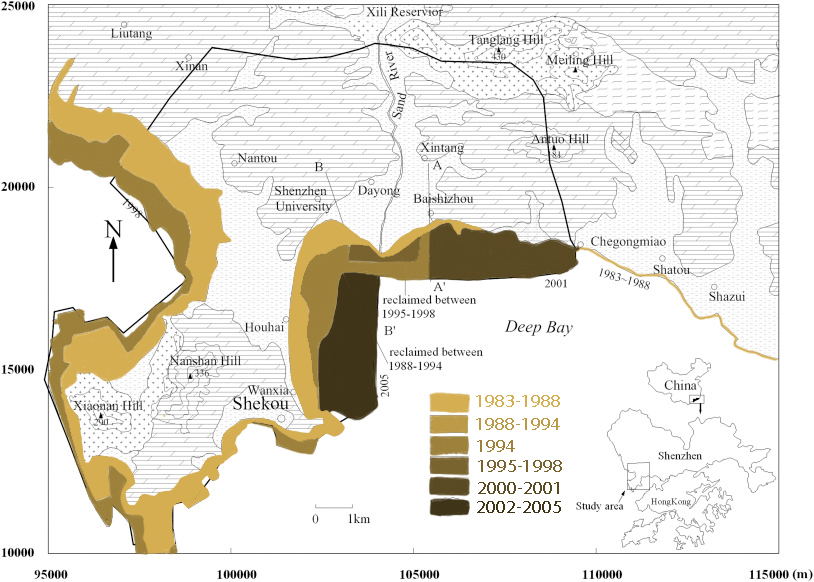
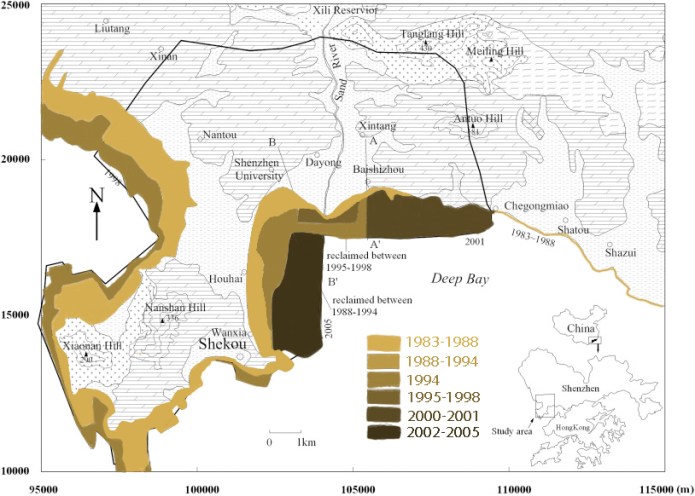
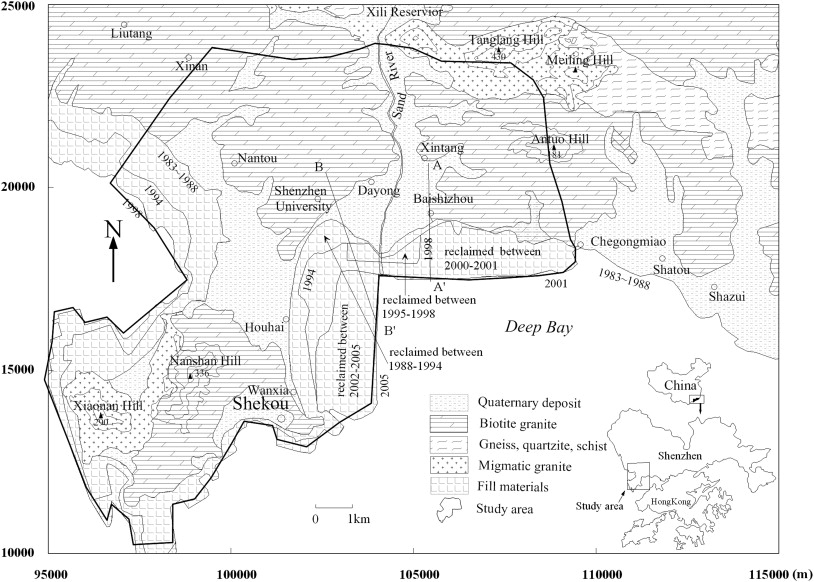
Ryoyu Kido sent me the link to Modeling the influences of land reclamation on groundwater systems: A case study in Shekou peninsula, Shenzhen, China, which includes a map of land reclamation around the Nantou Peninsula, 1983-2005:

shenzhen land reclamation

I colored in the boundaries to give a sense of the progression of land reclamation in in the Qianhai and Houhai areas of the Peninsula:

shenzhen land reclamation-mao

The tags land reclamation and Shekou bring much of this change into cultural perspective.

another park, this time in dongmen

Went for a ride with Sarah.

This slideshow requires JavaScript.

mapping the southern block, hubei old village

Students of Hong Kong artist, Momo Leung Meiping created a series of interventions in Old Hubei Village. Projects included making pillows out of old clothing, poetry painted onto the walls, a balloon release, an exhibition of portraits, planters made out of old bricks, and a map of the area with renamed streets. We followed their tracks and discovered the joy public art can bring.

This slideshow requires JavaScript.

more on smog

Previously, sections of the Municipality had reported dangerous levels of carbon diaoxide, but on April 15, 2013 and for the first time in its history, Shenzhen recorded dangerous levels of air pollution in every part of the city.

Shenzhen is not alone in its unhealthy rush to a narrowly defined standard of wealth. Indeed, concern in Shenzhen follows upon the outrageous levels of pollution that were reported in Beijing. But as David Roberts reminds us, this level of pollution is just one example of a worldwide trend:

The Economics of Ecosystems and Biodiversity (TEEB) program sponsored by United Nations Environmental Program asked environmental consultancy, Trucost to tally up the total “unpriced natural capital” consumed by the world’s top industrial sectors. (“Natural capital” refers to ecological materials and services like, say, clean water or a stable atmosphere; “unpriced” means that businesses don’t pay to consume them.) …The biggest single environmental cost? Greenhouse gases from coal burning in China. The fifth biggest? Greenhouse gases from coal burning in North America.

Moreover, our respective industrial sectors thrive on coal:

unep-top-five-industrial-sectors-by-environmental-impactsjpg

I feel like I parrot myself at every opportunity: the United States and China are the same country. Really. The similarities are of kind, while our differences are merely of scale. And so the question remains: how do we fix shared problems, rather than getting settling for the politics of blame?

click this

The internet confuses us into thinking that everything we need to know can be found in one place, such as the Shenzhen Life Net (深圳生活王), where all sorts of information and experiences are just a click away. Questions about public welfare? Click 社保. Want to watch whatever is currently being broadcast on Shenzhen’s television 16 television channels? Click 电视. You can also find out about traffic conditions, confirm important dates on the lunar calendar almanac, and figure out how much tax you owe: click, click, and click!

In fact, Shenzhen’s ongoing efforts to modernize by becoming one of the most inter-connected cities on the planet continue to fill virtual space with all sorts of information. The government is online. The library is online. The museum is online. And the historical archives are online. Moreover, Tencent, one of the key Chinese companies inter-connecting us through qq and we chat is a Shenzhen company.

At the same time that Shenzhen builds its virtual world, China’s great firewall continues to make it difficult to click to the New York Times, or Facebook, or Youtube without a tunnel. Ineed, just the other day, China banned its media from quoting foreign news articles without permission. In this sense, Shenzhen’s vast internet culture is itself the form of a pervasive inequality and the ideological expression of this inequality. The point as Global Voices co-founder and author of Consent of the Networked, Rebecca McKinnon has argued:

A substantial body of previous work has been produced over the past two decades on human rights risks in sectors such as extractives or labor services. Much less work has been done on business and human rights in the ICT sector – particularly on free expression and privacy rights. The novelty of the technology requires a translation exercise of existing human rights principles, policy, and law to ICT platforms and services.

In practical terms, however, surfing the internet often seems less about human connection and building more just worlds (as in the human writes discussion) as it does a question of our tendency to mental addictions. On the bus and subway, in meetings and movie theaters, we click, click, click through life. There is a compelling distraction to click culture. At times, I find myself simply clicking to visit sites that I have just left. I click away not because I think I may discover another post, but because the repetive action distracts me from the fact that all I’m doing is procastinating. I have have found myself fascinated by the number of visitors and clicks that Noted receives; confirmation that I have an audience. So pernicious is my click addiction that sometimes I even confuse the number of clicks with the value of my research.

I also am wondering how much of my online dependency is an expression of other forms of alienation in everyday life. My friends, for example, work long hours across town. It is difficult to arrange time together simply to hang out and chat without internet access. Likewise, the extent of urbanization in Shenzhen means that I can’t simply walk outside and enjoy fresh air and mountains. Instead, I have to navigate a six-lane road to jump on a bus, which then trundles off toward a central hub. In other words, I’m not sure how much of my online life is an attempt to heal virtually problems that can only be solved through realworld communities and life changes.

So today, I’m thinking about questions of scale and what manageable communities might look like, on the ground, here in Shenzhen, where popoulation density is over 5,500 per square kilometer and we still haven’t figured out how to plan and manage integrated communities.

life is elsewhere

These past few days back in Shenzhen, I have had several conversations about the fact that so many Chinese families are sending their children abroad to study. Moreover, since the point is to get the children out of China, the consensus seems to be, the sooner the children leave, the better and so more and more families are sending their only children to boarding schools.

The reasons are many — better education, better job opportunities, better environment, healthier food, more access to information — but all boil down to the perception that life is better in the United States than it is in China. This is also a sentiment I’ve heard from thoughtful American friends, who are frustrated by the lack of public accountability and trust in public projects (mostly overbuilding for profit) in both Shenzhen and the interior.

By sending their children abroad, friends and colleagues make a clear statement about their confidence in Shenzhen’s future. The situation has me wondering whether or not it is wise to remain in China. What’s more, these doubts seem more pervasive than previously. Cetainly it’s ironic that just as Shenzhen seems to have made the international headlines, the elite — both economic and academic — are opting out of the Shenzhen dream.

cold war ghosts in shenkong

For those inquiring minds that wonder, what was Shenzhen before it was Shenzhen, the opening scene from the 1963 classic Tracking Threats (跟踪追) reveals a threatened border and enemies whose souls have been twisted through betrayal. After the credits, the film opens with a scene of soldiers guarding the border and the Luohu bridge opening to allow peasants (and a spy) enter the country. From the filming, it is difficult to see immediately who the heroes and villains are. Instead, we find ourselves faced with a narrative tradition that begins with a social situation which the narrative gradually analyzes.

At the border, the guard opens an old woman’s bag, in which he finds a carton of cigarettes and candies. Suspicious, he opens the carton and discovers gunpowder hidden inside. Similarly, the candies also turn out to be decoys. The old woman protests that she’s never seen these items before. Her story is confirmed when another guard discovers an unclaimed bag, which includes toy cars that have been used to smuggle gunpowder

The security officer, Li Minggang leads a team to discover what’s happening. They follow the clues to the toy factory, where old Lin Dexiang works loyally. It turns out his nephew, Lin Yonggui was the spy who replaced the goods in the old woman’s bag. Li Minggang turns Lin Yonggui, who is used as a double agent to uncover the net of spies. This network includes refugees who try to escape to Hong Kong, smugglers of commercial goods, and of course, the evil chief spy, Xu Ying.

Tracking Threats was one of a series of movies that reflected the militarization of the Sino-British border during the 1950s. Indeed, between 1956 through 1958, the Guangzhou Security Department cracked several cases of Taiwanese incursions into Guangdong, and also discovered weapon stockpiles. During the 1960s, the Pearl River Delta Studio produced a series of red spy movies. The earliest, Secret Map (秘密图纸,1960) also filmed at the Shenzhen-Hong Kong border, but did not actually name the border crossing.

In retrospect, the Shenzhen-Hong Kong border in Tracking Threats seems claustrophobic and artificially patriotic à la contemporary North Korea. There is heroic music. There are poor but honest peasants. The military is distinctly noble. However, we know that by the mid 60s, China had already suffered famine and that Hong Kong had begun its economic reconstruction. Thus, during production filmmakers were not allowed to film the Hong Kong side of the border. Moreover, several peasants tried to take advantage of the filming and cross the border. They were, however, caught.

And yet. In Tracking Threats, the ideal of patriotism as a source of ethical thinking appears as pure and noble and good and far, far away from where we find ourselves in the post Cold War world.

In 2009, the earliest of the 1960s spy films, Secret Map was remade into a 30 episode television series (秘密图纸). Unlike the original movie, the television series opens with the spy murdering his godfather, who is portrayed as a Japanified elderly gentleman. The historic link, of course, was the Japanese colonization of Taiwan. In this way, the television series Secret Maps recodes race betrayals of Tracking Threats  as a question of generational betrayals (the godfather raising his godson to hate the Communists). In scene two, the spy, now a sympathetic anti-hero, washes up on the Shenzhen coast, where he is immediately captured by a beautiful revolutionary, a gaggle of peasants, and a noble peasant-soldier.

And there’s the interesting neoliberal rub: in the transition from 1960s Guangdong to new millennium Shenzhen, the Mainland-Taiwan conflict has been recoded as a story of misplaced love, rather than misplaced patriotism, while the desire for forbidden consumer goods has been naturalized. Indeed, that naturalization is precisely what makes the anti-hero sympathetic; he may have loved wrongly, but he knew what the fight was about. However, as in any good neoliberal bromance, love conquers all just before the anti-hero dies.