formalizing boundaries within the city

One of the results of grid management (see Covid Among Us for details) has been the hardening of the city’s informal boundaries. However, this process has been ongoing for several decades in part via the imposition of a second traffic grid on top of the original traffic grid. In practice, this has meant re-purposing earlier, narrow roads as the internal roads of a cordoned off housing estates 小区 and laying a wider, more extensive network around the newly isolated gated community. In other words, what was initially planned as an open city, was incrementally partitioned and closed off even before grid management came online. In some sense, 2022 zero-Covid protocols merely accelerated a process that was already underway. Once you understand the logic of how the traffic grid was re-inscribed, its possible to see how boundaries were hardened through urban expansion.

Continue reading

90s nostalgia

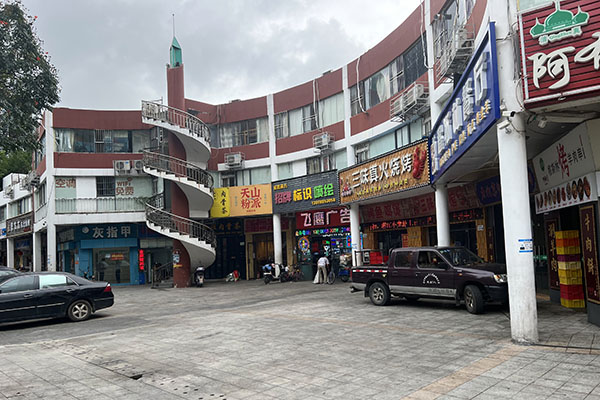
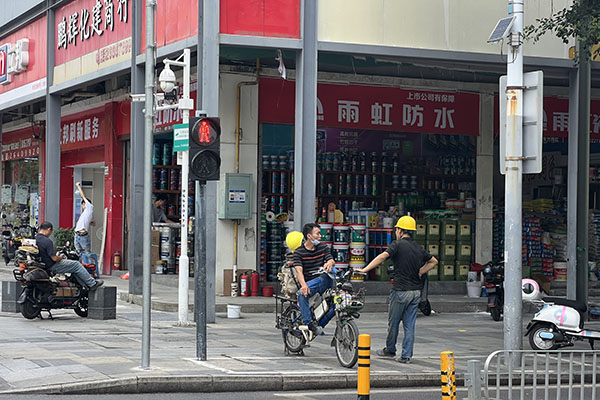
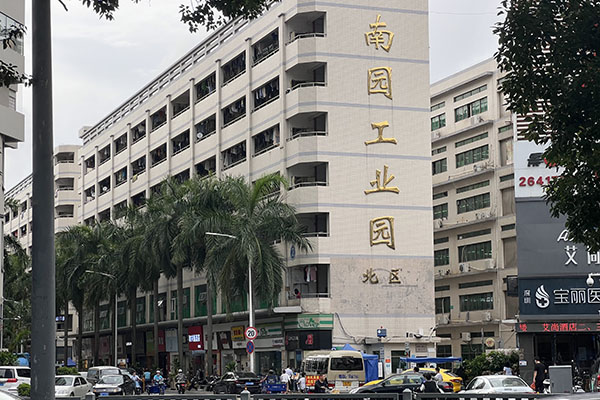
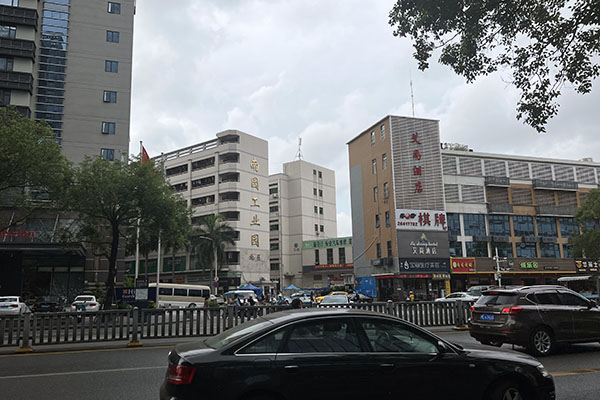
I walked Nanshan Road, from Daxin to the Shekou suburbs via one or two side roads. Below, impressions of “Old Nanshan,” which was built during the late 80s and early 90s, now appears highly nostalgic–the narrow roads, the shade trees, and mom and pop shops.

the animated pandemic: big whites on shenzhen social media

 “Big Whites (大白)” are the omnipresent and seemingly omnipotent figures of China’s 2022 lockdown, so named for their white full-body hazmat suits. Big Whites have been the Chinese government’s social interface for managing the Omicron outbreak. Big White teams consist of medical workers, police officers, community office representatives, and volunteers who come (as the government repeatedly emphasizes) from all walks of life. In their capacity as service providers, Big Whites conduct COVID tests, deliver food to residents in locked-down buildings, and coordinate other public services within a designated area. However, Big Whites are also the public face of COVID security. They conduct building sweeps for testing holdouts, they act as gatekeepers at locked-down estates and neighborhoods, and they patrol locked-down areas to ensure everyone else is in their homes. 

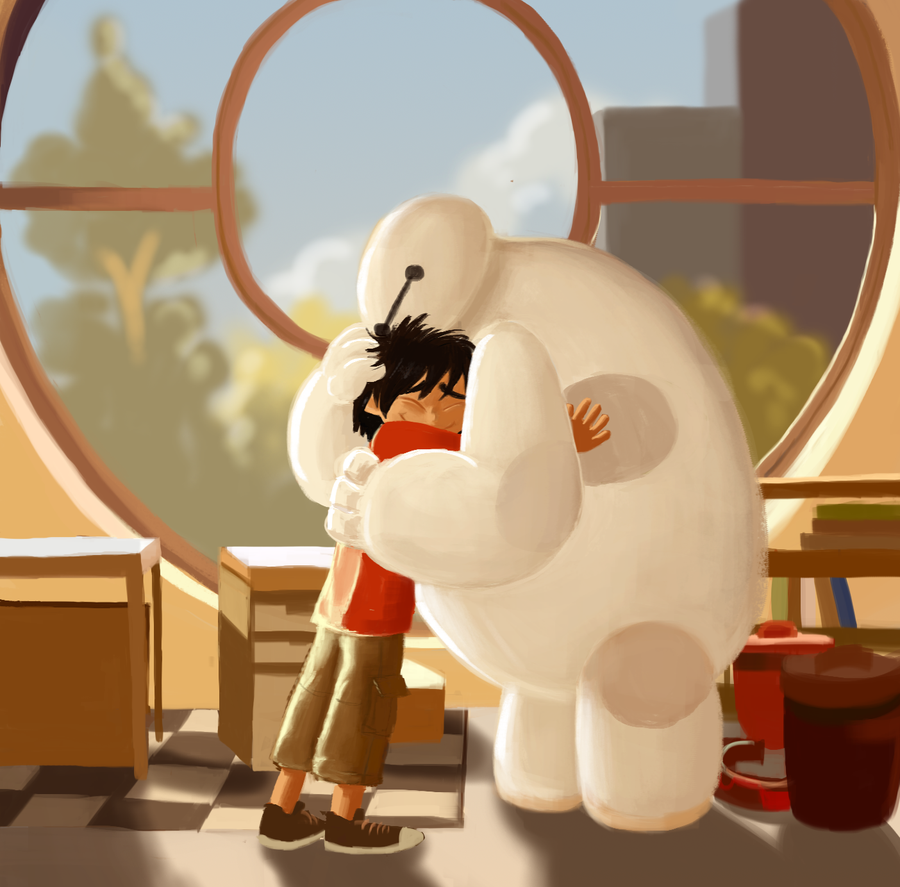
The moniker “Big White” has a double origin story. First, it derives from the gear that the management teams wear. In addition to being fully masked, hands are gloved and shoes are covered. There is a turquoise blue stripe which runs along suit seams and some Big Whites have personalized their suits with magic marker inscriptions. Second, “Big White” is also the Chinese translation for the plus-sized inflatable healthcare robot named Baymax, a character from the 2014 Disney film Big Hero 6. In the film, Baymax teams up with 14-year-old robotics prodigy Hiro Hamada to save their hometown San Fransokyo from an evil supervillain. Baymax and Hiro team-up with four other nerds to form a band of high-tech warriors against evil uses of technology especially biotech. 

In a 23 March post on the English language WeChat account, EyeShenzhen, author Li Dan explained the connection between pandemic work teams and an animated film: “Chinese netizens use it [Big White] as a nickname for frontliners who are fighting the COVID-19 pandemic because they wear white protective coveralls on the job, and they work selflessly to protect the safety of the public.”

This essay touches upon two interrelated issues in the social media representations of Big Whites in Shenzhen—the gender of caregiving and the role of animation in conceptualizing pandemic management.

Hiro and Baymax
Continue reading

配合: how do we change the world?

Yesterday, I participated in a day-long conference to promote environmentalism. I think I was invited for some combination of two reasons: I’m a recognized foreign friend of the city and anthropologists tell better stories than scientists do. Although technically, I’m a scientist, too! (Social science for the win–hee!) Anyway, the other guests have been diligently working alongside and via the government apparatus to create green spaces throughout the city. Event host, Nan Zhaoxu 南兆旭, for example, wrote The Shenzhen Natural History Encyclopedia 深圳自然博物百科 and event organizer, Meng Xiangwei 孟祥伟 has been director of the OCT Wetlands Field School since its establishment seven years ago. Their efforts have been instrumental in elevating district-level events to municipal, provincial and even national levels, not only contributing to Shenzhen’s status as China’s greenest first-tier city, but also to getting environmental sustainability on the city’s urban planning laundry list.

So, now you’re wondering: what was my takeaway from the event? Just how sustainable is Shenzhen’s environment? And what can environmentally conscious people do via an apparatus that is structured to sustain a political environment, rather than an economic let alone non-human environment? Unfortunately my thoughts are not so grand. Instead, I ended up thinking about the cultural forms of environmentalism:

Continue reading

wither the future? some anecdotes from shenzhen under normalized grid management

Yesterday I spoke with a cabbie about the future. He was excited to learn that I hold a US American passport, and quickly reassured me that even if many Chinese people dislike the USA and its residents, he felt otherwise. He wants China to become more democratic and for more voices to be heard in political conversations. He emphasized that presently China only has one voice, making everybody else what we in the US would call “sock puppets” and in China are sometimes called “marionettes” or 傀儡. He also felt that Shenzhen’s housing market made it impossible for anyone not rich to purchase a house and make a life for themselves, so why not “lay down” 躺平. If you have a place to lay your head and enough to eat, why bother with marriage and children?

Continue reading

无语😓:cultural incompetence is also cross-generational

I recently downloaded this sheet of Covid stickers and emoticons. I really like them because they reference specific features of Shenzhen’s experience during the February and March 2022 Omicron outbreak. However, I haven’t yet used any of them because I’m feeling nervous about being called out for cultural incompetence if I misuse them. Or even more scary is that I won’t be called out and I’ll just continue making the same mistake over and over again. That said, I don’t actually want to use emoticons enough that I am willing to learn how to use them by stumbling along and making mistakes. And there’s the rub: emoticons don’t actually resonate with me. They’re just part of a dialect that I recognize has overtaken me, but even so, I haven’t really put in any effort to learn.

So why don’t I emote-icon with confidence? What am I missing when chosen family and friends insert emoticons into a dialog? And why do I feel more comfortable writing in 普通话 than I do texting in either English or Mandarin?

Continue reading

to be of use…

人才是第一资源。古往今来,人才都是富国之本、兴邦大计。我说过,要把我们的事业发展好,就要聚天下英才而用之。要干一番大事业,就要有这种眼界、这种魄力、这种气度。Talent is the first resource. Through the ages, talented people have been the foundation of a country's wealth as well as great plans to rejuvenate the country. I have said that to develop our cause, we should gather talents from all over the world and use them. To realize a great cause, we must have this vision, this courage and this bearing. -- Xi Jinping, 2018

In some of my more fanciful moments, I imagine Confucius and Ignatius Loyola sitting down together to talk education, “Just how,” they muse, “do we cultivate the kinds of people we need to properly govern/ shepherd our people?” They agree to disagree about just how the will of god/ heaven should–and they enjoy a frisson of pleasure as they impose their shoulds on young bodies–manifest locally, but they share the supremely feudal idea that the purpose of education is to cultivate talents who will be of use to god/ heaven and the king/ emperor. And yes, the idea of education as a means of cultivating particular kinds of ideological subjects is feudal, directly contradicting the modern idea that the purpose of education is to cultivate enlightened and independent thinkers. (How feudal our minds are is topic for another post. Maybe.) Anyway, this is why it makes sense that before the protestant evangelicals sailed into Victoria Harbor, HK on the ships of predatory traders, Jesuits enjoyed over two hundred years of pleasant chats with Confucian scholars about grandiose topics, such as wither the world? (Check out The Taiping Heavenly Kingdom: Rebellion and the Blasphemy of Empire by Thomas Reilly for an insightful account of why Matteo Ricci and his Jesuit brethren received warm welcome in Beijing, whereas the protestant mission was criminalized because it informed rebellion.)

Matteo Ricci and Paul Xu Guangqi From La Chine d’Athanase Kirchere de la Compagnie de Jesus: illustre de plusieurs monuments tant sacres que profanes, Amsterdam, 1670. 
Continue reading

just when you thought it was okay to think…

To believe or not to believe? China has a “Big White Earth God Shrine” corona test site. Is it performance art or is it an actual test site? After all, zero-Covid is based on science, not irrational commitment to a political policy, which in practice looks a lot like, well, in practice zero-Covid looks a lot like folk religion:

Continue reading

end of an era? periodizing shenzhen urban villages

A few months ago, I published an essay that periodizes the development of urban villages in Shenzhen. It provides a more nuanced context of how we arrived at the public shaming of Shatou during the recent Covid outbreak. It also contextualizes Baishizhou as an important landmark in Shenzhen’s cultural geography, speculating on what the demolition of Baishizhou means and might mean for the city. Published in Made in China, Archaeologies of the Belt and Road Initiative.

mayday, mayday!

Labor Day, May 1, 2022: Shenzhen official media celebrated Xi Jinping thought, while many on social media circulated stories of Deng Xiaoping visiting the city in 1984 and 1992. This interests me because it highlights increasing dissatisfaction with the New Era as a return to the problems that caused and exacerbated by the Cultural Revolution. This logical connection has three elements: First, old Shenzheners associate the laissez-faire governance (reform) and porous borders (opening up) with the city’s ‘true’ identity, implicitly emphasizing the city’s role in repairing the damages of the Cultural Revolution. Second, there have been ongoing efforts to make Shenzhen a symbol of Xi Jinping’s new era, and indeed, the city has become a symbol of zero-Covid success during the ongoing campaign to achieve zero-Covid. Third, to the ears of many who were born before 1970, the New Era emphasis on Xi Jinping as the core of the party and the great leader of the nation echoes the rhetoric of the CR, even as zero-Covid mobilization is increasingly likened to the CR.

So there’s this uncanny resonance between Red Guards and Big Whites that hovers at the edges of social media posts, and sometimes becomes explicit when friends chat over drinks. But, Red Guards were populist, organized on-the-ground in response to specific situations. In contrast, Big Whites are bureaucratic, organized through governmental systems that reach from Beijing into homes via subdistrict police stations, public health stations, and community offices.

Thought du jour: ten years ago, during the Bo Xilai–Xi Jinping struggle to secure the position of general party secretary, the country’s leaders choose between two variants of CR–populist and hereditary. The idea was even though Xi Jinping was clearly a product of the CR, nevertheless, he was seen as a ‘party man,’ so to speak, whose platform was to maintain stability while and by rooting out corruption. (Yes, this is the same kind of choice-no choice just that has characterized recent US American elections.) Today, I’m wondering what if? What if China had gone with a populist CR leader, rather than a leader who seems to have incorporated CR methods into everyday politics?