Impressions of Guangming New District

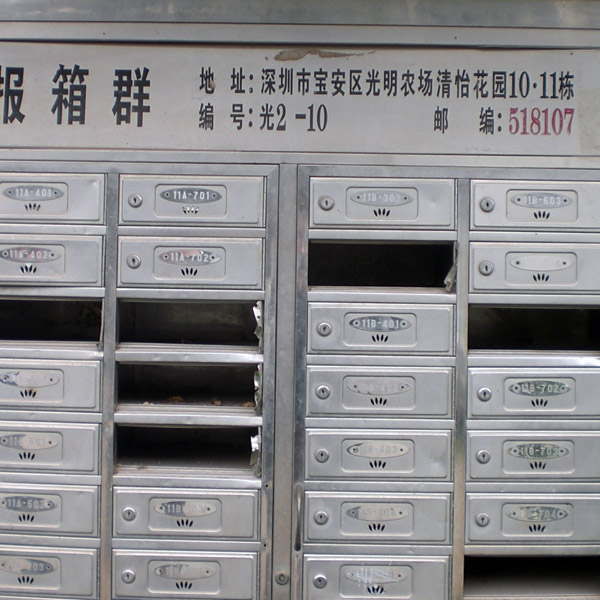
Located at the Dongguan border in the middle of Baoan District, Guangming New District (光明新区) remains surprisingly (within Shenzhen) agrarian. The settlement layout at the District center feels like a small market town and still runs along village paths, even though trucks rumble over the newly imposed traffic grid. The New District’s development has lurched along, hindered by its distance from both the Guangshen Highway and the Kowloon-Guangzhou Railway. In fact, according to a local villager, until the 1970s, no actual road connected the area to Shajing (in the west) and Loucun (in the east). Instead, villagers pushed wheelbarrows on a network of paths that threaded through lizhi orchards, around vegetable gardens, and into rural settlements.

Under Mao, Guangming was a farm (农场), a non-rural designation which had the same administrative rank as a commune (公社), but a different personal policy. Like a commune, farms were responsible for agrarian production. In contrast to commune farmers (农民), however, farm workers were state employees, receiving a monthly rice ration, food coupons, and housing. Practically speaking, farm workers were farmers with socialist benefits. In the Reform era, as Guangming was gradually integrated into the state apparatus, the farm remained not only the most organized institution in the area, but also the one with the most direct access to government monies, which could be redirected for capitalist purposes. Today, Guangming Farm is a tourist destination/ agrarian themepark/ playground (光明农场).

In addition, Guangming was a designated settlement first for Indonesian returned Chinese in the 60s and then for Vietnamese returned Chinese in the 80s (Wang Caibai provides a history of 归侨 as an official designation in the Chinese polity). This meant that the Returnees were integrated into the local work plan as farm labor, but were not given land rights, which have remained in either village or state hands. Indeed, even as late as 1990, then Guangming Market was posting laws pertaining only to Returnees. Nevertheless, the Returnees were often familiar with capitalism in ways that the local villagers were not and also, through family outside China had access to some investment capital. This is important because Guangming is not considered an Overseas Chinese Hometown. Moreover, as a remote part of Shenzhen, the area did not have immediate access to the early Hong Kong investment that went to border villages, even when there were no direct kin relations.

Today Guangming remains relatively clean and naturally beautiful. The local government is pushing renewable energy and resource development as well as suburban life styles in modern high rise developments. With the laying of new roads and the creation of an express bus route from the Shenzhen Bay border to Guangming, Shenzhen has made it easy for Hong Kong people to visit or move to these new developments. In addition, highways now make Guangming a short ride from the airport.

Due to its remote location and special designation, Guangming’s recent history is complicated and has produced a landscape that juxtaposes late Qing and Republican flat homes, Mao-era tile homes, handshakes, mid80s official housing, lizhi fields, mountains, several industrial parks, and construction sites, not only providing scenes for imagining what pre-reform Shenzhen was like, but also offering a space where another, more sustainable form of development might be pursued. Or so I hope. A walk through the center of Guangming New District, below.

This slideshow requires JavaScript.

the second line: nantou checkpoint to zhongshan park

Walked with Emma Ma and her father, Mike along Shenzhen’s northern loop expressway (北环大道) from the Nantou Checkpoint to the northern entrance of Zhongshan Park. Our path followed the remains of the second line (二线), the boundary that once divided Shenzhen into the SEZ and New Bao’an County. Cobbled together out of debris and plastic poster banners, a makeshift tent settlement hovers atop the obsolescent wall and a border guard platform falls apart. A section of the former border zone has been converted to a logistics depot for the Nanshan Oil company. Ironic, of course. Across the street in Zhongshan Park, the Ming Dynasty remains of the Nantou City wall have been designated cultural heritage. Impressions of the second line, below.

This slideshow requires JavaScript.

Jilong Village ruins

In the ongoing rush to raze urban villages, vestiges of the actual old villages have suddenly assumed an almost mythic aura and handshakes seem classically urbane. The latest example? Remnants of Jilong Village, one of the four neighborhood/ villages that constitute Huanggang (the other three are Shangwei, Xiawei, and Huanggang New Villages) are currently being renovated in the shaded grove next to Huanggang Plaza and now flicker with ancient promise. As close as half a year ago, migrant workers rented these decaying row houses; now, visions of a Huanggang Xintiande dance in my head. A few pictures, below.

This slideshow requires JavaScript.

Shuiwei’s New Park: Commemorating Reform and Ancestor Zhuangzi

As part of its ongoing upgrades, Shuiwei has finished a small park dedicated to Zhuangzi. In fact, the village traces its genealogy back to the famous philosopher; according to the plaque, the village’s founder Zhuang Sen (庄森) was born into the 48th generation of Zhuangzi descendants. The commemoration, like others throughout Shenzhen villages, links the establishment of the village with its Reform era rejuvenation.

This slideshow requires JavaScript.

先祖立村六百载,幸福小康颂党恩,围昌万年是祈愿,和谐共荣新家园,改革开放越千秋,庄氏族系倍兴旺,水环四壁换新颜。承先启后永向前。

Our founder established the village 600 years ago, for happiness and prosperity we praise the Party’s magnanimity,

Our prayer is that our compound thrives 10,000 years, harmony, co-prosperity, a new homestead,

Reform and Opening surpasses 1,000 autumns, the Zhuang family descendants to flourish,

The moat and old walls have been replaced. We connect past and future generations, eternally going forward.

stars in my coffee…

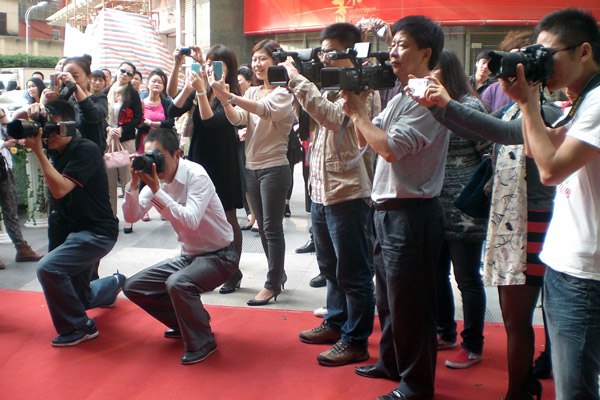
Shenzhen entrepreneurs enjoy big openings and Tuesday afternoon, I participated in the grand opening of Iris, a coffee shop located in the Hongxiang building, just off Hongling Road. I thought I had been invited to show my support for the owner’s new enterprise, but in fact had been invited as a special guest. Caveat: I’m not Hollywood red-carpet famous, but Shenzhen cultural circles somewhat well-known and happened to be free on Tuesday afternoon famous. Apparently, this friend of a friend of a friend is using cultural taste to brand the experience of drinking coffee there and all of the special guests were in some way related to cultural production in Shenzhen, especially writing and music. Continue reading

Daban Bridge Road

The other day, Annette Kisling and I walked from Xiangnan Village-Neighborhood to Guantou along Daban Bridge Road (大阪桥路), which once paralleled the coastline, connecting the old Yamen at Nantou to Dongjiaotou, a small cove that geographically marked the entrance to the Shekou Port. The stone bridge went over a small tributary from the inner Pearl River Delta. Today, of course, Daban Bridge Road twists parallel to Qianhai Road and the tributary has been reclaimed. In addition, Nanshan District’s extensive road network has partitioned the villages/ neighborhoods that Daban Bridge Road used to link, creating city blocks. Unfortunately, these blocks to not conform to historic breaks between villages along Daban Bridge Road, but rather enforce a strict traffic grid. Pay attention not only to the diversity within neighborhoods, but also between. Enjoy.

This slideshow requires JavaScript.


(光明新区)楼村: Of what use is [urban] planning?

Located in Guangming New District (光明新区), Lou Village has the largest area of any in Shenzhen and a villager population of 4,000. Of course, it is no longer Lou Village but Lou Village Neighborhood (楼村居委会) and its population is no longer under 5,000 — and therein lies today’s tale.

At the 15th Anniversary of the Establishment of the Shenzhen Special Economic Zone, the second line (二线) still divided Shenzhen into two distinct administrative structures, the SEZ (now called guannei or “inside the gate”) and Baoan and Longgang Districts (now called guanwai or “outside the gate”). The year was 1995 and Baoan and Longgang District governments had been built and staffed, 25 urban markets soon to be precincts (镇 into 街道办事处) had been designated, and consequently the work of incorporating over 200 guanwai villages into the municipal apparatus begun. Economic advancement was an important aspect of political incorporation precisely because 15 years into reform, Shenzhen had discovered that “allowing a few to get rich first (让一部分人先富裕起来)” undermined social stability. Continue reading

Not your cup of tea?

Ten of us were having dinner at a private style restaurant. Unlike mom and pop “family style” diners, which serve standardized fare at similar prices, a private style restaurant caters to the discerning rich, who have a good relationship with the owners. Trust and taste define this good relationship. Guests trust that the owner will provide quality tea, food, and service for a price that includes a “reasonable” profit. In turn, the owner trusts that these guests not only desire, but also can afford high quality teas, expertly brewed, seafood delicacies and soups adorned with beautifully shaped fungi. There is a menu, but it seems to be used for pedagogical purposes, including the health benefits of particular foods and herbs. Consequently, guests don’t order individual dishes, instead a meal’s host discusses a menu with the owner, who then plans the meal. The price of the meal is either set ahead of time (the host setting an upper limit, for example) or, if the guest returns regularly, the owner can plan a meal based on the number of guests. Special requests for imported seafood can be accommodated with 24-hour notice. Private style restaurants set the stage for intimate displays of taste and friendship. Sharing a meal of this quality, for example, enabled my friend both to demonstrate how much he cares for us (because the food is outstanding) and to show off how very good his good life is (because really, the food is that outstanding. And the tea. Wow.)

Bourdieu, of course, has reminded us that elites use aesthetic distinction or good taste to solidify class identity, arguing that cultivated predispositions to certain foods, music, and art enable us to recognize relative social status; we “like” that which is appropriate to our social position and “dislike” that which is not. Continue reading

rant on the state of shenzhen news

A journalist approached me for an interview on the topic, “送你一个好男人 (We’ll give you a good man)”. His newspaper is currently preparing special articles for International Women’s Day, next Thursday, March 8. I replied that my ideal man would have been a better topic for Valentine’s Day, when fantasy is given free reign and chocolate assumes its rightful place in the food chain. He responded that the newspaper was aiming for a “light” approach to women’s issues by collecting and retelling love stories. I’m presuming that the editorial moment will be to abstract those characteristics shared by good men the world over; my love story would be cross-culturally inspirational. So to speak.

The fact that newspapers are generating content for International Women’s Day isn’t surprising. In fact, making the ideal man the subject of Women’s Day reportage is an accurate reflection of the status of women and the terms of gender debate in Shenzhen. What’s more, I’m not even surprised that their story is gossip — the semiotic daisy chain that strings women and love and sex and gossip is so overdetermined that I’m moderating a roundtable on the relationship between gossip and architecture as part of my Women’s Day celebration. But here’s what I don’t get — why call me? Continue reading

new village origin stories: Caiwuwei redux

What to make of the following quote by Terry Farrell, architect behind the KK 100?

The site of KK100, [Farrell] says, used to be Caiwuwei village, a poor and rundown area. Kingkey had to build seven towers to rehouse local people and a further seven for other locals to own and rent out, so that they might share in the boom. It’s an extraordinary idea: even as China hurtles into capitalism, it does still show remnants of old socialist ideals.

It echoes a quote from archello, a website dedicated to world architecture. Although archello has erased the reference to socialism:

The 3.6-hectare site [for the KK 100] was previously occupied by a dense residential quarter, Caiwuwei Village. The developer had the creative vision to form a company with the villagers, initiating an entirely new approach to the art of place-making in Shenzhen. This serves as a model for 21st century for urban change all over the world. Existing buildings were run down and living conditions were poor. As part of initiating this transformation, a Joint Development Initiative was formed in which villagers became stakeholders. Each owner was offered a new property as well as a second home which serves as an income generating asset. This meant the preservation of community links that are built over generations.

Origin stories for Shenzhen and its various buildings continue to use “poor backward Baoan villages” as a foil for their own achievements. In Mandarin, stories about the KK 100 are more detailed (深圳城中村专题-罗湖蔡屋围蔡屋围:梦想的真实围绕, for example), but in essence no different: the KK100 symbolizes urban proress.

What’s more these stories share an enthusiasm for height, illustrating how phallic aesthetics not only bridge the social distance between England and China, but also between the Shenzhen Municipal Government, KK 100 developers, and Caiwuwei Villagers. Indeed, Farrell has received acclaim both for his design and the fact that it is the tallest building ever realized by a British architect, a neat illustration of the link between competitive masculinity and nationalism.

Importantly, the idea of the KK 100’s height is established through explicit comparison to low (level, quality, income) Caiwuwei. Continue reading