CZC Special Forces

Am collaborating with a multi-national group of architects, urban planners, and concerned citizens to jumpstart an effort to renovate the Tangtou section of Baishizhou. Yesterday, at one of the Design Center’s Cool Tea (酷茶) events, I gave a short presentation on our four meetings to date and an introduction to sociocracy, the form of governance we are attempting to set up. The talk was well received, especially the discussion of how to run a meeting.

I have recently realized that there is not only desire to transform Chinese society, but also many such salons and talks springing up all over Shenzhen. Significantly, the terms of the discussion are the built environment. Last night, for example, the first talk by the Shenzhen Green Building Association charted the expansion of government sponsored discussions about environmental standards — their group has several hundred members and they are quite active. SGBA seems to be moving in the direction charted by Wang Yang in his recent address to the Guangdong Party and one of their core ideas is happiness index (幸福指标). As mentioned in an earlier post, Wang Yang has defined happiness in neo-liberal terms: a feeling of personal well-being brought on by doing what one likes to do. Upside, this definition leaves space for heterogeneity. Downside, it justifies all sorts of social neglect and individual appropriations of common resources. Nevertheless, the point remains: Shenzheners are talking about what it means to inhabit the city as members of a society AND the discussion is being coded in architectural and urban planning terms.

A copy of my talk (in Chinese), here; the accompanying bi-lingual powerpoint, here.

because not all villagers were created equal…

The stereotype of the second generation of Shenzhen villagers being “rich, lazy, mah johng playing, playboys (who might also do drugs)” is not only predicated on the idea that all of Shenzhen’s original inhabitants are rich, but also that their children have grown up aimless. However, Bao’an County’s original 300,000 residents and their children were not all created equal. What’s more, they increasingly find themselves belonging to antagonistic economic classes, while their children come of age grappling with problems that none of their parents imagined facing. Some second generation SZ farmers must look for wage labor in factories that (rumor has it) do not hire locals, preferring instead to hire migrant workers, even as other second generation SZ farmers are the first in their family to gone to college, and still others are, yes, struggling with too much wealth.

The inequality among locals has been created through reform era legislation and urban development projects, which have built upon and elaborated historical inequalities and traditional norms. In an earlier post, I charted the borders and corridors that have shaped economic possibility and subsequent patterns of urbanization in the SEZ, arguing that three borders have enabled urbanization in Shenzhen: the border with Hong Kong, the second line, and the city limits, which abut Dongguan in the northwest and Huizhou in the northeast. Two economic corridors have facilitated Shenzhen’s growth: the Guangshen highway corridor and the Kowloon-Canton Railway. The Guangshen highway corridor parallels the area’s riparian trade routes, which were the means of Han expansion from Guangzhou southwardly on the Pearl River and its tributaries. The KCR, of course, was the British attempt to preempt and redirect the PRD’s extensive trade network.

Not unexpectedly, proximity to a border or corridor has been a condition of reform era riches. Villages near the nexus of these borders and corridors have had disproportional opportunities to build and manage industrial parks and real estate developments. The earliest villages to get rich, for example, were all located along the Shenzhen-Hong Kong border at corridor checkpoints — Shekou (Fishing 1 and Wanxia) and Luohu (Hubei), first, but then Huanggang (Huanggang, Shuiwei, Xiasha, and Shangsha). However, guanwai villages retained land rights a full 12 years longer than did guannei villagers, with the result that largest and wealthiest village joint stock companies are now primarily located along the Pearl River Delta (Shajing and Huaide) and KCR corridors (Nanling near Buji). Consequently, many villages have remained “stuck” in between these two different modes of production, neither farming nor investing in manufacturing, let alone transitioning to the new creative economy. Areas of relative poverty include many Longgang District Villages as well as villages in Gongming and Guangming.

However, proximity to the borders and corridors has not in itself created the conditions for villages to transition from lives based on rural production to lives based on urban industrial manufacturing. In addition to the construction of infrastructure, differences in Mao-era administrative designation have also shaped current inequalities among villagers. First, successful villages have operated as collectives, rather than relying on individual efforts. These villages not only inherited Maoist organization, including management experience, but also inherited common ancestry. Thus, single surname (一姓) villages, which have renovated ancestral halls and promoted traditional rituals have generally been more organized than random surname (杂姓) villages, which were created during the Maoist era for production purposes. Second, successful villages have had traditional land rights, which were extensive. Indeed, most traditional villages have made their fortune through land deals. In contrast, fishing villages (渔村) and overseas Chinese villages (桥村) had foundation rights (宅地), but not land development rights. This meant individual villagers could build private homes, but that villages could not collectively invest in industrial parks or real estate developments. Moreover, villages did not benefit from compensation deals between developers and nearby traditional villages. Third, as recent events in Wanfeng demonstrate, some village heads have been less corrupt than others, while the success of Huaide, Nanling, Huanggang, and Xiasha Villages has been directly attributed to the foresight of the incumbent leader.

It is an open secret that legislation has been the source of Shenzhen’s competitive advantage, both for outside investors and for indigenous Bao’an villagers. What’s more, this legislation did provide the framework for many local villages and individual villagers to become rich. Indeed, when Deng Xiaoping died in February 1997, Shenzhen villagers openly wept and brought funeral wreathes to the statue at Lianhua Park and his Shennan Road billboard. Nevertheless, the emergence of class differences within and between villages directs our attention to the ways in which Shenzhen has displaced Bao’an as “the local”. Within this new locale, hometown status no longer provides a viable identity because locals have been segregated into urban classes that have disrupted traditional rural relations, even as they learn to navigate a hometown that is no longer theirs, assimilate the mores and customs of urbanites, and speak standard Mandarin, rather than local Cantonese or Hakka dialect. And in this new world ordering, poor Baoan locals embody a poignant form of global tragedy.

as yet shenzhen has no capital h history…

The experience of walking Shenzhen is significantly different from visiting, Beijing or Shanghai, Xi’an or Guangzhou, where the meaning of the past has already been codified, renovated, and can be consumed on a nostalgic tour. In school we learn that Beijing’s history is Ming-Qing imperial, Shanghai’s history is East-West colonial hybrid, Xi’an’s history is ancient, while Guangzhou’s history is South China sea commerce and migration. We then go to the respective tourist destination to have our knowledge confirmed and perhaps enriched by and through an appropriate activity. We walk Beijing’s hutong and the Forbidden City, drink coffee or cocktails in a stylish restaurant in Shanghai’s shikumen and the Bund, admire Xi’an’s beilin and terracotta soldiers, and wander the small shops of Guangzhou’s West Gate. Indeed, each of these tourist destinations succeeds as such precisely because the site metonymically represents the respective city’s place in China’s “5,000 years” of civilization. We leave thinking we have a deeper understanding of where we have been. Maybe we do. Most likely we don’t. But there is something reassuring in having our stereotypes confirmed, and those stereotypes are what I mean by capital h history.

Now, there are historically significant sites in Shenzhen — Old NantouDapeng Fortress, the Chiwan Tianhou TempleDongmen, and Yumin Village. However, municipal efforts to promote Old Nantou and Dongmen, notwithstanding, none of these historical sites has captured the imagination of either residents or visitors. I suspect this is in part because each of these places represents a portion of Chinese history that is already preserved elsewhere. Old Nantou and the Chiwan Tianhou Temple, for example, represent ancient efforts to develop the Chinese salt trade and settle the Pearl River Delta, but there are finer examples of that era to be imagined and seen in Guangzhou, while ancient Chinese history is more elegantly preserved in Xi’an and Jiangnan. Even the Tianhou sea cult is more closely identified with Tianjin and Xiamen than it is with South China temples and shrines. Likewise, Dapeng Fortress is an outpost of Ming-Qing military imperialism, but of a failed variety, rather than successful garrisons to be explored throughout the north.

Dongmen and Yumin Village are perhaps more representative of Shenzhen’s importance as the epicenter of early reform. However, both are historically compromised. Although Dongmin is identified with so-called Shen Kong commerce, for example, there really are more upscale malls throughout both Shenzhen and Hong Kong where one might purchase global products. And what about Yumin Village? Deng Xiaoping visited Yumin Village in 1984, inspecting one of the three-story private homes that local villagers had just built. He declared that Shenzhen speed was a good thing and that the rest of the country should follow. The 1995 exhibition to commemorate the 15th anniversary of the establishment of the Shenzhen SEZ included an installation that reproduced the interior of one of those homes, which at the time, was more luxurious than the homes of urban cadres in Beijing and Shanghai. Here’s the rub: although Yumin Village has been integrated into the Shenzhen municipal apparatus as a Luohu neighborhood, nevertheless the actual buildings that Deng saw and even the home he inspected were razed over ten years ago. There is a history board there, but nothing from 1984 remains and Yumin Village continues to function as a border urban village, with low rents for migrants who work nearby, spas and massage parlors for visiting Hong Kong people, and places where villagers play mah jong and gather to drink tea and gossip.

The absence of an agreed upon master narrative means that walking Shenzhen allows individuals to judge what does and does not represent capital h history in the SEZ. Now Shenzhen does boast upscale skyscrapers that represent achievements within this process — Guomao, Diwang, and the Civic Center all come to mind and are worth a visit. Those wanting to see the “real” capital h historic Shenzhen, I suggest visiting either an industrial park or an urban village. Early 80s work unit housing in Luohu and Shekou are also great examples of how industrial urbanization transformed the area. Personally, however, I believe that if Shenzhen has a place in China’s 5,000 years narrative it is as an epicenter of rural urbanization, including transformation of the local environment, proletarianization of rural migrants to SEZ factories, and the forms of urbanization that returned workers have promoted or their remittances enabled. However, even after over 30 years of reforming and opening Baoan villages, the city is only just starting to come to terms with this legacy and most villages, even the most famous such as Baishizhou are scheduled to be razed. All this to say that as yet, the meaning of Shenzhen’s cultural and historical inheritance is still up for grabs because we are only just starting to come to terms with the urban legacy of Reform and Opening. This means that as yet the city has no capital h history and no corresponding historical sites that one can visit and say, “Yes, I’ve been to Shenzhen and I know where I’ve been.”

Walk anyway. The Shenzhen you experience will be only loosely tethered to stereotypes about China and you might make something else of it. Below, impressions of a recent walk in Fuyong.

This slideshow requires JavaScript.

The Value of Urban Villages

US American real estate developers chant, “location, location, location.” In Shenzhen, primary locations open for development are actually urban villages slated for old village renovation — redevelopments that involve the final transfer of village held property to the Municipality.

In a Jingbao article on the future of Nanshan District, Li Xiaogan, recently appointed Nanshan District Secretary, noted for example, “In constructing a global district and promoting urban renovation, Nanshan District will have several advantages over the next few years. First, the largest urban renovation project in Guangdong Province – Dachong Urban Village, with a total project area of 683,000 square meters; second, the urban renovation project for the five villages of Baishizhou in Shahe, which is currently being planned, also has an area of over 650,000 square meters, and is again one of the largest in the Province; third, located in the north of the District, the three Shuiyuan villages are within the water conservation and ecological conservation red lines, and are thus relatively backward, however, they are also now in the planning stage of development; forth, the old Xili Market, which we are planning to convert to an urban complex; fifth, the banks of the Shahe River, where we will take international bids to create an ecological cultural corridor, and; six, Nanshan Old City, which with everyone’s support we hope to return to its status as Shenzhen’s historical and cultural root, by resituating all residents and completely rebuilding.”

Recent impressions of Baishizhou, below:

This slideshow requires JavaScript.

Langxin: Impressions of Rural Preservation

I first walked through Langxin in 2006 and returned yesterday to discover that the area had been designated a historic preservation area in 2007. Unfortunately, this time, we were unable to talk our way into the Ancestral Hall, even though we did talk our way into several homes and up to the roof of a three-storey walk up. The higher perspective gives a broad impression of the former lay of village housing. During the Mao-era, the round buildings were used for grain storage. Of documentary note: the Shiyan Precinct Administrative Law Enforcement Building is located in the Together Rich Industrial Park (同富裕工业区), from the “Together Rich Project” that began in early 1997 in a first effort to ameliorate uneven development within Shenzhen. Impressions, below.

This slideshow requires JavaScript.

hakka borderlands: xiawei and shiyan

On Thursday, I joined a group of architects and students from the Future Cities Laboratory on a rainy guanwai trek along Bulong Road, which parallels the second line. This particular trek interests because it hints at generations of ongoing cultural transformation both as industrial manufacturing has spread and as Cantonese and Hakka urban villages have renegotiated collectives identities over the past 150 years.

We departed from Huaqiangbei and crossed at the former Buji Checkpoint, which today has been partially cleared to make room for the Buji subway station (Longgang Line) although cars still lined up to pass through check booths. Directly north of the erxian boundary, Xiawei Village (吓围村) handshakes huddle tightly, giving the impression of an ordinary new South China village. However, the entry gate and main hall of Xiawei’s ancestral hall remain, suggesting that at some point the village had enough collective funds to erect a substantial building. According to an old worker who was organizing collected paper products in the compound plaza, villagers continue to burn incense for ancestors during the Spring Festival.

We then headed west to the precinct headquarters of Shiyan. During the Mao-era, this area also served as the headquarters of Shiyan Commune. Located between the Kowloon-Canton railroad and Guangzhou Shenzhen corridors, Shiyan has remained relatively poor when compared to precinct headquarters at Buji or Shajing, for example. Nevertheless, it has Mao-era flat housing, Reform era factories, and two generations of single-family homes and handshakes. More to today’s point about Hakka borderlands, Shiyan is also interesting because it is located along Baoan County’s traditional border between Cantonese and Hakka cultural regions. Thus, although the Ye Ancestral Hall boasts Hakka exhortations of Confucian morality, the structure itself, like many of the areas older flat buildings are Cantonese style.

Impressions:

This slideshow requires JavaScript.

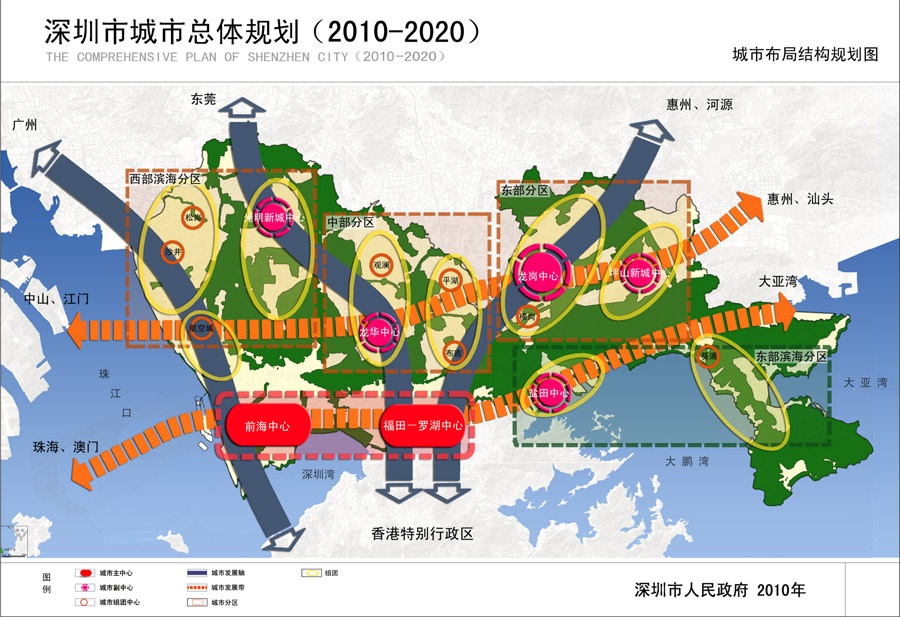
borders and corridors: one interpretation of the 2010-2020 shenzhen comprehensive plan

At first glance, Shenzhen’s 2010-2020 Comprehensive Plan seems a writhing mass of blue snakes and bright hotspots.

However, by simplifying the Comprehensive Plan in terms of the historical relationship between political boundaries and and early infrastructure in Shenzhen development, I came up with the following grid of borders and corridors, which explains the Plan’s horizontal flows, the connections to Hong Kong, and investment initiatives in New District hubs:

Three borders have enabled urbanization in Shenzhen: the border with Hong Kong, the second line, and the city limits, which abut Dongguan in the northwest and Huizhou in the northeast. Two economic corridors have facilitated Shenzhen’s growth: the Guangshen highway corridor and the Kowloon-Canton Railway. The Guangshen highway corridor parallels the area’s riparian trade routes, which were the means of Han expansion from Guangzhou southwardly on the Pearl River and its tributaries. The KCR, of course, was the British attempt to preempt and redirect the PRD’s extensive trade network.

This grid enters everyday conversation through place name protocols. For example, no one today refers to the “second line”, which evokes the yesteryears of early reform. In contrast, ever since the boundaries of the SEZ have been made coterminous with city limits, we now speak of guannei and guanwai, or “inside the gate” and “outside the gate”, respectively. Interestingly, however, I rarely hear people speak of the guanwai area well east of the railroad as “guanwai”, instead, it is more common to refer to that part of Shenzhen as “the east”.

In fact, the SEZ’s historically most important hubs are all located on this grid. Luohu/ Dongmen is the first stop on the Chinese side of the railroad, while Buji was the first stop on the guanwai side of the second line. Likewise, Shekou was the end of the old riparian trade network, activating Delta resources. Bao’an District government is found just over the guanwai side of the Guangshen highway corridor and Shajing Wanfeng Village, once called “the first village in the south” occupies the area just south of Dongguan on the Guangshen Highway corridor. Given the importance of political territorializations and infrastructure to development, it is unsurprising that the poorest areas in Shenzhen are either in (a) the guanwai area between the railroad and highway corridors (Shiyan and Guangming) or (b) the East. With the exception of Guangming, all of Shenzhen’s other three new districts — Pingshan, Longhua, and Dapeng — are located in the east, far from easy access to the railroad, let alone the Pearl River and riparian access to Guangzhou.

In the new Comprehensive Plan the old hubs appear renamed, but their functions unchanged. The Guangshen corridor has been resutured to the Pearl River through the Qianhai Center. The Luohu/ Dongmen railroad corridor has been interestingly diverted into two streams, one that enters guannei at Huanggang/ Lok Ma Chau and leaves guanwai through Guangming and a second that enters guannei at Luohu and then exits guanwai through Longgang. Meanwhile, Hong Kong has been absorbed/ extended into the Shenzhen administrative apparatus at both the Lok Ma Chau Loop and Qianhai Cooperation Zone, begging the question: will the next Comprehensive adjustment will be political integration of the two cities and the re-establishment of a first or second line at Shenzhen city limits? Indeed, the question doesn’t seem too far-fetched when we recall that for 5 months in 1997, the transition government for the Hong Kong Special Administrative Zone met in Shenzhen.

tianmian update

Has been a while since I last visited Tianmian. In the interim, the biggest changes have been to the relentlessly upgrading lay of the land. In the north, renovations to the outer factories have been completed and there are now higher end restaurants and several chains. In the west, the border between New Tianmian Village and the City of Design has been eliminated so that people now pass freely from one section to the other, even though the aesthetics suggest a clear distinction between office workers in Design and New Villagers. To the east, the former red line of the 1980 SEZ at the Shanghai hotel continues to transform itself higher and bigger as Tianmian rents remain higher than service wages in neighborhoods diners, convenience shops, and beauty parlors.

This slideshow requires JavaScript.

旧楼村: alleyways and crumbling bricks

This slideshow requires JavaScript.

Images from Old Loucun (旧楼村), a large swathe of crumbling tile homes, traditional brick homes, narrow roads and alleys, and mid 80s 2 and 3-storey homes. Handshakes on horizon.

Impressions of Guangming New District

Located at the Dongguan border in the middle of Baoan District, Guangming New District (光明新区) remains surprisingly (within Shenzhen) agrarian. The settlement layout at the District center feels like a small market town and still runs along village paths, even though trucks rumble over the newly imposed traffic grid. The New District’s development has lurched along, hindered by its distance from both the Guangshen Highway and the Kowloon-Guangzhou Railway. In fact, according to a local villager, until the 1970s, no actual road connected the area to Shajing (in the west) and Loucun (in the east). Instead, villagers pushed wheelbarrows on a network of paths that threaded through lizhi orchards, around vegetable gardens, and into rural settlements.

Under Mao, Guangming was a farm (农场), a non-rural designation which had the same administrative rank as a commune (公社), but a different personal policy. Like a commune, farms were responsible for agrarian production. In contrast to commune farmers (农民), however, farm workers were state employees, receiving a monthly rice ration, food coupons, and housing. Practically speaking, farm workers were farmers with socialist benefits. In the Reform era, as Guangming was gradually integrated into the state apparatus, the farm remained not only the most organized institution in the area, but also the one with the most direct access to government monies, which could be redirected for capitalist purposes. Today, Guangming Farm is a tourist destination/ agrarian themepark/ playground (光明农场).

In addition, Guangming was a designated settlement first for Indonesian returned Chinese in the 60s and then for Vietnamese returned Chinese in the 80s (Wang Caibai provides a history of 归侨 as an official designation in the Chinese polity). This meant that the Returnees were integrated into the local work plan as farm labor, but were not given land rights, which have remained in either village or state hands. Indeed, even as late as 1990, then Guangming Market was posting laws pertaining only to Returnees. Nevertheless, the Returnees were often familiar with capitalism in ways that the local villagers were not and also, through family outside China had access to some investment capital. This is important because Guangming is not considered an Overseas Chinese Hometown. Moreover, as a remote part of Shenzhen, the area did not have immediate access to the early Hong Kong investment that went to border villages, even when there were no direct kin relations.

Today Guangming remains relatively clean and naturally beautiful. The local government is pushing renewable energy and resource development as well as suburban life styles in modern high rise developments. With the laying of new roads and the creation of an express bus route from the Shenzhen Bay border to Guangming, Shenzhen has made it easy for Hong Kong people to visit or move to these new developments. In addition, highways now make Guangming a short ride from the airport.

Due to its remote location and special designation, Guangming’s recent history is complicated and has produced a landscape that juxtaposes late Qing and Republican flat homes, Mao-era tile homes, handshakes, mid80s official housing, lizhi fields, mountains, several industrial parks, and construction sites, not only providing scenes for imagining what pre-reform Shenzhen was like, but also offering a space where another, more sustainable form of development might be pursued. Or so I hope. A walk through the center of Guangming New District, below.

This slideshow requires JavaScript.