handshake 302 in the classroom

Our current project, “Shake Hands with the Future” started last week, when curator Liu He and I went to Shenzhen Middle School to talk with students about an after school project to investigate and creatively respond to the urban villages in their neighborhood. And, because Shenzhen Middle School is located right next to Dongmen, the school is also next to several of the most iconic urban villages. So very excited about what the students will bring us.

star bright dalang: keeping it real

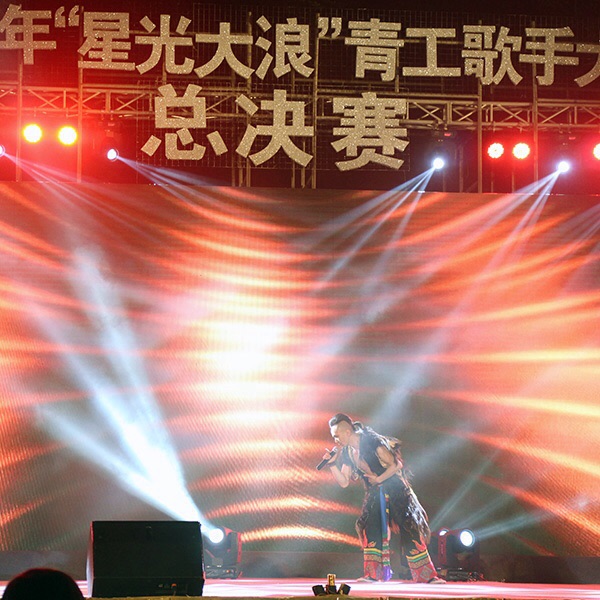
The Star Bright Dalang Singing Competition Finals took place on January 25, 2015. Despite having been abruptly postponed a week (due to government shuffles), nevertheless the production sparkled. Five LED screens adorned the temporary stage in Workers’ Park, a sixth was set up for simultaneous broadcast, lasers beamed through the nighttime sky, and glow wands had been distributed to audience members seated in the front section. The total audience was estimated to be around 3,000 people who gathered to listen to 13 migrant workers sing popular songs a la Idol. Continue reading

“this time, this place”: these concerns

The balmy days of installation gave way to cold winter rain for the opening of “This Time, This Place” in Shenzhen’s Central Park. Our brief as participants was to respond to the site, and in this sense the weather reminded us just how different indoor and outdoor exhibitions can be. But that’s not what I want to talk about. Today, I’m wondering: is there art that ameliorates rather than is predicated on class privilege? Continue reading

paper crane tea #2 is online

For the curious. “So why do foreigners go to urban villages?” is online. Please check it out and grow the conversation about Baishizhou and why it matters. For all of us.

what’s the good of public art…

…in an urban village?

This was the topic of the first Paper Crane Tea 2014.03.09. I’m posting the link because my VPN isn’t fast enough to tunnel video over or under the great firewall. Will upload next time I’m in Hong Kong. Sigh.

baishizhou superhero!

Baishizhou Superhero has been installed at Handshake 302. Come and see and play with the first urban village superhero photo stand-in!

superhero

Below, the curatorial statement for the installation.

Baishizhou Superhero

Superheroes navigate the debris of urban despair, haunting the rubbished alleyways and crumbling staircases that lead to cramped spaces at the end of unlit hallways. They appear as exaggerated silhouettes or bursts of neon light. They leap over tall buildings in a single bound and rescue the victims of unfettered greed and malignant desire. Most importantly, superheroes represent the fantasy of latent potential and unlimited transformation in these techno-modernized times; mild-mannered, nerdy and bureaucratically inclined Clark Kent steps into a telephone booth and strides out a decisively manly man, who rights systemic wrongs through physical prowess. Hooray!

In the installation Baishizhou Superhero, Liu Wei’s playful cartoon characters transform Handshake 302 into a magic telephone booth. Visitors step into the space and through the power of a photo stand in become one of seven possible urban village superheroes – Methane Man, Wonder Granny, Stir Fry Fly, the Amazing Beer Babe, Village Guardian, Super Dog, or Cat-a-go-go. Friends can then take pictures of each other as they model the most common social roles in any of Shenzhen’s urban villages.

At first glance, the installation seems a tacky party game until we remember that these social roles – deliveryman, child care provider, food hawker, beer waitress, and village fireman – are the vehicles through which migrant workers transform their lives. Each migrant worker undergoes the sometimes exhilarating and often bizarre transmogrification from ordinary peasant to urbanite. However, the Baishizhou Superheroes also sustain Shenzhen’s economic boomtimes. After all, these superheroes provide the services and social network that Shenzhen’s factory workers need to make themselves at home in the city.

At second glance, the insidious charm of the installation becomes even more apparent. There is no doubt that human beings have latent potential to transform ourselves and our lives. The Shenzhen Dream hinges on this fact and migrants come to the city in order to improve their material lives. Within the maelstrom of globalization, however, the latent potential of human beings to transform ourselves has been limited by the necessity to commodify ourselves. The super power of an unpaid grandmother, for example, is to create value by providing unpaid childcare so that both fathers and mothers can join the gendered labor force, as deliverymen or waitresses.

The “super power” of all Baishizhou migrants is, in fact, the power to sell their labor on an unregulated market for as long as their bodies hold out. A popular expression maintains that migrant workers “sell their youth”. As individuals, there are limits to the scale of transformation. When a deliveryman’s legs can no longer pump a bicycle or when a waitress’ breasts succumb to gravity, these workers are replaced by younger, more energetic migrants. And there’s the fantastic allure of the superhero myth – unlimited strength to endure and transcend physically exhausting and emotionally alienating jobs.

Participating Artists: Lei Shenzheng, Liu Wei, Lv Linxuan, Mary Ann O’Donnell, Yang Qian, Zhang Kaiqin, Zhang Yan, Zhou Tianlu

Hours: Weds 19:00-21:00; Sat & Sun 15:-17:00, or by appointment.
Access: Baishizhou Subway Station Exit A, walk north to Jiangnan Baihuo Supermarket, make left down alley, follow to Shangbaishi Block 2 Building 49 (above the flip flop store). Ring bell and come up.

handshake 302 sneak preview!

We’re installing Accounting at Handshake 302! The opening happens October 20 15:00 to 17:00 come and enjoy an afternoon of public art in the village. Later, at 19:00 Peter Moser brings his community music project to the Baishizhou Culture Square. Impressions and map to Handshake 302 as well as the Culture Square, below.

This slideshow requires JavaScript.

czc manifesto (of sorts)

CZC logosCZC特工队 (tègōngduì) organized in 2012 in order to discuss, plan and support creative engagement with Shenzhen’s urban villages. Three questions have inspired us.

1. What can be learned and gained from returning to the urban villages?

2. How can handshake efficiency apartments, densely crowded streets, and bustling small plazas be repurposed as cultural spaces?

3. How can creative interventions motivate Shenzhen residents to cross cultural and economic difference and discuss our common urban condition?

Our decision to locate our art space and the performance series, Handshake 302 in Baishizhou, one of Shenzhen’s most (in)famous villages, constitute concrete answers to these questions. We hope that each visitor to our art space and every audience of a performance will use these diverse works to discuss and formulate their own answers to these questions, stimulating a rediscovery and re-evaluation of Baishizhou – the good, the bad, and the ugly.

In order to integrate art exhibitions, performances and research with the residents of Baishizhou, we are collaborating with the Shenzhen Baishizhou Investment & Development Company. We also attempt to purchase supplies from Baishizhou shops and vendors.

We welcome collaboration with artists, performers, and scholars from Shenzhen and the rest of the world. Please contact us if you have a project to realize in Baishizhou or another urban village.

Handshake 302 has been selected as a collateral exhibition of the 2013 Shenzhen-Hong Kong Bi-City Biennale of Urbanism\Architecture.

opening at handshake 302!!

Handshake 302 is a 12 sq meter effeciency apartment, which is transformed through changing site-specific installations. We are open Wednsdays from 19:00 to 21:00, and Saturday and Sunday, 15:00 to 17:00. Our first show opens October 20 with two installations, “Accounting (算数)” and “Exchange Corner (交换角)”. “Accounting” is a room-size installation, collaboratively conceptualized, designed, and installed by Lei Sheng, Liu He, Mary Ann O’Donnell, Wu Dan and Zhang Kaiqin. “Exchange Corner” by performance artist Fang Fang is installed in the tiny kitchen space of the efficiency appartment. Here’s the poster:
IMG_3824

The poster for “more music” with Peter Moser is also ready for the October 20 19:00 performance at the Baishizhou Cultural Plaza. Here’s that poster:
IMG_3823

Very much a “yeah us!” moment chez CZC特工队.

mapping the southern block, hubei old village

Students of Hong Kong artist, Momo Leung Meiping created a series of interventions in Old Hubei Village. Projects included making pillows out of old clothing, poetry painted onto the walls, a balloon release, an exhibition of portraits, planters made out of old bricks, and a map of the area with renamed streets. We followed their tracks and discovered the joy public art can bring.

This slideshow requires JavaScript.