resolutely believing in the party

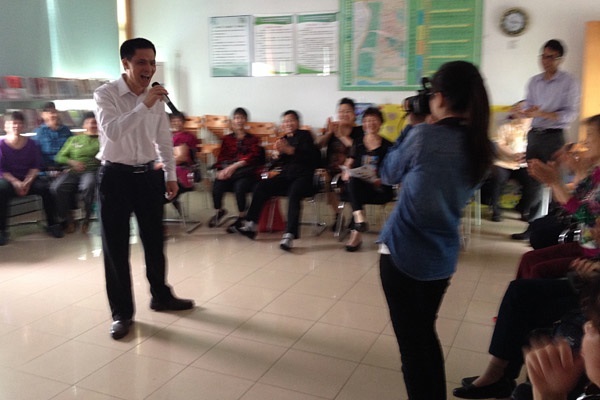
This morning I observed the Baishizhou Culture Station in action. Two groups of aunties were singing. The first group was singing Mandarin karaoke, the second group was singing an original Hakka composition entitled, “Resolutely Believing in the Party”. Later that morning the new Shahe Party Secretary came by, singing a karaoke song (“The Northern Spring”) and enjoyed the performance by the Xintang Hakka Mountain Song Chorus. Handshake 302 also presented our work to date.

The morning of community culture, including a Party Secretary karaoke moment reminded me that so much of Chinese political culture is making and maintaining good relationships between Party representatives and the represented. The pictures show the lyricist, the singing Secretary, and the Culture Center’s documentation of the event.

So here are the translated lyrics of “Resolutely Believing in the Party”. Note the definition of xiaokang–a basic material standard of well being. Note also in the picture that the lyrics have been written by hand.

Spring brings the fragrance of one hundred flowers, one hundred flowers
Everyone has a car and building, a house, a building and a house
Every kind of furniture
Three healthy meals a day, nutrition and health

Summer comes and the heat is hard to bear, the heat is hard to bear
Everyone has a fan or air conditioner, installed an air conditioner
No need to roast and sweat
We have electric slow cook pots for traditional soup, traditional soup

Fall comes and it turns cool, it turns cool
We wear fashionable clothes, fashionable clothes
Everyone carries a cell phone
Each home has internet and is linked to the world, linked to the world

Winter brings snowflakes to the mountain, snowflakes in the mountain
Reform and Opening is the promise of Spring, the promise of Spring
Resolutely believing in the Party
Beauty and happiness with the realization of xiaokiang, we’ve realized xiaokang

the winners of the mistress awards have been announced!

The results of the “National Awards for Mistresses (全国包二奶大奖赛)” spoof the time and money and presumably effort that some of China’s leaders have expended on accumulating mistresses. The results indicate that many have crossed that fine line between peforming masculine virility and paradoy, which in turn slides into corruption charges because no one actually believes these old men are achieving sexual satisfaction, let alone satisfying their young mistresses — the numbers are just too high. Indeed, the results seem more like baseball cards than gossip; we’re trading statistical representations of performance, rather than vicariously participating in the realization of desire (or actually enjoying a sunny afternoon game). I’m also wondering about how many of these leaders were simply pimping their way to business deals and higher political ranking because these statistics are invariably linked to corruption charges and convictions. Consequently, when available I’ve also linked the offenders’ names to English language reports about these cases.

Results of the National Mistress Awards

1. Quantity Award: Jiangsu Province Department of Construction, Xu Qiyao Director, Xu Qiyao (徐其耀) who has had 146 mistresses;

2. Quality Award: Chongqing Municipal Party Committee Department of Propaganda Director, Zhang Zonghai (张宗海)for having kept 17 beautiful co-eds in five star hotels;

3. Scholar’s Award: Hainan Province Textile Bureau Chief Li Qingshan (李庆善) for his collection of 95 sexual diaries and 236 illustrated guides;

4. Youth Award: Leshan Mayor Li Yushu (李玉书 Sichuan Province) for keeping 20 mistresses between the ages of 16 and twenty;

5. Management Award: Xuancheng Municipality Party Secretary Yang Feng (Anhui Province) for using his MBA to effectively manage 77 lovers;

6. Expense Award: Shajing Credit Union Manager Deng Baoju (邓宝驹 Bao’an District, Shenzhen), also known as the “5 mistress youth” for spending 18.4 million yuan over 800 days on mistresses, this averages to 23,000 perday or almost 1,000 per hour;

7. Solidarity Award: Zhouning County Head Lin Feilong (林龙飞 Fujian Province) for organizing a dinner for 22 mistresses and awarding a 300,000 prize for best mistress;

8. Harmony Award: Lingao Municipal Administration Chief Deng Shanhong (邓善红 Hainan Province) for having 6 children by 6 mistresses and a wife who says she doesn’t believe the gossip;

9. Effort Award: Hunnan Province Telecommunications Bureau Chief Zeng Guohua (曾国华) for guaranteeing that before he turns 60, he will have sex three times a week with each of his 5 mistresses.

dishing on sino-american relations

There is a current blurb flitting through virtual space about a fictional meeting between Xi Jinping and Obama, who has just finished watching an episode of CCTV’s popular 舌尖上的中国后 (A Bite of China). A friend described this parody of bi-lateral mis/understanding as hilarious, another called it an example of literary talent, and yet another as nugget of cultural truth so Chinese it could not be translated!

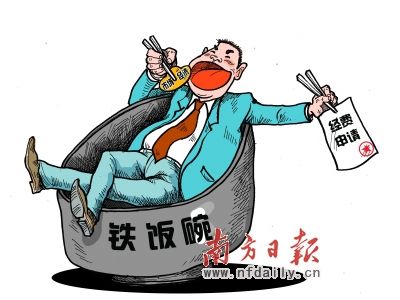
High praise for a political side dish. So, I decided to create a taste challenge for bi-lingual readers, adapting the piece from Chinese to English. Four political facts might enhance appreciation of the spoof: (1) Obama is just Obama, but Xi Jinping is always, “General Secretary”; (2) there is an important role for overseas Chinese figured by US Ambassador to China Gary Faye Locke (骆家辉); (3) subtitled episodes of A Bite of China can be viewed on Youtube, which remains off menu for those of us dining chez Cafe le Firewall, and; (4) General Party Secretary Xi never mentions the iron rice bowl (铁饭碗), an expression used to described the difficulty of removing officials from their posts. Also of note, the expressions emphasize the acting of eating, not food. Consequently, more colloquial English would use variously use “take” or “swallow” or “suck up” or “eat” to translate 吃 — and therein, perhaps, is an experiential entry into cultural differences structuring Sino-American misunderstanding.

After viewing “A Bite of China [literally China on the Tongue]”, Obama said to General Secretary Xi Jinping, “I’ve realized that although Chinese culture consists of extensive knowlege and profound scholarship, it is really an eating culture. Consider: a job is called a rice bowl, working is called living from hand to mouth (糊口); to be employed is called getting enough to eat (混饭), getting by in style is called eating with gusto (吃得开), and things that are liked are said to whet one’s appetite(吃香); to be taken care of is called eating from the little stove (吃小灶), to spend your savings is called eating your principle (吃老本) to take advantage of a woman is called eating tofu (吃豆腐); to depend on your parents is called gnawing on the old (啃老); a man who spends a woman’s money is said to eat soft rice (吃软饭); to overwork is to eat without digesting (吃不消), to take advantage of someone is to eat an advantage (吃亏), jealousy is called eating vinegar (吃醋); to dither is called to eat indesively (吃不准), to do substandard work is to eat dry rice (吃干饭), to take advantage of anyone is also to eat tofu (吃豆腐), to be taken advantage of is to have swallowed the disadvantage (吃了亏), to be afraid to speak up is called a mute eats coptis root (哑巴吃黄连). To have nothing better to do than make trouble for others is called overeating (吃饱撑), to make a decision is called Eight Wang eats the scales (王八吃秤砣), to ignore an order is not to eat soft or hard (软硬不吃), and to have reached one’s limits is called can’t swallow and slink off (吃不了兜着走).

General Secretary Xi interupted him and said, “We should speak about Sino-American relations. Are you talking about this because you’ve overeaten?”

Obama fainted at these words!

When Obama had recovered, General Secretary Xi earnestly said, “With respect to the importance of Sino-American relations, we will eat deeply and throughly, because we haven’t any principle to eat. The way of the world is that big fish eat little fish, but Cold War thinking is no longer appetizing, and cooperating for mutual benefit is the only way to eat with gusto. Only if China and the United States join hands will the benefits be eaten together. There are those who eat at our table and secretly help others; they eat from the rice bowl of harming Sino-American relations. We eat too much bitterness because they eat vinegar, making us eat with effort to establish a partnership. We have to learn from eating the moat (吃一堑长一智), and prevent them from eating from their bowls with their eyes on the pot. This will also let the world eat heart balls of reassurance. Mister President, are you still eating indesively about these matters? If not, I’d like to dine with you in this compound.”

Obama was speachless, and said after a pause, “It really is too deep to be predicted! Only the last idea could be expressed without the character for eating!”

Gary Faye Locke was standing nearby and couldn’t resist reminding Obama, “That’s because he was actually inviting you to eat!”

奥巴马看了《舌尖上的中国》,后对习近平总书记说:我发现中华文化博大精深,其实就是吃的文化。你看:岗位叫饭碗,谋生叫糊口;受雇叫混饭,混得好叫吃得开,受人欢迎叫吃香;受到照顾叫吃小灶,花积蓄叫吃老本;占女人便宜叫吃豆腐;靠长辈生活叫啃老;男人老是用女人的钱叫吃软饭;干活多了叫吃不消,受人伤害叫吃亏,男女嫉妒叫吃醋;犹豫不决叫吃不准,办事不力叫吃干饭, 占人便宜叫吃豆腐,被占便宜叫吃了亏,还不敢声张叫哑巴吃黄连。没事找事叫吃饱撑的,下定决心叫王八吃秤砣,不听劝告叫软硬不吃,收不了场叫吃不了兜着走。
习主席打断他说:我们应该讨论中美关系,你怎么尽说这些,是不是吃饱了撑的了?奥巴马一听,当即晕倒!
奥巴马醒来后,习主席语重心长地说:对中美关系的重要性,我们一定要吃深吃透,这方面我们没有老本可吃。世界的规则就是大鱼吃小鱼,但冷战思维已不吃香,合作共赢才吃得开。只要中美两强联手,一定赢者通吃。有些人吃里扒外,专吃破坏中美关系这碗饭,跟我们争风吃醋,让我们吃了不少苦头,建设战略伙伴关系更加吃力。我们一定要吃一堑长一智,不能再让他们吃着碗里看着锅里,也让全世界吃颗定心丸。总统先生,对这些你还有什么吃不准吗,如果没有,我很愿跟你在这个庄园里共进晚餐。
奥巴马目瞪口呆,半晌才说:果然深不可测!一席话只有最后一句没有吃字!骆家辉在旁忍不住提醒:总统先生,习主席最后这句话您听懂了吗,他是要您请他撮一顿!。。。

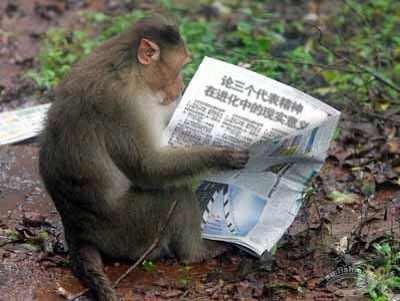
monkey see…

IMG_5155

The monkey is reading about the “three represents“, a direct dig at former General Party Secretary Jiang Zemin. And, if weixin memes are to be believed — if not totally, perhaps partially — then current General Party Secretary Xi Jinping is targeting neibu, or inner circle folks.

In fact, online Xi Jinping’s talks are repeatedly characterized as “strict (严厉)”. The adjective, of course, emphasizes the current administration’s explicit task to broaden reforms. In the aftermath of mixed messages, we’re still trying to figure out what that means. A larger political role for civil society and public debate? Or are we simply talking about a new purge? Excerpts of “strict” talking suggest the both/ and muddling of the current political landscape.

Of note? The ongoing use of classical CCP rhetoric to make veiled attacks on opponents. There’s a fight going on, but who’s the actual target? Also of note, The fact that the “Talk on the meeting about development work” took place in September, but the memes are still circulating. I received these memes yesterday.

A picture (for a sense of the Xi Jinping meme aesthetic), three excerpts and translation:

20139619571399354Today some people are using reform like a tiger skin, [frightening] the people so they don’t speak or make judgments. In my opinion, this is using reform for anti-reform purposes.

We’re not not reforming, we’re actually reforming, actually satisfying the people, pursuing a reform that will increase and further reforms. And what has been the status of reform these past years? Handcuffing productive capacities, perverted models of economic development, and serious environmental problems; we’re killing the goose [reform] that lays golden eggs.
The gap between the rich and poor is too wide. This is not only a problem of individual abilities, but also a result of unequal access to opportunity and power. All along we’ve been saying that we want to empower society, that we want to liberate productive capacity, that we want to realize sustainable development and a stable society, but we haven’t done anything because within the Party there are small mafias (的利益集团的黑手) who benefit too much from the current situation. Is a tiger willing to spit out the meat in its mouth? All that can be done is fight the tiger.

There are many such memes and, whatever the actuall status of Xi Jinping’s reform efforts, the memes resonate. What’s more, the memes are online, which means they have tacit support from the Center. Have we truly entered virtual political world of “monkey see, monkey reform”?

cold war ghosts in shenkong

For those inquiring minds that wonder, what was Shenzhen before it was Shenzhen, the opening scene from the 1963 classic Tracking Threats (跟踪追) reveals a threatened border and enemies whose souls have been twisted through betrayal. After the credits, the film opens with a scene of soldiers guarding the border and the Luohu bridge opening to allow peasants (and a spy) enter the country. From the filming, it is difficult to see immediately who the heroes and villains are. Instead, we find ourselves faced with a narrative tradition that begins with a social situation which the narrative gradually analyzes.

At the border, the guard opens an old woman’s bag, in which he finds a carton of cigarettes and candies. Suspicious, he opens the carton and discovers gunpowder hidden inside. Similarly, the candies also turn out to be decoys. The old woman protests that she’s never seen these items before. Her story is confirmed when another guard discovers an unclaimed bag, which includes toy cars that have been used to smuggle gunpowder

The security officer, Li Minggang leads a team to discover what’s happening. They follow the clues to the toy factory, where old Lin Dexiang works loyally. It turns out his nephew, Lin Yonggui was the spy who replaced the goods in the old woman’s bag. Li Minggang turns Lin Yonggui, who is used as a double agent to uncover the net of spies. This network includes refugees who try to escape to Hong Kong, smugglers of commercial goods, and of course, the evil chief spy, Xu Ying.

Tracking Threats was one of a series of movies that reflected the militarization of the Sino-British border during the 1950s. Indeed, between 1956 through 1958, the Guangzhou Security Department cracked several cases of Taiwanese incursions into Guangdong, and also discovered weapon stockpiles. During the 1960s, the Pearl River Delta Studio produced a series of red spy movies. The earliest, Secret Map (秘密图纸,1960) also filmed at the Shenzhen-Hong Kong border, but did not actually name the border crossing.

In retrospect, the Shenzhen-Hong Kong border in Tracking Threats seems claustrophobic and artificially patriotic à la contemporary North Korea. There is heroic music. There are poor but honest peasants. The military is distinctly noble. However, we know that by the mid 60s, China had already suffered famine and that Hong Kong had begun its economic reconstruction. Thus, during production filmmakers were not allowed to film the Hong Kong side of the border. Moreover, several peasants tried to take advantage of the filming and cross the border. They were, however, caught.

And yet. In Tracking Threats, the ideal of patriotism as a source of ethical thinking appears as pure and noble and good and far, far away from where we find ourselves in the post Cold War world.

In 2009, the earliest of the 1960s spy films, Secret Map was remade into a 30 episode television series (秘密图纸). Unlike the original movie, the television series opens with the spy murdering his godfather, who is portrayed as a Japanified elderly gentleman. The historic link, of course, was the Japanese colonization of Taiwan. In this way, the television series Secret Maps recodes race betrayals of Tracking Threats  as a question of generational betrayals (the godfather raising his godson to hate the Communists). In scene two, the spy, now a sympathetic anti-hero, washes up on the Shenzhen coast, where he is immediately captured by a beautiful revolutionary, a gaggle of peasants, and a noble peasant-soldier.

And there’s the interesting neoliberal rub: in the transition from 1960s Guangdong to new millennium Shenzhen, the Mainland-Taiwan conflict has been recoded as a story of misplaced love, rather than misplaced patriotism, while the desire for forbidden consumer goods has been naturalized. Indeed, that naturalization is precisely what makes the anti-hero sympathetic; he may have loved wrongly, but he knew what the fight was about. However, as in any good neoliberal bromance, love conquers all just before the anti-hero dies.
xi jinping rocks shenzhen

On his first trip out of Beijing, Xi Jinping visited Shenzhen and none of the streets or areas were cordoned off. And he walked the unguarded walk with Wang Yang, proponent of ongoing neoliberal reforms (transparency and ending corruption). Weibo went wild. As the two toured, Shenzhen residents swarmed taking pictures and uploading them to weibo, taking the trip as a sign that Guangdong may be the first Chinese provence to actually take on corruption.

“Anti-corruption” is, of course, the new content of political “reform”. Hence Xi Jinping’s explicit and repeated references to Deng Xiaoping. The trip itself inscribed the cartography of neoliberal reforms that are glossed as the Shenzhen Model, visiting the Qianhai Cooperation Zone and Tengxun’s corporate headquarters — both symbolize Shenzhen’s role emergence as a leader in new forms of international investment and high technology. In addition, Xi Jinping’s southern tour not only celebrated the 20th anniversary of Deng’s 1992 southern tour, but also included a visit to Luohu’s Yumin Village, the village that became famous during Deng’s 1984 tour. And in case anyone missed the point — Deng Xiaoping reformed Maoism, Xi Jinping will reform corrupt practices — Xi Jinping laid a wreath of flowers at Deng’s statue in Lianhua Park.

It is in this context that “no cordons” between the Party Secretary and the Shenzhen People resonated so strongly. One of my friends commented on the weibo posts saying, “If the biggest (老大) is willing to go out unprotected, the rest of them won’t dare to set up cordons!”

Another replied, “Well Comrade Jiang keeps himself safe.”

“Bah,” was the immediate reply, “He’s an old man, so we’ll give him face. That’s just a question of respect.”

This brief conversation hints at the cultural context of anti-corruption / political reform in China. Both friends were correct. On the face of it, Xi Jinping and new best friend Wang Yang are anti-corruption. Yet, they confront an entrenched power structure that doesn’t retire. All this conjecture matters because many of us are hopeful that Guangdong will be the first province to require corporations and public officials to release financial records to public scrutiny. This is being called “the clean government storm (廉政风暴)”, another reference to the Shekou Model, the Shekou Storm of 1988, when Yuan Geng protected students from investigation by visiting Beijing officials.

top ten concepts of shenzhen

On November 28, I participated in a symposium to celebrate the English language edition of Top Ten Concepts of Shenzhen (深圳十大观念 for Chinese i-pad version).

The production, organization and publication of the Top Ten have been very Shenzhen, so to speak. The Publishing House of Shenzhen Press Group (深圳报业集团出版社) created an online website, where people could vote for the slogans and campaigns that they though best represent the city’s history. These slogans and campaigns were then re-presented (re-issued?) as concepts that epitomize Shenzhen’s values and way of thinking. Thus, in his preface, Guangdong Provincial Committee Standing Member and Shenzhen Party Secretary, Wang Rong, “[T]he top 10 concepts are the concrete manifestation of the era’s zeitgeist and a vivid imprint of the reform and opening-up program.”

The ideological slippage from political slogans and campaigns to civic values and zeitgeist interests me because it points to Shenzhen’s simultaneously fraught and co-dependent relationship with Beijing. On the one hand, experimentation in Shekou and early Shenzhen legitimated ongoing policy debates in the Chinese capital. On the other hand, the Shenzhen model, specifically and the Guangdong model more generally continue to be at slight odds with the rest of the country. Specifically, Shenzhen continues to advocate a managerial approach to governance, promoting not simply business, but also entrepreneurship and a vibrant grassroots economy.

Two of the slogans did, in fact, challenge prevailing political currents and concomitant power structure. Yuan Geng provided the two most obvious examples — “Time is money, efficiency is life” (1981) and “Empty talk endangers the nation, practical work brings prosperity” (1992). The first was a clear challenge to the Maoist planned economy. The second not only expressed Shekou’s ongoing support of Reform policies, but also the industrial zone’s continued advocacy of talented young people with alternative ideas. The Top Ten discussion of “Empty talk” introduces the history of the Shekou Storm. At the time, Yuan Geng emphasized that while Beijing officials blathered on about ideology, Shekou youth were building the future. The decision to erect the “Empty talk” billboard in the aftermath of the June 4th Incident was especially telling because Shekou actively hired transferred hukou of intellectuals who had been sidelined for their support of students.

Nevertheless, thirty years later, those same slogans uncannily echo neo-liberal values throughout the world. “Time is money” quickly looses its oppositional potential when we remember that in Shenzhen, workers’ wages have not kept up with the price of housing; many white-collar workers are also unable to purchase homes. Likewise, “Empty talk” no longer seems  an effort to protect those with alternative ideas as it does the instruction to “suck it up”. It is therefore unsurprising that concepts 3-10 express the municipality’s ongoing efforts to promote neo-liberal neo-confucianism. More to the point, these concepts clearly resonate with Wang Yang’s call to deepen and extend neo-liberalism not only in Guangdong, but also throughout the rest of China.

I’m thinking that it is thus best to read the Top Ten as a list of double-edged swords. As political campaigns and slogans, the concepts reflect contemporaneous power games. “Shenzhen embraces the world”, for example, was a blatant attempt to justify outrageous spending on the 2011 Universiade, while “You’re a Shenzhener once you come” is the self-serving motto of the Shenzhen Volunteer Association; what exactly does it mean that everyone is a Shenzhener when less than 1/5 of the population has a Shenzhen hukou? However, when understood as exemplars of civic values and a city’s zeitgeist, the concepts illuminate cracks within the power structure and spaces for alternative practices, both in business and everyday life. Indeed, it would be wonderful if these slogans/values might in turn reshape Shenzhen’s neo-liberal juggernaut, creating spaces for legitimate political opposition and open debate on whither the next thirty years of reform.

The top ten concepts are: Time is money, efficiency is life; Empty talk endangers the nation, practical work brings prosperity; Dare to become the world’s first; Reform and innovation are the root and soul of Shenzhen; Let Shenzhen be respected for its enthusiasm for reading; Innovation encouraged and failure tolerated; Fulfilling the cultural rights of citizens; The fragrance of the rose lingers on the hand that gives; Shenzhen embraces the world; and You’re a Shenzhener once you come here.

China Daily and Shenzhen Daily coverage of the symposium online.

demise of the shenzhen youth herald

In April this year, Cao Changqing (曹长青 who now operates an influential Chinese language news source) posted “Bo Xilai’s Father Destroyed the Shenzhen Youth Herald (薄熙来父亲灭掉《深圳青年报》)” to commemorate the 25th Anniversary of the closing of the Shenzhen newspaper, where he began his career in journalism. The post was prompted by a conversations with Yan Jiaqi (严家其), who had been the Head of the Politics Department, the Chinese Academy of Social Sciences (中国社科院政治所长) during the 1986-87 student movement and was an advisor to both Hu Yaobang and his successor, Zhao Ziyang. Indeed, Yan Jiaqi himself would flee to Paris after his support of student protests in the 1989 democracy movement.

In the early years of reform, the Shenzhen Youth Herald was, along with Shanghai’s World Economic Herald (世界经济导报), one of the two most independent newspapers in China. Consequently, despite being a small newspaper, the Youth Herald had a national subscription base, providing Chinese intellectuals a platform for debating progressive ideas and evaluating ongoing experiments in reform Chinese society. On October 21, 1986, for example, the newspaper printed Qian Chaoying (钱超英)’s contraversial opinion piece, “I Support Commerade Xiaoping’s Decision to Retire (我赞成小平同志退休)”.

In the manner of traditional intellectuals, Shenzhen University professor of literature, Qian Chaoying’s writing style was sincere and humble, but the content was unmistakably radical. Moreover, the piece drew directly on and from Shenzhen’s experience, asking: Why must the People show our sincere and deep feelings for Deng Xiaoping by sacrificing further reform of the political system (为什么表达人民对小平同志纯朴深挚的普遍感情,就非要以延缓政治体制改革的进程为代价不可呢)? On Qian’s reading, Deng’s retirement would allow China to reflect on and establish a more just political system, a system that was more in keeping with the needs of reform, rather than a return to the cult politics, which had characterized the Cultural Revolution glorification of Mao Zedong.

Yan told Cao that Bo Yibo (薄一波, Bo Xilai’s father and one of the Eight Elders of the CCP) was not only furious about the opinion piece, but had also approached it as an attack the power of older and already retired leaders. During a meeting on political reform, Bo Yibo participated as a consultant. Zhao Ziyang was talking about the opinion piece with Peng Chong (彭冲). Upon overhearing the conversation, Bo Yibo became livid and is reported to have screamed at the younger leaders, “You are already fifty, sixty and seventy years old. We won’t die and you won’t rise (你们也五十六、七岁了吧?我们不死,你们也上不来).” Hu Qili (胡启立) was apparently so frightened that he immediately showed his support for the elders, wishing that the the old leaders of the proletarian revolution would live to a healthy old age (我们希望老一代的无产阶级革命家健康长寿). Importantly, at that closed meeting, Bo Yibo called for the Party to investigate who had written and the newspaper that had published the opinion piece. The word used, zhuicha (追查) meant to find out who Qian Chaoying was speaking for. Bo Yibo assumed that neither Qian Chaoying, nor the Youth Herald was acting as an independent voice, but rather was acting on behalf of one of the young reformers, most likely Hu Yaobang.

The opinion piece was published at a critical time in Central politics. Hu Yaobang and Zhao Ziyang, Deng Xiaoping’s “right and left hands” were pushing for further political liberalization. Less, than two months after the letter was published, students organized public protests across over a dozen cities in support of political and economic liberalization. Astrophysicist, Fang Lizhi (方励之) led the protests, calling for introducing political reforms that would ultimately end the one-Party system and the continuing use of government as an instrument of Party policy. Two other intellectuals, Wang Ruowang (王若望) and Liu Binyan (刘宾雁) also led the intellectuals. It is said that Deng disliked Fang, Wang, and Liu, directing Hu to dismiss them from the Party, but Hu refused. In the fallout, Hu was forced into retirement because it was said he had been too lenient with student protestors. The Shenzhen Youth Herald was also one of the victims of the 1987 crackdown. The Shenzhen Youth Herald was closed and Cao Changqing banned for life from working in journalism at the same time that Hu Yaobang was forced into retirement. Two years later, the Tian’anmen protests would begin when students gathered to eulogize Hu Yaobang. The now defunct World Economic Herald published an article supporting the students’ call to re-evaluate Hu’s legacy.

the chief eats a fish

So a translation of a story making the rounds, again. The Chief Eats a Fish first appeared at the end of 2011 and keeps circulating. Fish, of course, is a common pun for “extra, or too much”. Of note are the different ways that each of his subordinates addresses Chief Yu and the way that puns function, making the social body out of different parts of the fish. Nevertheless the satire speaks for itself.

 The Chief (局长) Eats a Fish

The weekend had come and as was their custom, the work unit staff gathered to dine. According to Chief Yu this activity was “going deeply into the lowest levels of society (深入基层)” and the best shortcut for connecting with the masses.

Chief Yu loved to eat fish, which was of course on the menu. They had drunk three rounds of wine and five different dishes when the fish was served. The waitress knew Chief Yu and so she made sure that the fish head was directly facing him. Without waiting for anyone’s input, he immediately drank three cups of wine (fish head wine is a colloquialism which means “delicious wine”). When he had put down his wine cup, Chief Yu began to allocate the fish.

Chief Yu used his chopsticks to pluck out the fish’s eyeballs with practiced ease. He gave an eyeball each to the people on his left and right. He said, “this is known as the far-seeing eye. I hope the two of you will act in concert with me.”

The two vice-chiefs smiled and gave the Chief their heartfelt thanks, saying, “Chief Yu we will not let you down and will completely support the work you have begun.”

Chief Yu removed the fish skull and presented it to the Head of Accounting, saying, “this is known as the axial column. You are the key worker in our department so of course I’m giving it to you.”

The Head of account was surprised to be treated so well, but said, “Thanks, boss.”

Chief Yu gave the pretty mouth to his “young cousin”, saying, “The lips and the mouth rely on each other (唇齒相依)”, which is a traditional proverb to express the idea that two people cannot get along with each other.

The Chief’s “young cousin” shot him a flirty glance and said, “Thank you older brother Yu.”

Chief Yu gave the fishtail (wei 尾) to the office manager, making a pun on the expression, the committee takes responsibility (wei 委以重任). The office manager was completely grateful and said, “Thank you, elder.”

Chief Yu gave the fish stomach to the assistant (fu 副) head of the planning department, again making a pun, “this is called treating others with sincerity (推心置腹 – fu is also the character for stomach).” The assistant head dipped his head and replied formally, “Thank you Chief.”

Chief Yu gave the fins to the administrative director, saying “open your wings an fly. You are the nearest to our Chief and so will definitely go higher everyday.”

The administrative director a huge smile saying, “I hope that the Chief will give me the necessary support.

Chief Yu gave the fish buttocks (ding 腚) to the union chair and said, “If you hold the course, there will be happiness in the end (ding 定有後福).”

At the end of the allocation, all that was left was a picked over slab of meat. Chief Yu smiled bitterly and shook his head, saying, “I should probably take care of the leftovers, after all that’s what a Chief does.”

More Princeling drama: Guagua returns and possible public appearance by Bo Xilai

Yesterday, Epoch times reported that the FBI repatriated Bo Xilai and Gu Kailai’s son, Bo Guagua. Why should we care?

Before the 18th National People’s Congress opened, the Party had stripped Bo Xilai of his Party standing and his post, which is called “double removal (薄熙来双开)” and sentenced Gu Kailai to death, with a two-year probationary period. So one would think that the Congress would open and the folks at the top would get on with sentencing Bo Xilai and making official appointments. However, the 18th NPC has opened and we still don’t know what exactly is happening.

We can speculate, however, that with the repatriation of Guagua, apparently the United States has decided to help Hu Jintao and Xi Jinping do whatever it is they’re doing behind closed doors. It may be that Gu Kailai was actually poisoned, and Guagua needs to give evidence. It may also be that he knows something about his parents’ affairs. More importantly, whatever the legal reasons for dragging Guagau back home, the fact of his return seems to indicate that Hu Jintao and / or Xi Jinping have decided to break with Deng Xiaoping’s famous decision to spare Zhao Ziyang’s children from prosecution in the post Tian’anmen era.

Common wisdom holds that given the decision to deploy the military to squash the protests in 1989, Deng Xiaoping had no other option than placing Zhao Ziyang under house arrest. Nevertheless, he expressed his solidarity with his former protege by announcing that investigations into Tian’anmen would not include the children of prominent leaders. In fact, in the post-1989 era, Zhao Ziyang’s daughter, Wang Yannan (王雁南) has been active campaigning for the rehabilitation of her father and other leaders.

Deng Xiaoping’s decision to spare Zhao Ziyang’s four sons, let alone his wife and her family reflected a modern understanding of the family. Traditionally, when high-ranking officials were sentenced, the victims included “executing the nine branches of a lineage (灭门九族)”. Chinese kinship traditionally reckons lineage through the father-son relationship (agnatic descent-家族), but also distinguishes branches within the lineage through mother-daughter-and sister marriages (嫁). The nine kinship branches (九族) are:

  1. Father’s family, four kinship branches — self (kinship branches counted from eldest and other sons), married paternal aunts and cousins, married sisters and sisters’ children, married daughters and grandchildren;
  2. Mother’s family, three kinship branches — mother’s father’s family, mother’s mother’s family, and mother’s sister’s family;
  3. Wife’s family, two kinship branches — father-in-law’s family and mother-in-law’s family.

Obviously, contemporary Princeling court dramas are different from the Confucian first, second, third, and fourth wife scenarios a la Raise the Red Lantern (movie and book). This is why Bo Xilai’s first wife, Li Danyu could gossip with New York Times reporters about Bo-Gu family intrigue, while her and Bo’s eldest son Li Wangzhi can continue cattle farming. However, more colloquially, Guagua maybe be one of the implicated (株连) simply because his father has no other weakness and has yet to admit that he was wrong. After all, Gu Kailai did confess; Bo Xilai has made no public apologies or admissions of error.

Speculation du jour, if Princelings benefit from family connections, perhaps they can also be used against each other, especially against those like Bo Xilai, who might not otherwise bend. Bo Xilai will be sentenced in Guizhou, Guiyang. So to speculate even further, weibo has it, that on Monday, Oct 15, Bo Xilai will appear publicly in Guizhou, and inquiring minds want to know: how is this appearance connected to his younger son’s return?