architectural thinking — from the nanjing sun yat-sen memorial to luohu train station

One of the highlights of the XLarch Masterplanning the Future Conference was Wang Yun (王昀)’s keynote speech that periodized the development of Chinese style architecture, arguing for an internationalist approach to architecture, rather than an ideologically charged use of architectural symbols.

As an architectural style, Chinese classicism was invented by western trained architects who upon returning to Nationalist China received commissions to build “Chinese style (中华风格)” buildings during the decade of 1927-1937. These buildings had large, Chinese style roofs, windows and decorative details, and sometimes included stylized gardens. The Nationalist capital, Nanjing was the location of some of the most important examples of this style as well because commissions not only represented individual client preferences, but also the determination of government leaders to create a recognizable Chinese public architecture.

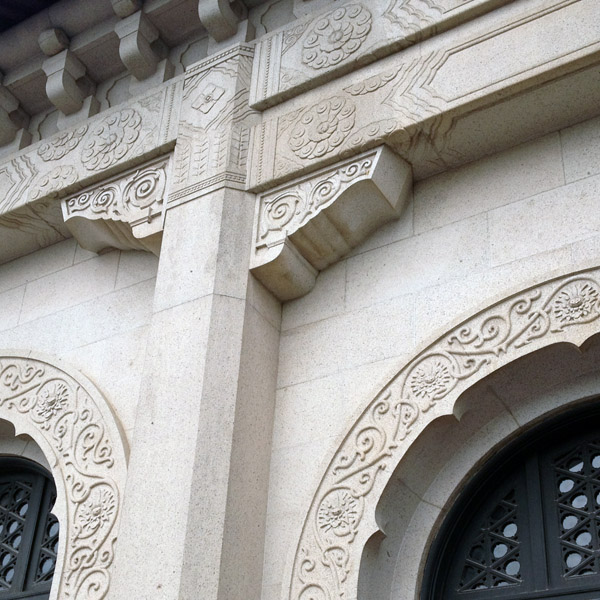
One of the most important examples of Chinese classicism is the Nanjing Sun Yat-sen Memorial, which was designed by one of China’s first starchitects, Lv Yanzhi (吕彦直). Lv also also designed the Guangzhou Sun Yat-Sen Memorial before his untimely death in 1929. The Nanjing Memorial reinterprets traditional themes through choice of material (reinforced concrete and mosaic tiles) and through the secularization of traditional symbols (animals become geometric shapes, for example). In addition, the Memorial layout abstracts and represents Nationalist China as the difficult realization of Dr. Sun Yat-sen’s three principles of the people (三民主义) — nationalism, democracy, and public welfare. To reach the Memorial proper, for example, there are 392 steps going upward, each step representing one million Chinese, and together representing the population of nationalist China. These steps are broken by eight flat platforms, which represent the fragmentation of China by warlords and civil war. However, when one looks back on the stairs, all one sees is a flat surface, an optical illusion that promises national unification.

The Nanjing Sun Yat-Sen Memorial provides a lexicon for understanding Chinese Classicism during the Nationalist era, including the reference to the Lincoln Memorial (1920) by way of the seated figure of Dr. Sun (1926-29). Not unsurprisingly, perhaps, the Lincoln statue also dominates a neo-classical building, albeit through references to Greek architecture. Indeed, both the Sun Yat-sen and Lincoln Memorials use the respective classicism of their countries to assert timeless governance, even as they commemorate leaders who governed countries divided by civil war.  I show the following images of the Nanjing Memorial with the caveat that they are not architectural — an architectural photo has amazing resolution, geometric composition, and absolutely no people, unless, of course, the figure contributes to architectural exegesis. My snaps, however, aim to emphasize just how popular this site is and thus how it continues to shape the visceral experience of being in “China” through a particular architectural style.

This slideshow requires JavaScript.

How does the Nanjing Memorial relate to Shenzhen?

This architectural lexicon has been picked up, tweaked and redeployed throughout Shenzhen, but as a private rather than public source of architectural symbols. The Luohu Train Station is the only exemplar of public Chinese Classicism that has been built in Shenzhen in the Reform Era. The other large example of post Reform classicism is the Hongfa Temple in Fairy Park, which is arguably political in its adamant denial of any political message. Certainly, in its assertion of the reintroduction of official religion to civic life, Fahong was as ideologically charged as the train station, which signaled China’s opening to capitalist countries. However, with the exception of these two buildings, Chinese Classicism in Shenzhen is limited to decoration in urban villages, where many handshakes have tiled roofs, restaurants, and the odd sculpture, such as Nvwa Holding up the Sky in Shekou, which is a socialist realist rendering of a mythic theme.

All this is interesting because given the explicit modernism of Shenzhen’s public architecture, the rediscovery or explicit use of Chinese tradition and roots are often used in neoliberal arguments for alternative forms of architecture and historic preservation. Chiwan comes to mind as do struggles for some form of preservation in urban villages. These efforts contextualize the design and construction of key civic architecture, including the Civic Center and central axis, which has the ideological expression of Reform and Opening (here, here, and here). Importantly, both the relentless modernization of Reform era public buildings and the alternative movement to construct a classical past for Shenzhen ignore Maoism, which nevertheless continues to inform the built environment.

good bye urban village, hello middle class

The ideological consolidation of Shenzhen’s middle class identity continues. Of note is the subtle repositioning of urban villages as sites of upward mobility that have outlived their social usefulness, rather than as the home village of local people. This is particularly interesting because efforts to map Shenzhen’s cultural heritage through the history of local villages have also intensified.

At the OCT B10 Gallery, for example, the Zeus Cultural Communication Group has installed a photography exhibition “Goodbye Urban Village (再见城中村)”, which was part of ceremony to celebrate the commencement of production on an eponymous film. As a company, Zeus specializes in filming large-scale documentary films and documenting engineering projects and “Goodbye Urban Village” will document urban renewal projects in several Shenzhen urban villages.

The images have been mounted in various formats — actual printed photographs, large wall posters, and backlit windows. The content of the images, however, is consistent: the daily life of urban migrants. In the forward to the exhibition catalogue, Zeus CEO Zuo Li provides the ideological gloss for exhibition visitors, “The truest moment in any urban village is that everyone who has made the leap here – man or woman, elder or child, is arduously struggling for a better tomorrow (城中村里最真切的落点,是每一个跃动在这里的身影--男女老少都在为明天艰辛地努力着)”.

Zuo Li’s gloss highlights two sites — migrant bodies and architecture — where new discourse about urban villages semiotically parses them into two, distinct elements of Shenzhen identity — rural migrants and local heritage.

With respect to the representation and ideological construction of a stereotypical urban villager, urban village residents are identified as migrants, who have come to pursue the Shenzhen dream of a better life. A series of portraits literalizes this understanding as young workers pose next to a sign in which they have written their job, salary, length of time in Shenzhen, and dream. These scenes of everyday life relentlessly publicize what in middle class homes are kept private. We see, for example, people sleeping and eating, children playing and urinating, friends playing cards, local security apprehending someone, and prostitutes resting.

Concomitant with this fascination with the display of “real life” in the urban villages is the marked absence of images of Shenzhen locals. This absence is particularly glaring when we remember that as recently as five years ago, photographers still took pictures of village holidays, ceremonies, and festivals to include in discussions about urban village life. Today, those images have been naturalized as local heritage and appear in magazines, travel blogs, and, of course, the Shenzhen Museum.

With respect to the representation of urban villages as human settlements, the urban village environments that are presented are decrepit and dank, and the images overwhelmingly dark, except for moments of muted color. Indeed, many of the pictures frame the human subject with handshake building walls and the garbage that hangs from overhead wires. Again, absent from these images are recent renovations, such as those at Xiasha or Huanggang, where village ancestral halls, temples, small parks, and plazas provide the historical links between contemporary Shenzhen and “ancient” or “traditional” China.

Extant urban villages place middle class Shenzheners in an ideological conundrum: on the one hand, Shenzhen’s rise continues to represent the fulfillment of rags-to-riches dreams. On the other hand, many of those who are now rich want to take the rags out with the trash, cleaning up the environment. The social justice question, of course, remains does cleaning up the environment mean making urban villages sites of clean, convenient and affordable housing? Or, does cleaning up the environment mean transferring urban village land rights to real estate developers and forcing residents to less convenient sites outside the downtown area?

The representational choices made in the Goodbye Shenzhen photography exhibition ellide the important question of the place of (or a place for?) urban poverty in Shenzhen. Instead, they reframe migrant dreams of a better life as being already realized in the anticipated jump from neighborhoods of handshake buildings to those of glass and steel.

In keeping with the theme of exploring the ongoing rise of Shenzhen’s middle class identity, it is interesting to view this show along with the Kojève exhibition in the OCAT Contemporary Art Center. The most obvious difference is the respective intended audiences (OCAT has translated its program into English, while Urban Villages has not). However, at the level of content, the two shows are uncannily similar. OCAT offers Kojève’s photographs/postcards of post-historical spaces and Urban Villages provide realist documentary of Shenzhen’s anticipated past. In both exhibitions, we find ourselves positioned to look at what no longer exists.

The urban village photography exhibition will be up through Saturday September 29. Kojève will be up through November 16.

三打两建:ideology in guangdong

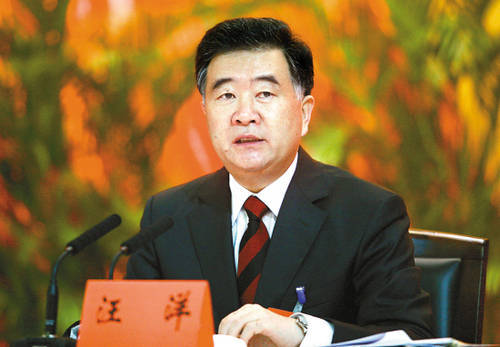
Guangdong Party Secretary, Wang Yang has been busy shoring up his position as a reliable, upstanding, and neo-liberal party member.

Since February this year, all of Guangdong has been engaged in “three attacks and two establishments (三打两建)”, a movement that has its own, quite extensive website. The three targets of attack are “illegal monopolization of the market through violence (欺行霸市)”, “manufacturing and selling fake goods (制假售假)”, and “commercial bribery (商业贿赂)”. The two principals to be established are “a system of social trust (社会信用体系)” and “a system of market oversight (市场监管体系)”.

It seems on first glance a call to rationalize highly local systems of production, consumption, and regulation because I have usually seen movement banners in urban villages, rather than in malls, making villagers the target of Guangdong’s current ideological movement. For example, “illegal monopolization of the market through violence” and “commercial bribery” seem to be descriptions of how markets and shops are actually run (with their reputed mafia ties) in villages. Likewise, “manufacturing and selling fake goods” also seems to be located in villages, with low-level investors setting up shanzhai factories in older, under the radar of municipal oversight spaces and then distributing these goods through local outlets. In contrast, the double aim to establish systems of trust and market regulation point to the government’s determination to bring all production, distribution, and consumption under a system of generalized oversight.

Currently, Shenzhen’s villages have all been incorporated into the municipal apparatus and villagers given citizen status. However, to the extent that industrialization in the Pearl River Delta has created rich villages that cultivate loyalty to the collective (or extended family) rather than to the state (as an abstract system), the next step in rural urbanization has become transforming villagers into citizens. Currently, one of the defining characteristics of a citizen in contrast to a villager is that “citizens” position themselves with respect to national laws (shared with strangers), while “villagers” position themselves with respect to traditional values (shared with familiars and intimates).

Point du jour, an important task of Chinese governance has become shifting how the state interpellates rural residents, hailing them as individualized “citizens”, rather than as collectivized “farmers” even when and despite the fact that many villages (such as Xiasha) are investing in symbols of collective identity, and the “urban village” has become a stereotype of Shenzhen cultural identity.

accidental exhibition, thoughts on the 7th sz sculpture biennale

Co-curated by Liu Ding, Carol Yinghua Lu, and Su Wei, the 7th Shenzhen Sculpture Biennale, Accidental Message: Art is Not a System, Not a World (偶然的信息:艺术不是一个体系,也不是一个世界) has two sections, “Unexpected Encounters,” which presents the curators’ take on pivotal Chinese work from the 90s, and “What You See is What I See,” which showcases international artists with whom the curators have engaged over the past few yeas.

Liu Ding and Carol Yinghua Lu have written that their decision to juxtapose 1990s Chinese artwork with recent global artwork (including several Chinese artists who now travel on those circuits) in terms of a “secret glue” and the “mental bonds” that exist between creators, rather than needing “to be delineated according to artificial art politics and planned boundaries of the art system (exhibition catalogue page 25).” In other words, this is not an exhibition about the developments in sculpture over the past two years, or even about placing sculpture into conversation with other medium to get a sense of how digital art and video (the two strongest elements in the show) have reshaped our appreciation of what Benjamin once identified as sculpture’s yearning for immortality. Instead, Accidental Message is a celebratory catalogue of the desires, taste and experience of three people.

I actually get the curators’ urge to categorical disruption and their yearning for “unexpected encounters, chance glances, open hearts and respect for individuals (p 25)”. We all of us want to be recognized as unique personalities, creating connection through idiosyncratic gestures and resonating heartbeats. Nevertheless, I’m pretty sure I get the impulse for random hook-ups because alienated, individual and individualizing subjectivity and celebration thereof are symptoms of neoliberal political economics and I was raised in the neoliberal suburbs of New Jersey and currently reside in a neoliberal with Chinese Characteristics Shenzhen neighborhood, [1] where pleasure is derived by crafting oneself into a subjectivity that can be picked up and broadcast over diverse, global networks, unhampered by borders or culture or paychecks or jobs or even history, in short to become a “creation of serendipity and individual spirit.”

Thus, point du jour is actually quite simple. Liu Ding, Carol Yinghua Lu, and Su Wei did not randomly encounter artists and ideas, but did so within the institutional context of art schools and certification, art grants and residencies, and arts funding choices, all which increasingly reflect the ongoing privatization of art for the benefit of corporations and their shareholders.

This year’s show, for example, coincided with the decision to rebrand the Shenzhen International Contemporary Sculpture Exhibition as the Shenzhen Sculpture Biennale and hold it at the Overseas Chinese Town Contemporary Arts Terminal and B-10 gallery. OCT is a major Shenzhen real estate developer that has marketed itself through appeals to high cultural consumption, personal taste, and of course individualized pleasure. Indeed, the event also signaled the general upmarketing of OCT culture industry as an integrated component of its real estate projects. OCAT has been formally established as an independent, not-for profit art museum and as Overseas Chinese Towns (now a recognizable lifestyle brand) develop across the country, the Museum will take the lead in creating a series of art centers under the “Art Museum Cluster Program,” which the curators will take an active lead in developing.

Accidental Message runs until August 31. I enjoyed some of the pieces. I worry that taken as a whole, however, the show is not as subversive as the curators hoped, but instead exemplifies “business as usual” in Shenzhen’s push to become a player in global cultural industry. I close with impressions, below:

This slideshow requires JavaScript.

[1] In her paper Enjoying Neoliberalism, Jodi Dean provides a relevant definition of neoliberalism as “…an economic doctrine that channels state intervention toward the elimination of projects of social solidarity in favor of privatization, economic deregulation, tariff reduction, and the use of public and monetary policy to benefit corporations and their shareholders.”

The Violence of Childhood

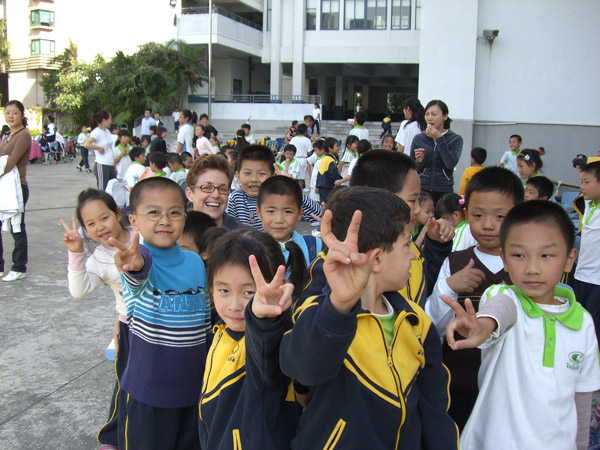
In talking with people about sociocratic principles, I find myself reminicing about my time as a vice-principal or college councelor and am once again reminded of the violence of childhood and how that violence shapes our understanding of governance because governance is, ultimately, about figuring out how to live together.

I have a clear memory of a first-grader who didn’t like math. Not hard to understand from my US American perspective perhaps, but unacceptable from the perspective of his parents, teachers, and other Chinese adults in his life. The reasoning was both psychological and pragmatic: to excel in math, self-confidence was important and the best way to develop self-confidence was through high test scores. Moreover, the logic continued, elementary math tests were simple and so there wasn’t any reason, except perhaps laziness or stubbornness for a child not to do well in math.

The boy’s first grade math scores were low by local standards; he was averaging between 88 and 93ish on tests, but his classmates were all forging ahead with perfect scores plus extra credit and, a friend helpfully reminded me, in elementary school most students received over 95 on math tests. Clearly the boy had a problem. Nevertheless, his parents were progressive in that they believed that if a student liked a class, he would do better in it and so it became imperative to talk their son into liking math. They thought that if he liked math then he would (1) stop being lazy and work harder and (2) stop resisting their efforts to make him do extra math problems and cooperate with his tutor.

So the parents talked to him. His grandparents talked to him. His teachers talked to him. Several months into this process, they scheduled a meeting with me so that I too could talk him. Nobody actually listened to him.

At the time, I spoke directly to the parents suggesting that the boy had a responsibility as a student to work hard in class and finish assignments, but had no corresponding obligation to like math or spend time each week with a private tutor preparing for Olympic maths, I was told that (1) I was too idealistic and (2) I was American and didn’t understand Chinese children. What didn’t I understand? The importance of elementary school math test scores? They aren’t actually important. And thus, our conversation came to ignoble cross purposes and the boy continued to dislike math and do relatively poorly at it. Over the next few years, parental and teacher conversations escalated into scolding and punishments, although to my knowledge the boy was never beaten for his math scores.

In retrospect, I think the boy’s parents were trying to tell me that I hadn’t assuaged their fears for their son’s future. I’m not sure I could have because for them math tests symbolized future potential to navigate the “real world”. What would happen, the analogy goes when a child went out in the real world, where life tests weren’t simple and failure meant… although this is actually where the logic stumbles because no one knows how low math scores might ultimately destroy a human life. The immediate source of parental fear seemed to be that if the boy didn’t excel in elementary math, he would do poorly on the Shenzhen high school entrance exam, subsequently do poorly on the gaokao, and then end up in a vocational school or worse, laboring as a construction or sanitation worker. Although here again, the logic blurs, because in Shenzhen rural boys who fail to get scholarships to high school end up working on construction sites and although these same rural boys also collect garbage, cleaning jobs go to rural girls who fail to get high school scholarships. In contrast, the boy’s parents were actually worried that the boy couldn’t do better than getting into a foreign university equivalent of Shenzhen University.

I regret that I didn’t actively listen to either the boy or his parents. Its possible that with more practiced skills I might have helped the boy come to terms with the inevitability of classes we don’t like and how to deal with contradictions between our feelings and our responsibilities. I might also have helped his parents have more reasonable expectations for their son’s test scores and a more respectful attitude toward his likes and dislikes; not their job to tell him how he feels.

When we don’t actively listen to children, we teach them that their desires and fears and joys and accomplishments aren’t important. What matters is that they fit into our graded boxes. Clearly the boy’s parents didn’t care if he actually liked math, they simply wanted to find a way of achieving better test scores. They disagreed with traditions of forcing a child to something he didn’t want to do, and so the solution seemed to be forcing him to like it, so that he would then become a pro-active math student. Equally clearly, I didn’t care about the parents’ fears, I just wanted them to stop wasting my time lamenting a first grader’s math scores. I disagreed with their valuation of exams and didn’t see any way of convincing them that disliking math is okay and thus the solution seemed to be getting them out of my office as quickly as possible.

And there’s the rub: I’m starting to understand the violence of childhood as the lack of respect we have for children’s abilities and desires. And this lack of respect blossoms into grown-up inabilities to actually resolve problems in ways that nourish each other’s lives. His parents left my office more deeply convinced that a huge cultural gap separates Chinese and US American people. I remained in my office anxious that another set of parents would schedule a meeting to talk their daughter into liking a difficult subject, like English. But what seems to have actually occurred was another instance of childhood violence in which none of us adults had the wherewithal to help a six year old learn simple concepts of addition and subtraction.

渔一村:of old men and the landfilled sea

Yesterday’s bloggy romance with the sea continues and although I have shifted my gaze from Cuba to Shekou, it is worth mentioning that the writers’ emphasis on masculine conquest continues; today, in episode 8 of The Transformation of Shenzhen Villages (沧海桑田:深圳村庄三十年), Chen Hong tells the story of Fishing Village 1 (渔一村), Shekou. Again, the story begins in a village, but this is also where similarities between the two narratives end. Hemingway figured human life through the isolated figure of an old man navigating the Caribbean on a rickety skiff and superstition. In contrast, Chen Hong figures humanity through the construction of ports, trading ventures and the world-making connections that they enable, suggesting that the opportunity to launch one’s skiff is itself a political decision which once made determines the fate of villagers. For those who remember the 1988 television documentary, River Elegy (河殇) which linked China’s decline and ultimate humiliation to the Ming decision to ban maritime activity, a not-so-subtle critique of Maoist isolation, Chen Hong’s passion for the sea and the [free trade] world it symbolizes is self-evident.

Episode 8 opens by juxtaposing images of Ming and Qing trade centered on Guangzhou with pictures of the construction of Shekou, reminding viewers that Zheng He (郑和) set forth from or loaded supplies at Chiwan Port at least five times. Lest the viewer forget the consequences of isolation, the opening sequence ends with bleak, black and white footage of a backwater port, overgrown and clogged with weeds, small wooden boats berthed in stagnant waters. Boom! The first explosion opens the door to new world order, which is also, new village order.

Traditionally, the villagers of Fishing 1 weren’t actually villagers but individual fishing families who lived on boats, coming onshore to sell the day’s catch. Families came from all over the Pearl River Delta forming a community through their livelihood, rather than through ancestry or even a common version of Cantonese. However, in 1959, the political decision was made to organize them as a brigade (生产大队). They were 90 households with a total population of 450 people and settled as four small production teams (小队) in Nantou, Gushu, Neilingding Island, and Shekou. The Fishing Brigade worked to modernize the fleet and in 1978 during a meeting on scientific production, Hua Guofeng actually gave the brigade a first place award. Indeed, at the beginning of Reform, the Brigade had 69 ocean fishing vessels, 72 transport ships, and 18 oxygen boats that fished the South China Sea and Pearl River Delta bringing in fresh seafood for Cantonese dishes and by 1992, had accumulated enough capital to invest in modern industrial deep sea fishing vessels.

From 1978 through 1986, the Fishing Brigade lived the socialist dream, which was a traditional Chinese dream; the men fished, going as far away as Guangxi, the women kept house, children went to school and had medicine, and all ate in a common canteen, where the work team provided delicious food, including squid and shrimp. The system was called the 8 provisions (八包). However, by the late 80s early 90s, the scale of urbanization and land reclamation meant that traditional fishing areas had been contaminated and fish breeding grounds buried, and it was impossible to continue living from the sea. Suddenly, the advantages of the sea declined as property values soared and Fishing 1 faced a contradiction that many other villages would eventually face — what to do when urbanization decimated the conditions of traditional livelihood?

Once the sea was gone, Fishing 1 had no way of making a living because it did not have any land, except for that which the government had given it for housing in 1959, including a section on Neidingling Island, which Fishing 1 decided to develop as a resort and in 1992 as part of the guannei rural urbanization movement, the Fishing Brigade became the Fishing 1 stock holding corporation. However, after Fishing 1 had already invested their accumulated capital and borrowed against the development, Shenzhen and Zhuhai began a court case over who actually owned the island. Traditionally, the Island belonged to Zhuhai. However, in 1955, the Center had assigned Neidingling to Baoan, but no one could actually prove whether or not the transfer had gone through until 2002, when a copy of 1955 decision was found. In 2009, the Guangdong Provincial government finally ruled in favor of Shenzhen’s claim to Neidingling Island. However, the case raged long enough to impoverish Fishing 1 as the joint stock corporation/ fishing brigade/ village could no longer fish and except for Neidingling had no other traditional land rights. Indeed, by 2009 when the case was settled, Fishing 1’s deep sea fishing rights had already been bought out by China Merchants, which in turn sold them to Wanxia, one of Shekou’s original land-based villages.

And so here’s the neoliberal twist in Chen Hong’s story of old men and their vanishing sea: Fishing 1 re-entered Shenzhen urban planning as part of the Together Rich Project (同富裕项目), and over the past decade restructured and invested elsewhere: an industrial park in guanwai Gongming and fish breeding farms in Zhanjiang, for example. In addition, the Municipality organized training for fishermen to learn new skills. Nevertheless, the members of Fishing 1 have not only been proletarianized over the past 30 years, but are still paying off one of the debts that fueled Shekou’s growth. After all, Fishing 1 had no rights to any of the coastal property developments that enriched both China Merchants and neighboring Wanxia Village. Instead, Episode 8 ends with exhortations — from the Municipality and from the filmmaker — for individual development and initiative, ironically and inexorably returning us to Hemingway’s sea, where old men struggle feed themselves because they have been isolated by .

For more on my obsession with Houhai Land reclamation, more entries, here. A wander through the earliest Shekou landmarks, including the Shekou and Neilingding fishing families settlements, below:

This slideshow requires JavaScript.

the secret to happiness…

Yesterday, Guangdong Party Secretary Wang Yang (汪洋) addressed the 11th Guangdong Provincial Congress of Party Representatives, making five statements which have set him apart from other high-ranking leaders. Once a rival of Bo Xilai for a place in the 18th Naptional People’s Congress appointments, Wang Yang has also made his gesture to gain the support of the people. However, where Bo Xilai went poor populist, Wang Yang’s speech has me remembering the Province’s historic role in the 1911 Xinhai Revolution, when 100 years ago, with its links to overseas Chinese and relatively advanced economy, Guangdong was the cradle of China’s bourgeois revolution, in contrast to the rural uprising that Mao Zedong transformed into a socialist revolution. Wang Yang is a leader for China’s emergent and increasingly vocal middle class. And yes, many of them live in the Pearl River Delta.

Wang Yang’s Five Statements

1. The People are the agent that makes history, as well as the agent that constructs and enjoys Happy Guangdong. The people have the right to pursue happiness; it is the responsibility of the Party and the government to benefit the People. We must discard the mistaken idea that the People’s happiness is a result of the Party and government’s benevolence. (人民群众是创造历史的主体,也是建设和享有幸福广东的主体。追求幸福,是人民的权利;造福人民,是党和政府的责任。我们必须破除人民幸福是党和政府恩赐的错误认识.)

2. We need to discard unwritten rules and bad habits, creating a just, lively, and orderly social environment, where those who follow the rules don’t suffer, where talented people can take the lead, and can pursue and create their own happy life to the best of their ability. (破除潜规则陋习,创造公平公正、活力有序的社会环境,让守规矩的人不吃亏,让有本事的人有奔头,各尽所能地追求和创造自己的幸福生活.)

3. The greatest threat to the Party’s long-term political control is becoming too far from the masses. Our Party can only achieve eternal success to the extent that it comes from the People, is rooted in the People, and serves the People. (党长期执政的最大危险是脱离群众。只有始终坚持来自人民、植根人民、服务人民,我们党才能永远立于不败之地.)

4. We need the courage to use personal revolution to firmly destroy the interests that have turned their backs on socialist market economic reforms in order to resolve problems of government agents exceeding their function, absenting their function, and mistaking their function, making government into a provider of public goods and services. (我们要以自我革命的勇气,坚决打破背离社会主义市场经济改革方向的利益格局,解决政府职能越位、缺位、错位等问题,使政府真正成为公共产品和公共服务的提供者.)

5. Guangdong’s market society has already begun to change… If we take hold of this opportunity, we can breakthrough many difficulties and problems on the road ahead of us, smoothly entering the ranks of more modern areas; if we don’t take hold of this opportunity, we may be unable to escape “the middle income trap”, stagnating and retreating, and the advances we have already made could be lost.  (广东经济社会已经步入转型期……把握得好,我们就能破解前进道路上的各种困难和问题,顺利步入比较发达的现代化地区行列;把握得不好,我们就有可能跨不过‘中等收入陷阱’,出现停滞和倒退,已经取得的发展成果也有可能断送.)

Thoughts on Shenzhen’s New New Districts: Longhua and Dapeng

This past week, when the Center brought the country’s 3,300 provincial, municipal, and county members of the Politics and Law Committee (政法委) to Beijing to learn “what to do and how to do it,” they did so to strengthen top-down unity, or the line from the Center (中央) to the “local (地方)”. Party control of the Politics and Law Committee means that it directly controls the writing of laws, their interpretation, and enforcement. As far as we know, Zhou Yong “Noodle Master” Kang remains the Chair of the National Committee. We hypothesize that Hu Jintao was critical to making the decision to convene a Politics and Law Committee meeting and what would be taught there. Ergo, we are waiting to see whose line actual becomes the standard that will be brought back to Local governments, like Shenzhen.

How does this administrative apparatus shape the possibility of progressive social transformation in Shenzhen?

One way to answer the question is to think of all the districting and redistricting and micro-districting and statutory planning that create what the Municipality spins as Shenzhen’s “Industry First” as ways of side-stepping Center intervention and oversight by giving investors in hi-tech manufacturing, logistics, finance, and cultural industry preferential policies without any kind of political reform. Continue reading

Consuming power — Xi’an snacks

Power, its cultural incarnations, and subsequent transvaluations fascinate me. How we work with and through inequality defines us not only as an identifiable people, but also as a moral community. I understand the scholarly imperative to be discovering who, what, where, why, when, and how our appetites and assumptions, our attachments and defilements inform and transform shared worlds. That said, my interest in power tends toward the practical; I like knowing when I should pick up the tab and when silence is not a sign of respect, but a sin of omission. Continue reading

power and authority in a chinese high school

Last night I heard a fifteen year old girl ask the rhetorical question, “Why are some suited to be a leader and others aren’t?” She had been comparing a teacher and a vice principal, both from her school. Apparently, the teacher had treated her badly and the vice principal had treated her well. Her disparaging remark neatly summarized a common understanding of power — people who treat others well deserve to be leaders. Implicit, of course, was the assumption that those who don’t treat others well don’t deserve to be leaders.

The question vexed me. On the one hand, she was correct to note the difference between authority and power as styles of leadership. The vice principal had helped her, which confirmed the legitimacy or the authority of his position. In contrast, the teacher had coerced her to do something she didn’t want to do. Coercion falls pretty unambiguously into the deployment of power category. On the other hand, these were not isolated events. They took place within a fraught social network in which the reason she had sought out her teacher and the vice principal came into play. At this level, both the teacher’s and the vice principal’s actions make sense. Continue reading