what is the price of a human life?

If my friends are to be believed, doctors occupy the same hated position in China that lawyers occupy in the United States; they are the white-collar workers who represent all that is wrong with the system.

Indeed, the similarities between stereotypes are striking: Chinese doctors are said to be only working for money; if you go to a public doctor, you can expect substandard care, and; the purpose of medicine is to keep you in the system, paying for unnecessary tests and medicines. Good doctors are few; they work against a system that is stacked against them, and the common people suffer for the greed of the majority of bad doctors. Similarly, not a few Americans hold the same ideas, albeit about lawyers. Private attorneys are only in it for the money; if you have a public attorney you can expect to lose your case, and; the purpose of legal advice is to keep you in the system, paying for unnecessary hours and court appearance. Good lawyers are few; they work against a system that is stacked against them, and the common people suffer for the greed of the majority of bad doctors.

Not unsurprisingly, there are all sorts of Chinese doctor shows — both for entertainment and self-help, just as there all sorts of US American lawyer shows and call-in programs. A popular trope in both countries is the renegade who addresses the injustice of the system, dispensing healthcare and legal aid without thought for his or her personal gain. In these shows, lives are at stake and doctors and lawyers save the day in happy endings and loose the day in tragedies. Likewise, an assortment of hacks lurk in these programs and take advantage of unsuspecting or desperate folk, who have nowhere else to turn. Moreover,there is generally an implied moral entitlement: good characters should receive top medical care in China or the very best representation (in the US).

Interestingly, the contempt that common Chinese and ordinary Americans feel for their doctors and lawyers, respectively, is directly related to the fact that (unlike other white-collar workers), doctors and lawyers represent the highest political values in their country. The purpose of government in China, for example, is to provide for the wellbeing of the population. This care includes healthy food, affordable homes, and timely medical care. Indeed, it is remarkable the outrage and press coverage that these three issues consistently generate in the Chinese press, online, and now through weixin (Tencent’s We Chat app).  In the US, we hold our government accountable to protect our rights, both from each other and against corporations. In China, doctors are the last line of defence in securing wellbeing. Likewise, in the US, we turn to lawyers to secure our rights. And yes, those who break the law and get away with it repeatedly show up in the headlines, while taking on the legal system and calls for particular uses there of can turn mere pundits into talk show personalities and ordinary people into national heroes.

Speculation du jour: Chinese doctors and US American lawyers have been cast as villians and heroes in national dramas because neither system is providing the “good life” for its people. In China, wellbeing is the highest value and doctors exist to maintain this wellbeing. In the US, fairness is the highest value and lawyers exist to ensure a level playing field. However, in both countries, those in most need of healthcare or legal aid are most likely not to receive it. Moreover, Chinese doctors often can’t provide adequete healthcare without bankrupting patients, just as UA lawyers can’t provide decent representation without bankrupting clients. In both cases, systemic breakdowns break ordinary lives. Nevertheless, public anger has not (yet) led for widespread calls to change either the Chinese or American systems, but rather nasty jokes about and threats against doctors and lawyers, respectively.

Sigh.
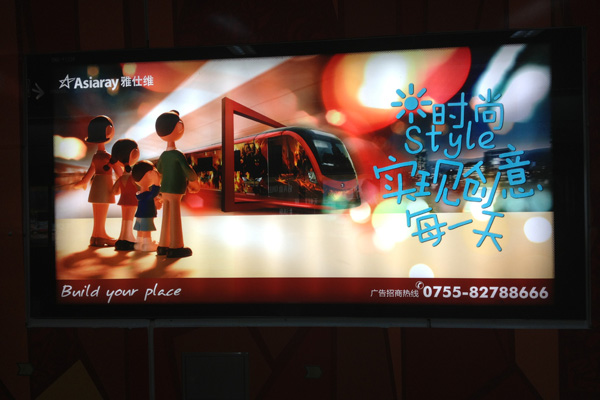
two child style

IMG_1920

The above advertisement is for the Shenzhen office of Asiaray, a Hong Kong company that specializes in providing outdoor advertising throughout the Mainland. Three related comments:

1) This particular advertisement caught my eye because of its representation of a two-child family. Just who is the intended audience of this advertisement? Families who have paid fines for their second child? Only children couples who are permitted to have two children? Or is it another sign that China may relax the one child policy, as discussed on Reuters?

2) Cultural turning. The copy literally translates as “Fashion Style — Realize Creativity Everyday”. It may be thanks to Psy the English word “style” is now showing up in advertisements all over the city. However, the official translation of 宣传部(文体局) on the Nanshan District Government website is Propaganda Department (Style Council).

3) Backlit billboards are particularly common in the Shenzhen subway and at bus stops. Indeed, outdoor advertising is the most common form of public art in Shenzhen. Recent research suggests that how we feel can impact our actions — just not in the way we think. This particular advertisement, for example, may not stimulate people to buy backlit billboards from Asiaray. Nevertheless, it does promote both the two-child family and fashion as the means for crossing a threshold into a better future.

Thought du jour: We know that Asiaray and other agencies (including Municipal Style Councils) sell wish fulfillment, using our desires against us. And maybe that’s the point. Maybe what we want is to be caught up in a daydream, all four of us, hand-in-hand on a fashionable rush to the future … until we loop back and repeat the experience, all four of us, hand-in-hand on a fashionalble rush to the future.

double bind urbanization

At dinner last night a friend asked me, “If you had to choose between living in a 50 story building or an urban village walk-up, where would you live?”

This question illustrates the kind of double bind thinking that current debates about urban villages generate. As posed, the question compels us to choose between either high end futurism or unsanitary crowded settlements. But all too often the question itself becomes rhetorical justification for ignoring other examples of more successful urbanization. What’s more, the question also blinds us to what we can learn from the  tight organization and convenience of the villages, while using high tech knowledge and skills to imagine low-rise, more environmentally friendly settlements. Continue reading

luohu culture park: the antidote to mall-burbia

DSCI0079 I prefer early Shenzhen urban planning to the rush to mall-burbia that is the current trend. Early planning assumed small scale, low cost urban living that promoted street life. In contrast, mall-burban developments raze central areas of the city to build large scale, high cost gated communities and attached mall, where security guards keep out the riff raff, effectively suburbanizing densely populated urban areas.

Luohu Culture Park (罗湖文化公园) exemplifies the latent urbanity of early Shenzhen planning. The 2,000 sq meter park includes underutilized cultural infrastructure, a lake, and my favorite kind of public art — a sculpture that children can easily appropriate. Continue reading

that time of year

Several clear signs that Shenzhen is gearing up for the holiday:

(1) Everyone is in overtime mode to finish work by the end of next week, so that they can get off as early as possible. New Year’s eve is Feb 9 and the first is Feb 10, but elementary students are already off and the streets have emptied significantly;

(2) Lunches and dinners with friends have increased as everyone is taking time to sit down and visit, which is somehow at odds with all the overtime that is being put in;

(3) The traffic cops are out confiscating motorbikes. It is only legal to ride motorbikes in small communities or campuses, it is illegal to ride motorbikes on the road or sidewalk. Every year, the traffic cops start hanging out at intersections and confiscating illegal bikes. I’m told the reason is to earn a little extra for the holiday by selling the bikes elsewhere. I’m also told that this has been going on for decades, and that when a friend of mine was in middle school, the cops hung out at intersections and snatched bicycles;

(4) Flowers have appeared at all the plant shops. The annual flower market is one of the highlights of a Guangdong New Year’s, and individuals purchase all sorts of lovely flowers for their balconies and homes;

(5) I’ve received warnings not to help children who say they are lost or need money to go home because the common sense is that they are part of some scam. I’ve been instructed to take the children to the nearest police station because if they are truly lost, they will go and if they are part of a scam, they will run away;

(6) Snakes of varying degrees of cuteness are on sale everywhere.

thinking about the southern weekend event

It’s called “the Southern Weekend Incident (南周事件)” in Mandarin and refers to a standoff between the Guangdong Provincial Minister of Information, Tuo Zhen and the editorial board of the Southern Weekend News Weekly (南方周末). If you’ve been following the story in the western press, you are well aware that at stake in the standoff is the question of just how free China’s press should be. However, if you’ve been following the story in Chinese, you’re also aware that what the Incident has revealed how serious disagreement between the two main factions in the central government are.

So what happened and what might it mean?

At the beginning of the year, the Southern Weekend editorial board decided to use “China’s dream, the dream of constitutional government “中国梦,宪政梦)” as the headline for their social commentary page.  With the support of the National Minister of Information, Liu Yunshan, GD Provincial Minister Tuo Zhen change the headline to read “China is closer than it has ever been to achieving its dreams (我们比任何时候都更接近梦想)”.

Apparently, Tuo Zhen made the changes after the editorial board had gone on holiday to celebrate the new year. On January 3, when they discovered what had happened, they went to weibo and announced that “After the Southern Weekend had already decided on its final draft, the editorial board left work, and thus were completely unaware that the Guangdong Provincial Standing Committee Member and Minister of Information Tuo Zhen directed the New Year’s words to be change and altered, leading to many mistakes. On January 4 the editorial board went on strike to protest Tuo Zhen’s heavy-handed intervention, garnering widespread support.

Importantly, the content of the two editorials represent different factions within the central government. The expression “China’s dream, the dream of constitutional government” are quotations of current General Party Secretary Xi Jinping. In contrast, the idea that “China is closer than it has ever been to achieving its dreams” reflects the position of the Jiang Gang, who are supporters of the former General Party Secretary Jiang Zemin.

Thus, the stakes in the conflict were two-fold: (1) the formal question of freedom of the press and (2) the political question of the Jiang Gang’s blatant challenge to Xi Jinping’s reforms.

The day after the Incident became public, Xi Jinping gave a talk that went after one of the primary conflicts with the Jiang Gang — dismantling the labor camp system. Liu Yunshan responded by way of “The Southern Weekend‘s ‘to our readers’ Really Makes one Reflect (南方周末“致读者”实在令人深思)” an editorial that was published in the Global Times (环球时报). Subsequently, the Ministry of Information demanded that all subordinate newspapers print the editorial, supporting Tuo Zhen and attacking Southern Weekend. Not unexpectedly, there were different levels of cooperation with the Ministry; the editor-in-chief of New Beijing Times (新景报), Da Zigeng resigned in protest.

Yesterday, in his first public appearance since the Southern Weekend Incident, Tuo Zhen was unrepentant. He opened the Guangdong Ministry of Information Meetings by announcing that the meetings transmitted the spirit of the national Ministry of Information, rather than the spirit of the new General Secretary’s reforms. The opposition to Xi Jinping was straight forward because on January 4 during its meetings, the national Ministry had made it clear that the mission of the Ministry of Information was to “continue to be guided by of Deng Xiaoping theory, the three represents thought, and the perspective of scientific development (要坚持以邓小平理论、‘三个代表’重要思想、科学发展观为指导)”. Thus in his opening speech, Liu Yunshan explicitly invoked Jiang Zemin’s political project (the three represents) and did not mention Xi Jinping’s project (constitutional government).

So what happens now that Tuo Zhen has backed off, but not really, and an abbreviated version of the Southern Weekend came out as scheduled yesterday? Well the two meetings (两会) are upon us. The Chinese People’s Consultative Committee (全国政协) will meet March 3, 2013 and the National People’s Congress (全国人大) will convene on March 5, 2013. As important government positions are filled, inquiring minds are curious to see how successful the Jiang Gang’s attack on Xi Jinping will be, or whether Xi Jinping and the Princelings will solidify their authority. We’re also wondering whether or not the embattled General Secretary will be able to wrest control of the Ministry of Information away from the Liu Yunshan and Jiang Gang supporters, or if no matter what he does, it will be at odds with the truth that the Jiang Gang is putting forward.

All this to say, more freedom of the press would be welcome precisely because we need open debate about these two positions — constitutional reform versus maintaining the status quo. Indeed, open debate would also allow for alternative voices to enter the conversation, allowing us to see how deep and far-reaching Xi Jinping’s reforms might actually be.

more evidence that china and the usa really are the same country

Back in the day — and a good fifteen years ago it was — Shenzhen University gave me toilet paper and toothpaste,  economy sized bottles of shampoo and other necessities as part of my new year’s bonus. This year, they gave an impressively health conscious and self-consciously environmental package of whole grains, legumes, and two bottles of Spanish olive oil. In addition, they included a shopping cart that has a map of the university campus printed on its sack and two coffee cups. I used to think, “What the f—?” upon receiving a sleeve of 10 rolls of toilet paper. But now I’m happy to receive such plenty, especially because neither organic grains nor imported olive oil come cheap. Thus, it is perhaps worth noting that the economic conditions of the imagined university community have shifted into familiar territory. Shenzhen University teachers and staff imagine themselves to be and engage society as full on members of an enlightened, cosmopolitan middle class. And that’s point du jour:  our paths cross in the fantasy land of neoliberal desire because as a child of the Jersey suburbs, I still live there, no matter where my body might physically be located.

border theory

End of last semester, I attended the review for MArch 1 studio: Inbetweeners taught by Joshua Bolchover, The Department of Architecture, The University of Hong Kong. Six teams offered analysis and plans for the Shenzhen-Hong Kong border. I have found it useful to think through and against the students’ work because when juxtaposed, our respective points of departure highlight critical issues that need to be thought if we are to create a genuine cross-border society. So, thoughts:

1) From the perspective of Hong Kong, the SZ-HK border is peripheral to the city proper or downtown. In contrast, the border was the reason that Shenzhen was established. Two areas in particular — Luohu/Wenjingdu and Huanggang — have been exceptionally important to Shenzhen’s ongoing self-construction and yet remain, on the Hong Kong side relatively marginal to the larger society. Luohu and Wenjingdu were of course the points where respectively people and goods passed during the Mao era and early Reform. In fact, Dongmen refers to the area that used to be Old Shenzhen Market and was the commercial area that thrived once the border reopened as both Chinese and Hong Kong residents went there to purchase goods and services unavailable or unavailable that cheaply back home. Huanggang, of course, is an extension of the new central axis and with the construction of the Lok Ma Chau Loop will become even more important to Shenzhen’s construction of its border-crossing cosmopolitan identity.

2) The disproportional population growth in Shenzhen and Hong Kong complicated by residential densities in the region. Over the past thirty years, Hong Kong has had one of the world’s lowest birthrates, growing from a population of roughly 5 million in 1980 to a little over 7 million in 2010. During that same period, Shenzhen’s official population exploded from 300,000 to over 10 million in 2010. However, I have heard that the Shenzhen’s administrative population (管理人口) is over 17 million, while Hong Kong’s population continues to hover at 7 million. Moreover, even though Hong Kong has one of the highest residential densities in the world (6,420 people per square km), Shenzhen has surpassed it (7,500 people per square km), and continues to grow. How to feed, shelter, and provide for the well-being of this population, which is also concentrated along the border fundamentally shapes and will continue to shape both how we imagine the integration of these two cities as well as the social and environmental forms that integration will take.

3) All this begs the question of the appropriate scale of planning and designing for a cross-border society in the absence of a vision of what that society is and/or might be. Does the border area refer to those who live there? Those who cross through? Or those who benefit from the way the border sustains the international division of labor? We all know that borders are social artifacts, built and maintained for particular ends. And that’s the rub: in order to design and plan a better border, we need a vision of how the border might benefit both Shenzhen and Hong Kong, or maybe a vision of how Shen Kong might be differently lived. A story perhaps of membranes and sutures, rather than borders and exclusions.

Impressions from the review, below:

This slideshow requires JavaScript.

local historian, liao honglei

How we evaluate the meaning of Shenzhen’s emergence and increasing prominence, both nationally and internationally, often hinges on when we entered the SEZ maelstrom of frenzied development and nouveau riche ambition.

Local historian Liao Honglei (廖虹雷) concludes a post on the thirtieth anniversary of Shenzhen’s founding with the following words:

It’s been thirty years. I remember what thirty years in Shenzhen have given me, I also can’t forget what the thirty years before Reform and Opening left me. What has been the greatest gift of these sixty years? “Life” — two completely different lives. The first thirty years constituted a difficult, pure, honest, and bitter but not painful life; the second thirty years constituted a nervous, struggling, deep pocket, wealthy, and sweet but not optimistic life. (30年了,我记得深圳30年给我什么,也不忘改革开放前30年给我留下什么。60年给我最大的礼物是什么?“就是生活”,两种截然不同的生活。前30年是一种艰苦、清纯、扑实,苦而不痛的生活;后30年是一种紧张、拚搏、殷实、宽裕,甜而不乐观的生活。)

As a local historian, Liao Honglei is sensitive to the disparagement in phrases such as “Shenzhen was just a small fishing village” because he knows that before the SEZ, Baoan Shenzhen was not simply a “one college graduate town” or “border town with only 300,000 residents”. He remembers the first experiments with cross border culture — in the 1980s, Shenzhen made famous al fresco dining (大排档) and night markets (灯光夜市), which were local graftings of Hong Kong’s Temple Street and Western Vegetable Streets (庙街 and 西洋菜街). As well as when and how Shenzhen adopted Hong Kong protocols for the institution of joint ventures, stock issuances, and futures trading. And, of course, the language that came with this change — illegal booth owners (走鬼), settle a matter (搞掂), did you get it wrong (有没有搞错呀), bye bye (拜拜), and bury (pay for) the check (埋(买)单).

Liao Honglei’s blog, 廖虹雷博客 is a wonderful resource for anyone interested in Shenzhen’s history. On the one hand, the gritty details of lived experience permeate each post, taking into account how profoundly the establishment of Shenzhen transformed Baoan lives. On the other hand, he calls for the active inclusion of pre-1980 Baoan culture and material history as the basis of any kind of Shenzhen identity. Liao Honglei is a rare Shenzhener: an organic intellectual who advocates the recognition of Baoan as one of the SEZ’s true and necessary roots. Moreover, he actually knows this history, rather than has generalized a Lingnan type past onto the territory. Thus, on his reading, Shenzhen is not just an immigrant town, but also and more importantly, a hybrid mix that has a responsibility to acknowledge and to nurture its diverse origins.

egalitarian architecture

One of the more interesting architectural continuities between Maoist Tangtou and Handshake Baishizhou is the ideology of egalitarianism (平均主义).

When Tangtou villagers first came to Baishizhou in 1959, they gave up their rural status and became members of the Shahe Farm (沙河农场). As members of the Farm, their hukou status was “non-rural (非农)”. This meant that they had rights to socialist welfare benefits, including housing, a salary, a rice allocation, and education for their children. In turn, they gave up their land rights. All this, even though they continued to do agricultural labor. Thus, as a architectural typology, Tangtou’s flat houses were not rural buildings — traditional or modern — but rather socialist dormitories.

According to the Maoist planned economy, non-rural members of socialist work units were entitled to dormitory housing, or “one houselhold, one room (一户一间)”. Within these dormitories, all facilities were the same — the same size sleeping and communal areas, the same number of windows, and the same access to the collective canteen and outhouses, differences in family size, notwithstanding. This type of dormitory construction was the architectural manifestation of a larger egalitarian ideology.

Of course, architectural egalitarianism was relative to regions as well as local resources. For example, the dormitories that Tangtou villagers built in Baishizhou were one story structures made of cement admixtures, wooden beams, and Hakka technology. After the canteen system broke down, families constructed small stoves outside their front doors, but continued to share nearby outhouses and wells. In contrast, dormitories in cities ranged from buildings of stacked, one-room efficiencies with a bathroom at the end of the hallway to buildings of multiple room apartments. In the colder northern cities, the decision to turn on and off central heating for everyone in a dormitory was an extension of this theory as was the decision not to provide central heating to dormitories south of the Yangtze River.

The construction of urban villages in Shenzhen has been an extension of architectural egalitarianism in the post Mao era. All handshakes were built on plats of 10 X 10 meters. To insure equal access to sunlight, there is a mandatory distance of 3 meters on the east-west axis between buildings and a distance of 8 meters on the north south axis. This mandated layout is the basic grid of an urban village. Moreover, when juxtaposed against older settlements, including rural dormitories like Tangtou or village settlements at Hubei, for example, the layout of a handshake settlement extends and often further rationalizes the egalitarianism of the previous layout.

This form of development has brought with it two urban planning conundrums:

  1. The 10 X 10 grid, with its mandatory distances of 3 and 8 meters between buildings pre-empts the efforts to put in adequate roads. 3 meters is small enough that handshakes have grown closer together — albeit without touching — on the east-west axis. At the same time, 8 meters is only wide enough to accommodate one traffic lane, which often gets jammed during deliveries or when too many motorcycles dart through.
  2. Public space and access to main roads is at a premium within the settlements. At Tangtou, for example, the large basketball court in front of the 59 dormitories is the one large space, where children and older people can meet outside. At night this area becomes a night market with more business than those areas in the Baishizhou alleys. Likewise, the roads that connect Baishizhou to Shennan Road are also the most profitable because they have storefronts in areas with large numbers of pedestrians.

The ongoing ruralization of Tangtou (and other urban villages  neighborhoods) has had paradoxical ideological effects. On the one hand, thinking of Tangtou as rural empowered Tangtou residents to make handshake land grabs. On the other hand, thinking of Tangtou as rural continues to justify the exclusion of Tangtou residents from discussions of future development, differing to the expertise of “urban” intellectuals and authorities. Moreover, the urban planning problems presented by Tangtou are considered effects of “rural” and “traditional” thinking. However, Tangtou is as “rural” and as “traditional” as Greenwich Village, NYC. The current built environment of Mao-era dormitories and post Mao handshakes is itself a product of non-rural socialism, first as the Shahe Farm and then as the Shenzhen Special Economic Zone.

And there’s the rub: what does it mean that “rural” and “traditional” Tangtou Baishizhou has come to represent all that is good and problematic about Shenzhen’s “urban villages”?  More generally, what are we to make of Maoist egalitarianism — both its continued appeal to the broad masses of Chinese people and its problematic manifestations — when we confuse it with a Chinese past that never happened?