dog (fucked) times

Last night, our downstairs neighbors locked their pooch out on the balcony, where it cried until well after midnight. I have noticed more and more pet dogs in Shenzhen. Feral cats have occupied greenspace on the Shenzhen University campus and  young children continue to purchase goldfish, turtles and rabbits, however, high status, well-dressed dogs ride in large handbags and appear with their owners in parks and on street corners, often joining them in restaurants and boutiques. Indeed, a good friend has a fluffy and quite friendly, brown bichon frise that is groomed weekly, eats from the table, and sits on his master’s lap at private teahouses.

The original scratched graffiti in the above photograph notes, “People who raise pets are abnormal [could also translate as perverted].” Someone then came along and added “don’t”, asserting that non-pet owners were the truly perverted.  Continue reading

The Shenzhen Model, 20 years after Deng Xiaoping’s 1992 Southern Tour

Reading a Shenzhen newspaper requires a sense of the absurd, a sense of the city’s history, and awareness of what’s up in Beijing. The front page of today’s Jing Bao (晶报2012年2月24日), for example, proclaims, “If the Special Zone doesn’t reform, it will soon disappear (特区不改革很快就消失).” The next headline is “In 2025, Shenzhen’s GDP will be the 11th largest in the world (2025年深圳GDP全球第11名)”, asserting that “The Shenzhen Model has Great Significance for the Country (深圳模式对中国意义重大).”

Inquiring minds want to know, well, which is it? Is Shenzhen not reforming fast enough to avoid extinction or is the Shenzhen Model stable enough to become the  world’s 11th largest urban economy over the next 13 years? Continue reading

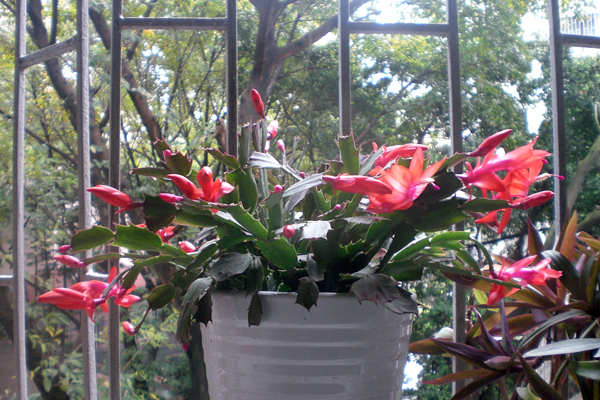
blooming schlumbergera

I knew it as a Christmas cactus, but our blooming cultivar is officially a member of the Schlumbergera genus, buckelyi group. Plant is thriving in muggy warmth of Shenzhen February. Of interest du jour, a brief search for instructions on how to keep said cactus happy also turned up the information that Schlumbergera is originally from eastern Brazil.

Apparently, Schlumbergera truncata was first cultivated in Europe by 1818 and S. russelliana was introduced in 1939. My S. buckleyi is a descendent of an 1852 deliberate cross of truncata and russelliana. Yes, the English plant crosser was surnamed Buckley. Schlumbergera had its 15 minutes and was cultivated in different colors for hothouse habitats, but by the early 20th century (a mere 50 years later!) it lost popularity and many of the breeds were lost. From the 1950s, breeding resumed in Europe and North America, which is also when S. buckleyi made recorded appearance in the Pacific colonies of Australia and New Zealand.

What I’m curious about is the history of South China traffic in houseplants. Clearly, schlumbergeras, which were named to commemorate Frédéric Schlumberger, a French cultivator of cacti didn’t jump across South America and then swim to Shenzhen on a pacific gyre. I’m assuming that an ancestor of my S. buckleyi came to Hong Kong through postwar British colonialism. But I’m not sure. After all, there were British concessions in Tianjin and Shanghai and I’m sure that one or two of the elites would have had hot houses. I’m thinking that if cacti survived a trip from Brazil to England, they could also have survived one from England to the Chinese coast. So, does anyone know interesting stories and / or books about household gardening practices that illuminate the tortured tracks of colonial homemaking abroad? If so, please let me know.

汉奸 — notes on China’s gendered racism (and it lives just like gendered racism in the United States)

The bloggers at 乌有之乡 continue to push neo-Maoism to its logical extremes. Today, Feb 21, one of the hotter posts is 今日汉奸知多少. The keyword here is 汉奸, which can be translated as “traitor to one’s country”, but literally refers to “a person who betrays the Han people (背叛汉族的人).” Thus, the article title, which clumsily (albeit patriotically) alludes to Meng Haoran’s poem (春晓), might be literally translated as “Who Knows How Many Are Betraying the Han People Today? as well as figuratively as “Who Knows How Many Are Betraying China Today?”

The slippage between betraying the Han people and betraying the Chinese people is a key difference in contemporary critiques of what’s wrong with Mainland society, reminding us that racism continues to shape these debates. It bears mentioning that 汉奸 debates are eerily similar to White supremacist concerns with race traitors because yes, the talk gets just as ugly just as quickly and yes, the loudest voices in the debates are also men who embody an ideal racial type.

For example, Mu Chuan identifies those who are not only corrupt, but like Guo Jingyi whose corruption leads to the transfer of Chinese resources to foreign multinationals as being Han traitors. This seems rather straightforward enough. However, Mu Chuan also accuses intellectuals like Xiao Han (萧瀚), a lawyer and proponent of making Chinese legal system more democratic as being 汉奸.  Continue reading

new village origin stories: Caiwuwei redux

What to make of the following quote by Terry Farrell, architect behind the KK 100?

The site of KK100, [Farrell] says, used to be Caiwuwei village, a poor and rundown area. Kingkey had to build seven towers to rehouse local people and a further seven for other locals to own and rent out, so that they might share in the boom. It’s an extraordinary idea: even as China hurtles into capitalism, it does still show remnants of old socialist ideals.

It echoes a quote from archello, a website dedicated to world architecture. Although archello has erased the reference to socialism:

The 3.6-hectare site [for the KK 100] was previously occupied by a dense residential quarter, Caiwuwei Village. The developer had the creative vision to form a company with the villagers, initiating an entirely new approach to the art of place-making in Shenzhen. This serves as a model for 21st century for urban change all over the world. Existing buildings were run down and living conditions were poor. As part of initiating this transformation, a Joint Development Initiative was formed in which villagers became stakeholders. Each owner was offered a new property as well as a second home which serves as an income generating asset. This meant the preservation of community links that are built over generations.

Origin stories for Shenzhen and its various buildings continue to use “poor backward Baoan villages” as a foil for their own achievements. In Mandarin, stories about the KK 100 are more detailed (深圳城中村专题-罗湖蔡屋围蔡屋围:梦想的真实围绕, for example), but in essence no different: the KK100 symbolizes urban proress.

What’s more these stories share an enthusiasm for height, illustrating how phallic aesthetics not only bridge the social distance between England and China, but also between the Shenzhen Municipal Government, KK 100 developers, and Caiwuwei Villagers. Indeed, Farrell has received acclaim both for his design and the fact that it is the tallest building ever realized by a British architect, a neat illustration of the link between competitive masculinity and nationalism.

Importantly, the idea of the KK 100’s height is established through explicit comparison to low (level, quality, income) Caiwuwei. Continue reading

Thinking conservation: whose lives matter?

Thursday last (Feb 16), the Hong Kong version of the bi-city biennale opened and then on Friday afternoon, Shenzhen began its closing events with a series of roundtable panels. Along with moderator Juan DU, architect Ben Wood, and urban planner Michael Gallagher, I participated in panel #2, contemporary perspectives on preservation.

We agreed that history should serve living people and thus conservation was not a question of saving old buildings for their own sake. Rather, what is conserved are patterns of human relation and environments that support those relationships. In this sense, any act of conservation entails a value judgment; whose lives do we wish to strengthen and deepen by creating sites that reference the past?

Not unexpectedly, it was at this moment of making value judgements that our differences became clear precisely because history serves different purposes in different social groups. Continue reading

princeling genealogy and advanced guanxixue

Normally, I am not a fan of imperial court television dramas first because the family dynamics of dog eat dog don’t appeal and also (and primarily) because I can’t keep track of all the players. Even with a scorecard, the nuances of multiple and overlapping connections between protagonists and lesser characters evade me. There are, for example, reportedly over 400 main characters in Dream of the Red Chamber. What’s more as an American, I like watching the action. However, as far as I can tell in an imperial television drama nothing of substance ever really happens — a marriage here, a conquered nation there, perhaps, but we never see it. Instead, the drama of an imperial court melodrama unfolds through charting various levels of family ties and in turn the revelation of who respects those ties, who abuses them, and who ignores what those ties mean. In other words, family protocols reveal personal ethics — national affairs are an effect thereof.

Take, for example, a brief sojourn into Bo Xilai’s family circle. I’ve already mentioned that his father was Bo Yibo and that his son, Guagua is know for his extravagant lifestyle. Bo Xilai’s second wife, Gu Kailai is a Beijing lawyer slash Princess. Gu Kailai’s father and Bo Yilai’s father-in-law, Gu Jingsheng (谷景生) was one of the key leaders in the December 9th [1935] Movement (一二九运动) to organize resistance against the Japanese invasion. Imprisoned for twelve years (from the Anti-Rightest campaign through the Cultural Revolution), Gu Jingsheng was appointed Vice Political Commissar of the Guangzhou Military Region after his rehabilitation, leading troupes in China’s brief Vietnam War, when Deng Xiaoping secured his place among PLA leaders. In 1981, Gu Jingsheng was appointed Second Secretary of Xinjiang, the first Secretary of the Xinjiang Production Brigade, and first Standing Member of the Xinjiang Provincial Politboro.  Just a few days ago, Bo Xilai’s brother-in-law, Lt. General Gu Junshan (谷俊山), Vice Minister of the People’s Liberation Army was removed from office. Speculation is that the removal is connected to the Wang Lijun fiasco and associated corruption charges.

All this to say, the Bo Xilai Wang Lijun scandal has rekindled my anthropological interest in genealogy and its obvious connection to guanxixue (关系学). And yes, it seems that Bo Xilai’s family background is more and more the story, regardless of what he or Wang Lijun may or may not have done. Meanwhile, Shenzhen announcements have begun to remind us that in 1979, when Xi Zhongxun, father of China’s future leader Xi Jinping was Guangdong’s governor, he proposed the establishment of the Shenzhen SEZ. And in that shimmering moment of imperial court Princeling drama, Deng Xiaoping is simultaneously remembered and erased from Shenzhen history, as local leaders try to position themselves and the SEZ as close to the inner party family as they can.

serve (only) the people’s currency?

My one brand, two systems cup of java has me thinking about the manipulation of national currencies in an international economic system. In particular, I reviewed what I knew and didn’t know about the rise and fall of 外汇卷 (foreign exchange certificate) as opposed to 人民币 (the People’s currency). FEC circulated from the early 60s through January 1, 1995, when the government began phasing it out, completing the process on Dec 31, 1996, just in time for Hong Kong’s Return.

Now, China’s FEC is interesting because before 1980, Chinese citizens were not allowed to hold either FEC or foreign currency, while after 1980, they were. Continue reading

Thinking Macau

Happy serendipity. I have been trying to make sense of my superficial impressions of Macau and this morning, a former student pointed me to the article, Capital Flight of China’s Wealthy Gets Ready for Takeoff. Long story short — using credit card purchases to transfer Chinese savings into international accounts. If this loophole sounds suspiciously like the money laundering another friend attributed to Yongfengyuan, that’s probably because the same group of people are involved: China’s officials and/or those with business ties to the current administration.

What have I seen and overheard? Continue reading

Wandering Macau’s Historic Center

Macau’s historic center presents us a fundamental conundrum. On the one hand, it’s Qing / Republican China meets Portugal spaces charm and entice; I find these older spaces beautiful in ways that the city’s casinos and glass towers are not. On the other hand, these spaces manifest colonial legacies; the East India Company’s cemetery and crucified Jesuses that adorn the Portuguese churches give visceral form to the foundational violence of the contemporary world system. Impressions of world heritage, below:

This slideshow requires JavaScript.