sino-british border, 1972

This short “border tour” emphasizes the training of British troupes in contrast to Chinese troupes, with clips of the Luohu border crossing as well as food and livestock being transported into the Colony from Wenjingdu.

At his youtube site, Ben Mumford has also posted 8 Hong Kong Beat documentaries, which look at how the British managed police corruption at the border. The intro to the series on the BBC webpage promises all sorts of adventure, seeming more soap opera that cinema verite.

Nine documentary programmes which take a close look at the world’s most controversial police force in action. The Royal Hong Kong Police have been accused of corruption and bribery at all levels. This series shows the job they have to do – as a British Colonial Force working among 4 1/2-million Chinese. John Norman, ex-London policeman is now a CID Inspector in Tsim Sha Tsui – Hong Kong’s Soho -Triad Territory, where you’re bought off or framed if you get too near the truth. As Norman is drawn into robbery, kidnap and murder, he shows what it is to be on the Hong Kong beat, where British policemen bow before the God Kwandai. And where the Yaumati Force now row in a Dragon Boat Race against the Triads.

what’s on display and who can see it?

This past week, in addition to participating in large public culture events, I also had the opportunity to visit two privately organized cultural spaces. The first was a private collection of shoushan stone carvings (寿山石) and the second was a community museum.

So some preliminary thoughts about what these spaces suggest about post COVID culture in Shenzhen.

Continue reading

material and spiritual traditions. thoughts?

Long ago and far away, I wondered when History would enter Shenzhen’s bildungsroman. And now that it has, it’s interesting to see how deeper settlements have emerged as roots for contemporary Shenzheners. The original SEZ–now the inner districts (关内)–especially Luohu (Dongmen) has become the city’s connection to Hong Kong. Indeed, it is still where you go if you want to speak Hong Kong Cantonese and eat delicious Cantonese and Chao-Shan style foods. In the outer districts, “Longgang” (and I’m using it in its circa 1990 designation, rather than picking through the new districts) is home to Hakka traditions, which are housed in the area’s great compounds (围屋、世居). In Bao’an (and yes, as a cultural homeland, we’re talking about the sliver of villages that stretch north-south between the reclaimed west coast (now Qianhai) and Bao’an Boulevard), ancestral halls are flourishing and traditions like lion dancing have been elevated to national immaterial culture status (上川黄连胜星狮舞). The Huang alliance comprises eight troups, extending from Shanghe to Fuyong.

What I’ve noticed is that this geographic distribution assumes different historical subjects which are all mushed together into some kind of “Shenzhen” identity. The implicit subject of history in Luohu, for example, are the cross-border entrepreneurs (个体户 mainly from Chao-Shan area) and their Hong Kong clientele (many who also originally hail from Chao-Shan). This first generation came in the early 1980s and transformed the old market into a gritty cross-border playground a la Tijuana. In Bao’an, the villages (now communities under a street office) have cultivated and paid for the continuation of their traditions, including pencai (盆菜) banquets, the birthdays of divinities and founding fathers, and celebrations at various scale. In contrast, in the Hakka areas, various levels of government have assumed responsibility for the compounds and are using them to promote new kinds of high culture. Pingshan Art Musuem, for example, includes the Dawan Compound (大万世居) as a satellite exhibition hall, while Longgang District has transformed the Hehu Compound (鹤湖新居) into the base of its cultural think tank, hosting outdoor lectures underneath shade trees.

So, thoughts du jour are more random associations that still make a kind of sense. Shenzhen’s culture and history are being reworked in ways that both deploy local cultural geographies and map along the city’s historic interest in establishing a new material and spiritual culture. In Luohu, the early Special Zone is re-emerging in new forms of (admittedly cleaned up) cross-border consumption; Bao’an is emerging as the locus of South China Sea diaspora connections (the lion dance, for example, is a major competition in the region), and Longgang compounds form a material platform for high end civilization, where the city’s “new guests” can strut their cultural stuff.

luohu landmarks: the border as an apparatus of integration

The Shenzhen-Hong Kong border at Luohu manifests the contradictions and aspirations of integrating the two cities. On the one hand, the border has been solidified with concrete and barbed wire, while on the other, the border is presented as an easily accessible gateway to a modern shopping experience. Indeed, the concrete and barbed wire fence that lies parallel to the border is located directly behind Luohu Plaza, as seen in the pictures below.

Continue reading

Extreme rains in Shenzhen

Flooding in Luohu, Sept 8, 2023

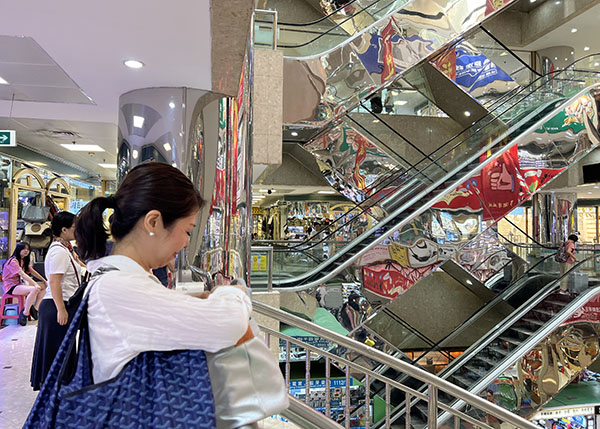
so…luohu commercial city

Hong Kong day-trippers are–if we chat posts are to be believed–shopping again in Shenzhen. There seem to be generational differences. The young and hip are in the malls, while the old and once-upon-a-time hip are revisiting their former haunts, like Luohu Commercial City. Maybe? Anyway, I went back to Luohu Commercial City and realized that the more things change, blah blah still the same. Or is it?

One of the things that I like about Commercial City is the 90s-naughties vibe. The entrepreneurs rent their spaces and then sell what they like. Now, admittedly, they only sell a few types of goods–glasses, dance costumes, fashion, watches, scarves and haute fake fashion–and only offer a few services–mani-pedis, massages, tooth care. But. Within these categories of pampering commodities, they sell what they like. This means that unlike the malls and many commercial streets where stores are all selling the same goods, in Commercial City, every store is a curated experience of what the vendor thinks is fashionable. And. It’s still possible to haggle. So. Fun.

dagongmei: gendered troubles in the city of dreams

Over at Made in China, Ivan Franceschini and Christian Sorace have co-edited Proletarian China: A Century of Chinese Labour, which traces the history of Chinese labor since 1898. Compiling events from the late Qing, Republican, and PRC eras, the book offers a diversity of voices and perspectives on the meaning and experience of work in China. Indeed, the brevity of each chapter allows for a comprehensive introduction into how political movements, economic restructuring and individual desires have constantly shaped and redirected the norms and forms having (or not) a job and the meaning of said job within and against a landscape of shifting national goals. Moreover, the scope of the volume allows for more refined comparison; for example, the unstable meaning of women’s labor, how technology has been mobilized inside factory walls, or even how the spatialization of labor has changed in the years from the rise of Shanghai to the socialist factories of Tianjin and then the emergence of assembly manufacturing in Shenzhen. I contributed a chapter on the moral geography of Shenzhen’s dagongmei 打工妹 during the early years of the Special Zone, mapping how the path to respectability was differently manifest in Shekou, Luohu and Bao’an.

An early and famous picture of Shenzhen dagongmei.

90s futian, or the xiaokang quilt of days gone by…

Not so long ago and not so far away, Futian was known as Shangbu and was considered the rural burbs of up and coming Shenzhen (which was mapped as Luohu-Shangbu). But then (somewhat deus ex machina) Deng Xiaoping appeared in 1992, promising that the experiments would continue. So, during the 1990s, the SEZ boomed and Shenzhen restructured. Old Futian (well, xiaokang Futian), emerged out of all this governmental restructuring and economic booming.

Continue reading

更新–renewal, 2.0 (or is it 3.0?)

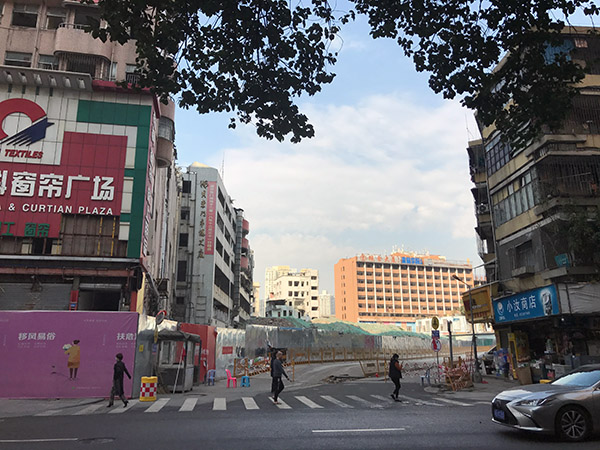
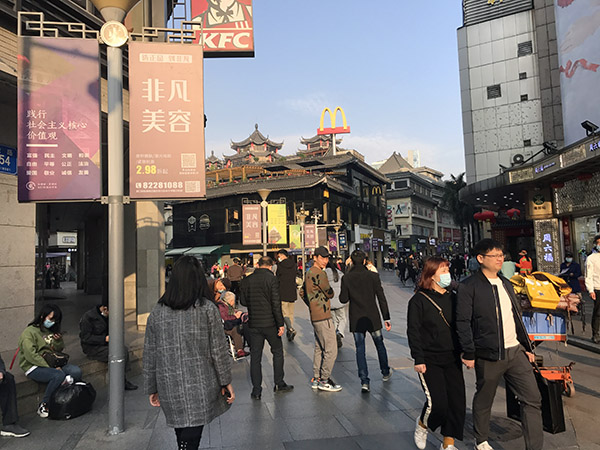
So, I realized the other day that I’ve been walking neighborhoods that have been scheduled for urban renewal without actually posting anything about them. I’m not sure if that’s because I’ve lost track of what iteration of Shenzhen planning we’re on, or if its just that construction sites blur together after awhile. At any rate, photos from a recent walk around Dongmen (东门) and Hubei Ancient Village (湖贝古村).

from bamboo curtain to the silicon valley of hardware

For the 2019 edition of the Shenzhen Hong Kong Bi-City Biennale of Urbanism/Architecture (UABB), Handshake 302 installed Electronic Lifestyles at the Futian Station Main Venue. To situate the installation with respect to Shenzhen’s cultural geography, I wrote From Bamboo Curtain to the Silicon Valley of Hardware, which was published at as part of e-flux architecture‘s Software as Infrastructure project.

From the essay:

Located on the “bamboo curtain” at the Sino-British border, Shenzhen’s spatial liminality facilitated national political and economic restructuring, which ultimately had international effects. In the ordinary order of things, liminal spaces have recognizable thresholds and boundaries; one crosses from one side to the next. Most liminal spaces are located at the edges of mainstream society. In contrast, the geopolitical logic of Shenzhen has been to place liminal spaces at the center of society, making perpetual transformation—of the self, the nation, and the world—a key feature of the model. The transformation of Luohu-Shangbu from a riparian society into the earliest iteration of the Shenzhen Special Economic Zone (SEZ) can give a sense of how liminality was deployed to as metaphor and strategy. Today, the Luohu area is known as Dongmen, a bustling cross-border shopping district, and Shangbu is known as Huaqiangbei, the world’s “Silicon Valley of Hardware.”

Curious? Please give it a read.