I wandered to the Shenzhen Bay Park, tracking the construction and commodification of the new coastline. Land reclamation has brought views and parks, but I noticed that children and dogs still want to get their feet wet. Impressions, below.
I wandered to the Shenzhen Bay Park, tracking the construction and commodification of the new coastline. Land reclamation has brought views and parks, but I noticed that children and dogs still want to get their feet wet. Impressions, below.
Yesterday evening, I walked from the Peninsula housing estate along Wanghai Road, which winds around the back of Shekou Mountain through a new section of reclaimed land. I passed the walled off and abandoned construction site in the bit of land that belongs to the military policy (武警) and paused to look at the remaining fishing boats and tangled nets that hug the remaining bit of coast, before making a left onto Houhai Road. After 8 p.m., small trucks are permitted on Houhai Road, and a line of pick up trucks backed up from the new coastline all the way to Old Shekou Road at the Shekou Oil Depot. Dirt filled the open backs and floated into the air, as the trucks trundled into a new reclamation area. I also saw a family living in a van. The lettering on the outer body of the van announced small repairs, however, the sliding side door was opened to reveal a makeshift bed, a mother rocking a child, and a man fixing an appliance of some kind. It’s not uncommon for neidi wives and children to join working husbands on construction sites, however, this was the first time that I have seen the interior of a service car remodeled for family life. So it seems that Shenzhen’s homeless are paradoxically richer because they have a car and tools for making a living and yet more isolated because the more “traditional” — if I can use the term — Shenzhen homeless families squatted in tent settlements under lychee trees, or more recently have occupied the edges of the reclamation projects, which of course, is where my walk began.

I live on Shekou Gongye Number 8 Road, translated, my address is “Shekou Industry Road #8”. There are 10 industry roads in Shekou, remnants of the Shekou Industrial Zone. Walking these roads gives a good sense of not only how the city is gentrifying, but also the different street lives that various generations of urbanization have engendered.
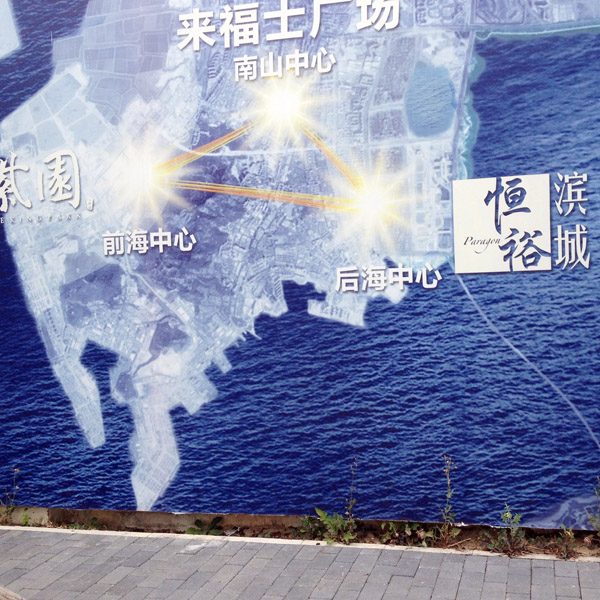
To understand my discussion of class differences and symbolic geography of Industry Road #8, please reform to the map below which gives a rough sense of extent of land reclamation on the Nantou Peninsula. For purposes of this discussion, key landmarks, Industry Rd #8 and Houhai Road, which connects to New Shekou Road:

The older core of #8 threads through the residential parts of Old Shekou, linking up with what was the area’s commercial center and industrial parks. However, as part of the stutterstep Houhai Land Reclamation Project, #8 has lengthened with each burst of fill. Houhai Road used parallel the coastline and marked the thick edge where Mangrove trees gave way to piers and oyster cultivation, it now marks the historic divide between the old and new coastlines, between which upscale residential areas and shopping malls continue to be built. Thus, Houhai Road also constitutes a boundary between older but poorer and new rich neighborhoods
On #8, Houhai Road also divides the area into two different kinds of street life. The older section has concrete sidewalks that connect housing developments with 7 story walk-ups, community park areas with local foliage, and simple (also concrete) benches. The gate between the housing development and the street is a security bar that controls traffic flow in and out of the area. The new section has stylized sidewalks that are embellished with granite and marble at residences. The buildings are over 20 stories, the community park areas landscaped with imported topiary, and the benches ornate designs of iron and wood. The gates are over one story high with faux noble emblems that control pedestrian traffic in and out of the development because cars have a separate entrance that leads to underground parking.
During the day, the older section bustles with ad hoc businesses — soybean milk and steamed bun venders, people sitting on plastic chairs chatting, and various kiosks selling drinks, snacks, and newspapers. In the newer section, all these activities take place indoors and no one uses the public benches because the trees haven’t grown in enough to give shade. At night, in the older section a bbq station sets up and older people play chess. In the newer section, several entrepreneurs have set up roller blade classes for the children of the housing estates.
All this to make a simple observation about the ongoing construction of the Houhai Land Reclamation Area — in Shenzhen’s symbolic geography, the reclaimed areas function as a negation of the previous areas. This is not surprising given the SEZ’s historic role as a negation of Maoist space. However, it is important to note the vocabulary through which the ongoing formation of class identities in Shenzhen is expressed. The most recent, the newest is the best, representing the improvement of the past.
In practice, this symbolic geography has depended upon building large projects on unclaimed or reclaimed land. As unclaimed and reclaimed land become increasing scarce, however, this has meant that razing older areas has become the preferred way of creating “new” space. Consequently, these new spaces do not only negate the old symbolically, but increasingly depend razing old neighborhoods and the displacement of poorer residents, so that the negation becomes explicit — you and your type not welcome in the city. At present this logic is most visible and visceral in the urban villages. Nevertheless, here in the older section of #8, we hear the bulldozers on the horizon. More notes and images of the Houhai transformation, here.

 The Transformation of Shenzhen Villages (沧海桑田深圳村庄30年), Episode 9: Haiwan Village tells the story the Nantou Peninsula and the reclamation of land in Houhai (the southern coast facing Hong Kong) and Qianhai (the northern coast facing Guangzhou). This was the platform from which Hong Kong entered China and Baoan villagers once launched themselves to Hong Kong.
During the Mao era, Wanxia Village was divided into two production brigades, one land based for agricultural cultivation and the other water based for oyster farming. Eventually, the Wanxia Oyster Brigade was renamed Haiwan Brigade, creating two administrative villages through the division of one natural village. This division points to the importance of production — rather than history — in defining Maoist administrative units, especially in rural areas, where villages were integrated or split depending upon production needs. Importantly, however, these administrative categories were not naturalized in the same way during the early years of Reform and Opening, when some administrative villages re-instituted traditional boundaries while others did not. Haiwan retained Maoist status and began building village level factories.
Access to the sea shaped village demographics, with a population gap of people, ages 45-65 who escaped to Hong Kong in the last large flights in 1968 and 78, respectively. Nevertheless, traditional land rights enabled Haiwan to prosper. In addition, we learn from an older, Cantonese-speaking villager that Haiwan Village is an Overseas Chinese village, with many descendants scattered throughout the world with village association buildings in the United States and Hong Kong, representing support, ranging from monetary to knowledge to investment connections. The village has also maintained its identity through traditions and ritual that centered on a small Tianhou Temple.
Watching this episode, I suddenly realized something that was clearly obvious to the filmmaker: Deng Xiaoping’s 1992 Southern Tour coincided with the establishment of guannei villages as stock-holding corporations and urban neighborhoods. In other words, the second tour did result in new policies or breakthroughs as they are known. My a-ha moment was in seeing the connection between politics and the radical restructuring of the south china coast. The episode ending rhetorically juxtaposes images of Wall Street with Houhai, asking if Shekou can become the next Manhattan. The question is illuminating not for its booster-hype pretensions, but rather because it clearly reiterates the primacy of investment and real estate over traditional livelihoods such as oyster farming. In such a world, insofar as the sea becomes a factor in determining property values and not an independent source of value, reclaiming the sea makes good business sense.
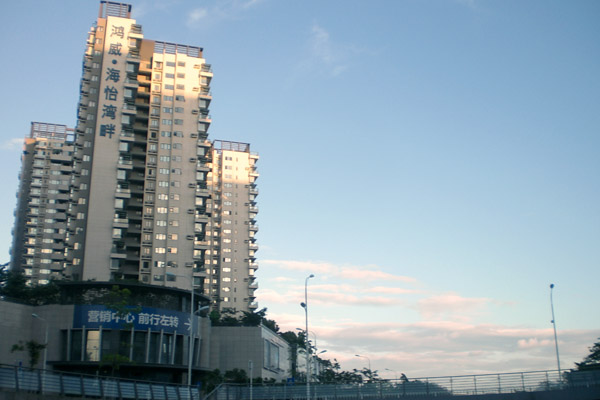
I have learned that the runoff stream that threads the Houhai land reclamation area along the southern coast of the Nantou peninsula is called, the Houhai River. It has been mapped and landscaped to accompany the futuristic luxury homes that boast both estuary and river views, and it leads to the Shenzhen Bay Park. Nevertheless, remnants of an older landscape linger, fishing families and the sand processing docks of the no longer extant Dongjiaotou pier.

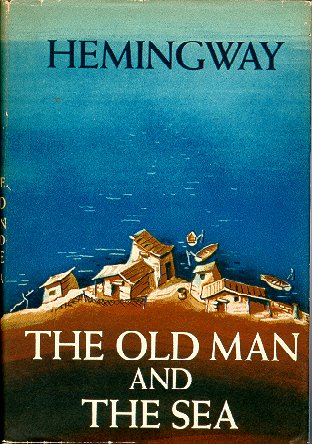 I am currently reading The Old Man and the Sea with two 16 year old Chinese high school sophomores. They are cousins. One is a “good” student, strong and sly in the self-protective way of students who know how to work the system, but do not reach the upper echelon of test results. The other is delicate and shy, a “top” student, who is being groomed to test into Beijing University, producing results (出成绩) for her school and family. The good student knows that unless she goes abroad, she will no doubt end up at Shenzhen University, no matter how much harder she works at school; fortunately, her parents can afford to send her anywhere and so she is not too sly, and her eagerness to model good student answers quickly gives way to assertive self-confidence. The top student already struggles with contradictory desires and ambitions. She yearns to study abroad, but her homeroom teacher has already begun pressuring her to stop studying for the TOEFL and to use her extra time more productively — taking practice gaokao tests or studying the junior year high school curriculum. What’s more, the child of divorce she knows that her mother can’t afford Chinese tuitions, let alone foreign and thus she must secure a scholarship wherever she attends university.
We sit around a square table, tracking the relationship between the old man and the marlin. Santiago believes that his fish is out there, and his quest begins when he sights the purposeful circling of a man-of-war bird. His faith is rewarded and the contest engaged. As the fish pulls the man further out to sea, away from from the lights of Havana and known landmarks, the old man endures, charts his progress against the stars and his suffering, and the fish becomes more than a fish — first a friend, then a brother, more noble, but less intelligent, a brother who must be convinced that he is less than he who came to kill. It is a grand battle that does not end in glory, but the realization of hubris, “I shouldn’t have gone out so far, fish,” the old man says to the marlin’s corpse, which has been strapped to the skiff and is being inexorably eaten by sharks. When the old man finally drifts ashore, all that remains is an 18 foot skeleton and the certainty of death.
I chose The Old Man and the Sea because, well misgivings about Hemingway notwithstanding, he knew his craft. His language is deceptively simple. Any sentence taken out of context seems ordinary, common even, but together his words sculpt moral landscapes that make exquisitely salient the brute masculinity and ultimately tragic consequences of lives lived against nature.
“Americans aren’t very peace-loving,” the good student concludes.
“Did the old man have faith in luck or faith in the sea?” the top student asks.
Thus, yesterday’s lesson transformed from a discussion about human limits into a conversation about how being human is culturally defined and experienced. The old man is not their old man, his fish is not their fish, and the sea that relentlessly pulls us out of our depth, that tests our forbearance and ultimately claims our soul, that sea does not figure their dreams. It may be a generational difference. But perhaps not. Certainly the new US passport is replete with pictures of men taking on nature — cowboys and seamen ruggedly occupying the western plains and Pacific waves, respectively. And that’s the point: the girls read with me because the good student’s mother is a friend and she has entrusted her daughter to me (and yes those words were used “交给你”) for old-fashioned Chinese purpose: edification rather than simple instruction. The goal of our bi-weekly meetings is not to improve English test scores or practice oral English, but rather close reading of novels, essays and poetry, to help the teenagers learn to navigate literary nuance elsewhere, which it turns out is also learning to simultaneously recognize oneself and one’s Other despite and across epic difference, which isn’t quite what Hemingway had in mind when he figured Man through his engagement with the Fish, but nevertheless where yesterday’s lesson ended.

These past few days, rain has cleared Shenzhen skies and when the sun comes out, everything sparkles. Yesterday, I followed the rays to the Spring Cocoon, which has been opened for commercial use. The walk from Coastal City to the sports center was once landscaped to assert the SEZ’s green ambitions. However, the corridor is now under construction. In the east, another shopping mall and in the west, lest we have any doubts about the Municipality’s futuristic plans, China State Construction (中国建筑) has begun laying the foundations for the Aerospace Science and Technology Square. Impressions, below; past walk when the Cocoon was under construction, here.
Visited OCT Bay (欢乐海岸) this afternoon. OCT Bay is the third Shenzhen development of “The New OCT‘” to expand and develop their brand throughout China. The first effort was OCT (now OCT Loft) and the second was OCT East. OCT Bay’s advertising slogans suggest the state-owned enterprise’s ambitions to provide fantasy shopping experiences, for example: Elegant Christmas, Fashionable New Year’s (风雅圣诞,时尚新年). However, their motto, Give Happiness a Coast (给欢乐一个海岸) is beyond ironic. Water light shows, an artificial lake, and boat rides on the winding river, notwithstanding, the entire complex is built on reclaimed land from Shenzhen Bay. In fact, the former coastline (at least a km inland) used to be edged with mangrove trees and, further into the bay (in the middle of the complex), oyster cultivation. Impressions, below:

I’m in Tianjin, listening to the firecrackers that go from dusk well into the early hours of the morning. Traditionally, people set off firecrackers from New Year’s Eve through the Lantern Festival. Firecrackers also provided an opportunity for Tianjin friends to distinguish themselves from Cantonese people because “northerners love firecrackers more than southerners”. In fact, they said, the further north you go, the more festive the towns as firecrackers don’t stop.
I don’t actually know how much of my friend’s claim about northern enthusiasm for pyrotechnics is true. I do know that early on, Shenzhen attempted to outlaw firecrackers. In fact, I remember buying illegal firecrackers and setting them off at the coast. We drove with a truck full of illegal poppers to houhai land reclamation area, snuck out, and set them off. This year and last, however, I’ve noticed stands selling firecrackers because — according to a friend — the SZ Municipal government finally accepted the fact that it was safer to sell legal firecrackers and regulate production than the alternative.
I’m also told that people set of firecrackers just to “burn money”. Last year, the economy was good and people celebrated by “burning money”. However, this year I’m told that there are fewer people willing to buy firecrackers because of economic difficulties. Nevertheless, everyone I’ve talked with has set off firecrackers or played with sparklers; we bought a box of fireworks and watched them light up the sky for all of five minutes. New Year’s — relatives and friends emphasize — is the People’s holiday. In contrast, on National Day, only the government willingly burns money and, my friend joked, those fireworks are of different quality.
I walked along the old Shenzhen Bay Coast today. Reclaimed land to the south, old Shekou to the north.
 Shenzhen Noted