the dalang graffiti festival

Today we held the design workshop for the Dalang graffiti festival. 27 people attended the workshop, which involved creating designs for manhole covers. With the exception of one individual, none of the participants admitted to having taken any art classes outside of school; none admitted to sending their children to art classes. All were immigrants and during their self introductions, they mentioned their hometowns; one made a joke that her hometown was “too small to have English names”. Next week, participants will take their designs and begin painting manhole covers at a workers’ dormitory, a neighborhood, and a school.

Continue reading

sunday afternoon in dafen

Dafen is now a destination, with artists posing as painters, and visitors posing with paintings. Meanwhile, the subway is open and many of the new developments are opening and real estate is booming, so that it’s now difficult to find the painting village–it’s a sinkhole in the midst of rising towers. Impressions, below:

This slideshow requires JavaScript.

qingming ramblings

It’s grave sweeping day, and the streets were empty. So my friend and I headed out to the Fenghuang Mountain Fenyan Ancient Temple. Neither of us have been and we were curious. However, it turns out that we couldn’t get into the temple because there were too many people burning incense and all traffic was being redirected. In the middle of the only traffic jam we encountered all day (including on Guangdong 107), I jumped out of the car and took a picture of the old pagoda at the Wen Tianxiang memorial; handshakes, many, many, many migrant workers, and a touch of something ancient. My friend mentioned that during the Cultural Revolution, they were only allowed to sweep the graves of revolutionary martyrs; no sweeping family graves. Today, however, although workers had the day off, most could not go home and so they had gone to the temple or to walk the mountain paths. Then, because we couldn’t find a parking spot from which to visit either the completely restored ancient village or the temple, we headed back to guannei. On our way to Shekou, we passed the former site of the Nanyou Building; once upon a time was an important landmark but is now a building site. We reminisced about how narrow and small Nanshan and Shekou used to be, as we approached the recently erected sign for the Shekou and Qianhai Free Trade Zone at the border between Shekou and Nanshan. Reading the sign, I realized that Shekou-Qianhai is not precisely a free trade zone, but rather a pilot free trade zone, which sounds ominously unstable, with the possibility of expanding or retracting at any moment. Ramble. Ramble. Ramble.

This slideshow requires JavaScript.

guangming office: historic questions of translation

Speakers of North American English such as myself often fall into linguistic rabbit holes when reading official Chinese documents. My confusion arises from what both Western Marxists and Chinese Party members might call “historic questions/ problems of translation (翻译的历史问题)”. Thus, although their are semantic overlaps, a city is not a 城市, an office is not a 办公室, a community is not a 社区, and a collective is not a 集体 because the respective geographies of the USA and PRC have been formed through vastly different cultural ecologies and property regimes. Continue reading

怀德村:virtue’s rewards

It’s been a while since I’ve summarized an episode from The Transformation of Shenzhen Villages (沧海桑田深圳村庄三十年) and so today, episode 6: The Secret of Huaide Village (怀德的秘密), which puns the village’s name and also means “the secret to cherishing virtue”.

The episode opens by telling viewers that Huaide is a revolutionary village, which contributed over 40 soldiers to the People’s Liberation Army. The connection between good Party leadership, virtuous villagers, and getting rich is then personalized through the story of Pan Baliang, a Huaide villager, who fought in the Korean War, (or the Resist American War as it is known in Chinese). However, during the Cultural Revolution he was jailed because his children were abroad, and was only to be rehabilitated in 1980, when out of gratitude for his fellow villagers continued support, he petitioned the village/ brigade if he could open a factory.

In 1988, Huaide was chosen as the location for Shenzhen’s Baoan International Airport. At the time, the SEZ decided that guannei land should be saved for urban development, rejecting a proposal to build at Baishizhou, which was then considered the suburbs and choosing instead to stimulate the guanwai economy by converting Shenzhen’s largest duck farm into an international airport. The Shenzhen airport expropriated over 1,000 mu of village land and in return Huaide received a compensation package of 3.5 million yuan. The question became: should the sum be divided evenly and distributed to each villager (as many villages had chosen to do) or should the village create a jointly held corporation and invest the money in common cause?

In 1988, guanwai New Baoan County was still rural. This meant that the village was still organized as a collective brigade, which provided the organizational infrastructure for Huaide’s subsequent development as a jointly held corporation. Huaide’s current CEO and current Party Secretary, Pan Shansen earnestly explains that Huaide Party leaders understood that unless they could correctly direct the thinking of the villagers, the village was in danger of making a collective mistake. Collective and Party leaders then went to work on villagers with dissenting opinions in order to make sure that everyone was on board with the next step — using the money for capital investment to build and manage Cuigang Industrial Park. Pan Shansen then expresses his gratitude for the previous Party leaders’ foresight in using the Airport compensation to create a strong, collective economy.

Pan Shansen describes the work of creating “a center where there was previously no center” as arduous and only possible through the cooperation of the people and their government. In addition to creating a large wholesale furniture market, in 1996 Pan Shansen established a venture capital fund that provided interest free loans to young villagers who wanted to start up companies. The fund started with 1/2 million when and grew to 2 million, and loans grew from 20-50,000 per project. In 2005, this venture capital project was expanded through collaboration with Shenzhen’s rural bank, providing low interest loans of up to 300,000 yuan to Huaide Villagers. By 2010, when the documentary was made, in addition to the villages collected holdings, over 40 families had used Village venture capital to create family businesses.

Fiscal conservatism of the defining features of Huaide Village’s success. Huaide Village has its own “constitution” that requires any private investment over 5 million yuan to be approved by the village, they set up a legal aid office for villagers to consult when writing contracts, and since 1992 have not sold any village land rights. Telling, Pan Shansen makes a point of reminding documentary viewers that Huaide Villagers are farmers — to break their ties to the land and the village is tantamount to destroying what makes them who they are, regardless of how they actually make money. Land is at the heart of Huaide’s neo-Confucian CCP virtue and unlike many Shenzhen villages that no longer have collective land, Huaide still owns almost 1/2 of the land they owned before 1980. What’s more, the Village has actively purchased land rights from other Shenzhen villages, leaving its own land for future use.

The rewards of Huaide’s virtue are a neo-Confucian-socialist hybrid capitalist success story, or as it is sometimes said, villagers washed their feet and left the paddies. In addition to its village venture capitalist fund, Huaide invested in social services and local culture. Huade provides medical insurance, education, including college scholarships, and old age activities for its 700 villagers, and in 2010, its Lion Dancing Troupe was the only village level troupe to receive an invitation to perform at the opening ceremony of Belgium’s Chinese Culture Festival. And thus, the moral to this episode tallies with Shenzhen’s ongoing campaign to promote Confucian ethics: good party cadres are at heart neo-Confucians, serving their people, who become collectively rich. In turn, inquiring minds wonder: to what extent has Huaide’s ethical sensibility extended to the organization of workers’ rights in the village’s three industrial parks?

Cultural postscript: the Lion Dance Troupe is talented and fun. Check out a performance, here.

Langxin: Impressions of Rural Preservation

I first walked through Langxin in 2006 and returned yesterday to discover that the area had been designated a historic preservation area in 2007. Unfortunately, this time, we were unable to talk our way into the Ancestral Hall, even though we did talk our way into several homes and up to the roof of a three-storey walk up. The higher perspective gives a broad impression of the former lay of village housing. During the Mao-era, the round buildings were used for grain storage. Of documentary note: the Shiyan Precinct Administrative Law Enforcement Building is located in the Together Rich Industrial Park (同富裕工业区), from the “Together Rich Project” that began in early 1997 in a first effort to ameliorate uneven development within Shenzhen. Impressions, below.

This slideshow requires JavaScript.

hakka borderlands: xiawei and shiyan

On Thursday, I joined a group of architects and students from the Future Cities Laboratory on a rainy guanwai trek along Bulong Road, which parallels the second line. This particular trek interests because it hints at generations of ongoing cultural transformation both as industrial manufacturing has spread and as Cantonese and Hakka urban villages have renegotiated collectives identities over the past 150 years.

We departed from Huaqiangbei and crossed at the former Buji Checkpoint, which today has been partially cleared to make room for the Buji subway station (Longgang Line) although cars still lined up to pass through check booths. Directly north of the erxian boundary, Xiawei Village (吓围村) handshakes huddle tightly, giving the impression of an ordinary new South China village. However, the entry gate and main hall of Xiawei’s ancestral hall remain, suggesting that at some point the village had enough collective funds to erect a substantial building. According to an old worker who was organizing collected paper products in the compound plaza, villagers continue to burn incense for ancestors during the Spring Festival.

We then headed west to the precinct headquarters of Shiyan. During the Mao-era, this area also served as the headquarters of Shiyan Commune. Located between the Kowloon-Canton railroad and Guangzhou Shenzhen corridors, Shiyan has remained relatively poor when compared to precinct headquarters at Buji or Shajing, for example. Nevertheless, it has Mao-era flat housing, Reform era factories, and two generations of single-family homes and handshakes. More to today’s point about Hakka borderlands, Shiyan is also interesting because it is located along Baoan County’s traditional border between Cantonese and Hakka cultural regions. Thus, although the Ye Ancestral Hall boasts Hakka exhortations of Confucian morality, the structure itself, like many of the areas older flat buildings are Cantonese style.

Impressions:

This slideshow requires JavaScript.

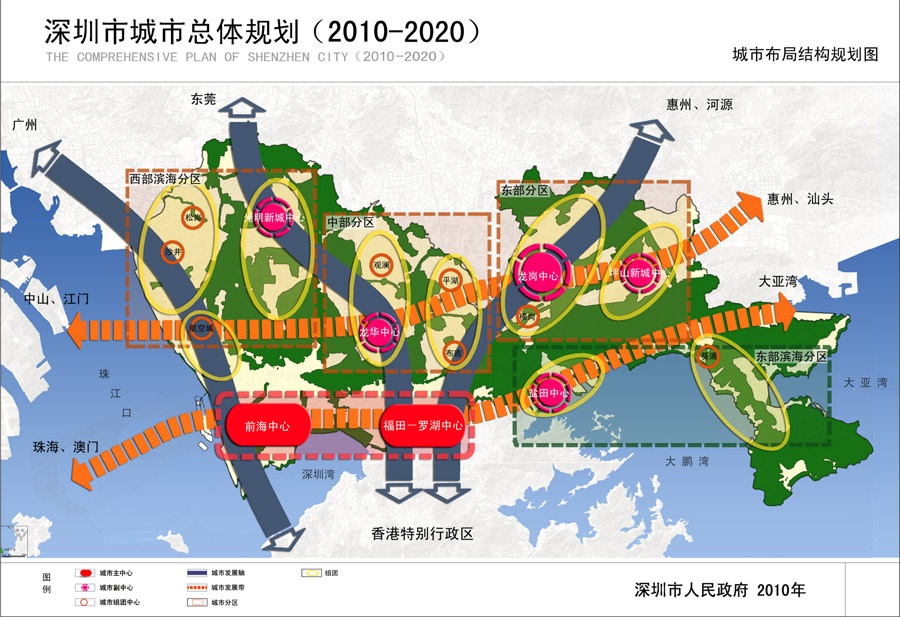
borders and corridors: one interpretation of the 2010-2020 shenzhen comprehensive plan

At first glance, Shenzhen’s 2010-2020 Comprehensive Plan seems a writhing mass of blue snakes and bright hotspots.

However, by simplifying the Comprehensive Plan in terms of the historical relationship between political boundaries and and early infrastructure in Shenzhen development, I came up with the following grid of borders and corridors, which explains the Plan’s horizontal flows, the connections to Hong Kong, and investment initiatives in New District hubs:

Three borders have enabled urbanization in Shenzhen: the border with Hong Kong, the second line, and the city limits, which abut Dongguan in the northwest and Huizhou in the northeast. Two economic corridors have facilitated Shenzhen’s growth: the Guangshen highway corridor and the Kowloon-Canton Railway. The Guangshen highway corridor parallels the area’s riparian trade routes, which were the means of Han expansion from Guangzhou southwardly on the Pearl River and its tributaries. The KCR, of course, was the British attempt to preempt and redirect the PRD’s extensive trade network.

This grid enters everyday conversation through place name protocols. For example, no one today refers to the “second line”, which evokes the yesteryears of early reform. In contrast, ever since the boundaries of the SEZ have been made coterminous with city limits, we now speak of guannei and guanwai, or “inside the gate” and “outside the gate”, respectively. Interestingly, however, I rarely hear people speak of the guanwai area well east of the railroad as “guanwai”, instead, it is more common to refer to that part of Shenzhen as “the east”.

In fact, the SEZ’s historically most important hubs are all located on this grid. Luohu/ Dongmen is the first stop on the Chinese side of the railroad, while Buji was the first stop on the guanwai side of the second line. Likewise, Shekou was the end of the old riparian trade network, activating Delta resources. Bao’an District government is found just over the guanwai side of the Guangshen highway corridor and Shajing Wanfeng Village, once called “the first village in the south” occupies the area just south of Dongguan on the Guangshen Highway corridor. Given the importance of political territorializations and infrastructure to development, it is unsurprising that the poorest areas in Shenzhen are either in (a) the guanwai area between the railroad and highway corridors (Shiyan and Guangming) or (b) the East. With the exception of Guangming, all of Shenzhen’s other three new districts — Pingshan, Longhua, and Dapeng — are located in the east, far from easy access to the railroad, let alone the Pearl River and riparian access to Guangzhou.

In the new Comprehensive Plan the old hubs appear renamed, but their functions unchanged. The Guangshen corridor has been resutured to the Pearl River through the Qianhai Center. The Luohu/ Dongmen railroad corridor has been interestingly diverted into two streams, one that enters guannei at Huanggang/ Lok Ma Chau and leaves guanwai through Guangming and a second that enters guannei at Luohu and then exits guanwai through Longgang. Meanwhile, Hong Kong has been absorbed/ extended into the Shenzhen administrative apparatus at both the Lok Ma Chau Loop and Qianhai Cooperation Zone, begging the question: will the next Comprehensive adjustment will be political integration of the two cities and the re-establishment of a first or second line at Shenzhen city limits? Indeed, the question doesn’t seem too far-fetched when we recall that for 5 months in 1997, the transition government for the Hong Kong Special Administrative Zone met in Shenzhen.

旧楼村: alleyways and crumbling bricks

This slideshow requires JavaScript.

Images from Old Loucun (旧楼村), a large swathe of crumbling tile homes, traditional brick homes, narrow roads and alleys, and mid 80s 2 and 3-storey homes. Handshakes on horizon.

Shajing Wanfeng Community learns from Wukan

Weibo reports that on the afternoon of April 8, 5-600 Wanfeng (万丰社区) community members/ villagers took to the street to protest Community Secretary and  Wanfeng Ltd CEO, Pan Qiang’en selling off collective lands for private profit. The protests began February 17, when 20-30 elder villagers gathered outside village offices and have continued until today.This afternoon, Epoch Times reported on the event, noting that villagers are calling for an accounting of the past twenty years. Currently, Wanfeng Community has an area of 6.8 sq km and a population of 2,067. Most are surnamed Pan. It is estimated that over 50,000 migrant workers also live in Wanfeng.