轮侯制: economizing moralities

In the United States, we make an economic distinction between “needs” and “wants”. We teach children (here, here, and here, for example) to recognize and manage the difference between their needs and wants. Subsequently, we re-code these management skills in terms of individual ethics — good people recognize their needs and wants, and then make rational choices to live within their means. In contrast, bad people make irrational choices based on uncontrolled desires that lead to debt and bankruptcy.

e9ec64bb5bcb

The flip response — “one girl’s need is an aging man’s want” — to this statement merely confirms the underlying double bind of this economizing morality. In this financial literacy exercise, for example, only the social facts of suburban car culture, supermarkets, and fast food restaurants conspire to make white bread, bottled water, and a tent vacation “needs” in contrast to the “wants” of a bicycle and a pizza. What if our built environment depended on bikes for transportation? What if we were homeless and the best we could cobble together was a tent made of discarded plastic and corrugated steel? In these situations, the economizing morality is to recalibrate our personal needs and wants rather than to challenge the inequality that poses this choice as reflecting real world conditions.

All this to say: the economizing morality of individual needs and wants is the elementary school version of neoliberal ethics.

I’m thinking about individual needs and wants and neoliberal immorality for two interrelated reasons. At the level of urban planning, given the prime location of urban villages and the lack of developable plats in Shenzhen, the villages were targeted for redevelopment (or renovation — 更新 as a verb). In turn, the need for neighborhoods for the working poor has been recoded as the need for individuals with Shenzhen hukou to find affordable housing. A shift of hand, and the debate ceases to be about communities and becomes one of individual economies. Moreover, convenience, access to schools and social infrastructure, as well as economic opportunities are concomitantly transvalued as wants to be satisfied through economizing.
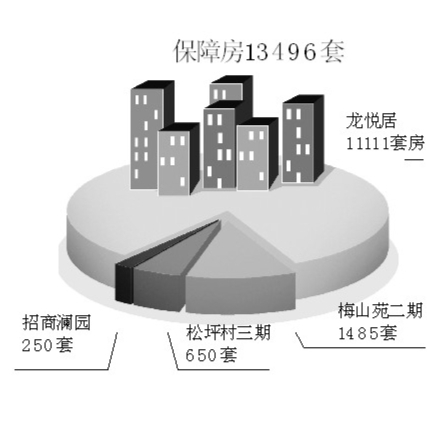
res01_attpic_briefOn January 31, 2013 for example, the Municipality made available 13,496 units of public housing. Of that total, all are located in the outer districts (guanwai) and the majority (11,111) are located in Longgang, roughly 35 kms from the city center. To allocate these units, Shenzhen will be testing what is known as the 轮侯制 or “revolving wait system”. Basically, this system entails meeting conditions, including hukou status, time in Shenzhen, and maximum income to apply for a residence. When any of these conditions change, the family has to move out of the unit, thus opening it for another. The family also has to find another place to live.

In Shenzhen, those opposed to urban renovation projects have been reminding the Municipality out that urban villages like Baishizhou already provide low-cost housing and small scale economic opportunities for working poor families. Moreover, the given the Municipality’s demographics 13,496 housing units are sufficient to absorb displaced populations only when those with hukou may apply. Point du jour: locating public housing far from urban centers only makes moral sense (cents!) in a world in which individual economizing ideologically justifies disrupting neighborhoods for the working poor in order to pave the way for developers. And yes, this is just more evidence that China and the United States really are the same country.

the shape of space: buji village #1

In the urban villages around the Old Buji Market (布吉墟), alleys and narrow roads wind upward, accomodating dense settlement and inadvertant public spaces. The most notable feature of the space is the proliferation of walls and determined privatization of small plots, or homesteads (宅基地). The isolating spatial organization of Buji reflects what urban planners disparagingly call “small farmer mentality (小农民意识)”. In practice, this means only investing in one’s own home, and minimal investment in public spaces and programs. Obviously, not only farmers have this mentality.  The Shenzhen Dream entails homeownership, while Tea Party populism represents one version of the US American  urge to privatize land and resources. However, the term “small farmer mentality” is usually a pretext for urban renewal programs that involve razing neighborhoods where the working poor live and replacing them with mall-burban settlements, where only the upper middle class can buy into the dream. Spaces like a Buji urban village  illustrate one of the key conundrums facing not only Shenzhen, but cities everywhere — creating livable neighborhoods for the working poor, rather than leaving urbanization in the hands of privatizing opportunists, whether they be individual farmers or employees of an urban planning board.

This slideshow requires JavaScript.

the difficulty of representing shenzhen’s urban “villages”

Talking about Shenzhen’s urban villages is difficult because legally they are not villages, but “communities (社区)” that have been integrated into the urban state apparatus. Moreover, depending on their location, these neighborhoods have different social functions — slums, gateway communities, and affordable housing for both the working poor and recent college graduates.

Mark Leung‘s photo essay,  Welcome to Wuwucun, a Village in the City offers a detailed and sympathetic look at life in Wuwucun, a Shenzhen urban village and is well worth checking out. However, the images beg contextualization, illustrating the difficulty of interpreting images  in the absence of historical knowledge. Is Wuwucun poor? Are these villagers? Is manufacturing a good thing?  On the one hand, a shorter version of the same essay, for example, explained that these images showed how manufacturing in Shenzhen was providing small steps forward to improve the lives of China’s rural millions. On the other hand, these images depict one of the more peripheral villages in Shenzhen, where the level of poverty depicted justifies ongoing campaigns to raze working class neighborhoods in other parts of the city. In other words, these images can be used either to show that industrial manufacturing in Shenzhen has been good for the country or to justify the Municipality’s ongoing program of razing urban villages in the inner districts. Continue reading

tea time stories

Old Sui makes starkly whimsical woodblock prints the old fashioned modernist way — by hand, alone, and in a studio that is open to friends who drop by for tea and chats. He has collected over 1,000 teapots that when individually shelved and arranged seem oddly menacing. Not a first mind. At first, one sees artistry in the smooth lines and soft glow of each pot. However, as Old Sui opens a drawer to show part of the collection, and then another, and then says that the majority of the collection is elsewhere, the care and time necessary to make and care for a teapot gives way to numbers games and ranking; here are 50+ teapots, here are several dozens, the top  twenty or so have been displayed on a shelf that stretches around the room.

And the rest?

In a room at home.

I know the feeling of insatiable desire. I also enjoy aesthetic displays of objects. But. I am not a collector. Learning that Old Sui has set aside a room for private delectation? The intimacy of this knowledge startles me and my eye settles on a teapot crafted in black clay with flecks of golden sand. Continue reading

mama troll

The Mandarin expression for internet trolling — visiting sites, but not actually participating — is scuba diving or 潜水. Last night, I heard it used in the context of parental supervision. Apparently, there are mothers who have requested that their children give them their qq, we chat, and other social networking account passwords so that they can supervise them. The person describing the mother in question joked she was as “mama troll (潜水妈妈)”.

When I mentioned that I found this behavior highly disturbing, my friends responded that yes, it was a bit excessive, but what could you do? Children are an extension of their mothers, and if I didn’t understand this cultural root, I couldn’t understand Chinese mothers.

What’s more, another friend added, many of these mothers have nothing to do. They sit around and worry about who their husbands may or may not be seeing. They chat with friends and imagine all sorts of situations that their daughters might encounter. The most worrisome problem would be young love, especially because young love adversely affected grade point averages.

I then did another of my highly selective surveys, where I told this story to friends and cab drivers and the odd waitress to get their take. I asked if they thought it possible that a mother would go to such extremes? The 100% answer: yes. Most agreed that this kind of supervision was excessive. However, they pointed out that many mothers worry about their children, especially their daughters and so the concern was natural. Others remembered that when they were younger, their friends’ mothers might read their diaries for similar reasons.

I then asked why didn’t the children just sign up for another email or we chat account? Here the responses varied — maybe the children lived at home and their mothers paid for their cell phone and internet access; maybe the children always did what their mother asked them to do, and; maybe it was just easier to put up with the intrusive supervision than it was to set up independent accounts.

After all, another friend pointed out, as long as a child is living with her mother, her options are limited because sometimes teachers will request parents to increase supervision over a child. “It’s a conspiracy,” she then said half jokingly, “Teachers and mothers work together to make sure that children do what they should.”

沓饼节: the second annual pounded biscuit festival

Yesterday, Bao’an District organized the second annual pounded biscuit festival (沓饼节). Pounded biscuits are a traditional local sweet that are especially popular at Chinese New Year’s. It so happens that a Shenzhen brand, 合成号 has been making said biscuits since 1901. The company celebrated its 100th anniversary in 2011, and to kick off its next century, in 2012, it became the sponsor of Shenzhen’s latest festival.

Local historian, Mr. Liao Honglei (廖虹雷) invited me to join the celebration. Mr. Liao curated the event and has been active promoting local Chinese culture. He is particularly attentive to cultural differences between Cantonese, Hakka, and Chaozhou settlements. Shenzhen inhabitants from outside Guangdong, refer to Cantonese as “baihua (白话)”, or local language. In contrast, Mr. Liao makes a point of calling each of these cultural strands by their official names, Guangfu (广府 literally provincial capital of Guangdong), Hakka, and Chaozhou in order to draw attention to Bao’an’s heterogeneous roots.

Also present was special guest, Professor Wu Bing’an (乌丙安), an 86-year old specialist in Chinese folklore. Professor Wu began his discussion by explaining why he opposes calling Chinese New Year “Spring Festival”. On his analysis, festival (节 jie) refers to a date on the calendar. In contrast, year (年 nian) refers to a period of time. Thus, jie mark the passage of time within a given nian. Professor Wu said that in order to leave one year and enter the next, Chinese people need sound and color. After praising the reintroduction of noisy, pounding to make New Year’s biscuits, he mentioned that firecrackers were the traditional “sound” for sending off and greeting the new year. Professor Wu also complained that too many safety restrictions had made Chinese New Year too quiet.

Impressions of the pounded biscuit festival, below.

This slideshow requires JavaScript.

More Princeling drama: Guagua returns and possible public appearance by Bo Xilai

Yesterday, Epoch times reported that the FBI repatriated Bo Xilai and Gu Kailai’s son, Bo Guagua. Why should we care?

Before the 18th National People’s Congress opened, the Party had stripped Bo Xilai of his Party standing and his post, which is called “double removal (薄熙来双开)” and sentenced Gu Kailai to death, with a two-year probationary period. So one would think that the Congress would open and the folks at the top would get on with sentencing Bo Xilai and making official appointments. However, the 18th NPC has opened and we still don’t know what exactly is happening.

We can speculate, however, that with the repatriation of Guagua, apparently the United States has decided to help Hu Jintao and Xi Jinping do whatever it is they’re doing behind closed doors. It may be that Gu Kailai was actually poisoned, and Guagua needs to give evidence. It may also be that he knows something about his parents’ affairs. More importantly, whatever the legal reasons for dragging Guagau back home, the fact of his return seems to indicate that Hu Jintao and / or Xi Jinping have decided to break with Deng Xiaoping’s famous decision to spare Zhao Ziyang’s children from prosecution in the post Tian’anmen era.

Common wisdom holds that given the decision to deploy the military to squash the protests in 1989, Deng Xiaoping had no other option than placing Zhao Ziyang under house arrest. Nevertheless, he expressed his solidarity with his former protege by announcing that investigations into Tian’anmen would not include the children of prominent leaders. In fact, in the post-1989 era, Zhao Ziyang’s daughter, Wang Yannan (王雁南) has been active campaigning for the rehabilitation of her father and other leaders.

Deng Xiaoping’s decision to spare Zhao Ziyang’s four sons, let alone his wife and her family reflected a modern understanding of the family. Traditionally, when high-ranking officials were sentenced, the victims included “executing the nine branches of a lineage (灭门九族)”. Chinese kinship traditionally reckons lineage through the father-son relationship (agnatic descent-家族), but also distinguishes branches within the lineage through mother-daughter-and sister marriages (嫁). The nine kinship branches (九族) are:

  1. Father’s family, four kinship branches — self (kinship branches counted from eldest and other sons), married paternal aunts and cousins, married sisters and sisters’ children, married daughters and grandchildren;
  2. Mother’s family, three kinship branches — mother’s father’s family, mother’s mother’s family, and mother’s sister’s family;
  3. Wife’s family, two kinship branches — father-in-law’s family and mother-in-law’s family.

Obviously, contemporary Princeling court dramas are different from the Confucian first, second, third, and fourth wife scenarios a la Raise the Red Lantern (movie and book). This is why Bo Xilai’s first wife, Li Danyu could gossip with New York Times reporters about Bo-Gu family intrigue, while her and Bo’s eldest son Li Wangzhi can continue cattle farming. However, more colloquially, Guagua maybe be one of the implicated (株连) simply because his father has no other weakness and has yet to admit that he was wrong. After all, Gu Kailai did confess; Bo Xilai has made no public apologies or admissions of error.

Speculation du jour, if Princelings benefit from family connections, perhaps they can also be used against each other, especially against those like Bo Xilai, who might not otherwise bend. Bo Xilai will be sentenced in Guizhou, Guiyang. So to speculate even further, weibo has it, that on Monday, Oct 15, Bo Xilai will appear publicly in Guizhou, and inquiring minds want to know: how is this appearance connected to his younger son’s return?

anthropologizing

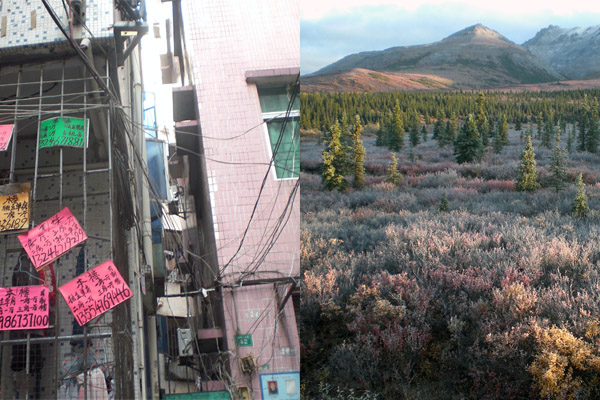
So, a juxtaposition of Baishizhou and Denali, which may be achieved through visual flattening, but as lived required movement through time and space — from Shekou to Hong Kong international by way of Shenzhen Bay checkpoint to SeaTac and then on to Anchorage and passage on the Alaskan Railroad.

I look at snapshots taken here and there, searching for commonalities, for what we might call human universals, which Donald Brown has defined as “those features of culture, society, language, behavior, and mind that, so far as the record has been examined, are found among all peoples known to ethnography and history.”

There is, of course, the eye of the beholder — mine — which seems drawn (here, at least) to pink, but all this does is raise the question of whether or not what I experience in each of these places is what other people also experience. In Chinese poetics, this common — unquestionably and recognizably human — response would be called yijing (意境), which literally means “idea scape” and denotes the moment of union between interior and exterior states of being.  意, for example, is composed of characters meaning “sound (音) and heart (心)”, while 境 is composed of characters for “earth as soil or land (土)” and “final or complete (竟)”, which here functions as a sound marker for jìng.

What are the respective yijing‘s of Baishizhou and Denali? And can we confidently generalize our responses to say, “Just so and how could it be otherwise?”

These questions matter because both Baishizhou and Denali are the focus of conservation efforts, albeit of a different ilk. Both discussions assume a common response to a particular environment. Moreover, in both discussions, one’s response to the environment is taken as an expression of one’s humanity and there, of course, is where the debate rages.

At Baishizhou, the current discussion of how to raze and rebuild an urban village focuses on the experience of mass urbanization and the need for access to housing, food, and transit networks. The debate has two assumes. First, the debate assumes that inequality is a defining feature of human life and that the purpose of social life is to ascertain that level and take measures to insure that people do not live in inhuman conditions. In turn, the content of the debate is over where to draw the line between human, subhuman, and inhuman living conditions. Second, the debate also assumes that urban living is a desirable form of life because it results in access to cultural goods, such as medical care and education by way of intentionally crafted environments, such as hospitals, schools, restaurants, and entertainment districts. As debated, these two assumptions are hierarchically ranked into the Maslovian categories of “basic needs” and “higher needs”. Thus, as one debates, one is not simply drawing lines between this life and that, but also and more importantly, revealing one’s humanity as a function of social responsibility.

Likewise, at Denali a general assumption and its implementation shape debate, but here over the nature and value of wilderness. On the one hand, the debate assumes that the experience of wilderness reveals and cultivates the wild, untamed spirituality that makes us human and that the purpose of social life is to maintain and create spaces where people can realize this spirituality. In turn, one’s love of wilderness functions in this debate as a marker of one’s spirituality. On the other hand, the debate also assumes that wilderness occurs in the absence of human settlements, such that in order to build human settlements one must transform wilderness. As debated, these two assumptions are also ranked hierarchically in terms of what is essentially human (nature) and acceptable transformations of wilderness (culture). Thus, as one debates, one is not simply drawing lines between this life and that, but also and more importantly, revealing one’s humanity as a function of wild spirituality.

It is possible to note the Chineseness of the Baishizhou debate (all that Confucianism going down), just as it is easy to remark on how much Emerson and Muir continue to shape American understandings of our place in the world. And therein lies the challenge of cross-cultural debates about what it means to be human in a world where Baishizhou and Denali cross paths, so to speak. The question is not so much either / or — which is a more accurate definition of what it means to be human: social being or wild spirituality, but rather the question seems to be: what might the Baishizhou debate teach us about the cultural place of wilderness, and what might Denali remind us about the limits to human settlements?

deng xiaoping’s inscriptions

Deng Xiaoping was born Deng Xiansheng (邓先圣) on August 22, 1904 in Guang’an, Sichuan (四川广安). To commemorate his birthday, below I have translated his calligraphic inscriptions, which suggest the contours of reform and its social terrain.    

October 1, 1983 for the Beijing Jingshan School: “Education must be oriented to modernization, the world, and the future (教育要面向现代化、面向世界、面向未来)”.

January 1, 1984 for the Shenzhen Special Economic Zone: “Shenzhen’s development and experience proves that the policy decision to establish Special Economic Zones was correct (深圳的发展和经历证明我们建立经济特区的政策是正确的)”.

February 16, 1984 for the then under construction Shanghai Baoshan Steel Factory: “To grasp new technology, one must not only be able to study, but also more able to innovate (掌握新技术,要善于学习,更要善于创新)”.

October 15, 1984 for the first Chinese exhibition to the South Pole: “Use the South Pole to contribute to humanity and world peace (为人类和平利用南极做贡献)”.

February 1986 for the Tianjin Development Zone: “The Development Zone has great hope (开发区大有希望)”.

May 30, 1987 a general inscription: “Unite Marxist truth with the actual situation of the country, so that China will walk its path (把马克思主义的普通真理和本国的实际情况结合起来,走自己的路)”.

May 11, 1988 for an anthology of essays on true standards that was published by Guangming Daily: “Praxis is the only standard for investigating truth (实践是检验真理的唯一标准)”.

October 10, 1989 a general inscription:”Nurture successors to the proletariate revolution who have ideals, morals, culture, and self-restraint (培养有理想、有道德、有文化、有纪律的无产阶级革命事业接班人)”.

September 5, 1990 a general inscription: “Project Hope (希望工程)”.

March 1991 for the 10th Anniversary of Arbor Day: “Green the Motherland, Create Riches for 10,000 Generations (绿化祖国,造福万代)”.

April 23, 1991 for a national meeting: “Develop high technology, realize industrialization (发展高科技,实现产业化)”.

lotus east: the horse gang village

Half an hour outside Weishan, Lotus East Village (莲花东村) stands apart from the surrounding villages, both historically and culturally. Unlike mountain villages, like those around Lushi, which cultivated Yunnan Red (滇红茶), Lotus East once supplied the horses and guards for the caravans that moved tea and other goods along the Tea and Horse Route (茶马道). Although small, the village was powerful and relatively wealthy. In fact, during the Nationalist era, the clan heads – brothers Ma Shiji, Ma Shiqi, and Ma Shixiang – were aligned with Long Yun, the former Party Secretary of Yunnan Province.

Culturally, the residents were and remain Muslims, who elegantly synthesized elements of Han and Bai traditions within the context of Islam. The couplet that graces the entrance to the village mosque exemplifies the hybrid cultures of Southwestern China. In Mandarin, the word for “mosque” is literally “clear truth temple (清真寺)”.  The author has taken those two characters and used them as the opening characters of a Mandarin style couplet:

清升浊沉万教终归一统

真诚不二宇宙同赞阿拉

The pure rises, the polluted sinks, ultimately 10,000 teachings return to one

Truth and piety are not different, the entire universe praises Allah

Today, the Mosque and former homestead of the Ma brothers are open to the public, as is a small museum that introduces horse caravan culture (马帮文化 – literally “horse gang culture”) and the cross cultural breadth of China’s southwestern trade in tea, horses, and other luxury items. Impressions, below:

This slideshow requires JavaScript.