This afternoon, I sat in Xiasha Plaza watching children and their caretakers. The plaza is vast and the people hug the edges, chatting in the shade. The coi pond is particularly popular.

This afternoon, I sat in Xiasha Plaza watching children and their caretakers. The plaza is vast and the people hug the edges, chatting in the shade. The coi pond is particularly popular.
Episode 13 of The Great Transformation, takes us to Gaoling Village (高岭村), which is located on Qiniang Mountain at Shenzhen’s eastern most edge on the Dapeng Peninsula.
The story of Overseas Chinese Chen Jiageng (陈嘉庚) opens the episode, connecting the history of Shenzhen’s eastern periphery to early modern Chinese nationalism. An ethnic Hakka, Chen Jiageng raised funds among to construct the Jimei School in his hometown Jimei Xiamen. For his nationalist efforts, Mao Zedong referred to Chen Jiageng as being “the banner of Overseas Chinese, the glory of the race (华侨旗帜,民族光辉)”.
Settled over 400 years ago by Hakka migrants, the layout of Gaoling reflected the founders need for safety and arable land. The village houses were located deep in the mountains, while village fields were located at the foot of the mountain. Every morning, villagers went down the mountain to work their fields and every evening, they returned to the relative safety of their homes.
The architecture of Gaoling reflected the agonistic relations between Hakka and local (本地 boon day [H], bendi [M], pundi [C]) peoples during the 19th Century. In fact, between 1855 and 1867, relations disintegrated into open conflict during the Punti-Hakka Clan Wars. During the early 20th Century, the village housed anti-Japanese troops, who were led by Hong Kong born Liu Peidai.
As in Xiamen, Gaoling villagers who lived overseas donated funds to build a school in their hometown. Over the course of the village’s history, Gaoling villagers immigrated to Singapore, Holland, the United States, and Canada, and many more lived in Hong Kong. Importantly, the Overseas Chinese funded improvements to their hometown, including modernizing the water system. The Euro-Chinese style of the school architecturally reflected these migrations and returns.

Yesterday, Bao’an District organized the second annual pounded biscuit festival (沓饼节). Pounded biscuits are a traditional local sweet that are especially popular at Chinese New Year’s. It so happens that a Shenzhen brand, 合成号 has been making said biscuits since 1901. The company celebrated its 100th anniversary in 2011, and to kick off its next century, in 2012, it became the sponsor of Shenzhen’s latest festival.
Local historian, Mr. Liao Honglei (廖虹雷) invited me to join the celebration. Mr. Liao curated the event and has been active promoting local Chinese culture. He is particularly attentive to cultural differences between Cantonese, Hakka, and Chaozhou settlements. Shenzhen inhabitants from outside Guangdong, refer to Cantonese as “baihua (白话)”, or local language. In contrast, Mr. Liao makes a point of calling each of these cultural strands by their official names, Guangfu (广府 literally provincial capital of Guangdong), Hakka, and Chaozhou in order to draw attention to Bao’an’s heterogeneous roots.
Also present was special guest, Professor Wu Bing’an (乌丙安), an 86-year old specialist in Chinese folklore. Professor Wu began his discussion by explaining why he opposes calling Chinese New Year “Spring Festival”. On his analysis, festival (节 jie) refers to a date on the calendar. In contrast, year (年 nian) refers to a period of time. Thus, jie mark the passage of time within a given nian. Professor Wu said that in order to leave one year and enter the next, Chinese people need sound and color. After praising the reintroduction of noisy, pounding to make New Year’s biscuits, he mentioned that firecrackers were the traditional “sound” for sending off and greeting the new year. Professor Wu also complained that too many safety restrictions had made Chinese New Year too quiet.
Impressions of the pounded biscuit festival, below.

One of the more interesting architectural continuities between Maoist Tangtou and Handshake Baishizhou is the ideology of egalitarianism (平均主义).
When Tangtou villagers first came to Baishizhou in 1959, they gave up their rural status and became members of the Shahe Farm (沙河农场). As members of the Farm, their hukou status was “non-rural (非农)”. This meant that they had rights to socialist welfare benefits, including housing, a salary, a rice allocation, and education for their children. In turn, they gave up their land rights. All this, even though they continued to do agricultural labor. Thus, as a architectural typology, Tangtou’s flat houses were not rural buildings — traditional or modern — but rather socialist dormitories.
According to the Maoist planned economy, non-rural members of socialist work units were entitled to dormitory housing, or “one houselhold, one room (一户一间)”. Within these dormitories, all facilities were the same — the same size sleeping and communal areas, the same number of windows, and the same access to the collective canteen and outhouses, differences in family size, notwithstanding. This type of dormitory construction was the architectural manifestation of a larger egalitarian ideology.
Of course, architectural egalitarianism was relative to regions as well as local resources. For example, the dormitories that Tangtou villagers built in Baishizhou were one story structures made of cement admixtures, wooden beams, and Hakka technology. After the canteen system broke down, families constructed small stoves outside their front doors, but continued to share nearby outhouses and wells. In contrast, dormitories in cities ranged from buildings of stacked, one-room efficiencies with a bathroom at the end of the hallway to buildings of multiple room apartments. In the colder northern cities, the decision to turn on and off central heating for everyone in a dormitory was an extension of this theory as was the decision not to provide central heating to dormitories south of the Yangtze River.
The construction of urban villages in Shenzhen has been an extension of architectural egalitarianism in the post Mao era. All handshakes were built on plats of 10 X 10 meters. To insure equal access to sunlight, there is a mandatory distance of 3 meters on the east-west axis between buildings and a distance of 8 meters on the north south axis. This mandated layout is the basic grid of an urban village. Moreover, when juxtaposed against older settlements, including rural dormitories like Tangtou or village settlements at Hubei, for example, the layout of a handshake settlement extends and often further rationalizes the egalitarianism of the previous layout.
This form of development has brought with it two urban planning conundrums:
The ongoing ruralization of Tangtou (and other urban villages neighborhoods) has had paradoxical ideological effects. On the one hand, thinking of Tangtou as rural empowered Tangtou residents to make handshake land grabs. On the other hand, thinking of Tangtou as rural continues to justify the exclusion of Tangtou residents from discussions of future development, differing to the expertise of “urban” intellectuals and authorities. Moreover, the urban planning problems presented by Tangtou are considered effects of “rural” and “traditional” thinking. However, Tangtou is as “rural” and as “traditional” as Greenwich Village, NYC. The current built environment of Mao-era dormitories and post Mao handshakes is itself a product of non-rural socialism, first as the Shahe Farm and then as the Shenzhen Special Economic Zone.
And there’s the rub: what does it mean that “rural” and “traditional” Tangtou Baishizhou has come to represent all that is good and problematic about Shenzhen’s “urban villages”? More generally, what are we to make of Maoist egalitarianism — both its continued appeal to the broad masses of Chinese people and its problematic manifestations — when we confuse it with a Chinese past that never happened?

Yesterday evening, Tianmian Industries Ltd (田面实业股份有限公司) celebrated 20 years of incorporation, simultaneously confirming the group’s new status as a corporation and the corporation’s status as the continuation of Tianmian Village. The celebration achieved this sense of historic continuity through the sequencing of socialist and traditional customs, including the presentation of and speeches by Tianmian, Fuhua Precinct, and Futian District leaders, which was followed by singing and dancing performances, a demonstration of Bruce Lee style kongfu by one of Bruce Lee’s students, and pencai, a local specialty that is only eaten at collective ceremonies. The speeches and performances took place on a stage in the vip area, while two large LED screens had been set up throughout the common area so that guests could watch the entertainment while eating.
Another important ceremonial function was to demarcate borders both within Tianmian and between Tianmian and outside communities. The 137-table event occupied most of the main road into the village (directly off Shennan Road) as well as adjacent public areas, dividing Tianmian into two sections: the ceremony area and the rest of the neighborhood. Importantly, only Tianmian Ltd has the authority to cordon off public areas for private ceremonies. The ceremony area itself was subdivided into a vip area for leaders, their families and guests and a common area for Tianmian stockholders, their families and guests. Tianmian guards prevented non-guests from passing the red cordons.
Rituals such as these and the concomitant right to occupy public space are perhaps why we continue to speak of Tianmian Village as a village. In point of fact, we were celebrating the dissolution of Tianmian Village and its reconstitution as Tianmian Ltd. In ritual terms, however, the celebration clearly established Tianmian Village as the host and hegemonic subject of this territory and Tianmian Ltd as the contemporary manifestation of the village. What’s more, throughout the evening the gaze of outsiders — many of whom live in Tianmian housing stock — reinforced the sense of Tianmian as a vibrant and recognizable collectivity.
These rituals are particularly important in Tianmian because the corporation has not built traditional village buildings, such as an ancestral hall or a temple. In obvious contrast to Tianmian’s appropriation of public space, when larger village-corporations hold pencai ceremonies, they set their tables in designated village plazas that are surrounded by traditional buildings. In Xiasha, for example, the large village plaza includes an ancestral hall, a temple, a public theater, a traditional garden, and a path to the Xiasha Museum. Consequently, where Xiasha relies not only on ritual, but also on the built environment to reinforce communal solidarity, Tianmian’s village identity remains as such primarily through what is commonly called “non-material culture (非物质文化)”, or rituals.
It will be interesting to see, say in twenty or fifty years, how strong Tianmian’s sense of village solidarity remains and to compare that solidarity to that of a village like Xiasha, where the construction of village architecture sets the stage for village rituals. In other words, although Shenzhen has been seen as a laboratory for economic and social experimentation, we might specify further, and watch the ongoing reconstruction of traditional solidarities despite and within the maelstrom of modernization. Impressions from Tianmian’s 20th anniversary celebration, below.
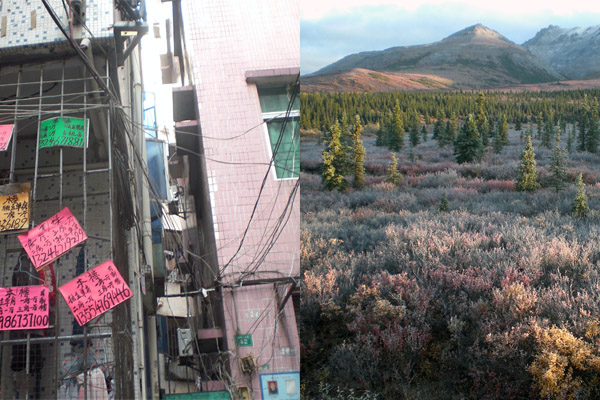

So, a juxtaposition of Baishizhou and Denali, which may be achieved through visual flattening, but as lived required movement through time and space — from Shekou to Hong Kong international by way of Shenzhen Bay checkpoint to SeaTac and then on to Anchorage and passage on the Alaskan Railroad.
I look at snapshots taken here and there, searching for commonalities, for what we might call human universals, which Donald Brown has defined as “those features of culture, society, language, behavior, and mind that, so far as the record has been examined, are found among all peoples known to ethnography and history.”
There is, of course, the eye of the beholder — mine — which seems drawn (here, at least) to pink, but all this does is raise the question of whether or not what I experience in each of these places is what other people also experience. In Chinese poetics, this common — unquestionably and recognizably human — response would be called yijing (意境), which literally means “idea scape” and denotes the moment of union between interior and exterior states of being. 意, for example, is composed of characters meaning “sound (音) and heart (心)”, while 境 is composed of characters for “earth as soil or land (土)” and “final or complete (竟)”, which here functions as a sound marker for jìng.
What are the respective yijing‘s of Baishizhou and Denali? And can we confidently generalize our responses to say, “Just so and how could it be otherwise?”
These questions matter because both Baishizhou and Denali are the focus of conservation efforts, albeit of a different ilk. Both discussions assume a common response to a particular environment. Moreover, in both discussions, one’s response to the environment is taken as an expression of one’s humanity and there, of course, is where the debate rages.
At Baishizhou, the current discussion of how to raze and rebuild an urban village focuses on the experience of mass urbanization and the need for access to housing, food, and transit networks. The debate has two assumes. First, the debate assumes that inequality is a defining feature of human life and that the purpose of social life is to ascertain that level and take measures to insure that people do not live in inhuman conditions. In turn, the content of the debate is over where to draw the line between human, subhuman, and inhuman living conditions. Second, the debate also assumes that urban living is a desirable form of life because it results in access to cultural goods, such as medical care and education by way of intentionally crafted environments, such as hospitals, schools, restaurants, and entertainment districts. As debated, these two assumptions are hierarchically ranked into the Maslovian categories of “basic needs” and “higher needs”. Thus, as one debates, one is not simply drawing lines between this life and that, but also and more importantly, revealing one’s humanity as a function of social responsibility.
Likewise, at Denali a general assumption and its implementation shape debate, but here over the nature and value of wilderness. On the one hand, the debate assumes that the experience of wilderness reveals and cultivates the wild, untamed spirituality that makes us human and that the purpose of social life is to maintain and create spaces where people can realize this spirituality. In turn, one’s love of wilderness functions in this debate as a marker of one’s spirituality. On the other hand, the debate also assumes that wilderness occurs in the absence of human settlements, such that in order to build human settlements one must transform wilderness. As debated, these two assumptions are also ranked hierarchically in terms of what is essentially human (nature) and acceptable transformations of wilderness (culture). Thus, as one debates, one is not simply drawing lines between this life and that, but also and more importantly, revealing one’s humanity as a function of wild spirituality.
It is possible to note the Chineseness of the Baishizhou debate (all that Confucianism going down), just as it is easy to remark on how much Emerson and Muir continue to shape American understandings of our place in the world. And therein lies the challenge of cross-cultural debates about what it means to be human in a world where Baishizhou and Denali cross paths, so to speak. The question is not so much either / or — which is a more accurate definition of what it means to be human: social being or wild spirituality, but rather the question seems to be: what might the Baishizhou debate teach us about the cultural place of wilderness, and what might Denali remind us about the limits to human settlements?
Yesterday, I met Chen Hong (陈宏), executive producer of the Shenzhen Villages documentary mini-series (桑海桑田:深圳村庄三十年) and was gifted my own set of DVDs and associated book! No longer dependent on the odd youku upload, I can now finish my review of episode 5, The Background of Xiasha (下沙背景).
The opening begins with the last Song Emperor fleeing the Yuan. His grave, of course is in Chiwan, but it turns out, over 800 years ago, Xiasha villagers met the imperial refugee and his ragtag army with large casseroles of chicken, seafood, pork, and vegetables or pencai (盆菜) as they are known in Shenzhen. The mini-series narrator solemnly intones that although the Emperor died before his ninth birthday, the pencai tradition lives on in Xiasha Village. Continue reading

 Shenzhen entrepreneurs enjoy big openings and Tuesday afternoon, I participated in the grand opening of Iris, a coffee shop located in the Hongxiang building, just off Hongling Road. I thought I had been invited to show my support for the owner’s new enterprise, but in fact had been invited as a special guest. Caveat: I’m not Hollywood red-carpet famous, but Shenzhen cultural circles somewhat well-known and happened to be free on Tuesday afternoon famous. Apparently, this friend of a friend of a friend is using cultural taste to brand the experience of drinking coffee there and all of the special guests were in some way related to cultural production in Shenzhen, especially writing and music. Continue reading
Last night I heard a fifteen year old girl ask the rhetorical question, “Why are some suited to be a leader and others aren’t?” She had been comparing a teacher and a vice principal, both from her school. Apparently, the teacher had treated her badly and the vice principal had treated her well. Her disparaging remark neatly summarized a common understanding of power — people who treat others well deserve to be leaders. Implicit, of course, was the assumption that those who don’t treat others well don’t deserve to be leaders.
The question vexed me. On the one hand, she was correct to note the difference between authority and power as styles of leadership. The vice principal had helped her, which confirmed the legitimacy or the authority of his position. In contrast, the teacher had coerced her to do something she didn’t want to do. Coercion falls pretty unambiguously into the deployment of power category. On the other hand, these were not isolated events. They took place within a fraught social network in which the reason she had sought out her teacher and the vice principal came into play. At this level, both the teacher’s and the vice principal’s actions make sense. Continue reading
 Thursday last (Feb 16), the Hong Kong version of the bi-city biennale opened and then on Friday afternoon, Shenzhen began its closing events with a series of roundtable panels. Along with moderator Juan DU, architect Ben Wood, and urban planner Michael Gallagher, I participated in panel #2, contemporary perspectives on preservation.
We agreed that history should serve living people and thus conservation was not a question of saving old buildings for their own sake. Rather, what is conserved are patterns of human relation and environments that support those relationships. In this sense, any act of conservation entails a value judgment; whose lives do we wish to strengthen and deepen by creating sites that reference the past?
Not unexpectedly, it was at this moment of making value judgements that our differences became clear precisely because history serves different purposes in different social groups. Continue reading
 Shenzhen Noted