handshake with the future: shenzhen’s maker plus culture

The world has glommed on to Shenzhen’s Maker culture, but what is often left undetected is just how Maker Plus the city actually is. Yesterday afternoon at Handshake 302, we held the opening for projects by interior design students from the Guangdong Xin’an Polytechnic College. During the opening, the conversation about their work focused on bridging the distance between design and implementation. A key thought came from Lei Sheng, Handshake 302’s master craftsman (seriously, he can make anything): in an information age, information isn’t the most important element for creativity. Instead, the knowledge of making things with our hands–craftsmanship–is the key to a successful design career.

Continue reading

handshake 302: WeChat connections

Handshake 302 has been we-chatting in Chinese for half a year now. We are now starting to offer updates in English as well. If you scan our barcode (above), you will receive updates in English and Chinese about one of Shenzhen’s most vibrant public arts projects. The updates also include information about upcoming events and instructions about how to join our events. Welcome to the conversation!

handshake with the future

opens on Sunday and students from Guangdong Xin’an Polytechnic are hard at work!

This slideshow requires JavaScript.

opening ceremony of the first annual dalang graffiti culture festival

So. Today, Handshake 302 extended its reach and joined hands with the Dalang Street Office to curate the first annual Dalang Graffiti Culture Festival. It rained, so not much painting happened. Nevertheless, we had a great time with balloons, handprints, and a short “WeChat” play. I made the emoji box masks!

Impressions of event, below.

This slideshow requires JavaScript.

the dalang graffiti festival

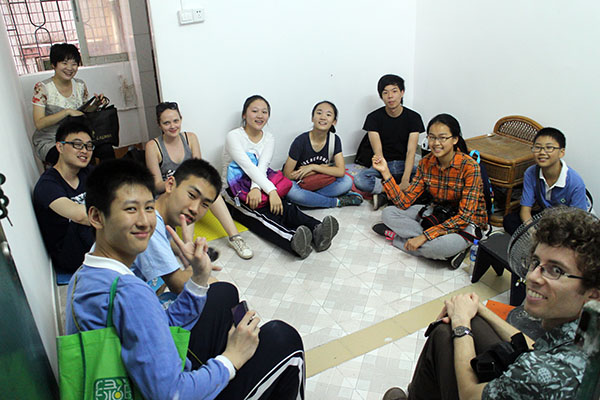
Today we held the design workshop for the Dalang graffiti festival. 27 people attended the workshop, which involved creating designs for manhole covers. With the exception of one individual, none of the participants admitted to having taken any art classes outside of school; none admitted to sending their children to art classes. All were immigrants and during their self introductions, they mentioned their hometowns; one made a joke that her hometown was “too small to have English names”. Next week, participants will take their designs and begin painting manhole covers at a workers’ dormitory, a neighborhood, and a school.

Continue reading

handshake with the future

Handshake 302’s latest project is moving along. This past weekend we met with middle school students (on Saturday) and Guangdong Xin’an Polytechnic students (on Sunday) to think about how their experiences and acquired knowledge about Baishizhou might be put to the interesting work of making art.  Continue reading

handshake 302 update: my white wall compulsions, III/ threshold

This week while helping to install the next edition of “My White Wall Compulsions (墙迫症)”, Laura Belevica’s beautiful “Threshold (生死之门)”, I was struck by the beauty of collaboration within small, shared spaces. Indeed, our exploration of what can be done with the walls of an efficiency apartment has revealed unexpected vastness and implicit conversation. Continue reading

international community. china?

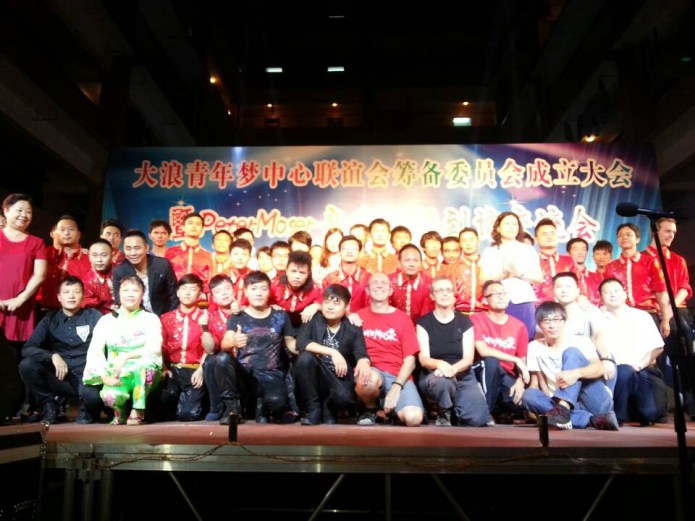
Over the weekend CZC curated a cultural exchange between the Dalang Street Office and Peter Moser of more music. A talented and inspirational music facilitator, Pete asks questions that go to the heart of community work — why this, why here? And the ever vexed question for moi (especially in light of the Hong Kong protests) — where do we draw the line between doing our work and our work becoming complicit with Party goals of social control at the expense of democracy and economic justice? Continue reading

墙迫症–my white wall compulsions

302 will start a new project–my white wall compulsions. The title is a pun: 强迫症 means obsessive compulsive disorder, while the characters for strong (强) and wall (墙) are homonyms.

The project itself is quite simple. 302 is a one room efficiency with four white walls. We’re looking for four individuals and or teams to transform one wall in the way they have always fantasized. And you know who you are. Staring at a white wall imagining all sorts of paint and bas-relief interventions! The project begins September 27 and ends with a party on November 21. Right now we’re accepting project proposals. We will also provide 500 rmb to pay for materials. If you’re interested in claiming your white wall compulsions and in Shenzhen contact me.

For those who’ve been wondering what’s up with community art in Shenzhen, the pictures below are from an August 29 performance in Shuiwei. The workshopped performance piece “feeling stones to cross the river” was part of the opening ceremony for the Futian International Images Festival, which celebrated documentary images and films.

This slideshow requires JavaScript.
baishizhou: intervention and experience

This weekend (Feb 22-23), two events organized for Shenzhen children focused on Baishizhou. On Saturday, ATU/观筑 held a “Young Architects” program in Venue B of the Biennale. On Sunday, CZC Special Forces and Ya Ya Theatre co-produced “Baishizhou Theme Park”, a 20-minute play that was written, directed, and performed by six of Baishizhou’s youngest residents in Venue A.

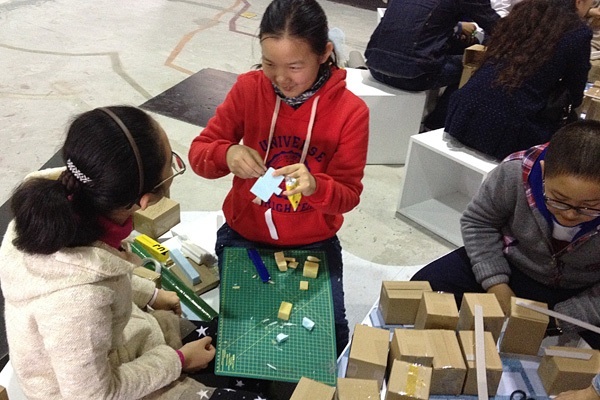
For the past two years, ATU has run the Young Architects program to teach architectural literacy through experience. They have intervened in the Baishizhou Tangtou row houses, building chairs and also built small spaces to spec, for example, a study room for one person that connects to another, but remains private. Saturday’s program was a urban renewal workshop for Baishizhou. Led by architects, Huang Jingjie and Feng Guochuan, six groups of pre- and teenagers took responsibility for one area. The requirements were, the total building area cannot change and improvements must be affordable so that rents will not increase dramatically. Each group had a professional consultant and 90 minutes to rethink urban renovation.

For over four years, Ya Ya Theatre has developed intimate performances that express unique experiences. Earlier in this year’s Biennale they produced a version of “One Person, One Story” in which members performed autobiographical and biographical monologues about a life-changing event. Lora Wang and Chen Lihua ran the two-month workshop that included exploration of Baishizhou and then developing a series of autobiographical vignettes. Sites visited included a dry swimming fountain, the Jiangnan Department Store plaza, and a video arcade.

So, the during the last official weekend of the Biennale, we had two events that developed the theme of the relationship that Shenzhen children have to Baishizhou, and by extension other urbanized villages. This in itself indicates that interest in the urbanized villages is spreading beyond commercial and academic enclaves. Moreover, we also saw community projects that assume urbanized villages as an important component of Shenzhen as an imagined community. This marks an important shift in the public awareness. Previously, urbanized villages existed outside Shenzhen representations of the city. The villages were (and to a large extent remain) glaringly absent from urban plans. Suddenly, the villages have emerged in public discussions about wither urban development and renewal?

These questions were at the heart of the post performance discussion “Learning from the Urban Villages” with Lora, Feng Guochuan and Zeng Guansheng. Audience members were not only interested in where the working class and young migrants would first settle in Shenzhen, but also in questions about the social value of street life and neighbors. This kind of conversation provided a glimpse into a larger, more general search for Shenzhen identity. This new identity reworks the version of high-speed development and red heroes that has been the previously ignored but not challenged vision of who Shenzheners are and what the city might be.

This slideshow requires JavaScript.