retirement plans for older migrant workers?

Yesterday, a weixin article claimed that among China’s 230 million migrant workers, the number of workers over 50 years of age could be as high as 36 million. These 36 million, of course, were the first generation of migrant workers, who left their villages in 80s and early 90s — before reforms had spread beyond the borders of special economic zones and coastal cities, to work in China’s newly opened factories.

The article raises the important and increasingly pressing social question, where will these workers retire? And what will they do in the absence of retirement plans? The journalist interviewed older workers in the northern city of Lanzhou, where there is little option but to retire to their hometowns. According to a report published in 2010 by the Chinese Elder Workers Council, 84.7% of city and town residents have a pension, averaging 1,527 yuan a month. In contrast, the percentage of rural residents with a pension is 34.6% and the average income is 74 yuan a month.

In Shenzhen, the debate over what to do with older migrant workers has been ongoing since March 1987, when the city legalized the participation of rural migrants in pension plans. Indeed, Shenzhen has been at the forefront of reforming China’s pension plans, allowing self-employed entrepreneurs to buy into pension plans (1992), and provided pension supplements for regional workers and for non-Shenzhen residents to collect pension benefits in the city (1999). In 2007, twenty years after migrant workers were permited to buy into pension plans, there was a rash of articles about Guo Jinzhao (郭锦钊), the first migrant worker to collect a monthly pension in Shenzhen (at the time of the article 1,005 yuan a month).

Over 25 years since the debate about migrant workers began and the celebratory publicity campaigns notwithstanding, the majority of Shenzhen migrant workers has not earned enough to either retire in the city or to have purchased into pension plans. In 2012, Wen Qingqiang published a photoessay on the city’s “naked old tribe (裸老族)”. The gist of the article anticipates the Tencent post: older migrant workers can not afford to stay in the city where they have lived and worked for the past several decades. Instead, their most viable retirement option is returning to their hometowns.

Note about language: In Chinese, the expression for “rural urbanization” is more specific than its English translation, highlighting both extant labor regimes and the administrative structure of the Chinese state apparatus: 农村城镇化, literally means, “agriculture villages city town transformation”, or “the transformation of agricultural villages into cities and towns. The distinction between cities and towns is relevant, of course, because within the Chinese state apparatus, cities rank higher than towns (which rank higher than villages) and are thus more eligible for state funding and preferential policies. At the level of geopolitics, then, rural urbanization has referred to the restructuring of spatial hierarchies. The transformation of rural Bao’an County to Shenzhen Municipality remains the national poster child for successful rural urbanization.

Importantly, rural urbanization has also occurred through the migration of rural residents from agricultural villages and townships to the country’s cities. In fact, these workers are literally called “farmer-workers(农民工)”, an expression that not only emphasizes rural origins, but also their role within urban hierarchies. This point bears repeating because rural migrants have not been fully integrated into urban societies, either formally (through hukou and concomitant welfare benefits) or informally (through friendships and associations that might blur the distinction between urbanites and bumpkins). Here, although Shenzhen has taken initiatives to experiment with tweaking the hukou system, nevertheless, the ideological distinction between urbanites and bumpkins continues to shape both public policy and the concomitant imaginary of just who is (and is not) a Shenzhener.

how chinese is weixin?

This past year, I have noticed that the age of text messages seems already over. Instead, the sarcastic couplets and stories that used to come by text, now come by weixin groups. On the face of it, it seems a case of new technology beating out a less convenient model. Afterall, weixin groups allow senders to conveniently send out targeted mass mailings.

Interestingly, Tricia Wang has suggested that their are cultural reasons for the popularity of weixin. Specifically, the “shake” and “nearby” functions, which allow young people to meet strangers through a virtual introduction. Indeed, Tricia has also translated rules for using weixin to set up a one-night stand. Tricia makes the point that

One of the most important things to understand about Chinese apps is that the successful ones make serendipitous communication with strangers really easy.

I’m wondering, however, if the cultural gap is as much generational than cultural? After all, young people who spend a great deal of time online are already habituated to virtual introductions. Moreover, I’ve seen groups of teenagers in both the United States and China, hanging out together while they chat and go through messages received on their smartphones. That said, I highly recommend visiting Tricia’s blog, Bytes of China to explore the ways in which social media and new technologies are shaping and being shaped by China.

shenzhen and china’s left behind children

The Foreign Policy series “China’s Left Behind Children,” by freelance journalists Deborah Jian Lee and Sushma Subramanian followed the migrant worker Huang Dongyan, who left her daughter back home to work in Shenzhen. Her relationship with her daughter remains fraught and teeming with unsatisfied yearnings. In response, Huang, decided to raise her son in Shenzhen instead of leaving him in the countryside with his grandmother. The two articles are well worth reading, here and here. Of note is the continued relevance of hukou in the lives of migrant workers, especially with respect to receiving an education.

national shame…

egyptApparently a Chinese tourist wrote the characters ” 丁锦昊到此一游 (Ding Jinhao arrived here)” on one of the bas-relief sculptures at the Luxor Temple in Amun, Egypt. In turn, another Chinese tourist discovered the defacement and uploaded a picture to weibo, where it was picked up by the weixin and other news outlets. Today, Epoch Times has reported that the parents of Ding Jinhao have appologized for their son’s behavior.

Unfortunately, a few clicks around the web suggest that vandalism of cultural heritage and sacred sites is common. What seems notable in this case has been the outrage of the Chinese netizens and the consensus around “national shame”. Moreover, the use of social media to bring about this public shaming reminds us of the ongoing debate about the public face of Chinese tourists. It may also be that this vandalism shocked my friends because they believe that no matter how much Chinese people disregard the law at home, once abroad they become law-abiding citizens.

yan’an by way of frankfurt

Theodor Adorno and Max Horkheimer’s 1944 essay The Culture Industry: Enlightenment as Mass Deception helps us think through the idea that capitalism in the West functions like socialism in China. The point, of course, is the attempt to control social processes to benefit a few, whether they be investors (as in the States) or cadres (as in China).

In the quote below, for example, I have replaced “consumer” with “the People (人民)” and “producers” with “cadres”. Note that as with the critique of censorship in China, Adorno and Horkheimer’s critique of the Western cultural industry focuses on the enforced passivity of the intended audience. Note also that A&H lament the fact that the cultural industry has coopted enlightment to its own ends. Similarly, the critique of cultural production in contemporary China emphasizes how the progressive ideal of liberating workers, peasents, and soldiers has been subordinated to maintaining Party hegemony:

There is nothing left for the consumer People to classify. Producers Cadres have done it for him. Art for the masses has destroyed the dream but still conforms to the tenets of that dreaming idealism which critical idealism socialism baulked at.

The result of systematically subordinating human creativity to monolithic ends (profit in the West and political power in China) results in boring, predictable literature and art:

Not only are the hit songs, stars, and soap operas cyclically recurrent and rigidly invariable types, but the specific content of the entertainment itself is derived from them and only appears to change. The details are interchangeable. The short interval sequence which was effective in a hit song, the hero’s momentary fall from grace (which he accepts as good sport), the rough treatment which the beloved gets from the male star, the latter’s rugged defiance of the spoilt heiress, are, like all the other details, ready-made clichés to be slotted in anywhere; they never do anything more than fulfil the purpose allotted them in the overall plan.

Adorno and Horkheimer assumed that the extent to which art and literature liberate or nourish or enhance a human life pivots on the the extent to which an individual actively participates in the realization of a work. They followed Kant in understanding that this participation is rational; the work of appreciation is to classify and organize aesthetic experience, creating a critical consciousness. In the Talks at the Yan’an Forum on Literature and Art (在延安文藝座談會上的講話), Mao Zedong also posited a beneficial kind of aesthetic engagement, albeit revolutionary rather than critical because he followed Marx. For Mao, socialist art and literature would facilitate the mental work of transforming one’s half-feudal, half-colonial consciousness into revolutionary consciousness.

I’m actually an advocate of both critical and revolutionary consciousnesses, especially when used to hone each other. Today, however, I’m wondering how it is that human societies end up in these painful and painfully similar cultural ruts. In other words: what’s the generalized (or mass) appeal of repeated bouts of boredom? Indeed, maybe what’s at stake isn’t boredom, but rather our anxiety about the fact that true repetition is impossible. In other words, what if we’d rather be bored than confront the irrefutable freshness of every moment? To the extent that we can’t step in the same river twice, it follows that we can’t watch the same movie model opera twice.

Thought du jour: when Mickey Mouse stepped through the looking glass, he found himself among a Red Brigade of Women, who were applying to study in the United States, where they might realize their Chinese dreams.

audience passivity in the yan’an talks

As preparations for the Bienalle start, I have found myself thinking again about the level of censorship over literature and art in China. Yesterday, I even went so far as to re-read the Talks at the Yan’an Forum on Literature and Art (在延安文藝座談會上的講話), which Mao began on May 2, 1942. Audience passivity and the ignorance of artists and writers were two key ideological assumptions structuring Mao’s arguments about the social functions of literature and art. Below, I have taken several key phrases in order to show the way in which the Maoist politicization of literature and art was concomitantly a disempowerment of the audience or reader of a work, even as artists and writers became tools — and I use the word deliberately — of the Revolution Party.

Mao opens the talks by greeting his comrades and outlining the social-aesthetic questions he sees facing revolutionaries: the question of standpoint, the question of attitude, and the question of the object of work. Mao’s interpretation of correct standpoint and attitude are unsurprising and straight-forward. The question of correct standpoint for Party members was unambiguously defined as being the Party’s position (對於共產黨員來說,也就是要站在黨的立場,站在黨性和黨的政策的立場). The question of correct attitude was then defined with respect to three types of people — enemies, allies, and one’s own people (有三種人,一種是敵人,一種是統一戰線中的同盟者,一種是自己人). The emphasis on “one’s own people” is important because in everyday Chinese, these are the people that one can count on no matter what. Mao then further defines “one’s own people” as the masses and their vanguard (這第三種人就是人民群眾及其先鋒隊). In short, on Mao’s reading, a correct attitude involved opposing one’s enemy, criticizing one’s allies when they were wrong, and “patiently teaching one’s own people, helping them with their burdens, and to struggle with their mistaken views in order to help them make great progress (我們應該長期地耐心地教育他們,幫助他們擺脫背上的包袱,同自己的缺點錯誤作鬥爭,使他們能夠大踏步地前進).” In turn, “our” literary and artistic works describe these struggles to overcome one’s mistaken views (他們在鬥爭中已經改造或正在改造自己,我們的文藝應該描寫他們的這個改造過程). However, when Mao turns to the long discussion of “the object of work” the discussion becomes interestingly convoluted.

The discussion opens with the line, “the question of the object of work, that is the question of who the literary work will be read/seen by (工作物件問題,就是文藝作品給誰看的問題)”. As I read it, the Mandarin defines the intended audience of revolutionary works as objects (物件) who will be given something to read/see (給誰看). In many translations of the Talks, this line is translated as, “The problem of audience, i.e., the people for whom our works of literature and art are produced”. This translation not only transforms the object of literary and artistic creativity into an “audience”, but also gives the writer and artist productive agency. However, neither of these subjectivities is implied in Mao’s language, a fact which becomes more explicit several lines later.

On the one hand, Mao contends that in Yan’an, the objects of literary and artistic work are the workers, peasants, soldiers, and cadres who are the “receivers of literary and artistic work (文藝作品的接受者)”. He emphasizes that the objects of literary and artist work in Yan’an were “completely different (完全不同)” from those in Nationalist-held Shanghai, where the primary objects were students, officials, and merchants.

On the other hand, he also stresses that “our literary and artistic workers (我們的文藝工作者)” who don’t understand the workers, peasants, soldiers, and cadres have a responsibility to learn about them. One of the more interesting examples of Mao’s designation of the object of literary and artistic work comes in this discussion of literary and artistic workers’ ignorance of the lives of workers, peasants, soldiers, and cadres. Mao states, “Literary and artistic works are not familar with the their descriptive object and product-receivers (文藝工作者同自己的描寫物件和作品接受者不熟,或者簡直生疏得很)”. In this line, we see that for Mao, “workers, peasents, soldiers, and cadres” were simultaneously the object of and receiver of descriptions. In other words, the purpose of literary and artistic work was to help the masses become self-conscious of their class position, without actually teaching them critical reading skills.

The discussion then turns to the question of education for both literary and artistic workers as well as for the masses, with the Party providing correct standpoints and attitudes for this work, which is based on Marxist-Leninism. At this moment, we see the rhetorical transformation of creative workers into tools of the State because standpoint and attitude have already been defined as being in line with the Party position.

Thought du jour: as someone who engages in literary and artistic work, I agree with Mao’s contention that many of our ideals and passions are class-determined. Where I part ways with his analysis, however, is in his characterization of audiences as passive object – receivers of creative work and writers and artists as vehicles for one standpoint and attitude on any question. It’s not only that I enjoy a good dose of whimsy in my art, but also that I have more faith in a variety of standpoints and attitudes than I do in one proscribed, formulaic interpretation there of. Indeed, I find the idea that all creative work must be immediately accessible to all audiences more in keeping with Hollywood goals than with creative exploration.

And there in lies a core paradox in doing creative work in Shenzhen: while I agree with Maoist analysis that we need to take economic inequality and class differences into account if we are to create a more just world, nevertheless, as both a writer and reader, I am nourished by a diversity of perspectives and interpretations.

politicized face masks

protests

On May 4 this year (more here), Kunming residents wore surgical face masks to protest the construction of a p-xylene factory. In response, the government issued a gentle reminder that clinics, pharmacies, and printers should use the “real name system (实名制)” to complete surgical mask sales and immediately report the transaction to the police.

IMG_2788

Gentle Reminder to all pharmacies, clinics and printing shops in Bianbanjie Village, Jitou Township: From this day forward, if anyone comes to you to purchase large quatitities of surgical masks or to print any of the phrases “human health, petrochemical project, Pengzhou [proposed factory location], or PX”, please take down their telephone number and identity card number, and then report the transaction to either the Jitou Precint or neighborhood police station. Thank you for your cooperation. Jitou Precint telephone number: 85369511 and neighborhood police officer cell phone number: 15828585968.  

Paraxylene is an isomer of xylene, one of the most produced petrochemicals in the United States. In the toxic daisy chain of polymers, xylene is a raw material used to produce terephthalic acid, which is used to manufacture polymers, which are used to make products ranging from pantyhose to take-out containers to baking tins. Paraxylene (or PX as it is being called in Chinese) is the most commonly used isomer in the production of terephthalic acid. The major producers of p-xylene tend to locate factories in poorer regions. One of the world’s largest producers, Chevron Phillips, for example, produces p-xylene at their Pascagoula, Mississippi plant. BP owns the world’s largest single factory in Texas City.

P-xylene is highly toxic:

In humans, overexposure to xylene can cause headache, fatigue, dizziness, listlessness, confusion, irritability, gastrointestinal disturbances (nausea and loss of appetite), flushing of the face, and a feeling of increased body heat. Exposure to xylene vapors above recommended exposure limits (100 ppm – TWA) can cause irritation of the eyes, nose and throat as well as tightening of the chest and staggering gait. Severe overexposure to xylene has been reported to cause irregular heartbeat or rapid incoordinate contractions of the heart, tremors, central nervous system depression, and unconsciousness. Lethality has resulted upon exposure to 10,000 ppm. The odor threshold for xylene is reported to be 1 ppm…Aspiration of this product into the lungs can cause chemical pneumonia and can be fatal. Aspiration into the lung can occur while vomiting after ingestion of this product.

Six years ago, protests against a PX plant in Xiamen caused local authorities to cancel plans to build a processing factory. Similar protests took place in Dalian (2011) and Ningbo (2012) also resulted in authorities withdrawing plans to build PC processing plants.

The levels of pollution in many Chinese cities have resulted in many residents wearing face masks. There are also reports of face-kinis to protect skin on the beach. To date, however, the Kunming protests and government response have been the most explicit politicization of face masks.

more on smog

Previously, sections of the Municipality had reported dangerous levels of carbon diaoxide, but on April 15, 2013 and for the first time in its history, Shenzhen recorded dangerous levels of air pollution in every part of the city.

Shenzhen is not alone in its unhealthy rush to a narrowly defined standard of wealth. Indeed, concern in Shenzhen follows upon the outrageous levels of pollution that were reported in Beijing. But as David Roberts reminds us, this level of pollution is just one example of a worldwide trend:

The Economics of Ecosystems and Biodiversity (TEEB) program sponsored by United Nations Environmental Program asked environmental consultancy, Trucost to tally up the total “unpriced natural capital” consumed by the world’s top industrial sectors. (“Natural capital” refers to ecological materials and services like, say, clean water or a stable atmosphere; “unpriced” means that businesses don’t pay to consume them.) …The biggest single environmental cost? Greenhouse gases from coal burning in China. The fifth biggest? Greenhouse gases from coal burning in North America.

Moreover, our respective industrial sectors thrive on coal:

unep-top-five-industrial-sectors-by-environmental-impactsjpg

I feel like I parrot myself at every opportunity: the United States and China are the same country. Really. The similarities are of kind, while our differences are merely of scale. And so the question remains: how do we fix shared problems, rather than getting settling for the politics of blame?

carry the purse, gentlemen!

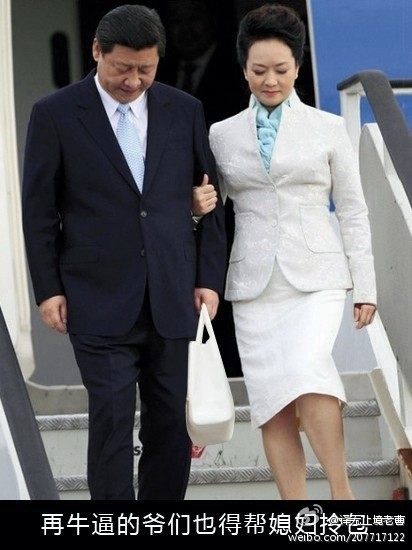
5198cc4ejw1e326t05m2gjMeme du jour: Even the most impressive have to carry their wife’s purse (在牛逼的爷们也得帮媳妇拎包).

Yes, it’s true. Xi Jinping carryies wife, Peng Liyuan (彭丽媛)’s purse and the Chinese internet is gleefully sharing the news. I know that many westerners-in-China have been disconcerted by the fact during a Chinese courtship, men carry their girlfriend’s purse. After marriage,  many men — especially those “caring alpha” types — carry their wife’s purse. And now Xi Jinping and Peng Liyuan have brought this bit of intimacy to the international scene.

My friends have been thrilled by Peng Liyuan’s performance as China’s First Lady. Now, they’re ecstatic that she’s reminding their menfolk about what it means to be a gentleman.

what kind of pig are you?

This is one of those unscientific “he said, she said” illustrations of just how difficult it is to know what’s happening in China, or anywhere for that matter. The story also indicates that the US and Chinese social media are not as autonomous as we might think. Indeed, anonymous sourced information that circulates in either the US or Chinese social media seems to increasingly show up in other networks, much like pig carcasses that wash up on unexpected shores. More to the point, the chronology through which we experience the overlaps between US and Chinese social media networks creates stories that read as magic realism in which you, gentle reader, must ask yourself, “what kind of a pig am I?”

Here is the timeline through which I have experienced the pig story.

Two weeks ago, several hundred dead pigs were found floating in the Jiaxing River, a tributary of Shanghai’s Huangpu River.

Last week, an American friend uploaded this photo Pigs Swimming in Mud Cake to Facebook.pigs swimming in mudcake

Yesterday, a friend in Hong Kong, uploaded the same picture and what followed were a series of jokes about not eating pigs and pork products. The apparent prompt for forwarding the picture was another message that was also circulating:

 I don’t know if this is true or false, but it must be forwarded: eat less pork! Shanghai has claimed that over 8,000 pigs froze to death! In the middle of a bright South China Spring! I’m begging the relevant ministries – can’t you exert your brains and come up with a more believable reason? Don’t treat the people as if we were three year olds. One dead pig is a random occurrence. Two dead pigs is a random occurrence. But over 8,000 pigs dead is random? There must be a reason! Today, the truth has finally been revealed! – Where is the future of the Chinese People? We’re digging our own graves and anhilating our people! [Forwarded message: according to a pig farmer, there’s a chemical called 机砷. In ordinary language that’s 砒霜 or arsenic! This chemical is used in pig feed like “四月肥” [literally “Fat in April”- MA] that accelerate the maturation of pig and make their skin shiny, increasing profits from selling pigs. The downside to the process is that the arsenic accumulates in the pigs’ bodies, which have no way of breaking down the poison. The poison causes the pigs’ internal organs to rot, and after four or five months eating this pig feed, most pigs die. Consequently, farmers only use this pig feed three or four months before bringing their pigs to market. As long as the pigs are slaughtered immediately, there’s no problem. But this Chinese New Year’s season, it was mandated that there could be no more government feasting and banqueting. Suddenly, the bottom dropped out of the pork market. Pig farmers were forced to continue raising pigs that had already been eating contaminated pig feed for four months. A month or two later, a massive die-off of the pigs that had been prepared to sell during the New Year’s season started. This story couldn’t be revealed. However, no one dared to bring already dead pig meat to market [instead of living pigs that would be slaughtered onsite to guarantee freshness – MA]. Consequently, the pig carcasses were tossed into tributaries of the Huangpu River. Clearly, the problem was caused because on the one hand, too many pig farmers are using pig feed to accelerate maturation and on the other hand, the banquet ban was too effective. The floating carcasses were discovered by the media. So maybe a thousand, maybe more pig carcasses are drifting silently in the Huangpu River. This is the horrific story that they are telling.

In contrast, yesterday The Guardian posted an article that mentioned that the pig carcass total had breached 16,000, and attributed the reason to a crackdown on selling dead pig meat in markets. In turn, The Guardian was citing (circulating?) a story from Southern Weekly (of the China Dream censorship fiasco):

The state-controlled Southern Weekly newspaper, citing court documents, said three men were sentenced to life in prison in Jiaxing last November for procuring dead pigs to sell their meat. It says the men and their group bought 77,000 dead pigs in a period of more than two years.

So, reflective moment du jour: Who are you? A pig happily swimming in a mud cake, anticipating sugar highs? Or a pig drifiting in dark waters, fearful about what the Chinese government might be hiding and how this silence kills? Of course, it’s all evidence that China and the US are the same country. After all, processed white sugar may also be toxic.

Text of the Chinese weixin that I received:

不知是真是假,但是不得不转: 少吃猪肉吧】上海8千多头死猪死因公布了一一居然是冻死的! 在春花灿烂的江南三月! 拜托了有关部门,能否多动动脑子找个更可信点的理由,不要把民众当三岁小孩哄。一头死了是偶然,二头死了是偶然,8千多头是偶然事件?一定有其必然的原 因! 现在,真相终于大白天下了! 一一一中国人的未来在哪里??我们在自掘坟墓,灭绝民族! 【转:据猪农说,有种制剂叫有机砷,砷就是砒霜啦,用在四月肥之类的猪饲料添加剂里,可以促进猪性腺发育和毛皮红亮,改进卖相有利于卖个好价钱。 但副作用是有 机砷蓄积在猪体内会部分分解为无机砷,喂食四五个月后会大幅增加猪的内脏腐蚀、大批死亡的概率。所以一般是在预备出栏前三四个月开始用,反正负作用还没出 来猪就宰了出栏,规避了有机砷的风险。 然而熹兴年底眼看通胀要升腾,赶紧猛刹车大力禁绝国企和机关摆酒席过年,导致大量酒席突然被取消,相应 地酒席用肉也大幅低于预期。猪农已经喂好四月肥准备出栏宰杀的猪也被迫继续在栏里养着。可是有机砷已经用了,本来马上宰杀负作用还不会出来,现在拖了一两 个月还没卖出去,有机砷的副作用 上来了,猪们纷纷内脏腐烂而死。这死因见不得光,又不敢拿去市场上卖这样的死猪肉,养殖户只好打落牙往肚里咽,抛到河里了 事。孰料这么投有机砷的养猪户太多,年末禁酒席的影响又太普遍,大家都往河里一丢,猪尸们就在黄浦江大游行了,被媒体发现了。 成千上万的猪尸在阴冷的黄浦江上默默地飘荡,它们在讲述着这样一个可怕的故事。