Impressions of the mountain villages in Tantou Village, Kaihua County and the neighboring, Yutianban Village fields.
Tag Archives: china

tantou: these are not mcmansions
This past week, I joined members of ATU on a research trip to Kaihua County, Zhejiang. ATU is a Shenzhen-based NGO, and their mission is to bring critical attention to architecture and urban planning practices. Most recently, they have decided to intervene in rural development in order to ameliorate the problems of bringing urban planning and its ideologies into rural areas. Continue reading

rural construction: can law serve china’s peasants?
While in Xi’an, I once again visited the Terracotta Soldiers in Lingtong, once upon a time center of Qin power. The First Qin Emperor (秦始皇 ) installed this death monument during his life. This seems to have been the way of ancient Emperors and Pharohs — a longing to control everything, as if making the world in our own image was (a) possible and (b) a means of achieving immortality. However, we don’t really know what the mass grave meant to him because we haven’t found his grave — just indications that he wanted to be safe in death. But maybe it was a ruse to distract observers from his actual gravesite. That said, we do know that he conquered unified six warring states and became the model for those future Chinese leaders who yearned to bring everything under heaven under themselves. Personally. Indeed, the visit sparked a conversation about the meaning of 法律, its historical constitution, and whether or not law can serve China’s peasants. Continue reading

cultural smog
I am in Tianjin where the smog is thick. It creates grey on grey cityscapes and irritates eyes and throats. My niece, a lovely and talented young woman jokes that, “Chinese people have iron lungs,” instantly showing up the dystopian anxieties that animate cyberpunk and urban fantasy (as popular literary genres, not simply as lifestyle choices).
I remember similarly edged jokes from my mother’s relatives and friends when we went back to the UP, where iron mining and tree harvesting for the paper mills had reshaped the wild north. “That,” they said with a half apologetic laugh when they glimpsed our pinched noses, “that is the smell of money.” Continue reading
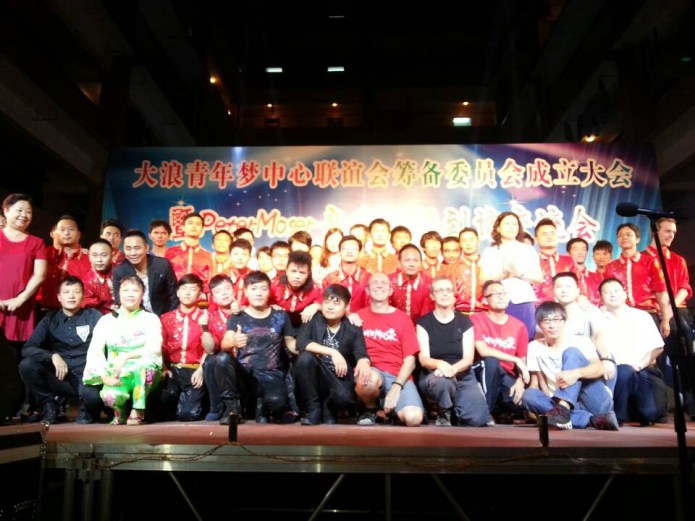
international community. china?
Over the weekend CZC curated a cultural exchange between the Dalang Street Office and Peter Moser of more music. A talented and inspirational music facilitator, Pete asks questions that go to the heart of community work — why this, why here? And the ever vexed question for moi (especially in light of the Hong Kong protests) — where do we draw the line between doing our work and our work becoming complicit with Party goals of social control at the expense of democracy and economic justice? Continue reading

meizhou: the violence of rural (re)construction
This is the first part of a six-part essay, Meizhou: The Violence of Rural (Re)construction. Rural construction (乡建) is currently one of the most important debates in Shenzhen specifically and China more generally. As China’s “first city without villages”, Shenzhen has an important place in this debate. In fact, Shenzhen is held up by social progressives, real estate developers, and Party officials alike as a model of what rural construction should be. More locally, civic groups are beginning to organize around this issue in order to promote more just visions of the city.
Friday, September 19, 2014, we made the five-hour bus trip from Shenzhen to Meizhou. We were an assorted group of scholars, architects, and journalists, but we had joined documentary film maker Deng Shijie in common cause–to visit the Meizhou suburbs in order to bear witness to the human suffering that has resulted from current development policies. Shijie and his allies are central to a small, but meaningful citizenship movement in Shenzhen. Many of Shenzhen’s second-generation have become active in what we in the United States would call social justice issues, but which in Shenzhen operate under the glosses of philanthropy (公益) or social renewal (社会创新).
We arrived well past midnight, but were greeted warmly by villagers who are trying to voice their demands. Some want to maintain their current homes, others want more equitable compensation, and all want the government to bring out a viable and legal relocation and compensation plan. And that, of course, is the crux of the matter. The government’s plan to construct a new city notwithstanding there has been no release of a relocation plan. Instead, villagers are being bought and when that fails forced out of their residences. Two of the nastier strategies of displacement are (1) using the police and/or local thugs to harass and beat villagers until they sign off and (2) razing homes and then transferring money to villager escrow accounts. If the villagers use the money, the action is interpreted as acceptance of the government’s terms. If however the villagers do not use the money, after a five-year period the money will be returned to the Ministry of Land. There are also reports of villagers having been detained at local police stations in order to compel village heads of household to sign property transfer agreements. (For an introduction to China’s duel system of land ownership by way of Shenzhen, please see “Laying Siege to the Villages“).
The crude background to this travesty is the Chinese state’s commitment to making urbanization central to economic development and (more importantly) a criteria for promotion within the Party and government. In 2011, Meizhou began planning a new city on the rural land that was traditionally held by villages. However, urbanization directives accelerated in March this year when China released its National New Type Urbanization Plan. Subsequently, in September 2013, the Meizhou government released the Meizhou Jiangnan New City Detailed Plan (梅州江南新城详细规划) for public debate. The official discussion period was from September 24 to October 20, 2013. The plan was made available in three sites: the Meizhou Government Building, the plaza of the Jianying Park, and the municipal urban planning. However, according to villagers, the City continued to raze homesteads during this time. Additionally, the City also targeted traditional Hakka compounds and ancestral Halls. Architect Ye Yikun (叶益坤) has been the leading voice of opposition to demolishing historic architecture.
Below are images from our trip to several villages in the Meizhou suburbs.
The other five entries in this series are:
Part II/ Meizhou: Hoodlum Government
Part III/ Meizhou: Living Genealogies
Part IV/ Meizhou: What Gets Preserved
Part V/ Meizhou: Lessons from Shenzhen
Meizhou VI/ Meizhou: Selected Translations

one day
Yesterday evening I went to a screening of 有一天 (One Day), a series of vignettes about children with learning disabilities and handicaps, their parents and struggles. The film itself features some of China’s biggest stars and the vignettes tackle some of the county’s most pressing issues, including recognition of and support for missing children (who have kidnapped, maimed, and forced into begging), blind and deaf children, and children with Aspergers, Down syndrome, and attention deficit hyperactivity disorder. A heavy list indeed, and each case receives roughly 7 minutes.
The Shenzhen premiere was organized by the Shenzhen Association for Children with Learning Disabilities (深圳市学习困难关爱协会), the first organization of its kind in China. The guest of honor was Shenzhen Women’s a Association Chairwoman, Ma Hong, who had approved the establishment of Shenzhen LDA in 2013. Also present was the Vice Director of the Nanshan District Bureau of Education, over 100 Nanshan teachers, twenty-odd elementary student volunteers, and special guests. The screening was so successful that a second public screening was scheduled for this morning.
Just a few observations about the evening, Shenzhen LDA, and the burgeoning Shenzhen interest and participation in and passion for philanthropy.
1) The “one day” of each vignette occurred when a child acted “normally”. In fact, there was no “happy end” that was consistent with a child’s disability. So the stolen child was returned home, the deaf sang, and a blind girl painted. The case of the Down syndrome child who learned to bake bread came close, but even then the happy resolution was that the boy could traverse Beijing with bus changes alone, even though he could neither read signs, nor clearly articulate his destination. Moreover, in each case, outsiders selflessly intervened and saved the child, providing the parental care the parent–for whatever reason–could not. I found this ideological position most disturbing in the missing children section because the child was not handicapped at birth, but had been criminally maimed, begging the questions: why can’t rural parents protect their children from urban predators? and, in what moral world is predation on children the logical equivalent of giving birth to a child with Down syndrome or Aspergers, let alone one with a club foot or weak eyesight?
2) The film clearly sympathized with parents who don’t have the tools to help their children and the distress children feel when they cannot meet parental expectations. Indeed, in each case, the solution was ebetter ducation. Likewise, speakers acknowledged the stress disabilities cause in light of both the one child policy and the cultural expectation that “sons become dragons, and daughters become phoenixes” through education. And I agree with the idea that we help children through more humane pedagogy. And yet. Despite the inspiring motto: there’s no inability, only difference (没有不行,只有不同), the dream that permeated the movie and the talk was the discovery of previously obscured genius, a la Einstein. In other words, the “solution” to each “problem” was not a change in parental and social expectations, but rather more effective means to groom children to meet and exceed those expectations. So a question of emphasis: in special needs education do we start from unquestioned social goals and figure out what needs to be done to change a child, or do we understand each child as the inspiration for other social possibilities?
3) Throughout Shenzhen people are turning to philanthropy to address social needs and issues that the government is unable or unwilling to meet. Of these issues, education is one of the most vibrant areas of participation. Other areas include architecture (as a site for reimagining urbanism) and art as a site for stimulating creativity. The characters for philanthropy are 公益, literally “public benefit or welfare” which speaks to the political importance of the philanthropy movement, broadly understood and whatever one’s position on how a particular issue has been articulated.
what is a nuclear family?
This past week, I joined a wedding tour to Bali, which brought the immediate families of the bride and groom, as well as several friends together on a four-day tour. The wedding was held at the Bulgari Villas, where the bride and groom stayed while the rest of us stayed at a nearby golf club. Apparently, given the high cost of wedding photos, many newly weds choose to combine their honeymoon with a proffessional shoot. What I didn’t realize was that a shoot could also include a wedding ceremony and invited guests.
Of random note: (1) we were not the only such tour, and a multiple sites encountered well-dressed and manicured brides with their respective posses; (2) there were other Chinese tours taking the same route as we did. In fact, the majority of tourists at all the sites we visited we Chinese, and many of the Balinese staff had learned some Mandarin; (3) friends I have told about the trip commented that it was expensive, but agreed that it was difficult not to spend an exorbitant amount on a wedding; (4) traveling together gave the two families an opportunity to get to know each other and take delight in the couple’s happiness; and (5) the distance between the two generations was clear.
The 30-something couple clearly enjoyed Bali, its exotic locales, and the frisson of non-Chinessness. In contrast, the parents seemed somewhat bewildered by this format. They understood a honeymoon and photos, but not quite how the intentional reworking of tradition had become so popular. I’m speculating that these more private weddings represent and deepen the ongoing nuclearization of Chinese families that is so prominent in Shenzhen.
In the US we understand the nuclear family to comprise two generations–parents and children. In China generally, and Shenzhen particularly, the nuclear family comprises three generations–grandparents, parents, and children. In other words, the the rationalization of the family unit points to the historic organization of paid and unpaid labor in the US and China, respectively. In the ideolized US, fathers worked and mothers kept house. This trend was explicit in the forced redomestication of women in the post WWII era, when a man’s income was expected to provide for his dependents. In contrast, in idealized China grandparents provide childcare and housekeeping services while both parents work. This is necessary because individuals (except in the case of the uber-rich) can’t afford to purchase a house, needing combined incomes to meet mortgage payments. In a chicken egg moment of cultural difference, US American families emphasize the bond between husbands and wives, while Chinese families emphasize the bond between parents and children.
Though du jour, Americans highlight sexuality as an important foundation of family life because sleeping together secures the primary bond of the US nuclear family. Similarly, Chinese celebrate eating as an important foundation of family life because dining together reinforces the primary bond of the Chinese nuclear family. This difference can be read as “cultural” and some, like my friend and her husband are deploying “western culture” (i.e honeymoon and romance) to re-imagine the ties that bind the “traditional” Chinese family.
PS: This past month I have been busy over at Village Hack, the latest project at Handshake 302. The last Hacker was Yin Xiaolong, an artist who does most of his work online, through social media documentation of social concerns. While at 302, he engaged in copy painting, photography, and a leave-taking performance piece that included shaking hands with neighbor/strangers. Meanwhile, the concession grows that our three young neighbors are the most interesting and interested of our interlocutors.
voice of the people?
It’s been a while since I’ve had an interesting conversation with a cabbie, but this morning Song Shifu impressed with his convictions, social analysis, and desire to share.
On the reason for China’s environmental problems: Song Shifu hails from Zhejiang, one of the core industrial areas. Throughout his home county, the rivers stink and smoke clogs the sky. These factories produce goods for European and North American countries. These countries have taken advantage of their strength to unload the contaminating industries on China.
When I asked about Mao Zedong and if there was a need for Revolution, Song Shifu had mixed feelings. The destruction of traditional values has not been good for the country. However, under Mao China stood up for itself. Now China doesn’t dare use it’s army because all the US has to do to influence China’s foreign policy would be to freeze the bank accounts of the Princelings and their children. Moreover, he wouldn’t fight against the United States, after all there was no animosity between the US and China. Contaminating industries notwithstanding. But Japan. He would volunteer to fight Japan.
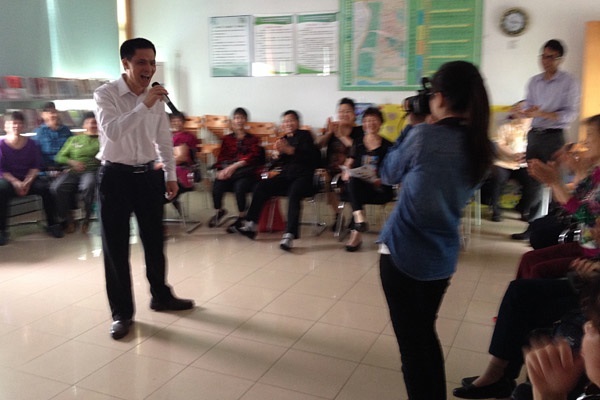
resolutely believing in the party
This morning I observed the Baishizhou Culture Station in action. Two groups of aunties were singing. The first group was singing Mandarin karaoke, the second group was singing an original Hakka composition entitled, “Resolutely Believing in the Party”. Later that morning the new Shahe Party Secretary came by, singing a karaoke song (“The Northern Spring”) and enjoyed the performance by the Xintang Hakka Mountain Song Chorus. Handshake 302 also presented our work to date.
The morning of community culture, including a Party Secretary karaoke moment reminded me that so much of Chinese political culture is making and maintaining good relationships between Party representatives and the represented. The pictures show the lyricist, the singing Secretary, and the Culture Center’s documentation of the event.
So here are the translated lyrics of “Resolutely Believing in the Party”. Note the definition of xiaokang–a basic material standard of well being. Note also in the picture that the lyrics have been written by hand.
Spring brings the fragrance of one hundred flowers, one hundred flowers
Everyone has a car and building, a house, a building and a house
Every kind of furniture
Three healthy meals a day, nutrition and health
Summer comes and the heat is hard to bear, the heat is hard to bear
Everyone has a fan or air conditioner, installed an air conditioner
No need to roast and sweat
We have electric slow cook pots for traditional soup, traditional soup
Fall comes and it turns cool, it turns cool
We wear fashionable clothes, fashionable clothes
Everyone carries a cell phone
Each home has internet and is linked to the world, linked to the world
Winter brings snowflakes to the mountain, snowflakes in the mountain
Reform and Opening is the promise of Spring, the promise of Spring
Resolutely believing in the Party
Beauty and happiness with the realization of xiaokiang, we’ve realized xiaokang
 Shenzhen Noted