gu kailai: he made me do it!

As Chongqing Turns takes no prisoners, literally.

According to Mirror News (明镜新闻网), Gu Kailai claims she had nothing to do with the alleged murder of Neil Heywood. Instead, she says that Bo Xilai’s secretary acted on the former Mayor of Chongqing’s orders to kill the British businessman. Her role in all of this was simply to invite Heywood to Chongqing. Moreover, she couldn’t refuse to help Bo Xilai because he frequently beat and sexually abused her.

It seems that Hu Jintao may have successfully arranged for Chongqing’s former power couple to receive the death sentence for their role in Heywood’s death. Or at least that’s cliff-hanger du jour, not to be confused with anything like verifiable news.

Meanwhile, there are reports (here, here, and here) that two days ago several thousand took to the streets of Chongqing to protest the government by singing red, a direct challenge to Bo Xilai’s administration and a call for change a la Mao. They also sang the national anthem: “Ten thousand hearts as one, braving the enemies canons — forward march!” In response, the government ordered the police disperse the protestors using teargas yesterday.

Online, extreme left websites such as “乌有之乡”, “毛泽东旗帜网”, “民声网” and “红色中国” have been closed down, although it is still possible to find their site addresses in Baidu’s cache and the British speculate about how Heywood’s Chinese wife is “suffering“, quote unquote.

gu kailai arrested: “as chongqing turns” really is one of the best shows on the worldwide web

In today’s episode of As Chongqing Turns, Bo Xilai’s wife, Gu Kailai has been arrested for the murder of Neil Heywood, a Beijing-based British businessman.

When we last visited Chongqing, Guagua had been urging his father to truly reform Chongqing’s political-economic system instead of singing Cultural Revolution karaoke and cracking down on “black” activities. One of Bo Xilai’s patrons, Noodle Master Kang (played by Zhou Yongkang) had been fighting with Direct Line to Heaven (played by Wen Jiabao) and Tire (Hu Jintao) for control of the Center. There were rumors of bullets having been fired in Beijing, rumors which increased levels of paranoia because of the administrative separation between control of the military and control of the police. Remember, the military is controlled by, well, the military and in the hands of Tire. The police, however, report to Noodle Master Kang and although the military is larger than the police force, nevertheless the police have more ground forces than the military, who serve and protect Chinese people in the air and at sea, in addition to on land…

Flashback to November, 2011, place: a fancy Chongqing hotel room. Neil Heywood is found dead. Representatives of the Chongqing government tell Heywood’s family that he died of a heart attack. They tell the British Embassy that he died of an overdose of alcohol poisoning. Strange, someone says, I never knew him to drink…

Flashback to Wang Lijun’s mad dash to the US Consulate in Chengdu. Close up of the Chongqing police surrounding the building, demanding that the Americans release Wang Lijun. We jump to a reconstruction of what the New York Times says took place: Wang Lijun telling the Americans (large and in blue suits) all sorts of things about the inner workings of the Center. He lowers his voice and accuses Gu Kailai of poisoning Heywood and to force the Center to reopen the case. Wang Lijun begs the US officials for asylum, but it is not granted. Instead, 30 hours after he entered the Chengdu Consulate, he leaves “of his own accord”, which is what was said at the time and we now know not to be true…

Meanwhile, the Chinese internet pulses and throbs with speculation and analysis. If Gu Kailai did poison Heywood and if hubby, Bo Xilai did cover up the murder, then speculations about the absolute lack of any moral restraints in Chinese leadership seem confirmed. If, however, Wang Lijun lied and now Bo Xilai’s enemies are using the case to end his political career, then speculations about the absolute lack of any moral restraints in Chinese leadership also seem confirmed. And what is to be done when there are two separate armed forces — the military and the police –reporting to (at least two) amoral leaders engaged in a power struggle?

This episode leaves us in Shenzhen to ponder appropriate levels of paranoia. Suddenly, for example, I’m recalling that after the recent Politics and Law Committee Training (政法委书记培训) in Beijing, I’ve notice increased police presence throughout Shenzhen. What’s the reason? I’m reconsidering Bo Xilai’s earlier trip to Kunming Military museum in terms of internal divisions. As Mayor of Chongqing, Bo Xilai had police, his chief supporter, Zhou Yongkang is head of the Politics and Law Committee and  and thus can deploy police from any part of the country anywhere else. Was Bo Xilai actually cultivating military support from his father’s old friends in preparation for a worst case scenario?

And yet. I’m also thinking that the mountain is high and the emperor far away (山高皇帝远) and most of the people in the hot and heavy pursuit of Chongqing rumors tend to be either newspaper reporters, who pursue these sorts of stories for a living and friends from Beijing, who actually identify with whatever the Center is up to and spend time online tracking the rumors. Many of my southern friends don’t seem so interested, except to wonder how the political maneuvering will or will not impact manufacturing, financial services, and summer vacation plans.

That said, I may re-read my Machiavelli just to remind myself that any act by a leader should be interpreted as a power play and not within the rhetoric of serve the people. And sadly, I’m looking at you, too, American politicians who might use this fiasco to pander to anti-Chinese sentiments and American media personalities who would use anti-Chinese sentiments to increase ratings in my homeland. Unfortunately, As Chongqing Turns isn’t a telenovela. It’s what’s happening instead of necessary work to improve the lives of millions of Chinese people, which in a shared world means improving all of our lives.

Consuming power — Xi’an snacks

Power, its cultural incarnations, and subsequent transvaluations fascinate me. How we work with and through inequality defines us not only as an identifiable people, but also as a moral community. I understand the scholarly imperative to be discovering who, what, where, why, when, and how our appetites and assumptions, our attachments and defilements inform and transform shared worlds. That said, my interest in power tends toward the practical; I like knowing when I should pick up the tab and when silence is not a sign of respect, but a sin of omission. Continue reading

the tale of hotpot waters…

For a brief moment, the following bit of satire circulated on the Chinese web:

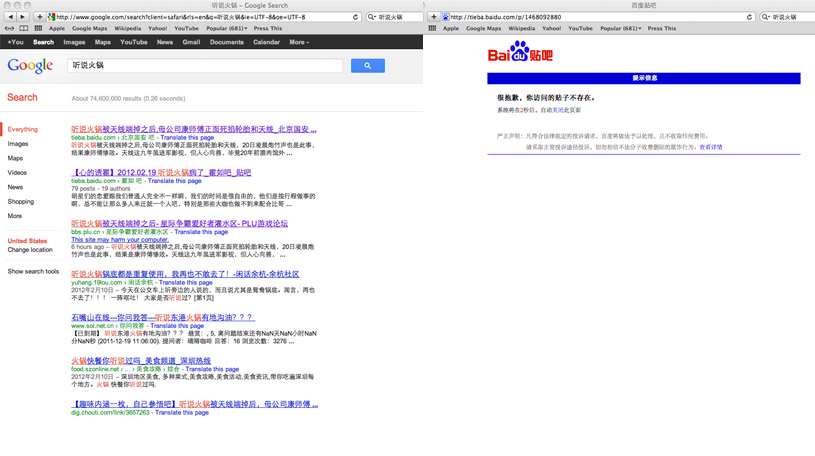
Rumor has it that after Hotpot was swept away by the Direct Line to Heaven, Noodle Master Kang of the Mother Company was openly fighting with Tire and Heaven Direct. The morning fireworks on the 20th were also part of this fight, with the result that the Noodle Master Kang took a serious hit. Even though these past nine years Heaven Direct has charged his way into the silver screen, nevertheless he’s well intentioned. After all, twenty years ago just outside the preserved ham shop, he was the man who stood behind Yangzhou Fried Rice. If y’all sing and eat hotpot again, his nine years of blood and sweat will be as nothing. Thus, it’s a good thing that Tire has the camouflage firmly in hand and soundly thrashed those instant noodles. [original: 听说火锅被天线端掉之后,母公司康师傅正面死掐轮胎和天线,20日凌晨炮竹声也是此事,结果是康师傅惨败。天线这九年虽进军影视,但人心向善,毕竟20年前腊肉馆外他是站在扬州炒饭背后的男人,你们再唱歌吃火锅,人家九年心血全没了,所以幸亏轮胎紧握迷彩涂装不放,才狠摔方便面。]

Traces of the passage remain in google cache but can no longer be accessed on Baidu (image below).

Why was the spoof so quickly removed from Baidu? Continue reading

Rumors, Rumors: What’s Bugging Guagua?

Two days ago, an open letter allegedly from a member of Bo Xilai’s family popped up on the internet, expressing the desire for a public hearing (“此信来自薄家亲戚, 希望公开发表”). Epoch Times – the media arm of Fa Lun Gong – broke the “story” saying that Bo’s son, Guagua may have written the letter. Maybe. Maybe not. Whatever else it may be, I believe that the letter is interesting for four reasons. First, in the absence of political opposition, satire formulates an alternative position. Second, the level of moral outrage that compelled the implied author to write seems genuine. Third, the fact that this letter is circulating as “news” reveals the extent to which the sentiments reflect popular dissatisfaction with the Center and its melodramatic backbiting political infighting Two Meetings. Fourth and relevant to Shenzhen, is the call that Chongqing might have been a Special Zone, like Yan’an and implicitly not like Shenzhen.

Translation of the Guagua letter below.

A FATHER’S TRAGEDY, A PEOPLE’S LAMENT – BO GUAGUA’S PUBLIC LETTER TO THE NETIZENS

In my last open letter to my father, I urged him to return the Chongqing Sing Red, Attack the Black back to the Yan’an years, making Chongqing the flag bearer for a democratic Party and the living spirit of Yan’an; to truly become a Special Zone for political reform. Unfortunately, my father has been too-long educated by the Party, ultimately prioritizing the Party and national power. I had hoped that through reflection and regret, the negative effects of the Chongqing model could be ameliorated. I had hoped that by sacrificing your political future, my Father could have restored the Party and the Country’s stability and harmony. Continue reading

Unapologetically superior — Bo and Blago

Without a name card, I’m have difficulty distinguishing Bo and Blago. Both are given to rhetorical flourishes — Bo quotes Mao Zedong poetry and Blago quotes Kipling. Both have channeled money out of their country of service. And both have both given highly public press conferences in which they continued to express their righteousness in the face of national misunderstanding.

Indeed, yesterday when I opened my yahoo account I discovered that Bo Xilai was suddenly all over the U.S. of A. (herehere, and here, for example), even in Utah! Meanwhile, literally just up the street, former Illinois governor, Rod Blagojevich headed off to prison on corruption convictions, not with a whimper but a full-on press entourage.

Here’s the rub: Bo and Blago are talking the same talk, albeit one filtered through Indo-Eropean grammar and the other through Sino-Tibetan tones — but don’t let it fool you.

When asked about the Wang Lijun affair during his March 9th Chongqing press conference, for example, Bo Xilai admitted, there may have been a “personnel oversight (用人视察)”! This language not only distanced him from Wang Lijun’s actions, but was the rhetorical equivalent of kicking a dog out of the house for crapping on the carpet. Not my fault, but not really a problem. Less than a week later, Blago picked up where Bo had left off, emoting “Saying goodbye is the hardest thing I’ve ever had to do. I’m leaving with a heavy heart, a clear conscience and high, high hopes for the future.”

So in the spirit of he said, he said, a few quotes to test how well you can distinguish between the rhetoric of being corrupt unapologetically superior in Chongqing and Chicago: Continue reading

The US and PRC are actually the same country. Except when they’re not.

Seriously?

At (more or less) the same time that Hu Jintao announced that Wang Lijun was a traitor and Bo Xilai continued to advocate the Chongqing Model for the rest of China to follow, NASA was debunking claims that aliens had invaded earth, arriving inside trojan horses meteors.

I’ve often joked that the US and China are actually the same country, just with different protagonists, costumes, and stages. But today, I’m sure it’s true. How else to understand the convergence of recent events? Alien life has clearly taken over the two conferences (两会: the National People’s Congress and the Chinese Political Consultative Conference) and the US is covering for the Party through a sustained disinformation campaign.

mapping ignorance

Was conversing friends about political succession since Mao and how to interpret reports coming out of Beijing and Guangzhou with respect to Shenzhen’s political status and symbolic valence within the national imaginary. Their 15 year old daughter was at the table, politely ignoring us, when someone mentioned Hua Guofeng (华国锋). She lifted her eyes and asked, “Who?”

Her father explained Mao’s appointed heir had been at the center of a political struggle with Deng Xiaoping to decide if China would continue Maoist policies or pursue reform. This struggle ended with a coup d’etat and the Sino-Vietnamese War as Deng Xiaoping gained political control by securing support of military leaders and high-ranking Party commissars. We then mused about the relationship between violence and political succession, even if indirectly, because Jiang Zemin (江泽民) only became Deng’s appointed successor in the aftermath of Tian’anmen and Zhao Ziyang‘s (赵紫阳) fall.

“Who?”

All this to say, that dinner I experienced a We Didn’t Start the Fire moment with post Cold War Chinese characteristics — recent history actually is this easily forgotten. Or more to the point, I realized (again!) the extent that what we know of recent history comes only as events disrupt our daily lives.  Continue reading

princeling genealogy and advanced guanxixue

Normally, I am not a fan of imperial court television dramas first because the family dynamics of dog eat dog don’t appeal and also (and primarily) because I can’t keep track of all the players. Even with a scorecard, the nuances of multiple and overlapping connections between protagonists and lesser characters evade me. There are, for example, reportedly over 400 main characters in Dream of the Red Chamber. What’s more as an American, I like watching the action. However, as far as I can tell in an imperial television drama nothing of substance ever really happens — a marriage here, a conquered nation there, perhaps, but we never see it. Instead, the drama of an imperial court melodrama unfolds through charting various levels of family ties and in turn the revelation of who respects those ties, who abuses them, and who ignores what those ties mean. In other words, family protocols reveal personal ethics — national affairs are an effect thereof.

Take, for example, a brief sojourn into Bo Xilai’s family circle. I’ve already mentioned that his father was Bo Yibo and that his son, Guagua is know for his extravagant lifestyle. Bo Xilai’s second wife, Gu Kailai is a Beijing lawyer slash Princess. Gu Kailai’s father and Bo Yilai’s father-in-law, Gu Jingsheng (谷景生) was one of the key leaders in the December 9th [1935] Movement (一二九运动) to organize resistance against the Japanese invasion. Imprisoned for twelve years (from the Anti-Rightest campaign through the Cultural Revolution), Gu Jingsheng was appointed Vice Political Commissar of the Guangzhou Military Region after his rehabilitation, leading troupes in China’s brief Vietnam War, when Deng Xiaoping secured his place among PLA leaders. In 1981, Gu Jingsheng was appointed Second Secretary of Xinjiang, the first Secretary of the Xinjiang Production Brigade, and first Standing Member of the Xinjiang Provincial Politboro.  Just a few days ago, Bo Xilai’s brother-in-law, Lt. General Gu Junshan (谷俊山), Vice Minister of the People’s Liberation Army was removed from office. Speculation is that the removal is connected to the Wang Lijun fiasco and associated corruption charges.

All this to say, the Bo Xilai Wang Lijun scandal has rekindled my anthropological interest in genealogy and its obvious connection to guanxixue (关系学). And yes, it seems that Bo Xilai’s family background is more and more the story, regardless of what he or Wang Lijun may or may not have done. Meanwhile, Shenzhen announcements have begun to remind us that in 1979, when Xi Zhongxun, father of China’s future leader Xi Jinping was Guangdong’s governor, he proposed the establishment of the Shenzhen SEZ. And in that shimmering moment of imperial court Princeling drama, Deng Xiaoping is simultaneously remembered and erased from Shenzhen history, as local leaders try to position themselves and the SEZ as close to the inner party family as they can.

political subtext in chinese television: bo xilai, wang lijun, and pla history

Just after Wang Lijun was reported on “medical leave”, Bo Xilai went to Kunming on an inspection tour, with a special visit to a military museum. Chongqing news broadcast footage of the tour. Now it is probable that this tour and visit to the military museum were previously scheduled. However, within the context of the Wang Lijun debacle and the rise of the Princeling Party to power, these images of Chongqing’s Secretary inspecting toothpaste and toilet paper resonated ironically.

During the revolutionary war, the People’s Liberation established six military regions: the Northeast (东北军区), the North (华北军区), the East (华东军区), the South (中南军区), the Southwest (西南军区) and the Northwest (西北军区). Each region had a General and a Political Commissar. Bo Xilai’s father, Bo Yibo was the Political Commissar of the North, Xi Jinping’s father, Xi Zhongxun was the Political Commissar of the Northwest, and Deng Xiaoping was the Political Commissar of the Southwest. Thus, in visiting Kunming, Bo Xilai was not simply going on an inspection tour, but also retracing the revolutionary steps of his father’s generation and thereby declaring his revolutionary lineage. Continue reading