lotus east: the horse gang village

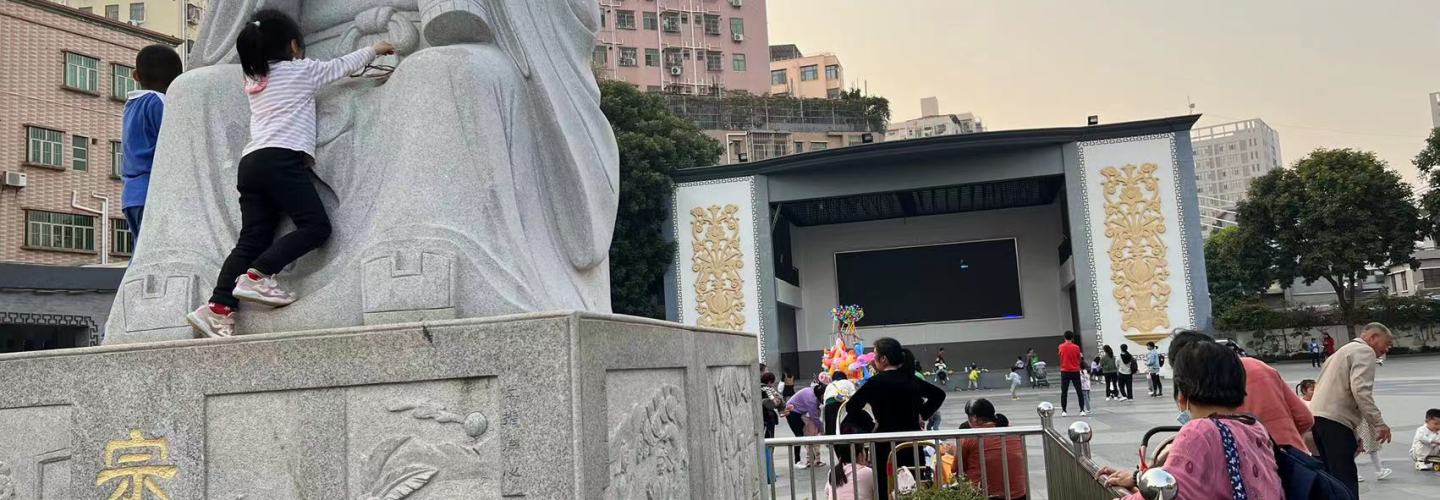
Half an hour outside Weishan, Lotus East Village (莲花东村) stands apart from the surrounding villages, both historically and culturally. Unlike mountain villages, like those around Lushi, which cultivated Yunnan Red (滇红茶), Lotus East once supplied the horses and guards for the caravans that moved tea and other goods along the Tea and Horse Route (茶马道). Although small, the village was powerful and relatively wealthy. In fact, during the Nationalist era, the clan heads – brothers Ma Shiji, Ma Shiqi, and Ma Shixiang – were aligned with Long Yun, the former Party Secretary of Yunnan Province.

Culturally, the residents were and remain Muslims, who elegantly synthesized elements of Han and Bai traditions within the context of Islam. The couplet that graces the entrance to the village mosque exemplifies the hybrid cultures of Southwestern China. In Mandarin, the word for “mosque” is literally “clear truth temple (清真寺)”.  The author has taken those two characters and used them as the opening characters of a Mandarin style couplet:

清升浊沉万教终归一统

真诚不二宇宙同赞阿拉

The pure rises, the polluted sinks, ultimately 10,000 teachings return to one

Truth and piety are not different, the entire universe praises Allah

Today, the Mosque and former homestead of the Ma brothers are open to the public, as is a small museum that introduces horse caravan culture (马帮文化 – literally “horse gang culture”) and the cross cultural breadth of China’s southwestern trade in tea, horses, and other luxury items. Impressions, below:

This slideshow requires JavaScript.

daoist china: weibaoshan

Another commercial center on the Tea and Horse Route, Weishan (巍山) is located about 75 minutes from Dali. Weishan was the first capital of the Nanzhao, but was soon replaced by Dali, which has a more temperate climate because located on the banks of Lake Erhai (洱海).

One of the main Weishan tourist sites is Weibaoshan (巍宝山), which literally means “Treasure Mountain Wei”. The mountain has been designated a national park and walking paths that thread from and between Daoist temples have been laid. Contemporary Daoists have occupied many of these temples and it is possible to stay the night there for a donation. However, the architectural treasure is the Long Spring Retreat (长春洞) which was constructed between 1779 and 1799 and is dedicated to the Jade Emperor, the Lord of the Underworld.

Sites like Weibaoshan vex me. I studied Chinese language and history in order to experience places like Long Spring Retreat, as if the poetry and philosophy of classical China still animated everyday life. However, 17 years in Shenzhen have taught me that even if the contemporary cultural mix includes Daoism, nevertheless capitalist forms and modern desires more obviously structure human relationships and desires in China.

And yet, if not for capitalist forms, I could not have visited Long Spring because I not only needed to purchase a ticket to enter the park, but also get myself from Shenzhen to Dali, Dali to Weishan, and then from Weishan to the mountain. Alas, none of those plane rides and car trips  manifest the Daoist virtue of regulating my life by according to natural rhythms. Instead, they more properly manifest the US American virtue of satisfying individual desires through post-industrial convenience.

The point seems to be remembering to take time to reflect on our place in the world, not only as individuals, but also as a species. What does it mean to be human? What does Long Spring Retreat teach that we cannot learn through Shenzhen’s rush to reproduce and exceed the material wealth of North America?

Impressions below.

This slideshow requires JavaScript.

sunny day, lushi

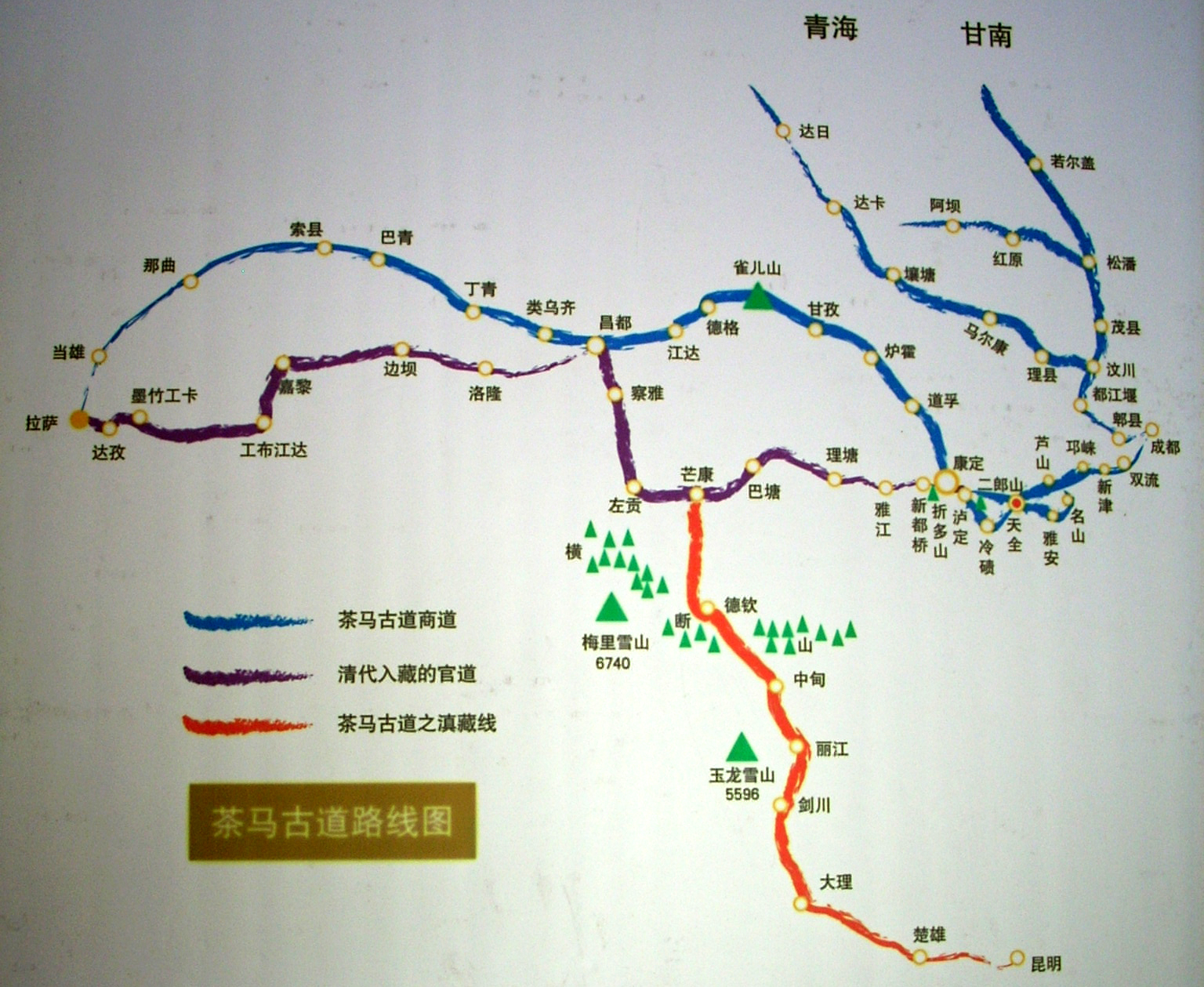
Although less famous than the Silk Road, the Tea and Horse Route (map) had three branches: the commercial route (Lhasa to Chengdu), the official route into Tibet (Lhasa to Kangding, where it reconnected with the commercial route), and the Yunnan-Tibet route (Mangkang to Kunming), which threaded through the Lincang mountains until it met up with the official route in Kangding. A small commercial center on the Yunnan-Tibet route, Lushi was located at the nexus trails that threaded through the Lincang Mountain Range.

Local farmers continue to live in villages along those ancient trails and still use pack mules to bring supplies from the town to surrounding villages. Mrs. Zhang discovered us wandering on one of the partially cemented trails that led to the river and invited us into her family compound for tea.

Mr. Zhang’s grandfather built the first building in the in the 1930s. Each subsequent generation added to the complex, and today the compound has three main buildings and a separate section for farm stock, a kitchen, and solar panels for heating water. With the family responsibility system, the Zhangs obtained several mu (666 2/3 sq meters) of land, where they have planted feed corn, walnuts, and vegetables. Their daughter has moved with her husband to Kunming and their son has opened a small shop in Lushi. One of the three buildings is for him and his girlfriend upon their marriage. The Zhangs earn between 10-20,000 rmb ($US 1,750 – 3,500) a year, which has been almost completely invested in building the house and their children’s education.

We chatted about their lives and in turn, they asked about ours. After half an hour, we took our leave and headed back toward Lushi. I remarked on the difference between walking in Lushi and Shenzhen, where I have been stopped by guards when trying to climb Jingshan Mountai in Shekou, let alone invited in for tea. My friend replied that the more commercialized a village or town, the less hospitable the residents.

This experience has me thinking about the potential and paradoxes of hospitality. In Lushi, if a door was open, we could walk into the compound and expect to be welcomed. The previous day, for example, Old Mr. Zhang (same surname as the village Zhangs) sat with us for 40 minutes, chatting about local history. We offered to continue the conversation by sending photos to the qq accounts of younger family members, who are online. At the same time however, when deflected through tourism, hospitality slips from a social practice into a commercial strategy. During this trip to Dali and its hinterland, we have stayed at hotels where our hosts are friendly, helpful, and pleasant and yet we do not feel obliged to grow the relationship.

Today I am wondering about hospitality in globalizing times. Social hospitality remains an important means of transforming strangers into acquaintances, even as commercial hospitality has expanded with the growth of tourism. The difficulty, of course, is that many of us travel hoping to encounter social hospitality and end up frustrated by differing expectations about the obligations of commercial hospitality. So just what do hosts and guests owe each other when the bill can be paid in full and yet we now live in a global village?

This slideshow requires JavaScript.

rainy day, lushi

We drove about eight hours from Dali to Lushi (鲁史), a market town (镇) in the Lincang Mountains (临沧山). The last 80 kilometers covered a narrow road, which twisted through dramatic slopes and was, in places, covered in thick mud and rocks from a rainstorm the night before. The trip and the unreliability of the roads created a sense of distance from my everyday life; lack of access to internet reinforced this sense that I was far from the modern world. Moreover, I found it difficult to understand local Mandarin, let alone the local language.

And yet.

The layout and size of the old city area remind us that Lushi was once a vibrant center of mountain life. Peasants packed mules with tea, walnuts, and palm leaves and then set out on narrow trails to sell their goods in seasonal markets in Fengqing (凤庆), Nanjian (南涧), and Weishan (巍山). Old Mr. Zhang told us that during WWII, national forces from Guangdong and Hunan stationed at Lushi. In the not so distant past, Lushi was more prosperous than Fengqing, which only rose to local prominence as a county seat during the Mao era.

Moreover, this was not a trip that placed me beyond the reach of gaokao results (all 42 members of the graduating class of 2012 found places at university), Olympic broadcasts, and packaged snacks. We stayed at a clean motel and ate regional specialities, including jizong mushrooms in spicy oil (油鸡枞) and broad beans stir fried with local pickles. There were telephones and high heels, motorcycles and cigarettes, angry bird balloons and electronic toys scattered through out the crumbling buildings and old stone walkways.

The restructuring of the relationship between Chinese cities and their hinterlands that began during Maoist collectivization and intensified with post Mao industrialization not only favored coastal cites, but also disenfranchised rural China. Today, Lushi is a painful contemporary to Shenzhen precisely because the mountain town has been so obviously positioned at the underdeveloped edge of the modern world and not because that’s what it once was.

Impressions of a rainy day in Lushi, below:

This slideshow requires JavaScript.

west lake, dali

This slideshow requires JavaScript.

fengyu: at the periphery of the periphery

The two hour trip from Dali to Fengyu Market Town (凤羽镇) eases senses overstimulated by tourist crowds, let alone Shenzhen’s urban crush. Nestled within extensive rice paddies and surrounded by mountains, Fengyu stands in provocative contrast with Shenzhen’s industrial parks and reclaimed housing estates. The town’s crumbling architecture evokes past elegance and stately lifestyles, while elderly women dressed in traditional Bai costumes maintain local religious traditions, setting up small altars at the entrance to the town. Here, at the periphery of urban China’s periphery, I slip into forms of rural nostalgia — once upon a time, a stately, elegant society of noble warriors, rural scholars and happy peasants resisted both Tibetan and Han incursions.

And yet. Where Shenzhen streets bustle with young migrant workers, Fengyu’s main street and side alleys shimmer silently. Whatever remains of the Nanzhao and Dali Kingdoms, today, young Bai must choose between agricultural labor and life elsewhere, in Shenzhen, for example, where one of my favorite restaurants serves Yunnan delicacies that are flown in daily to tempted jaded palates. A walk through Fengyu, below:

This slideshow requires JavaScript.

traveling in dali

Am in Dali, Yunnan, which for years was a favorite spot for backpackers, Chinese and foreign. The out of the way city boasts mountains for trekking, fresh weather, ethnic minorities with links to Tibet, and inexpensive crafts and food. Almost 30 years of backpackers have shaped the development of tourism in the area and many of the shops sell hippy clothes, while the cafes serve better bread and muesli than are available in Shenzhen.

Nevertheless, consistent low-end tourism has brought the area enough capital to inspire dreams of  attracting higher-end tourists. Yesterday, for example, I took the Cangshan Mountain Cable Car and then walked through the mountains to Xima Pool. The trip is over 5.8 meters long with a rise of almost 2 meters. Built with French technology, the cable car symbolizes the initiative to transform Yunnan into a world class tourist destination. In fact, the Kunming Airport, which opened June 28, 2012 exemplifies the scale of ambition — according to an architect friend, it is large enough to handle 30-40 million people a year, which is larger than Shanghai’s airport.

I’m not sure how much infrastructure debt Yunnan has incurred, but Cangshan has not been diminished.

Impressions, below.

This slideshow requires JavaScript.

of floods and politics, or how the beijing disaster helps wang yang

The official death tole for the Beijing floods is 77 people. Weibo reports however, that in Fangshan District (房山区) alone over 800,000 people have been affected. In response, Mayor Guo Jinlong resigned yesterday, acknowledging his failure to be responsible for the people’s well-being. Today, Beijing Party Secretary Guo Jinlong went to Fangshan to show solidarity with those suffering. Yes, that is correct. In one of the more off the wall moments of Chinese politics, Guo Jinlong was both the Mayor and as of a month ago, also the Party Secretary of Beijing. Even in Chongqing, Bo Xilai was only able to act as Party Secretary, while the Mayorship was held by Huang Qifan.

Here’s the beauty of Guo Jinlong’s gesture. As a government functionary, Guo Jinlong could legally resign. However, as the holder of a Party appointment, Guo Jinlong can only loose his position as Party Secretary if the Party leadership decides to remove him from office — hee!

Now, Guo Jinlong is of interest to those of us in Guangdong who are following Guangdong Party Secretary Wang Yang’s career because like Bo Xilai, Guo was one of Wang Yang’s key rivals to become either Secretary General of the Chinese Communist Party or President of the Country. To be appointed to one of the top two positions in China, Wang Yang must first be appointed to the Standing Committee of the Political Bureau, CPC Central Committee during the 18th NPC. These nine hopefuls will be chosen from provincial level appointees, which includes the Secretary Generals and Mayors of the four independent cities (Beijing, Shanghai, Tianjin, and Chongqing) as well as provincial secretary generals and governors.

In January this year, Wang Yang’s top rivals for one of the nine positions in the Standing Committee were Chongqing Party Secretary Bo Xilai and Beijing Mayor Guo Jinlong. Whatever one thinks of Wang Yang’s “three attacks and two establishes” campaign, notwithstanding, as a recent text message reveals, the Beijing floods may have given Wang Yang the push he needs to get one step closer the highest positions in Chinese politics. So the country may flip neo-liberal even faster than expected, not because privatization works, but simply because recently several political high-fliers are crashing and with them, alternative models of development.

Insights from the Beijing Floods (北京水灾几点启示):

1。The water in Beijing is deep;2。In Beijing, having a house and car is nothing, you also need to have a boat;3。All Beijing subway stations have the same name — Drainage Pool (a pun on the actual station 积水潭);4。Car owners finally understands the government’s great efforts to collect “car and boat taxes” from private citizens;5。The South to North Water Diversion Project (南水北调工程) is finally seeing results (this massive engineering project will be completed in 2013, connecting northern provinces to the Yangtze River);6。The Northern Drifters finally have a correct footnote (artists who go to Beijing to make a career are known as “northern drifters (北漂)”;7。As soon as Wang Yang enters the capitol he will have a job (because both characters in Wang Yang’s name have the water radical: Wang (汪) is a surname that means an expanse of water and Yang (洋), his given name, means ocean).

what does the athletic body signify?

Upside to Shenzhen’s Olympic propaganda push — less minutes of propaganda per bus ride than leading up to the Universiade. That said, during blurb du jour about the national body, I had an insight. To wit: I’m thinking that Chinese athletes represent state power, while US American athletes represent honed individual desire.

Consider the mise-en-scene: a busload of commuters reading weibo, some sprawled on a seat others dangling from a safety handle, still others huddled over fat children, one who smiled at me. Their expressions were neutral, passively waiting to jump off the bus to their next encounter, although I did see several people scowling at their cellphones and overheard a well-dressed lady in pumps, repeat in frustration, “No, we need the order to be shipped today.” In contrast, on the television screen another Chinese gymnast gracefully flip-flopped on a balance beam, paused, and looked directly into the camera. She wore a bright red and yellow bodysuit, her hair was pulled back in a neat ponytail, and she stood straight, shoulders thrown back in pride. The message was clear: if we commuters who were not exactly slovenly but far from neat and certainly tending to scrawny and flabby, ate healthy, exercised, slept regularly, and visited our doctors, we too could be proud members of the national team.

That’s when I realized that similar US American propaganda would have emphasized the same good behavior but for a different reason; we should eat healthy, exercise, get enough sleep, and have medical check-ups in order to fulfill our personal dreams. Another thought followed: even if the US and China field national teams to achieve different ideological ends — the US has to demonstrate that all that rugged individualism makes us a strong nation, while China has to prove that all that authoritarianism is the pre-condition for individual excellence, nevertheless, structurally all this athletic posturing affirms the status quo. But we knew that. It’s just that suddenly the status quo seems to be a pad de deux Sino-Americana, rather than say, a cold war.

killing the buddha in aurora

Eating lunch at a Taiwanese style buffet this afternoon, I experienced a bit of pop culture dissonance, when something vaguely “favorite instrumental love song from a Disney Film” followed Eminem and Rihanna’s “Love the Way You Lie” on the music piped-in music. I’m not sure how these two songs ended up back-to-back, without commentary, either canned or live — my immediate neighbors, for example, wore sanitation jumpsuits and repeatedly asked each other if they had had enough to eat, seemingly oblivious to the music radio faux pas — but I’m thinking maybe the manager had purchased a shanzhai mix of “top love songs, 2010” to enhance the buffet’s image as “cool” and “not neidi“. It may also have been a moment of pastiche prophecy. Not a few alternative rockstars have transitioned from producing troubled hits to belting Disney classics, and I see no reason why either Eminem or Rihanna shouldn’t follow in the footsteps of Elton John and Melissa Etheridge.

I started actively listening to the music when I realized that I was humming along to the chorus of “Love the Way You Lie”. The melody hooked me not only because I like Rihanna’s voice, which is especially poignant in contrast to the desperate anger of Eminem’s lyrics, but also because I know too much (or not enough) about their lives and the way that themes of violence and redemption, suffering and atonement, yearning and self-justification weave through and between their public and private performances. Indeed, whatever their actual relationship to and experience of brutality, Eminem and Rihanna seem apt symbols for the US American confusion of pain with love; we work really, really hard, to sell the story that some killings are justified, and some beings exist to be shot — Oscar Wilde in prison, as if murder were the expression of bravery, while the rest of us cowards go on about wounding each other in social acceptable ways:

Yet each man kills the thing he loves,
By each let this be heard,
Some do it with a bitter look,
Some with a flattering word,
The coward does it with a kiss,
The brave man with a sword!

And Oscar Wilde has nothing on the US American romance with death, destruction, mayhem, and murder. Consider alien invasion movies, where the aliens exist to be killed, and in process reveal the courage and fears of white (or whitened) humanity. Or westerns, where those black hatted fellers “get what’s coming to them”. I have joked that the formula for a US American soap opera is boy + girl + murder, and happy endings simply mean that the murder has brought the two characters together, while unhappy endings are more “hard core” because one of the lovers is the victim, while the other survives to achieve some kind of vengeance. And yet. When we stop to think about it, the extent to which US Americans confuse levels of hurt with intensities of love is distressing.

In thinking through the Aurora Massacre, Patrick S. O’Donnell at Religious Left Law refers to Erich Fromm’s idea of the “pathology of normalcy“, which refers to the ways that culture shapes human interaction, or a socially patterned defect. Importantly, on Fromm’s reading members of the same culture not only share the same defect, but also share behavioral patterns that enable us to live with a defect without becoming ill.

It is as if each culture provided the remedy against the outbreak of manifest neurotic symptoms which would result from the defect produced by it.

In this sense, Eminem and Rihanna might be thought of as symbolizing the American normal, enjoying a violent buzz but not actually killing anyone. In fact, because we know that love hurts, we expect some form of abuse or pain, but within limits. Not surprisingly, in our current fascination with BDSM, US Americans learn to ride the violence and pain to gendered forms of ecstasy.

Fromm also notes that for a minority the cultural pattern does not work. This “not working” has two forms — the expression of the pathology as individual neurosis and the recognition of the pathology as what it is, an unhealthy pattern of interaction. Here’s the point: a neurotic expression of normal All-American love would be if Eminem set Rihanna on fire and watched her burn to death. Neurotic on Fromm’s thesis because the underlying logic of burning a lover to death is the same as that of “normal Americans”; the more extreme one’s love, the more violently it will be expressed. And yes, we all know and derive various levels of pleasure from the formulation total love = total annihilation.

And there’s the rub. At Aurora, James Holmes crossed the fuzzy line separating normal from neurotic, the line in which its okay to play and sing and read about killing others, just not okay to actually kill.

More hopefully, however, there is a second maladaptation to the pathology of normalcy. In this maladaptation, an individual recognizes the pathology of normal life for what it is — a problematic pattern of interaction. We recognize, for example, that abuse within relationships is not an expression of love and thus our job is to learn to change hurtful patterns of behavior. We realize the need to nurture ourselves and others in non-violent relationships. We understand that this is precisely where we need help because changing deeply rooted patterns of interaction, patterns that are reinforced through popular culture and the lived expectations of friends and family, as well as our own conflicted desire requires courage and faith and the willingness to risk normal life for a healthier, happier life. A life, we might say, in which killing the buddha is not a made-for-telesion movie, but a koan.

His Holiness the Dalai Lama reminds us:

Before we can generate compassion and love, it is important to have a clear understanding of what we understand compassion and love to be. In simple terms, compassion and love can be defined as positive thoughts and feelings that give rise to such essential things in life as hope, courage, determination, and inner strength. In the Buddhist tradition, compassion and love are seen as two aspects of the same thing: Compassion is the wish for another being to be free from suffering; love is wanting them to have happiness. 

May the survivors of Aurora find healing. May we in the United States find the courage to look seriously at the normalcy of violence in our relationships. And, if we cannot yet love James Holmes, may we find the strength of heart not to wish him ill.