improvements, again


temporary roadblock, nanyou

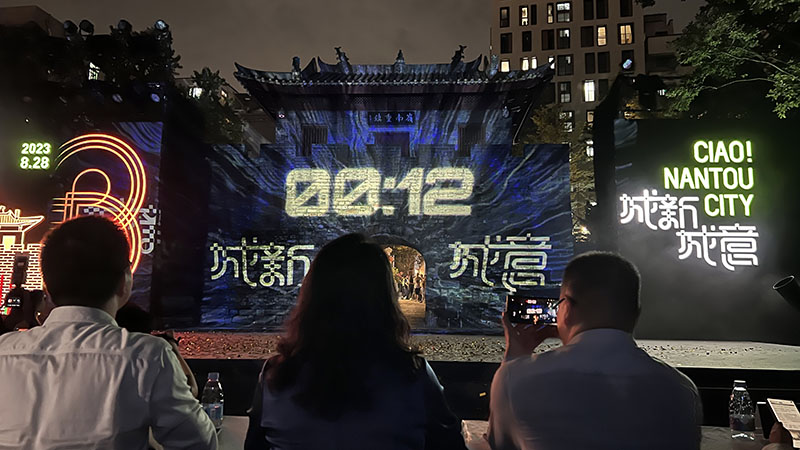
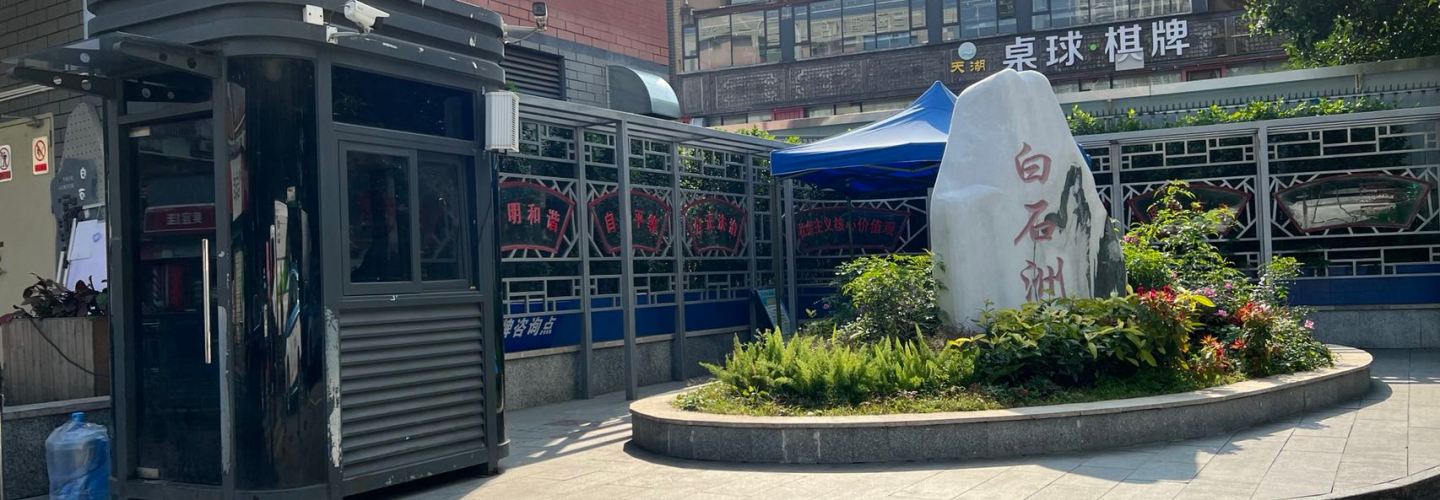
just when i thought it was safe to wear sandals, shenzhen embarked on a project to upgrade city sidewalks, ripping up roads that had been set only a few years previously. so once again, as the city improves its image, we pick our way through rubble and bricks, dust and exposed sewage pipes. a few photo-gripes here.

hong kong surfaces


self-portrait

this morning, as i walked from my friend’s cityplaza condominium to quarry bay park, i once again found myself refracted accross hong kong’s glitering surfaces. disorienting after the practical tiles of wangniudun.

emplacements


detail, incense burner, julong village

addresses in chinese read from the largest to the smallest unit. last week, for example, i went to guangdong province, dongguan city, wangniudun township, julong village (广东省东莞市望牛顿镇聚龙村). in terms of the use and organization of the built environment, this administrative hierarchy takes clear form. my trip began at the shenzhen city, luohu bus station, transvessed guangdong’s elaborate (and still expanding) highway network, passed through dongguan city center, and stoped on niuwangdun’s main street, which is narrower and less built up than downtown dongguan, which in turn, is less densely built than is downtown shenzhen, where the journey began. this pattern of narrower streets, shorter buildings, and fewer cars continued with each stage of the journey. from main street, niuwangdun toward julong village, for example, i walked on a main street of four lanes, turned onto a two lane street, stepped onto the one lane street that bordered the julong river, and then turned into a gated alley wide enough to accomodate motorbikes and pedestrians.

in addition to reiterating administrave ranking (provinces administer cities, which administer townships, which administer villages), chinese addresses also tell you whether or not an administrative unit is urban or rural. thus, dongguan (shi) is an urban administrative unit, while wangniudun (zhen) and and julong (cun) are rural levels. in contrast, i live in shenzhen city, futian district, huafu street office, tianmian neighborhood (深圳市福田区华富街道办事处田面居委会). district (qu), street office (jiedao banshichu), and neighborhood (juweihui) are urban designations. not unexpectedly, rural and urban designations also take clear form in the built environment. significantly, rural forms tend to be more traditional and urban forms tend to be more modern or western. thus, for example, the buildings in dongguan city, especially the new city plaza, reflect contemporary architectural trends, while in julong village traditional housing abuts updated one-story homes (平房 literally means flat house and refers to traditional village homes throughout china).

in the prc, rural and urban designations do not simply refer to landuse and population, but also to how the land is used. urban areas are directly under the state, where enterprises, corporations, and individuals can obtain landuse rights (in a process modelled after hong kong’s), but the land ultimately belongs to the state. in contrast, in rural areas, farmers have legal rights to land both for livelihood (growing crops) and housing. there are two main consequences of this situation. first, urban areas have been designated for industrialization, while rural areas have been designated for agricultural production. legally, one can only build a factory in an urban area (although in practice, this has been erroding since deng xiaoping’s southern tour in 1992). second, in terms of property, the traditional, one-stories in the villages are situated on land that belongs to the farmer. in contrast, an urban residents purchase a condo in a highrise, but they do not have eternal rights to it because the land on which the building stands still belongs to the state.

for the past few years, then, dongguan city has been a poster child of sorts for guangdong’s ongoing economic boom. if online statistics are to be believed, from 1999 to 2003, dongguan’s economy grew at a rate of 18.4% a year, enough to make the city the fourth fastest growing in guangdong and 10.3% higher than the national average. now before i went to julong village, i didn’t really think that much about dongguan and when i did it was in terms of boomtown evils: exploitation, prostitution, and pollution. i frequently passed by dongguan on my way to guangzhou and, like supernaut, was both distressed and fascinated by dongguan’s industrial landscape.

now, what’s important about townships like wangniudun is that much of the guangdong boom is actually located in rural townships and villages. administratively, townships are hybrids; they are rural cities. this means that in niuwangdun, julong villagers can invest in industrial production (because it is a city), but that the landuse rights return to villagers, both collectively and individually, because they hold eternal land rights. this loophole has provided guangdong townships and villages with the incentive and flexibility to industrialize in different ways from cities. on the one hand, it has also enabled villagers to become wealthy independent of the state. in shenzhen, this loophole inspired the rural urbanization movement, which changed the administrative status of shenzhen’s farmers from rural to urban, with the result that their children no longer have traditional rights to the land. on the other hand, it has produced a distinctive landscape of tiled multi-story housing, factories, and traditional remnants. for a sense of the emplacements that rural urbanization produces, please visit wangniudun township, julong village.

field tripping update

several weeks ago, i posted on the middle school trip to yangming township. since then, the heping youth federation has posted on the trip here and here.

glass edges

most construction sites in shenzhen are provisionally gated with cement and brick walls, glass edges, and barbed wire. once the project is finished, more elegant, or perhaps less blatent walls replace the makeshift as if it were all right, expected even to keep people off a construction site, but less savory to keep one’s neighbors outside the gate. i have uploaded some glass edges in my gallery.

韩流: caught in the undertow

A funny thing happened on the road to Heyuan. In order to keep passengers entertained, the bus company had installed a television screen and DVD system. At first, I entertained myself by composing an essay about the obvious irony of watching a Korean drama how a young girl marries up and going to visit poor people. But 15 minutes into the trip, I stopped thinking about social ironies and found myself following the intricacies of romance in an arranged marriage between an 18 year old high school student and a 28 year old district attorney.

I can’t say “The Bride is 18 ((新娘18岁)” was either intellectually compelling or even socially redeeming. The plot hinged on the question, could two radically different people get married and become a loving couple? The answer was yes. Yes because the groom understood compassion and how to teach a recent high school graduate how to be a human being. Yes also because the bride didn’t want to go to college but wanted to be a housewife.

These past few years, I have been vaguely aware of the popularity of Korean pop in China, especially music and drams. Indeed, I have listened to friends talk about their favorite dramas and even watched part of “Wish Upon a Star”, staring An Jae Wook (安在旭), who was a breakout Korean star in China. My students listen to K-pop stars Rain, se7en, and BoA. However, I never considered buying into the Korean Wave (韩流 hallyu in Korean). I classed them with Brittney Spears, Justin Timberlake and other young American popstars—cute, manufactured, well-dressed, cute, photogenic, and did I say cute?—but not really for me.

And yet.

After a four hour trip to Heyuan and then a four hour return to Shenzhen, I was still six episodes from our heroine’s happily ever after. I got off the bus, said goodbye to my students, and then felt compelled to do something I never thought I would: I bought the complete Bride just to watch those last six episodes. I was caught in the undertow.

I confessed to a good friend, who told me that Korean dramas are formidable (厉害). A business associate’s wife, she continued, is totally addicted. After breakfast, the wife is said to make herself a pot of tea, turn on the television, and cry along with her favorite stars.

So to understand how I and other 40-somethings might get hooked on k-dramas, I took an unscientific survey of my friends. One said that k-dramas are good to watch. The sets are fashionable, the costumes are beautiful, and the actors are really attractive. Another added that the shows are really relaxing because you don’t have to think when you watch them. Yet another added that she liked to follow k-dramas because they’re realistic. At this, I raised a disbelieving eyebrow, “Realistic?”

“They talk about urban life. And young people’s hopes and dreams. Not like Chinese dramas.”

My husband watched an episode with me. He thought that the attraction lay in the main characters’ rebellion against social norms, without actually breaking human ties. “Asian people,” he said, “live in relationships. But sometimes we just want to do what we want.”

“Yes,” another friend mused, “it’s that the shows always end with reunion (团聚). Real life isn’t like that. It’s comforting to see everybody come together, no matter what their differences were. And the actors really are attractive.”

Perhaps that’s all it is. Pretty people living beautiful lives. An easy distraction. A coffee break conversation. But then, again, I wonder. How could a contrived melodrama about a girl who gives up college to be a housewife hook me? It wasn’t the story. Not the pretty faces. Not even coffee break conversation. But I’m also sure that simply turning off the TV won’t make me immune. I want. Want powerfully. And in those shows wanting brings about its own reward. Forever.

waiting for godot

fat bird is in rehearsal for a december run of “waiting for godot”. estragon and vladimir appear onstage as a farmer-lei feng (played by yang qian left) and worker-lei feng (played by liu hongming right).

compare our hats with lei feng’s hats on stefan landsberger’s wonderful chinese propaganda poster pages.

和平县阳明镇新塘村: field-tripping


新塘村:new tang village, sunrise

the attitudes of young shenzhers, especially the children of the city’s upper classes, confound their elders, who really don’t know what to do about a generation that hasn’t experienced material poverty. almost thirty years into the shenzhen experiment, a certain material standard of living has become the norm among these children. they expect to have new clothes, pocket money for snacks, and the latest technological gadgets. indeed, if newspaper reports are to be believed, they are a wasteful and lazy group, who take long showers, play online games, and shirk homework responsibilities; in the language of american pop sociology, shenzhen’s young people think they’re entitled not only to what they have, but also to whatever they want.

to counteract their children’s sense of entitlement, wealthy shenzheners tell stories about impoverished childhoods and hungry farmers. these stories are as unsuccessful as those my parents told me: when i was a child, we walked four miles to school; eat all your food because there are starving children in africa. on the one hand, i think these stories fail because children don’t have the experience to imagine beyond their immediate lives. on the other hand, i think these stories fail because children know (even as i knew) that our parents aren’t going to radically restructure their lives to help either starving africans or farmers. instead, these stories aim to change the behavior of children, not to ameliorate social inequality.

nevertheless, adults still try and children still play along. on the 26th and 27th of october, our middle school went on a field trip to greater tang village, yangming township in heping county, in heyuan city (河源市和平县阳明镇大塘村) which is considered an impoverished area (贫困区). according to the heping township officials who hosted us, the official definition of “impoverished” earns less than the national average income but still has enough to eat. usually, families can afford school fees up through middle school, but often have difficulty meeting high school costs, let alone university expenses. according to a people’s daily report the 1,000 odd villagers that make up greater tang village (an administrative territory which is composed of 15 “natural” villages) demonstrate the fact that even if the richest villages are in guangdong province, their are villages that haven’t started getting rich, let alone keep up with the coastal villages. in chinese the expression for these poor cousins is “后无追兵” or “no following soldiers”.

the purpose of the trip was two-fold. our school wanted to give our students a new perspective on the privileges they enjoy as wealthy shenzheners as compared to impoverished students. our yangming middle school hosts wanted their students to be inspired to study even harder to break out of the cycle of poverty. as we discovered during the two-day fieldtrip, many of the yangming students had older brothers and sisters who had dropped out of middle school or not gone to high school in order to begin laboring in places like shenzhen. indeed, a fifteen year-old ninth grader told me she wouldn’t bother taking the high school entrance exam and go right to work after graduation from middle school next june.

the yangming high schools arranged host families for our students and teachers. two of us were assigned to a home, where we ate, slept and were shown the village. yang ming eigth grader, huang shanshan hosted me and my student nicole. shanshan and her family live in new tang village (新塘村), one of the 15 natural villages in the greater tang administrative village nestled between rocky slopes, rice paddies, chicken coops, and family gardens. xin tang village is a hakka (客家) settlement, where paths and shared walls connect the homes to each other, creating a densely populated space. there is a clear spacial division between the village and cultivated areas. indeed, the relative care given to the rice paddies and gardens was striking in comparison to the village proper, where it seemed people took care of inside their homes, but did not care for common areas, which were given over to garbage and scavanging chickens. people seemed to spend a great deal of time outside on paths, working and chatting.

nicole and i shared the only bed in the house; shanshan and her parents slept upstairs on mats. the house was made from local bricks covered by cement, wooden beams supported the ceiling. the first floor consisted of a main room and a kitchen. the main room was divided into two sections, a sleeping section, where the bed was and a social section, with a table, television, and several chairs, some plastic, two made of bamboo. the wash room was a concrete room built next to their pump. for our evening wash, shanshan heated water in the kitchen and then added pump water to adjust the temperature. the outhouse was a separate brick building with a trench dug into the earth. above the trench was a bamboo plank, where i squatted several times a day to relieve myself.

shanshan and her parents moved me with their generousity. they killed a chicken for us and prepared fresh vegetables, eggs, and homegrown rice. when we left, they gave us fresh eggs, homegrown peanuts, and special deep-fried potato cakes for the trip. yangming township gave us a box of kiwi fruits that were locally grown. indeed, their generousity eased the relationship, enabled it to move beyond a tour of poverty. i had feared that the trip would turn the villagers, especially our hosts, into exhibits in living museum and would turn us into tourists. the school had instructed students to give money to their host families as a token of their appreciation, and much thought had been given to what would be the correct amount: not too much so that the families were embarrassed but not so little that they lost materially by hosting us. although the act of hosting didn’t unmake our material inequality, it nevertheless did ameliorate some of the awkwardness of the visit. it certainly reminded me that each of us has something to give and that all of us have a responsibility to accept what is given graciously.

a native of longgang, shenzhen, nicole is also hakka. she enjoyed the trip because it brought back memories of her childhood before her family moved to downtown shenzhen. she grew up in a village like shanshan’s and used to sleep on the same kind of bed. more importangly, she remembered the beauty of the countryside and wondered about why modernization meant the destruction of beautiful places. specifically, as part of shenzhen’s ongoing expansion, her natal village will soon be razed and an upscale housing development built in its place. also, nicole said that she only understood about 70% of what shanshan and her parents said and preferred to speak with them in mandarin, reminding me again of how many variants of local languages (方言) there actually are. after all, heyuan is only a 3 hour drive away from shenzhen.

the belief that youth can be motivated by direct experience inspires this project. more specifically, adults in both places expressed that more communication (交流) between students from both areas would be beneficial. on the one hand, shenzhen youth might learn humility and social responsibility, while yangming youth might learn their are higher goals than working in a factory or restaurant. consequently, our schools hope to establish a hand-in-hand (手拉手) relationship with the yangming first and second middle schools, enabling students and teachers to visit each other.

i hope that this kind of experience might accomplish what exhortations rarely do–inspire us adults to help our children change the world. i know that this experience manifests one, more traditional (in the socialist sense of the word) meaning of the shenzhen experiment, which not only aimed to open china to the world, but also to improve the material wellbeing of all chinese people. in fact, at 63 our school principal is a child of the revolution and she still approaches education with an eye to socialist goals. as a friend of mine said, if china can improve the living standard of all chinese people, bringing stability to its internal affairs, it will have contributed to world peace. one could say the same for the united states and that we start one friendship at a time. i have posted some fieldtrip memories in my galleries.

field of dreams, shenzhen


unfinished, unoccupied timeshare, the fountain resort

managed by swiss-garden international, the fountain resort (深圳金海滩:假日星苑度假村) overlooks xichong bay in kuichong village, longgang. i suspect, but have yet to confirm that the resort was built as many international resorts in the southeast asia are–to attract both upscale locals and foreigners with hotels and timeshares on the beach. nevertheless, several years after construction, only the hotels are being used. except for one or two houses that have been occupied by a family and temporary workers, the other timeshares are unfinished and unoccupied, abandoned before occupation. and yet. the gardens are immaculate, expectant. when i asked the older resident if he was lonely, he said no because he lived with his wife, son, daughter-in-law, and grandson. what about neighbors? i continued. they come on the weekends, he replied. i thought but didn’t add, it’s saturday and we’re alone here.

if you build it will they come? recent photos here.

ostriches in shenzhen

the ostriches came to shenzhen by way of the united states, “where,” the farm manager told me, “american scientists spent over twenty years experimenting in order to breed an ostrich that could live out of africa.”