



The gifting chart for “Prosthetic Cosmologies – Sitka” is now online. Please visit and follow the ebb and flow of story-making.
Fake currency for true

Lately, I’ve noticed spray-painted advertisements for fake currency. Also, public opinion now holds that one should only give a taxi driver as close to exact change as possible, since handing over a 100 rmb note will usually result in a portion of fake change. I have been specially warned by concerned friends because I fit the profile of the forgers’ mark – foreign and travels between Shenzhen and Hong Kong. Indeed, forgers approach taxi drivers who are waiting to pick-up fares at the Huanggang border.
According to friends, the forgers can afford to be so blatent because the police have neither the time nor the inclination to take care of something that marks should be able to handle themselves. They point to cashiers, shopkeepers, and tellers as examples of people who check to see if a bill is genuine before accepting it. Ordinary people, they say, must take the same precautions.
Slow Shenzhen
Wed afternoon I heard a Taiwanese friend describe development in Shenzhen as “slow”!? Not slowing, but slow. My friend referred to the cultivation of talented people (人才). She pointed to how poorly Shenzhen students do on the college entrance exam to prove her point. 30 years into reform and a real city would have produced top scholars. She added that people who migrate to Shenzhen are go-getters (loose translation of 勤奋), but not cultured.
Bracketing a discussion of the way the gaokao quota system works and Guandong students’ limited options, my friend’s impression of education in Shenzhen is interesting because many of the students I work with will study abroad at top universities. This semester, for example, one of my students has been accepted to Cornell early decision and another accepted to Cambridge. I also know that top American universities now include Shenzhen schools on their Asian campus visits. Indeed, rumor has it that many of the best Shenzhen students use their high school senior year to prepare to study abroad, rather than cramming for the college entrance exam.
In other words, as soon as possible, Shenzhen students opt out of the Chinese system and their parents fund a major flow of talented young people abroad. All this to say, Shenzhen’s middle class and nouveau riche may be merely hardworking, but clearly they have elite aspirations for their children. I don’t know how relatively fast or slow this reorientation of the educational system has been, but I do know that the numbers of Shenzhen students studying abroad has grown steadily and will continue to grow in the foreseeable future. Moreover, I know many to be bright, creative, and capable of enriching wherever it is they ultimately decide to contribute their talents. Seen in this light, Shenzhen may be raising global, rather than national intellectuals. Lucky world.
Are we there yet?
Yesterday over coffee, a friend and I talked about how vast the houhai reclamation project actually is. She mentioned that her daughters love to drive on roads in the reclaimed area because their GPS (global positioning system) locates them in the ocean, rather than on land. Apparently, the system misreads their location because the maps that the system is accessing do not represent the new landscape. It’s true. Plans really can’t keep up with change (计划跟不上变化).
Who should have rights to the City?
Questions of civic identity haunt Shenzhen like the tag lines of a never-ending soap opera: When will people who live in Shenzhen feel that the city is their hometown (老家)? Is it possible to feel like a Shenzhener without a Shenzhen hukou? When will residents with Shenzhen hukou (户口) say, “I’m a Shenzhener (full stop)” and not, “I’m a Shanghai person (uncertain fade out)”? Will residents who claim Shenzhen identity ever admit that they are from Guangdong and not transplants in a non-Cantonese city? And if Shenzhen gives long-term residents with hukou in another city a residence permit that includes all hukou rights will this administrative restructuring generate a corresponding rise in civic identity?
30 years ago, most Chinese had hukou in the place where they were born and raised. Consequently, their administrative status reiterated their emotional identification with their hometowns. A Beijiner both held a Beijing hukou and self-identified as someone from Beijing.
Today, uncounted millions of Chinese people have migrated from their hometowns to live and work elsewhere, unmaking the easy correspondence between one’s hukou and one’s hometown that had defined Maoist society.This situation is particularly acute in Shenzhen, where the majority of residents are classified as 非深圳户籍的深圳人 (Shenzheners without Shenzhen hukou). Statistics from 2005 put Shenzhen’s population at 5.97 million of which 1.65 million had Shenzhen hukou and over 4 million had temporary residences (暫住证). In addition, the City identified over 4 million temporary residents who had lived in Shenzhen for under a year, bringing the actual population to roughly 10 million.
Here’s the rub: the traditional correspondence between hukou and hometown has had concrete effects on efforts to create post-hukou civic identities. In many cities, for example, those who are “really (have both hukou and hometown status)” from the city blame those who aren’t for urban problems. This logic hinges on the assumption that “real” residents care about the quality of life in a city, while “sojourners” don’t. In addition, under the current hukou system, a Chinese citizen only has rights to city welfare (including public education for child) in the city or town of their hukou residency, rather than in where they live.
The question of whether or not rights to the city should be based on hukou status is more pressing in Shenzhen than in any other Chinese city because most residents aren’t from here. Moreover, the City’s growth and success is attributed not to residents, but to immigrants. In other words, Shenzheners without Shenzhen hukou are the majority of Shenzhen residents.
In August 2008, Shenzhen promulgated the Shenzhen Residency Permit Temporary Application Process (深圳市居住证暂行办法), a reform of the hukou system, allowing anyone age 16 or over, who has lived in the city for more than 30 days to apply for a residence permit (居住证) that carries the same rights as a Shenzhen hukou.
The Shenzhen reform is notable for several reasons. First, it makes inhabitation, rather than birthplace the criteria for urban welfare. Second, it is open to all Chinese citizens, regardless of whether or not they hold a rural or urban hukou. Third, it assumes that people immigrate to rather than temporarily sojourn in Shenzhen. Fourth, it implicitly challenges traditional assumptions that hometown identification is natural, instead foregrounding the idea that civic identity is a voluntary practice.
Nevertheless, the larger question of who actually claims Shenzhen as their hometown continues to hinge on the question: does administratively designating a city necessarily produce a community that identifies with those borders? It’s possible that what is being produced in Shenzhen is not hometown identification, but rather a weak hometown identification with strong national ties. In other words, any Chinese person should have rights to Shenzhen regardless of hometown identity, making citizenship the only precondition for claiming rights to urban welfare.
This legislation has me hopeful. Not because I think it will be unproblematically implemented and thereby unmake the inequality that has structured Shenzhen hukou. Nor because a stop-gap status between no hukou and hukou status is enough to unmake the inequality that is the national hukou system. But rather, this legislation has me hopeful because it clearly states that living in Shenzhen entitles one to rights to the city.
Delta or Estuary? What’s in a Name?
Googling for information about environmental conditions in Shenzhen, I noticed that the distinction between delta and estuary has facilitated a disturbing separation between conversations about economic miracles and ecological disasters in Southern China. When I googled Pearl River Delta, I stumbled upon articles about economic development. In contrast, when I googled Pearl River Estuary, I came upon articles about the seriousness of our situation.
Here’s the rhetorical rub: Ecologically, deltas and estuaries co-evolve. However, through linguistic convention, the words delta and estuary refer to different aspects of this process. The word delta draws our attention to what’s happening on land, while the word estuary reminds us what happens in places where fresh and salt water mix. In other words, how we locate Shenzhen – either in an estuary or on a delta – has already determined whether our conversation will most likely be about environmental or economic issues.
So, by emphasizing the Delta in conversations about South China, what do English speakers leave out? The fact that in an October 19, 2006 press release, the United Nations Environment Programme announced that the Pearl River Estuary was a newly listed dead zone, where nutrients from fertilizer, runoff, sewage, animal waste, and the burning of fossil fuels trigger algal blooms. The most common algal bloom in the Pearl River Estuary is “red tide”, a colloquial way of saying HAB – harmful algal bloom of which the most conspicuous effects are the associated wildlife mortalities among marine and coastal species of fish, birds, marine mammals and other organisms.
What else do we English speakers miss? The ongoing houhai land reclamation and associated siltation, which is damaging coastal Mangrove forests. In the panel Gilded Coast from Prosthetic Cosmologies, I used images from the NASA Scientific Visualization Studio to draw attention to this process. The SVS images were taken in 1988, 1996, and 2001. Taken in December 2008, a recent Earth Snapshot from Chelyis shows how more has changed in the past seven years. The Chelyis image also contextualizes the SVS images within the delta/estuary. Compare the levels of siltation and environmental transformation below:
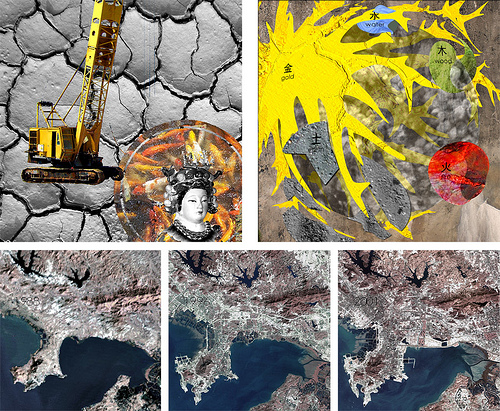
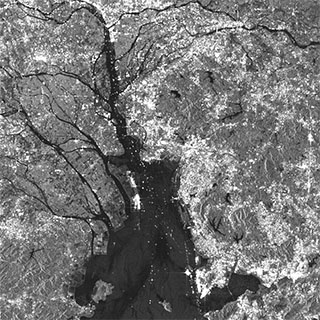
More importantly, the Cheylis explanation identifies both Guangzhou and Hong Kong, but not Shenzhen. This omission is disturbing not only because Shenzhenhas been the most active land reclaimer in the region, but also because it pre-empts inclusion of Shenzhen – as well as Dongguan, Foshan, Zhongshan, and Macau – in conversations about how to both clean-up and enrich the region. (This omission dovetails into dim sum with the Swiss writers, who were shocked by how developed Shenzhen actually is. I keep asking myself: how do westerners miss Shenzhen? And it keeps happening…)
Incidently, the Chinese character 洲 (zhou) further muddies rather than bridges waters between English and Chinese conversations about the environmental consequences of economic development. The two parts of zhou are: the three-dot radical for water and 州 (zhou), a sound component which is composed of the pictograph for river with three dots. According to my dictionary, a 洲 is a continent or an island, so a delta/estuary is actually a three-cornered continent island or 三角洲, while the character is two-thirds full of water. This means googling 珠江三角洲 brings up a different mix of economic and environmental articles than does an English attempt.
Tianmian: East West South North
About a year ago, I had the privilege of participating in Vexed Urbanism: A Symposium on Design and the Social at The New School. I contributed Tianmian: East West South North an image poem that mapped four of Shenzhen’s formative ideologies along east-west and north-south axes. In this piece, I aim to show – quite literally – how landscape is never simply place, but also and always a symbolically organized world, a cosmos. Thus, Tianmianillustrates how it is possible to read not only Shenzhen’s history, but also the values that have informed the city’s construction in the lay of the land, the placement of a building, and movements in and out of an urban village.

Prosthetic Cosmologies gallery up
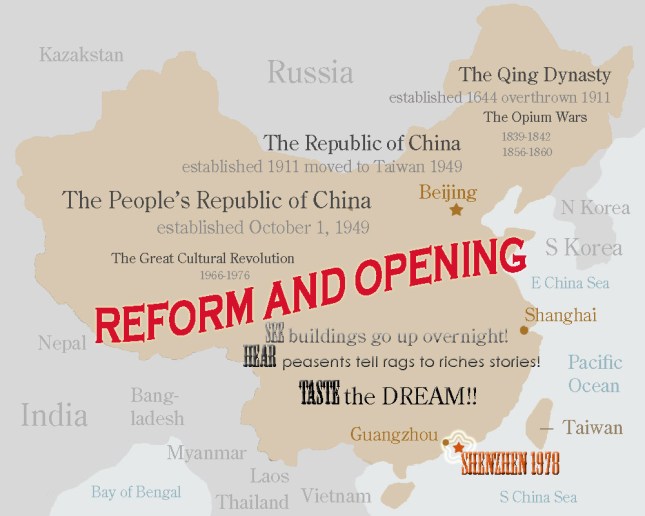 This is the first panel in the image poem “Your Presence is Requested” from Prosthetic Cosmologies. My artist statement follows.
My work aims to make visible the shared processes – cultural, environmental, political, and economic – that define daily life in both the People’s Republic of China and the United States of America. I believe that any person, any organism, any word, indeed, any object, connects us in transformative dependency and as yet unrecognized possibility. I proceed in the faith that respectful seeing reveals the structure of interconnection and new forms of hope. I compose images that testify to the poetic beauty of this complexity.
While at the Sitka Center for Art and Ecology, I added ten panels to an ongoing series of image-poems entitled Prosthetic Cosmologies, which chronicles the globalizing myths that situate Shenzhen across diverse levels of historical experience. The formal structure of each image-poem combines genre conventions from classical Chinese poetry, anthropological theories about the human quest for meaning, and photographic images from Shenzhen and elsewhere. I used my time at Sitka both to reflect on the mythmaking that emerges in delta cultures and to track those myths along the Oregon Coast.
Shenzhen Fieldnotes has moved
For the past few years, I have blogged about Shenzhen’s various emplacements – symbolic, economic, political – in Shenzhen Fieldnotes at LiveJournal. However, since completing my residency at the Sitka Center for Art and Ecology, I have reformulated the questions that inspired Fieldnotes. I also learned that on January 6, 2009, LJ laid off a majority of its San Francisco employees. All together, the time seemed right to change servers.
I will continue the conversations begun on Shenzhen Fieldnotes, here at Shenzhen Noted. I will also begin transferring Fieldnotes content to Noted. I’m hopeful that reviewing archives will lead to new insights. Joys of editing!
 Shenzhen Noted