two food related links.
the first is a chinese introduction to the food-scape project, here.
the second is a story about belo horizonte, a brazalian city that has ended hunger through innovative policies, here.




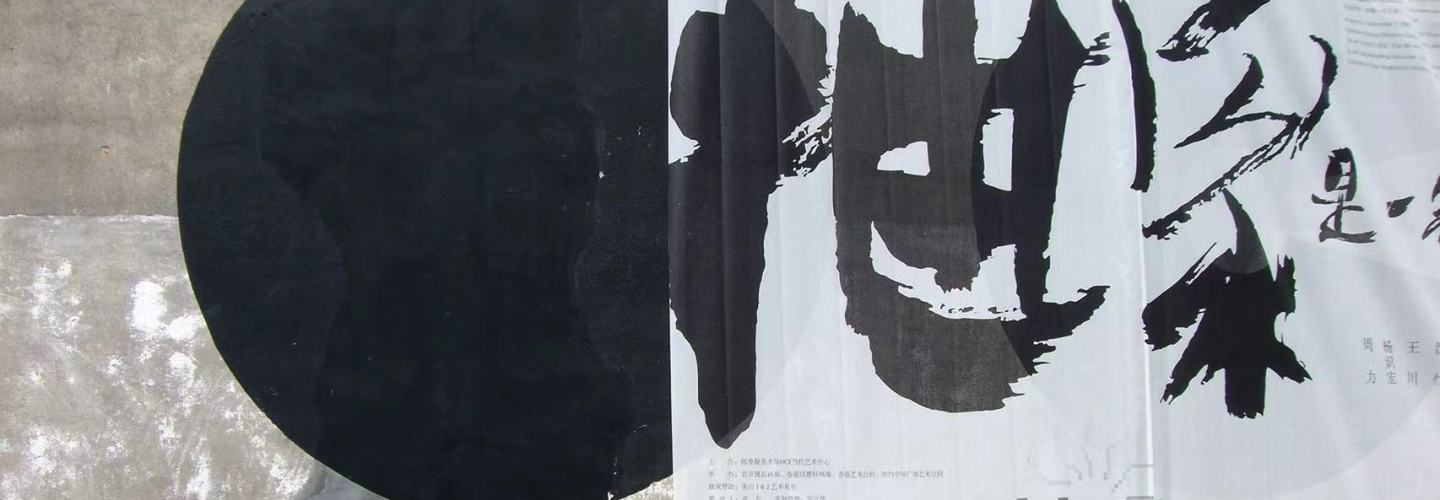
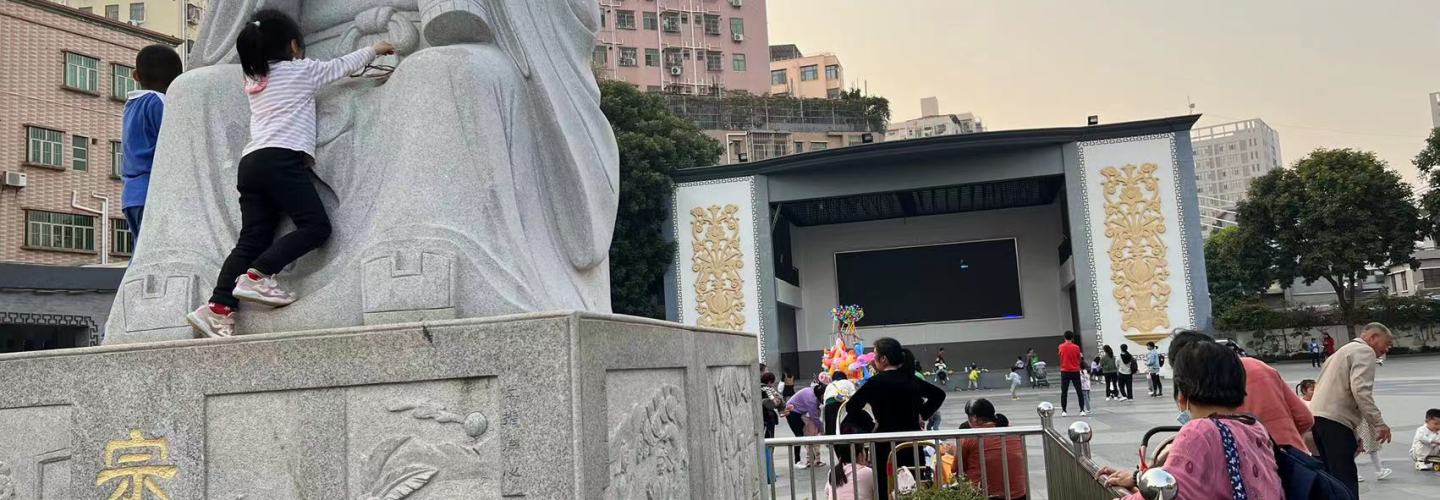
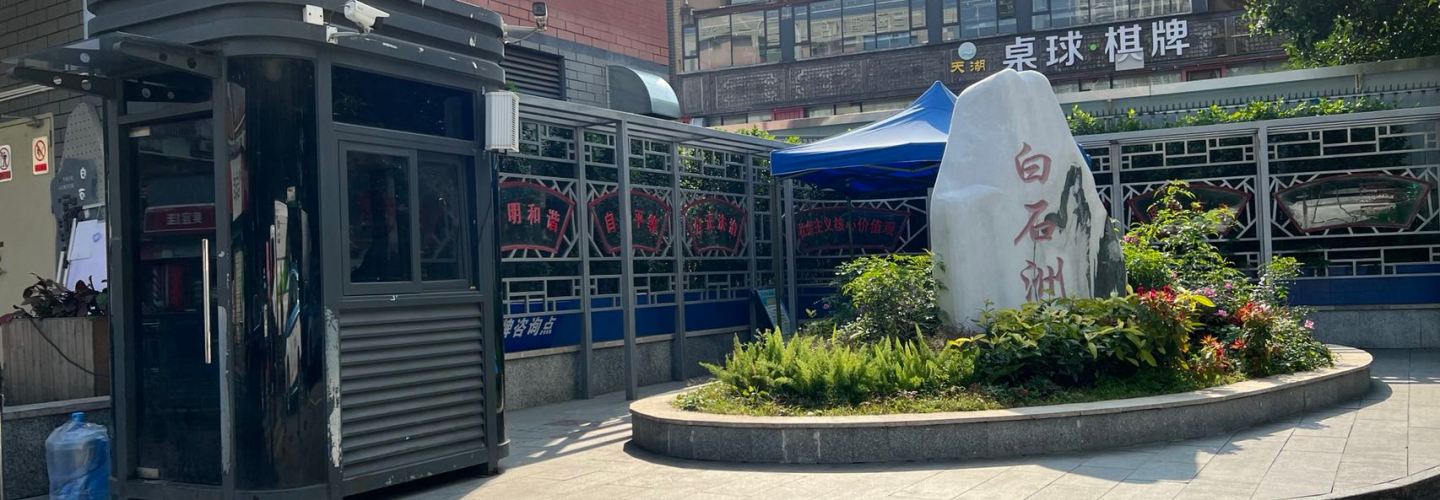

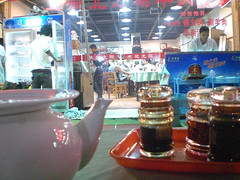
last night, we returned to a very old haunt–the nanyou food street, which used to be a thriving world of al fresco seafood, sichuan hot pot, and the odd miao restaurants. today, the street still bustles, but in a crumbling, obviously down-graded kind of way. it’s interesting to note that chains have moved in where independent restaurants used to be, while several spaces have been consolidated into larger restaurants, and rennovations were under way for another mega-restaurant.
for years, shenzhen has been actively upgrading its image by removing al fresco restaurants and other small, independent stores that used to spill onto the uneven sidewalks. all this grooming has resulted in neat, straight, clean streets that cut through beautifully tend and imported topiary–we are overwelmed by palm trees, where the restaurants and stores and kiosks used to be. the restaurants, of course, have (been) moved indoors, where air-conditioning, private rooms, and stylish chairs allow people to not only dine in comfort, but also eat in environments where open-toed high heals and business suits can be kept clean. after all, one of the downsides to al fresco dining is the grime that accumulates under the grill, between the tables, and in street gutters.
so, clear stratification under way in terms of unique dining experiences for those with money and increasingly mass produced for those with less. indeed, it is noticible that the al fresco restaurants continue to thrive in working class and older neighborhoods, while in more middle class neighborhoods (and those that have been subjected to beautification projects), the restaurants are all tucked away behind glass doors. unfortunately, for small restaurants, this layout is not comfortable. given the noise and proximity of fellow dinners in a successful chinese restaurant, big is better if you don’t have the sidewalk. thus, more fallout from the street-cleaning: larger, high capital restaurants do better in middle-class areas because they can provide a better dinning environment, while opportunities for low capital food entrepreneurs diminish.
yes, i am waxing nostalgic for old shenzhen, the shenzhen that friends once derided as “nothing more than a small town,” the shenzhen where al fresco dining was the norm, where workers and employees both jostled for tables under magnolia trees along uneven streets, and where cargo trucks rushed past, spewing carbon monoxide into our drinks.
the dubai-shenzhen connection reaches new levels of irony on the houhai land reclamation area, where “exotic dubai” is now an architectural style to be bought and sold in a soon-to-be-completed trés upscale residential area.
“exotic” is one interpretation of 风情 , which when refering to gender usually refers to the spiritual aspect of a woman’s sex appeal e.g. 多指女性.风情是女人的韵味,与性感有联系,两者的不同之处是:风情来自於“神”而性感来自於 “形” . likewise, when refering to place 风情 usually connotes whatever it is that makes minority groups “attractive”. this new marketing strategy not only begs the question: what other city has turned a bay into a desert in less than 10 years? but also has inquiring minds wondering: are they building artificial seas in dubai?
on that note, does anyone know if “shenzhen” is now or has ever been used as an adjective to describe real estate elsewhere?
Have just returned from twelve wonderful days in Switzerland as part of the Food-scape project. While there, Yang Qian, Debby Sou (苏慧琼) and Lo Kwai-cheung (罗贵祥), and I joined Margrit Manz, Martin Zeller and many other wonderful people to get a taste of Swiss food and culure.
I’m still thinking through what happened. This is one of the upside/downside effects of my life in Shenzhen. I seem able to think about experiences in Shenzhen faster than I am able to think through my experience elsewhere. However, I am not alone in thinking about the exchange. A teaser from Milan Buttner’s Interview gives a sense of the inspirations of and from the project.
In the interest of science (of course!), i’ve been trying to collect fake currency from various shopkeepers and friends and have been relatively unsuccessful. no one admits to having any counterfit bills to give me. the taxi drivers have been particularly vehement in denying their involvement with fakes.
three possible explanations. either (1) i come off as some kind of spy and no one trusts me; (2) there really isn’t as much fake currency out there as the signs and gossip would have it, or (3) all of the above.
a close friend did pull a fake ten out of her cash register for me, explaining, “the new help can’t tell the difference between real and fake currency.”
joys of field research!
Yesterday, a journalist interviewed me about differences between US and Chinese education systems. The heart of the matter was how might Chinese students apply successfully for US university and college admissions. I blah-blahed for a while – on the different social functions of testing, on the relative importance of excelling in one subject, rather than having good grades in all subjects, and on the advantages of finding an environment that fits the student, rather than choosing a college based on how famous it happens to be in China. Thus far, a rather ordinary interview. Or so I thought.
At the point when I was blathering on about how the ideal function of a US college education was for students to figure out their intellectual interests and then professionalize at the graduate level (as opposed to many other post-secondary systems, where professionalization happens at the undergraduate level because many countries track students into the humanities or sciences as early as high school), the journalist sighed (?!) and said, “You’re really idealistic.”
I’ve heard this. Frequently. It’s as if idealism was a bad, bad thing. My stock answer du jour is, “In the context of the US college system, it’s practical to assume that students will change majors once or twice, may transfer to another school, or could take time off to follow other passions. It’s safe to say, most will stumble into a job after college and then professionalize on the job (and even more likely professionalize through a series of jobs) with a possible detour through grad school.
“That’s just it,” the journalist jumped in. “In China we don’t have so many choices. It’s even worse when you reach middle age. Then the job chooses you. Living for one’s passions is a luxury that Chinese people don’t have.” And then he added the zinger designed to end the conversation, “You don’t have this experience of living for other people because you’re not Chinese.”
Bracketing the fact that the journalist was younger than me and I haven’t yet admitted to middle age-dom, his rebuttal was similar to other responses (especially from parents) that I’ve heard. What’s interesting to me is what makes my response seem “American”. On the face of it, the journalist’s rebuttal assumed that realism means getting a secure, high-paying job right-out-of-college. This seems to me a pretty standard response to capitalism as we know it wherever we happen to live. Specifically, I think Chinese and American parents share this definition of realism, especially about their children’s college education, because they are anxious about what will happen to their children once launched and they know that it’s harder to make a living in an uncertain economy.
Making college “about” getting a job is actually magical realism (of an albeit cross-cultural kind), rather than hopefully and practically idealistic. Imagine parents stirring the pot of destiny, thinking, “If I can control what college my child attends, then I can protect them from unemployment, debt, and exploitation. My child will never experience the humiliation of unemployment and the sadness of insufficient medical care.” Fingers wiggle, green smoke appears –Poof – “You won’t ever have to suffer the arrows of outrageous multi-national fortunes.” In contrast, it seems to me that protection from the injustices of an economy out-of-control (and I think that’s a constant state of being, rather than a momentary aberration) is more likely to come from discovering and nourishing passions that will make our lives more meaningful, and by extension, make the world more beautiful than it is to come from placing one’s faith in name-brand schools and top-ten jobs.
So I return to the question of what made my understanding American, rather than optimistically idealistic within a global context. I believe my American-ness hinged on the journalist’s belief that “Chinese” people live for other people and “Americans” live for themselves. Unsurprisingly, I’ve also had this conversation with other Chinese friends. When it’s pointed out to me that “Chinese” people live for others, the examples tend to be about sacrificing oneself for the greater good. – 牺牲你一个,幸福千万人 and 舍小家为大家 being two recent contributions to the debate. When I counter that I’m not opposed to living helpfully, I just don’t see how my unhappiness (and even death should sacrifice go so far) would improve the world, I have heard, that this is precisely the cultural difference that they are talking about. The sacrifice of a few for the many does lead to greater happiness. If I had the experience (体验 – which I understand to emphasize embodied knowledge of the walked-a-mile-in-a-man’s-shoes variety) of living for others I would know in my bones that this was true.
And yet. Throughout the public sphere, Shenzhen inhabitants butt in line to get on the bus, cut off other drivers to make a U-turn, and push themselves in front of me to buy breakfast buns. Why don’t the activities of lining up and waiting for one’s turn count as “living for others”? This kind of living for others I do quite well. However, my Chinese friends tell me these behaviors are examples of 素质 and 文明 – breeding and civilization. In contrast, living for others is about one’s relationships to 自己人 – one’s people. On this explanation, “living for others” defines degrees of intimacy; it is not about one’s relationships with strangers. So two points. First, what makes me American is an unwillingness to participate in forms of intimacy that are defined by a willingness to sacrifice myself for my family and friends. Second, in those contexts defined by a lack of intimacy, what makes one Chinese is full throttle “living for oneself” and giving over to one’s (unlimited) desires.
It seems to me that in defining cultural difference between Chinese and Americans, it’s more important to establish where and when self-expression (defined as giving over to one’s desires) is socially acceptable, rather than positing “selfless” Chinese and “selfish” Americans. Certainly, many Chinese have experienced the liberating effects of Shenzhen in terms of being unconstrained by the desires of family and friends back home. Indeed, this lack of constraint is what makes Shenzhen seem “un-Chinese”. My experience has been that the more friends I make, the more is asked of me in terms of social commitments. So that despite a zero intimacy starting point, I have been and continued to be socialized according to Chinese norms that are tempered with the “knowledge” that I am American and hence of the selfish ilk.
What’s your experience?
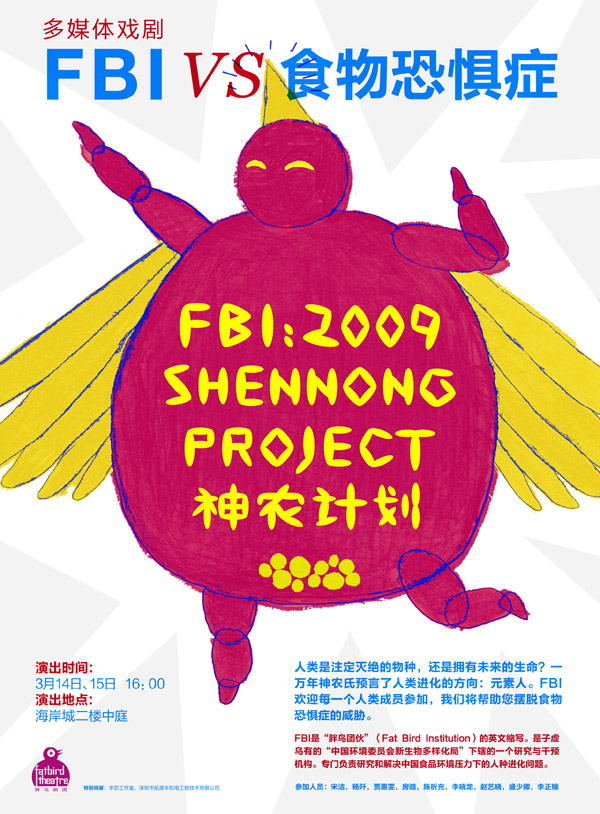
It seems that Three Deer scandal remains a sensitive topic. Even as representatives in the People’s Congress are arguing over whether or not stars who advertised for the company, in Shenzhen Fat Bird has adapted FBI: 2009 Shennong Plan to fit more snuggly into the rhetoric of Coastal City’s plan du month – “知性女性聪明消费 (The Intelligent Woman Shops Smart)” advertising focus.
So, as of last night, the advertising and and title of the play have changed. The play is now called “胖鸟VS食物恐惧症 Fat Bird Takes on Comephobia”. “Comephobia – fear of eating” was in the original production an ironic medical condition. This weekend, comephobia will be staged as a real social problem. The other major change to the piece is the staging of ritual. In Hong Kong, the piece also spoofed Falun Gong. In Shenzhen, the rituals have all been “upgraded” to modern dance.
Strange indeed which venues fear what. In Hong Kong, there was pressure to make sure everyone understood that “FBI” was an ironic naming of the theatre troupe. In Shenzhen, we must make sure that everyone realizes the troupe is making a joke about a problem that while real, isn’t so serious that it can’t be mentioned at all. FBI still hopes it will be able to sing its theme song to the tune of the Olympic theme song. However, that decision has not yet been imposed.
Time of the show has also changed from 3 to 4. The venue, 2nd Fl, Coastal City Mall, above Jusco.
On Mar 14 and 15 at 3 p.m, Fat Bird will perform “FBI: 2009 Shennong Plan” in the second floor public space of Coastal City. The space is located just above Jusco. After both performances, there will be an open discussion with with the audience about food safety and regulation.
This performance continues and elaborates Fat Bird’s efforts to use theater as a vehicle for encouraging public debate. Fat Bird began as a street theatre troupe which made strategic invasions into public space. In contrast, the Coastal City performance marks Shenzhen’s acceptance of Fat Bird into mainstream venues.
Come, enjoy, debate, and support Fat Bird! One bird, so much good.
Shenzhen buses have televisions that broadcast flash cartoon versions of popular skits (小品). Two days ago, Yang Qian and I saw Pan Changjiang and Wang Ping’s skit “O Sole Mio (我的太阳-regular performance)”.
The skit quit obviously spoofs blind infatuation with high western culture. Pan Changjiang plays “Pavaroti’s student’s student’s student’s student” whose English name is derived from his teacher’s teacher’s teacher’s teacher’s name” – hence 帕瓦罗蒂’s student’s student’s student’s student’s English name is 帕瓦罗锅 or “Pava Hunchback”.
Hunchback comes dressed in a tux to sing “O Sole Mio” to a Chinese audience. His accompanist, 二锅头 (played by Wang Ping, the “guo” in liquor picks up the “guo” in Hunchback) is dressed in a grey scholar’s robe. The differences between the two includes hairstyle. Hunchback frequently finger-combs his shoulder length, while Wang Ping’s short hair is neatly brushed away from his face in the style of middle management and party leaders.
Hunchback and Liquor quite literally can’t get on the same page. Hunchback keeps trying to sing “My Sun” – “His Sun” – “No, My Sun” – “Your Sun” – yes, shades of “Who’s on First”. Then, Wang Ping keeps playing a song I don’t recognize but includes the lines “The stars are still those stars…” The reason? When it’s sunny in “your” Italy, it’s starry in “our” China. Hunchback insists that it’s already today, so Liquor packs up to leave. Work is over.
A bribe of water (“It’s actually water!?”) later and Liquor starts playing the trumpet. He begins with O Sole Mio and then goes through a variety of songs. At each change in tempo, Hunchback follows with the appropriate dance or song. Any thinking that Hunchback does is always of the “Wait a minute” variety as he tries to keep up with the curveballs that Liquor keeps throwing.
This skit prompted a discussion about “The top has directives and the bottem has countermeasures (上有政策,下有对策)”. There’s never direct confrontation, but constant unending non-cooperation in the most obsequesiouly annoying manner possible.
Which in turn prompted another joke (loosely translated):
Reporters asked Pukin, what should be done about Bin Laden? –Blast him away with bombs.
They asked Bush — Deploy Israeli forces to destroy him.
Then, they asked Jiang Zemin who said — Why use such complicated measures? Send the “Three Representatives” to annoy him to death. heh!
As friends constantly remind me – no one has it easy (谁也不简单)!


 Shenzhen Noted