




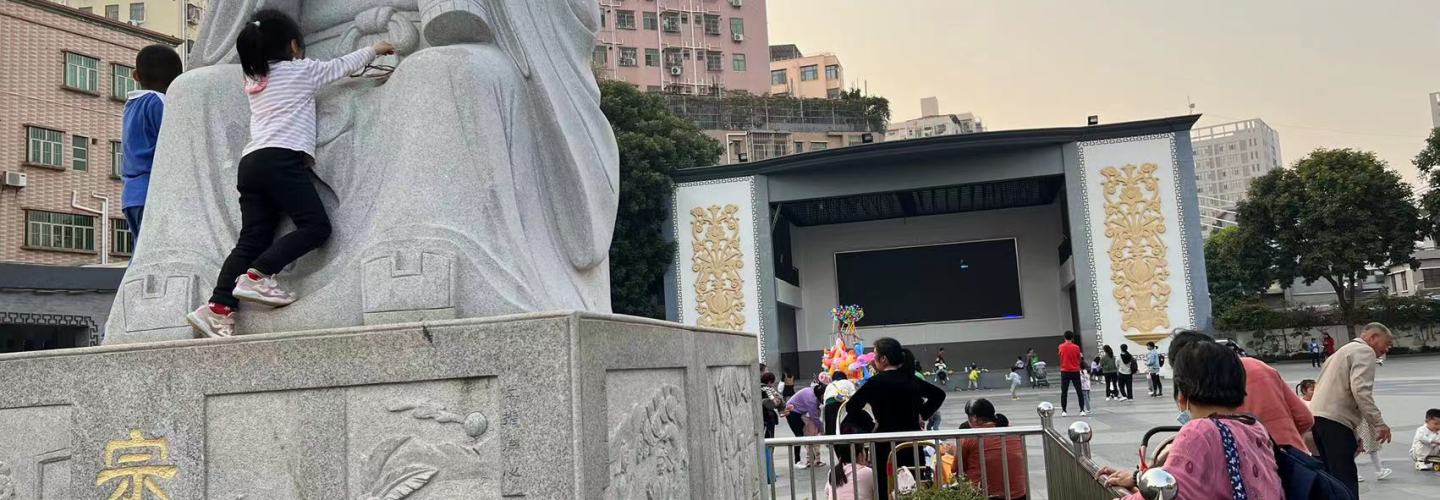
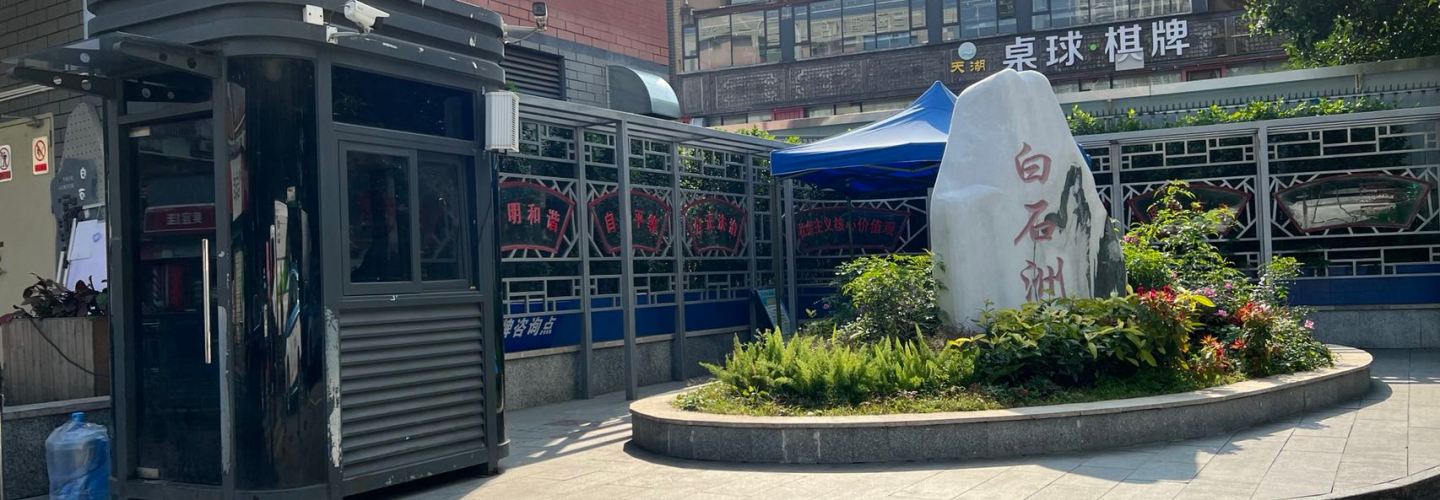

this afternoon, i walked through shazui, the village below my 31st floor windows and was struck by the odors and and the shadows. even though the streets are relatively wide, the cement is old and dank, the slabs of meat intimidating, and the people weary. shazui is an older industrial zone and where there is still work, chemical smells permeate the rows of factories. another section of the village has been upgraded and sells handicrafts and rocks, for half a million rmb. these pictures of the street. will add pictures of the cultural turn later.
Copenhagen 350
On December 10, 2009, students and teachers from Green Oasis School, Shenzhen, joined world wide vigils to limit carbon dioxide emissions. Scientists say that 350 parts per million CO2 in the atmosphere is the safe limit for humanity. Currently, we’re at 387 and rising.
10th grader, Ann Sheng organized students and teachers to march from the school to the park, including securing permits from the municipal government.
15 years ago, Shenzhen urban planners expected the population to use public transportation and bicycles. Today, Shenzhen has one of the largest car markets in China, and the city’s roads have been rebuilt to acommodate the huge number of private vehicles. 15 years ago, Shenzhen urban plans included green space and basketball courts. Today, those public spaces are now used as parking lots.
All this to say, already in Ann’s short life, air quality in Shenzhen has noticibly worsened. I hope her efforts and the enthusiastic support of her classmates and teachers help world leaders (yes I’m looking at you, Barack Obama and Hu Jintao) to reconsider their positions to represent the views of the people and not just car manufacturers.
pictures of the vigil, here.
the wizard of sz
Participants in the Shenzhen-Hong Kong Biennial will
Explore the possibility of large-scale effective social mobilization in a time that lacks centralized force, spiritual solidarity and practical organization – Ou Ning, Biennial Curator.
In the context of Shenzhen’s thirty year history, the word “mobilization” resonates ironically. In 1966, Mao Zedong began the Cultural Revolution by mobilizing Chinese youth to prevent the restoration of capitalism through ongoing class struggle. In 1978, Deng Xiaoping initiated Reform and Opening by mobilizing the national engineering corps, architects, and reform-mind cadres to plan and build a Special Economic Zone, where elements of capitalism would be deployed to finance modernization projects throughout China. In other words, the construction of Shenzhen was a countermeasure to large-scale social mobilization during the Cultural Revolution and the city itself is the product of effective social mobilization under the auspices of modernization. Juxtaposed with the stated aims of the Biennial, Shenzhen’s history thus begs the question, “Why mobilization? Why now?”
Choices PK 机会
This year, I began working as a college counselor, advising bright and talented students on the value of a liberal arts education and the concept of fit, as well as more mundane matters such as crafting essays that answer the question and making sure that an application is filled out correctly. My students willingly do homework, take tests, join clubs, and volunteer in order to craft themselves into highly desirable candidates. They are, no question, great students. Yet as the semester has progressed, I have found myself angry, frustrated, and screaming at my husband because the telephone is ringing.
Why the pissy attitude?
At first, I attributed all this unpleasentness to stress, comforting myself with wishful thoughts that after the first rush of applications, I would calm down, teachers would submit recommendations in a timely manner, and students would follow instructions. The question, as I first saw it, was procedural; all we had to do was figure out how to cooperate and everything else would fall into place. Nevertheless, despite major adjustments, minor tweaks, and a general policy of bribing and bullying students as necessary, my irritation only increased.
Several days ago, a student came to me and said, “I want to apply early decision.”
I asked, “What school are you thinking about?”
He replied, “What school do you think I have the best chance of getting in?”
I rolled my eyes and repeated, “Where do you want to go?”
“Recently, the University of X has admitted many Chinese students. Do you think I have a chance?”
“Why do you want to go there?”
“I want a good study environment and it has a high ranking.”
“But what’s special about this University?”
He stared at me. I rephrased, “How will you answer the application question – Why do you want to attend University of X?”
He reassured me, “That’s an easy question to answer. Don’t worry. I’m sure I’ll have something to say.”
Another college application standoff. I wanted to convince him to choose a college that fit him, he wanted me to get him into the highest ranking college possible.
This student typifies how my students have approached looking at US colleges and universities. They look at college rankings with an eye to how famous a school is in China and then compare the requirements for attending that university with what they have thus far achieved. They apply to a range of colleges based on these criteria – how highly ranked, how famous, how likely am I to get in? This is a highly rational approach to selecting a college and it has bothered me no end.
Only in retrospect have I unpacked my frustration in how my students have approached US college applications. I believe, unthinkingly, that which college a student attends is a choice. I maintain that the proper way of making a choice entails reflecting on one’s values, passions, and intellectual stregths. In this sense, academic achievements are necessary but insufficient to make a choice. The deciding factor is how a student wants to live. Moreover, it is the responsibility of the student to understand who she is and choose accordingly. This is a crude definition of “fit” – the idea that schools have different strengths, allowing students to flourish in different ways.
My understanding of “choosing a college” is based on a larger American valuation of choice in general. To my mind, a “good” person makes choices, a “bad” person opportunistically maximizes options. I value choice because it is where I express my commitments, ethics, and personality. I believe that society should be structured in such a way as to provide fair and equal opportunities to make choices. Indeed, I understand “freedom” to be defined through choice, experiencing the absence of choice as not only emotionally intolerable, but also unjustly oppressive. Moreover, I interpret other people’s actions with respect to my valuation of choice. I understand critical moments in a life to be defined by the choices that an individual has made – the choice of friends, the choice of where to go to college (or not), the choice of a spouse (or not), the choice of jobs… At each moment, I see that the self must express itself by making choices. A not B, C rather than D.
Here’s the cross-cultural rub: My Chinese students don’t operate out of the same valuation of choice. Instead, they value contexts of possibility. They understand that if they attend a certain high school, they will have the possibility to meet a particular set of friends, attend a given set of colleges, and find a related job. At each moment, they see that one’s options are context dependent. Consequently, they work to make ensure that at any moment they have as many options as possible. Indeed, they see the greatness and expansiveness of the self in terms of endless possibility.
Clearly, choice and opportunity as organizing principles have different consequences, both good and bad. On the upside, those of us who value choice making, craft highly defined selves. We also tend to see ourselves as shaping the world. [Good morning, America!] Those of us who value an array of options, craft highly fluid selves. We also tend to see ourselves as adapting to an already formed world. [Hello, China!] On the downside, Americans who value choice making, often miss opportunities to live and experience the world otherwise because our selves are so firmly fixed through definitions of what “I” should choose. Likewise, Chinese who maximize opportunities, often live passively and without passion, taking what is offered as if it were an unchangeable fate.
可想而知 – as can be well imagined – when I, a muddled and American teacher meet up with bright but Chinese students to discuss the future, we often talk at cross purposes. Fortunately, we become vexed when the misunderstandings become too obvious to ignore. In turn, this irritation allows us to re-think how different points of departure might nevertheless lead to common ground.
Another highly speculative post from the depths of Shenzhen. What do you think?
food-scape updates, closure
Closure on the foodscape project. Last Wedensday, Sept 16, 19:30 at the Hong Kong Arts Centre, mccmcreations hosted a book launch for foodscape, the book. The book is on sale at the Bookshop of said Arts Centre. Please stop by, puruse, and buy a book!
Also, Milan Buttner completed Inter-view, his 30-minute exploration of inter-cultural exchange and multi-lingualism during the project. Click, view, and enjoy!
中国观澜版画基地: What is a cultural resource?

Yesterday, Wenzi and I visited her classmate, Zhao Jiachun who works at the Guanlan Woodblock Print Base (中国观澜版画基地). Jiachun generously showed us the Base and briefly introduced its history.
Guanlan interests me for three reasons (in addition to the beautiful setting, pictures here):
Guanlan is, at the moment, a purely municipal government funded project. This points to the growing ideological importance of culture in Shenzhen’s identity – both domestic and international.
Guanlan is part of the movement to recuperate elements of Shenzhen’s pre-reform history as a cultural resource. What’s interesting is that this recuperation is happening village by village. Consequently, what emerges is a loose network of sites, rather than an overall “history” of the city. In this case, Guanlan is the third Hakka site incorporated into the municipal cultural apparatus. The first was Dapeng Suocheng (大鹏所城), a military installation in the eastern part of the city. The second was Crane Lake Compound, which is now the Hakka Folk Custom Museum (深圳客家民俗博物馆鹤湖新居) in Luoruihe Village, Longgang (罗瑞合村).
Guanlan is an example of using pre-modern architecture to incorporate international art production into local identity. More specifically, the experience of architectural difference (such as living in a Hakka compound) bridges even as it creates cultural difference. Thus, the Base invites foreign and Chinese artists for residencies. These residencies allow foreign artists to “understand” China / Shenzhen and incorporate these new experiences into their art. At the same time, these exchanges also refigure a local art form (woodblock printmaking) as international cultural heritage. Importantly, this kind of “experience” of the local past as a cultural bridge seems a global trend. In Switzerland, we visited Romainmotier, which also offers artist residencies in a beautiful, restored, pre-modern setting.
This has me wondering about the ideological relationship between past and present urban settlements: Is “history” now the location of “culture”, while the “present” is all about one’s location on a scale of relative modernity? In other words, do Shenzhen and NYC participate in the same “culture”, their real differences explained away as “levels of modernity”? While their cultural “difference” must be found by excavating the past?
31st floor, 4th air conditioner (hot side)

This weekend we moved from a 7th story walk up to a 31st floor apartment. Until this move, I tended to think of air conditioners as prosthetic reconfigurations of nature. Air is not enough, we need to cool it.
However, this move I viscerally realized that our comfort is not simply more precarious, but also more indifferent to the well being of others than I had thought.
We use split system air conditioners that separatecold and hot functions. The cold side, consisting of the expansion valve and the cold coil, is generally placed into an air handler and is mounted inside the house. The air handler blows air through the coil and routes the air throughout the room. The hot side, known as the condensing unit, lives outside the building. Plastic tubes, usually ducktaped together, connect the internal and external parts of the system. More details about how split system air conditioners work at HowStuffWorks.
We had three split system air conditioners removed from the 7th story for 330 rmb. There was an additional 50 rmb per system “heights” fee to because the workers could not reach the hot side from a window. Instead, they went to the top of the building, rappelled down the side of the building to the ledge where the air conditioner had been placed, detatched it, secured it with moldy ropes, lifted it to the top of the building, and then carried down to our apartment. Another group of workers carried two complete air conditioning systems (we gave the third air conditioner to a friend) and the rest of our possessions down seven flights of steps, put everything into a blue container truck, and brought them to our new apartment.
At the 31st floor apartment,there were already two split system air conditioners in place; we had two more installed. To install the hot side, a 19 year old youth squeezed out a narrow window, dropped to the air conditioner ledge, manuevered the unit into position, bolted it into place, and connected the plastic tubing, before hoisting himself into position to squeeze back through the window. The young man took about thirty minutes to complete the tasks. During this time, he was alone on the ledge, lashed to the building by another moldy rope. This time, we paid a flat installation rate because the ledge was accessible from the window.
Pictures of the installation, here.
计划赶超变化–a new era in Shenzhen development
赶 is often translated as “to overtake”, but can also mean “to drive away”. It first appeared in Chinese political discourse in 1957 when Mao Zedong responded to Nikita Khrushchev’s statement that “the Soviet Union would overtake the United States in 15 years” by saying that “In 15 years the PRC would overtake England”. In 1958, Liu Shaoqi supported the Great Leap Forward with the idea of “Surpassing England and overtaking the United States (超英赶美)”. Indeed, in Shenzhen’s previous incarnation as Baoan County, there once were two communes named Surpass England and an Overtake America, respectively.
In many of the online interpretations of 赶英超美 (here and here, for example) Reform and Opening (改革开放) is offered as the correct policy for achieving surpassing and overtaking. This scenario is one way of understanding both the importance of Shenzhen (first and largest experiement in reforming and opening the planned economy) and why it is often experienced as “not Chinese”. Indeed, residents have often asked me how similar the United States and Shenzhen are.
赶 reappears in Shenzhen popular discourse in the late 80s and early 90s in the expression “plans can’t keep up with change (计划赶不上变化)”, which comments sarcastically on the governments inability to implement its urban plans. In Shenzhen, for example, the overall plans have been done in 15 year bursts. This has meant that what is planned isn’t built for years. More often than not, village developers and others have taken advantage of this situation to errect their own buildings. Thus, in the 90s, I frequently heard the expression “计划赶不上变化” to explain this situation.
During the 80s and 90s, de facto independence from government plans in Shenzhen resulted in a kind of pioneering exuberence that was often called “the Shenzhen spirit (深圳精神)”, but also found expression in slogans such as “little government, big society (小政府,大社会)” that moved with Shenzhen mayor Liang Xiang to Hainan in 1986 and which continues to inspire debates about changing the relationship between the government and the people (here, here, and here).
However, in conjunction with urban village renovation [administratively located in “Urban village (old village) renovation offices (城中村(旧村)改造办公室)],the government has recently begun razing buildings that were erected on these unused sites, justifying their actions (with or without compensation depending on various) with respect to the plan. This means that Shenzhen may have entered a period of that could be called “plans overtake change (计划赶超变化)”, whereby neighborhoods of several years are being razed to make way for roads and other public infrastructure (the subway) that have been planned for years.
I am interested in how “plans overtake change” because it describes several of the important contradictions that over time have taken root and flourished in Shenzhen.
the meaning of work and the pursuit of 幸福
I have been thinking about the familial as opposed to the personal value of work in Shenzhen. More specifically,I have been thinking about how happiness (幸福) is tied to family life and thus, how work is understood in terms of how it contributes to and/or impedes the creation and maintenance of families. For example, when people talk about why their jobs are important, they do so in terms of how it contributes to family life, rather than in terms of personal satisfaction. Thus, a “good” job provides a stable income and respectability for a family. If the job allows an individual to pursue and develop interests, so much the better. But if not, individuals may still derive (some) satisfaction from their jobs insofar as these jobs allow them to fulfill their responsibilities to their families.
This insight has allowed me to rethink how my students and their families understand my role in their lives (helping them get into top schools so that they can launch into good jobs), as opposed to what I think my job should be (helping them get into schools that will help them further explore, discover, and develop their passions so that they can find satisfying jobs).
1. The purpose of education: If the social value of a job is familial, it means that the goal of education is to prepare students for well-paid, stable and respectable jobs. These means that in an increasingly technology driven world, education would focus on the sciences and mathematics, despite (and often at the expense of) students’ interests in the arts and humanities. In contrast, if the social value of a job is personal, it means that the goal of education would be to help students figure out what their passion is and how to perfect it, whether or not that particular passion was economically viable.
2. The gender of the job: If the social value of a job is familial, it means that family roles become one of the most important criteria for choosing a career. Fathers/husbands must find jobs that allow them to provide for their families. Likewise, mothers/wives must take jobs that allow them to take care of the family. This means that men often end up taking jobs that they don’t like and women often don’t pursue jobs that they might enjoy in order to maintain family stability.
3. Who decides what one does: If the social value of a job is familial, it also means that parents, spouses, in-laws, and lovers all have a say in what one does because what one does is understood to be an expression of one’s commitment to these relationships. For example, a man who pursues an engineering career has expressed both the potential and the desire to take care of his family because engineering is a proven middle class job. In contrast, a man who pursues a passion for painting has demonstrated neither the potential nor the desire to care of his family because earning a living from painting is difficult. Likewise, a woman is rarely evaluated in terms of her success, but how that success impacts family life. For example, after a woman has a child, the child’s welfare comes before her job. Moreover, problems that children have are often explained in terms of mothers’ inability to manage both work and family responsibilities, regardless if the mother works long, underpaid hours to help meet ends meet, or has chosen to pursue a demanding career, which requires long, well paid hours to meet professional goals.
4. There is more sympathy for folks who are trying, but failing to fulfill their responsibilities to their families through respectable jobs than there is support for folks who trying, but failing to fulfill their family responsibilities by pursuing their interests. Thus, men find their interests are limited by their ability to earn and women find their ambitions are constrained by household responsibilities.
5. Insofar as creating and maintaining a family is considered to be and bring about the highest happiness (幸福), it’s an open question as to how helpful it is when I encourage students to follow their dreams rather than to obey their parents’ instructions.
Hmm.
 Shenzhen Noted