shenzhen in nyc, literally

This morning while wandering in China Town, I stumbled upon the “Dapeng Hometown Association” or the hometown association for Dapeng villagers. The Association was established in 1982.

Curious, I went in and ended up speaking briefly with an elderly woman, whose life trajectory speaks to the twisting connections that constitute possible Shenzhen identities. Or outlying identities, as the case may be. Mrs. C explained that she was born in Indonesia, but in 1960 returned to her father’s hometown, Dapeng to escape anti-Chinese policies. In 1964, she swam to Hong Kong, finally settling in NYC in 1985. Mrs. C said she had joined the association because Dapeng was her father’s hometown, although her mother was Indonesian.

I mentioned Xichong and Dapeng Suocheng. She agreed that there was great seafood to be had. We smiled at each other. Mrs. C then took a phone call pausing long enough to suggest that I return to talk with the man in charge of the Association.

Uncanny moment that has me thinking all sorts of thoughts about fated encounters and entwined destinies…

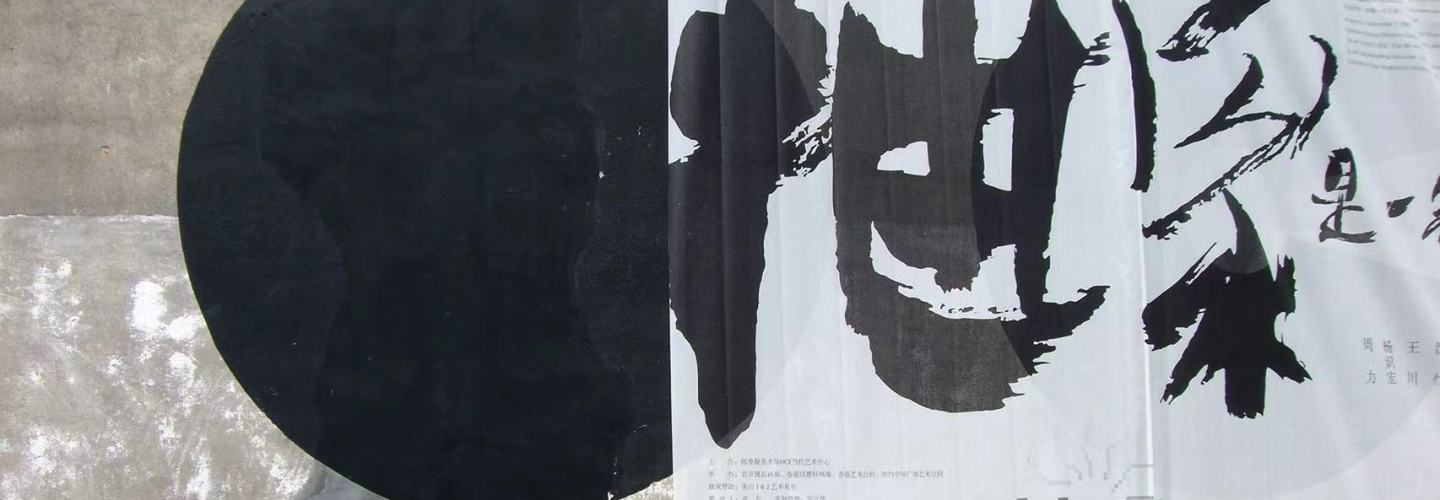
calligraphy in nyc

This is a post about the relative ghettoization of China studies within the U.S. academy and its concomitant marginalization in U.S. discussions about wither the post Cold War global world. I approach the topic not in search of lofty insights, but with practical intent; how do we learn to talk cross-culturally when most of the time we don’t have enough experience to make comparison meaningful?

Short answer: we need to cultivate wisdom, rather than pursue knowledge. Long answer meanders through musings on practice theory, calligraphy, and globalization. Continue reading

New Fat Bird online

videos of recent fat bird productions, 519 Happy Academy, Worm Hole, and particle-wave performance workshop are now online!

why shenzhen?

yesterday i gave a presentation on the shenzhen book of changes project. one of the questions that i was asked afterwards was, if shenzhen is so environmentally compromised, why do you love it?

i answered that i had experienced hospitality and generosity in shenzhen. indeed, that my husband and friends have all taught me how to be a better human being. and then, as i was walking away, i realized something else. i don’t think of myself as loving shenzhen. i think of myself as walking the city to understand what is happening here. i think of myself as an offering a highly subjective, partial english-language glimpse of the city for those whose only access to the city would otherwise be through journalism. i certainly hope that people who read noted come to shenzhen to learn and to understand and to participate in the life of the city; in other words, i hope that my blog might direct people to interesting and meaningful encounters with the city, rather than function as a substitute for personal experience.

all this to say, i bring a quality of attention and conscious intention to my inhabitation of shenzhen. this orientation has enabled me to see the beauty of shenzhen, land reclamation, fake foods, dank slums and squatter encampments, notwithstanding. so perhaps, yes, i have loved shenzhen more than any other place. but  it may be more accurate to say that learning to be attentive to shenzhen is teaching me to love where i am, today.

hearing meaning in chinese and english

yesterday, enjoyed a wonderful bbq with friends of friend. the conversation vered here, as it so often does in shenzhen to: how did i learn chinese?  the assumption behind the disbelief that i speak chinese is that it is difficult to learn chinese. i hear the same distancing shock when chinese people are surprised by the facts that i eat with chopsticks, navigate the public transportation system, and successfully bargain for goods.

it is more difficult to go from english to chinese than it is to go from chinese to french or spanish because english shares so much with the romance languages and very little with chinese. when i learned french, for example, it really was just a question of learning how to translate, once i knew the rules, i just needed to practice execution. were there details i din’t get? yes. do i still struggle with proper use of the subjunctive? yes. do i have difficulty navigating all those gendered nouns. yes.

and yet. did i already understand the use of the past tense and the importance of conjugation to making meaning? yes. did i have vague familiarity with french history and culture? yes. did my u.s. humanities education prepare me for themes i would find in french literature and philosophy? again, yes.

at first glance, then it does seem more difficult for an english speaker to learn chinese than it may be to learn french. the structures of english and chinese share little in common. and, given the tendencies of u.s. american education in the 70s and 80s, i was also unfamiliar with chinese history and culture, as well as great themes in literature and philosophy. all this to say, i understand the difficulty that native speakers of either english or chinese encounter when we attempt to crossover that divide.

nevertheless, learning chinese became easier when i realized that we share many linguistic features but not only use them, but also listen for them differently.  Continue reading

cultural tendencies – what does it mean to be lazy?

a few nights ago, i had a conversation with two friends, one old and one new about “resignation” and this has led me to rethink possible translations of 懒 (lan usually translated as lazy), especially within educational contexts.

my friends and i had just had drinks with an old married couple, who clearly still cared for each other and this led to a conversation about resigning oneself to unhappiness in a marriage or working towards one’s own happiness, whether or not this meant going through with a divorce at age 70. i mentioned a common mandarin expression, 懒得离婚 (lande lihun) from chen rong’s eponymous novel about a couple who stay married simply because they’re “too lazy divorce”. however, in context, it’s clear that chen rong is talking about laziness as a form of resignation (as in 无奈 wunai) and not as a form of non-cooperation (as in 不合作 bu hezuo).

this conversation prompted me to think about the different cultural valences of “lazy” in english and “懒” in mandarin because i hear chinese parents and teachers frequently complain that their children and students are “lazy”. as a general rule, i have had three interpretions of statements such as “he’s so lazy , he doesn’t love studying and is greedy to play (他很懒,不爱学习贪玩)”. if said by the parent / teacher of a student with high marks, i take the statement as negative boasting or a warning for the student not to become complacent. if spoken by the parent / teacher of spirited underachiever, i have understood the statement to mean the student needs to start studying and stop goofing off. and third, if spoken by a parent / teacher of clearly bored and unhappy student, i have assumed that the student was engaging in some form of let’s-see-if-you-can-make-me-study / get-good-grades passive resistance. i did not, however, associate laziness with resignation, especially when describing students who aren’t studying. indeed, i have tended to empathize with students who don’t study materials that bore them because i often understand laziness to be a form of self-protection.

so insight du jour, thinking of laziness in terms of resignation offers a fourth interpretation about what chinese teachers and parents might mean when they tell me a child / student is lazy. it is possible to think of statements about student laziness in terms of parental / teacher anxieties that a student is resigned to doing badly in school, indifferent to or perhaps unmoved by academic advancement, which in turn easily feeds anxieties about not getting into a good college, which in turn is thought to lead to a bad job (in the best case) or unemployment, which would prevent a happy marriage . . . and so yes, i suddenly see why it might be nerve-wracking to have a “lazy” child / student. i remain skeptical, however, about where the lines between over-achieving, doing one’s best, not trying, and opting out get drawn and more importantly, how parents and teachers recognize these different students responses to school.

p.s. my friend, a teacher has just read this post and commented that as an elementary school teacher in nyc, laziness distresses her as well because through their laziness, students learn that it is okay not to strive.

redistricting – guangming and pingshan xinqu

i try to keep apace of the changes, but alas, shenzhen redistricts and i find out about it after the fact. guangming new district was carved out of baoan and pingshan was carved out of longgang. thus shenzhen now has 8 districts: within the gate (guannei or the old second line, erxian) nanshan, futian, luohu, and yantian; outside the gate (guanwai) baoan, guangming, longgang and pingshan. see map.

this redistricting seems to be a return of the repressed because during the mao years guangming and pingshan were communes. of course, all shenzhen’s districts were once upon a time communes and so the city’s administrative history might be thought of as tweaking and reshuffling extant divisions upon revisions of a traditional world order. more to the point is that this redistricting speaks

  1. to shenzhen’s loosely planned uneven development (some places in shenzhen really are noticeably poorer than others, which is interpreted as intended-by-the-governmenet-to-be poorer than others, thus requiring explicit recognition through the establishment of a new administrative district. first case – yantian) and
  2. to the city’s growth (it really is too big for simple administrative bureaucracy).

a simple point of nomenclature: i don’t understand why guangming and pingshan are “new districts (xinqu)”, rather than districts (qu). it may have something to do with actual rights and responsibilities of the new district government as being distinct from other district governments (in terms of taxation and what not), but i don’t know. or, thinking from the analagy of new villages (xincun versus cun), i hypothesize that new districts are a variation of a past government, with status change and thus the right to transform whole chunks of the political-economy. thus for example, guangming was a zhen within baoan, just as pingshan was a longgang zhen, which were subseequently elevated to neighborhood (jiedao) as part of the 2004 rural urbanization movement. but again and alas, i’m not for sure.

cutting to the chase, i ask: does anyone know the reason for why xinqu rather than a plain and simple qu? please tell.

in nyc this summer

i am in nyc for the summer and will be blogging about stories i hear about shenzhen, here. i’m curious about the pattern and frequency of knowledge about / experience of shenzhen because globalization seems to me a question of uncanny immanence. we think tend to think that globalization is obvious – a korean zen center in the lower east side or a parc guell in yantian district, but then, suddenly, during the circle talk, i learned that a teacher’s brother is based in hong kong four months of the year and yes, spends time in shenzhen. there, in the lower east side, among all that obvious globalization hovered immanent connections and spectral possibility.

and a housekeeping note, which follows from being in nyc and the joy of being able to blog without a proxy and concommitant time lags. i am playing around with blog format. hopefully, by the end of the summer, i will have a new look and more integrated tag system / virtual filing system. then i can return to shenzhen and subverse posting. unless, wordpress is unblocked…

Wormhole

The Shenzhen University Department of Acting premieres Wormhole this Thursday, June 24, 2010 at the Shenzhen University New Black Box Theater.

Wormhole takes the audience on a speculative journey through the universe, where travellers encounter wormhole bugs (the Mandarin for wormhole is “bughole”), birds from a parallel universe, and a quantuum needle. The performance launches from the idea that knowing is itself co-evolutionary with the universe, so that how we know is the means for wonderfully, hopefully, and endlessly remaking the world. 

Wormhole was directed by Kuo Jing Hong, a long time Fat Bird collaborator.

Dates: June 24, 25, 26  and 28, 29

Time: 19:30

Place: Shenzhen University New Black Box Theatre

Directions:

Enter the Shenzhen University Main Gate; turn left and drive 30 yards; turn left onto the Teaching College driveway; facing the building make a left and go downstairs.

The theater is on sub-floor one in building B.

the importance of moral worlds

moral worlds matter. not simply because they teach us how to be human, but also (and precisely) because they set the terms by which we treat other humans. thus, not unsuprisingly, we use our moral worlds to identify other humans and thereby place them in relationship to ourselves.

like all western bloggers about experiences of and thoughts on living with / among / against chinese people, i care about chinese moral worlds because those terms are the point of departure for our interactions. call it homecourt advantage. for example, a few days ago, one of my neighbors approached me to ask if i would teach her daughter english. i replied that i didn’t teach outside of a school. she concluded, “well then, maybe you can be friends.”  with your 13 year old daughter? hmmm. Continue reading