Jiujie / Nantou / Xin’an Old Town

Years ago, I published becoming hong kong, razing baoan, preserving xin’an, an academic paper on urbanization as the ideology informing the construction of the Shenzhen SEZ. Part of that paper included an analysis of Nanshan District’s decision to create a walking museum at Nantou, the County Seat of Xin’an from the Ming Dynasty until the CCP moved it to Caiwuwei, in Shenzhen Market. The museum didn’t survive into 1998 and Nantou settled back into urban village life – migrant workers renting space in handshake buildings, small scale manufacturing taking place both at home and in low tech factories, and bustling streets of vendors, shops, and open air markets.

Yesterday, I walked Nantou and discovered Universiade traces. The roads that connected the buildings in the walking museum had been paved with grey bricks and the buildings abutting those streets (well all two of them) had been given “traditional” facelifts – a faux grey brick facade and eves. Moreover, the museum buildings have been reopened to the public! So the universiade upgrade of Nantou included Shenzhen’s ongoing push to open small museums in the urban villages.

Here’s the rub: Houses and streets beyond the scope of the museum remain as they were. Also, the gate god, which used to inhabit the old Ming gate to the city has been removed. All that remains of that living tradition are two holes on either side of the gate, where incense has been stuffed in. And yes, that’s an upgraded pedestrian overpass at the entrance to what remains of the walled city. Impressions of revamped and still unvamped Nantou, below.
This slideshow requires JavaScript.

cruising old shekou

Yesterday, a member of Generation 80 took me to the beaches and mountains of Old Shekou, where he played as a child. He remembers swimming off small docks, crabbing on the dike that used separate the Naihai Hotel from the backwash of Delta waters, and biking safely along narrow, dirt roads. Little remains from his childhood. Even the broadcast tower from Broadcast Mountain has been razed and the remaining structures converted to an upscale Cantonese restaurant. Anyway, the area he used to bike, we cruised in his sports car. Impressions, below:

This slideshow requires JavaScript.

RIP – Steve Jobs and neoliberal immortality


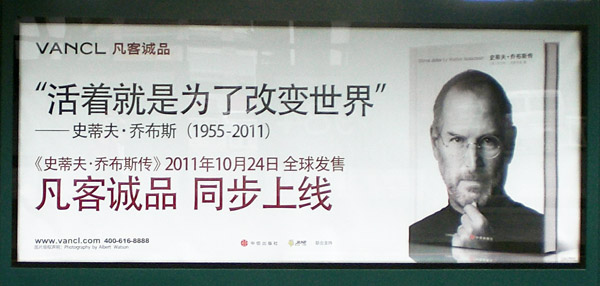
A recent advertisement for VANCL web quotes and shows a book about Steve Jobs. My first reaction was disgust: how is it possible to use someone’s death as a means of pushing goods? However, my random sampling of Chinese friends shows that there is another way of understanding this advertisement – social immortality or 不朽 (buxiu), which means that you continue to influence the world even after you have died. All agree, Steve Jobs achieved buxiu.

According to my friends, who don’t believe in an afterlife but do believe in continuing influence, Jobs achieved buxiu through three forms of social memory: 立功 (establish work),立言 (establish language),立德 (establish morality). 立 means to stand-up or to establish. 功 is a wonderfully rich character that has (at least) five meanings: merit, service, result, achievement, and accomplishment. 言 means language or speech and 德 refers to virtue. In other words, buxiu consists in setting up an institution, being cited, and setting moral standards. Steve Jobs’ accomplishment was to establish Apple, his speeches and citations now circulate on the internet and people learn from them, and his morality was to achieve brand confidence; Apple products are neither counterfeit nor substandard; their virtue as products is guaranteed quality.

Thus described, the kind of buxiu that Jobs has achieved seems classically neoliberal and begs all sorts of questions about how and why we are busy commodifying every aspect of our lives and afterlives. Indeed, we are clearly using economic metaphors to organize how we treat the living and the dead. How else to understand a world where trust can refer to forms of human relationship that have been structured by multi-generational financial arrangements? Consequently, talking about Steve Jobs and VANCL in Shenzhen reminded me of yet another cross-cultural capitalist truth; there’s as much honor and respect attached to VANCL’s use of Steve Jobs to promote online shopping, as there is when his American compatriots link the price of Apple stock to his passing.

conditions of possibility – grassroots discourse at the wutongshan arts festival

The title of this post shouts “academic theorization”, but in fact, the post itself is far less ambitious. I’m simply speculating about what conditions we need to put in place in order to cultivate cross cultural discourse in and about places with vexed histories, like Wutong Mountain, Shenzhen.

Creating models and forums for cross cultural discussions in and about places with vexed histories is difficult. On the one hand, most of us are not familiar with the values and concerns that inform the ethos of another people; indeed, even when we are relatively knowledgable about cross cultural differences, often we do not share our interlocutor’s priorities. On the other hand, cultural groups are not monolithic entities, but rather vexed by class, gender, and regional differences, creating what Bhaktin called “heteroglossia” – a situation in which context (including history and culture and politics and economy and one’s interlocutor) is more important in determining the meaning of an utterance than is the text.

This slideshow requires JavaScript.

With the Wutongshan Arts Festival (梧桐山艺术节 – impressions above), organizers Gigi Leung and Michael Patte (founders of the riptide collective) aimed to generate conversations between village residents, local businesses (including Canyou), and artists who have moved there. The situation was clearly heteroglossic with both foreign and Chinese participants, who represented a range of different class backgrounds as well as different relationships to and with Wutong Mountain as well as Shenzhen. We came together to discuss future development in and of Wutong Mountain. Continue reading

2 days in guangzhou – impressions

This slideshow requires JavaScript.


chicken

This slideshow requires JavaScript.

fresh eyes on an overcast day

Yesterday, went to the Hexiangning Museum to check out the Fresh Eyes exhibition of work by young painters. Very wonderful. I also enjoyed, again, the museum sculpture walk, which now abuts a shaded area with old bricks, lush south China foliage, and benches! Impressions, below:

This slideshow requires JavaScript.

Xiasha “Old village renovation”

In point of fact, the phrase “village renovation (旧村改造)” is a misnomer. What many Shenzhen villages are renovating is not the old village, but a village that was “new” in the mid-1990s. Images from Xiasha’s recently completed renovations suggest possible tradition-socialist-early reform-contemporary mashups or postmodern post-villages, so to speak.

This slideshow requires JavaScript.

rainy monday

Rain. Again. Pictures from random rainy day walk in the area around the Fanshen Metro Station.

This slideshow requires JavaScript.

binhe road pedestrian overpasses

So. As part of Shenzhen’s spit and polish for the universiade, some pedestrian overpasses got makeovers. In particular, overpasses in the Futian section of Binhe were turned into a sort of public art. In the pictures below, I have included two overpasses from the Luohu section of Binhe not only to give a sense of how differently Districts spent their upgrade funds, but also to contextualize what pedestrian overpasses looked like before the Universiade. Nanshan has many high end overpasses, but they tend to be located on Nanhai Boulevard (the pedestrian overpass at the Neptune Building is worth mentioning). Below, a survey of two Luohu and the seven Futian pedestrian overpasses on Binhe Road.

This slideshow requires JavaScript.