Just spent three lovely days in Guangzhou, enjoying conversation at Sun Yat Sen University and visiting tourist spots, including a walk along the river and a ride on the bubble train atop the Guangzhou Tower. Very Tale of Two Cities simply because looking down is so different from looking through even though vertigo set in when I tried to walk out onto a glass bottom viewing deck. No, I didn’t leave the opaque floor and yes, strangely did not feel as afraid when I walk outside onto the viewing tower and into the bubble train. Images below:
Category Archives: photos
what is luxury living?
I’ve been thinking about luxury because it permeates Shenzhen advertising, especially that for new housing estates. The definition of luxury that appears in these advertisements invariably links high-end consumption, images of happy elites, and the idea of homecoming. The strip of reclaimed land that stretches from Shekou Gongye 8 Road to Dongjiaotou, for example, is thick with malls and advertising, as well as littered with evidence that such lives don’t come cheap.
The characters for luxury 奢侈 reveal the extent to which inequality threads through and often sustains our desire for these objects. 奢 deconstructs to the characters 大者, or “big one”. Likewise, 侈 becomes 人多, or many people. Thus, the literal definition of shechi is big one many people, leaving the question of the verb that links big ones and the many open to interpretation. Is a luxury item something that all want but belongs to the big one? Or perhaps, it takes many to produce a big one? Continue reading
梧桐山:poetry in the world
Climbing Wutong Mountain, actions speak, names resonate, and language, well, language fails us.
environmental upgrades and other ironies
The Futian River has been channelized into a rainwater runoff and waste streams. The rainwater flows above ground, creating a walking area, which winds through the Municipality’s central park. The waste stream flows through underground tubes, unseen and unnoticed, unless one manages to the wastewater treatment center further downstream. The effect of separating the streams has been to create a cleaner environment, literally burying the problem.
Now, whether or not a Shenzhen river can be separated into rainwater runoff and wastewater tubes depends on the level of industrialization upstream. Thus, for example, the City efficiently handled the relatively underdeveloped Yantian River (in the East), while remains undecided about what to do with the Buji River. Consequently, lest we forget that water quality remains an issue throughout the city, upon crossing the silvery clean Futian River into Tianmian, one encounters literally hundreds of plastic bottles of drinking water.
happy happy
Walk about pictures and bus, Dec 24.
BOOM! Shenzhen
Gu Yun (she of the lovely biennale impressions) has taken photos of Boom! Shenzhen. Below are images from the show.
Boom! Shenzhen
In 1979, Shenzhen was a rural area, organized into collective fishing villages, lychee orchards, and oyster farms. From 1979 through 2010, the Municipality’s estimated population grew from 300,000 to over 13 million people, its GDP exploded from $US 308 million to over $US 149 billion, and agricultural land vanished, being replaced by international ports, industrial parks, residential areas, shopping malls, and green space. Indeed, Shenzhen’s boom redefined the scale and intensity of rural urbanization within China and set new standards for developing nations looking to modernize.
Boom! Shenzhen has five elements, which implode the idea of a timeline to contextualize the lived, environmental, and philosophical meanings of the SEZ’s short, yet volatile history. Continue reading
…and then it became a city workshops (the third window)
I have had the pleasure of participating in the “…and then it became a city“ workshops (活动照片), bringing the film series curated by David van der Leer to Shenzhen’s general public. The film series provides six answers to the question, “When do planned towns stop being new and turn into actual cities?” as filmmakers explore urban tipping points in Chandigarh, Brasilia, Gabarone, Las Vegas, Almere, and Shenzhen.
The workshops have a simple format. A screen has been installed in a city bus, creating a “third window”. As the bus travels through Shenzhen, visitors simultaneously view Shenzhen (outside the bus windows) and the city onscreen(through a “third window”). The juxtaposition of two new towns creates useful dissonance. Suddenly, the shared peculiarities of new towns become salient and cities that within their home context are decidedly atypical, abruptly make sense within the context of global modernization. For example, like folks in Shenzhen, people in Chandigarh live in large-scale concrete housing complexes, people in Botswana need to call ahead to be picked up because no one is familiar with new addresses, and people in Brasilia have found new ways to inhabit massive plazas and ongoing roads. Then, having viewed the films, we bring biennale visitors to a location in Shenzhen to discuss the question with the general public.
For those in Shenzhen, workshops will run through December 28, so come and think about when planned cities become living cities (报名). Impressions of workshop events, below.
2011 sz-hk biennale thoughts
Shenzhen photographer, Gu Yun (谷韵) has taken lovingly poetic images of Biennale exhibits. I appreciate these images for their intimacy. The biennale has presented massive projects at a scale that seems analytic and abstract; in contrast, Gu Yun’s images reveal her steps to engage individual works close up and personal, as we sometimes say. Indeed, Gu Yun has me thinking about the revealingly personal work of viewing, digesting, and appropriating objects. Enjoy.
what is cultural industry?
Friend Jonathan Bach is in Shenzhen, researching questions around cultural / creative industry in the city and I have had the pleasure of thinking the issue through his questions. A few days ago, we went to F518时尚创意园 or F518 Idea Land, “The first experienced sharing space in China, Creative industry multi-commercial semi-tourist destination” – unquote from the website. While at F518, we spoke with Zhang Miao, the architect of area’s landmark hotel and planner of other similar creative spaces in Hangzhou, Guizhou, and Guangzhou, in addition to Shenzhen, asking, “What is cultural industry?.”
In brief, as practiced and promoted in Shenzhen, cultural industry refers to the production and consumption of cultural commodities, including stories and artwork and design. Continue reading
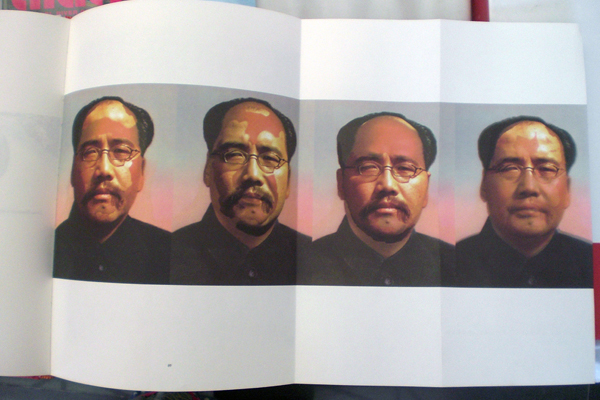
Zhao Shaoruo’s work, or, does solipsistic representation parody Mao’s cult of personality?
Visited the Wutongshan Culture Highland with friends, Jonathan and Gigi; resident artist director, Ryan Mitchell showed us the site. Of note, Zhao Shaoruo’s (赵少若) solipsistic exhibition in which he appears as every character in every painting and image. In addition to pieces in which he has substituted his face for Mao’s, Zhao has also produced work in the name of a variety of others, ranging traditional Chinese through Jews to insects. Telling, the only time that others appear in Zhao’s work, they do so as an extreme end of a continuum in which Zhao’s features are blended with his other.
Solipsists argue that the idea that only one’s own mind exists, that knowledge outside one’s own mind is unsure, or that only one’s own mind exists. Zhao’s relentless substituting his own face for those of others reminds us that extreme forms of solipsism are brutally pathological; I exist therefore you cannot. Continue reading
 Shenzhen Noted