architectural thinking — from the nanjing sun yat-sen memorial to luohu train station

One of the highlights of the XLarch Masterplanning the Future Conference was Wang Yun (王昀)’s keynote speech that periodized the development of Chinese style architecture, arguing for an internationalist approach to architecture, rather than an ideologically charged use of architectural symbols.

As an architectural style, Chinese classicism was invented by western trained architects who upon returning to Nationalist China received commissions to build “Chinese style (中华风格)” buildings during the decade of 1927-1937. These buildings had large, Chinese style roofs, windows and decorative details, and sometimes included stylized gardens. The Nationalist capital, Nanjing was the location of some of the most important examples of this style as well because commissions not only represented individual client preferences, but also the determination of government leaders to create a recognizable Chinese public architecture.

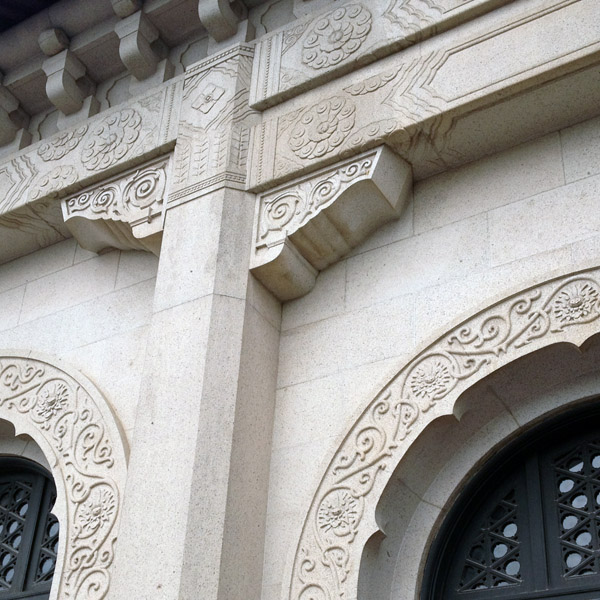
One of the most important examples of Chinese classicism is the Nanjing Sun Yat-sen Memorial, which was designed by one of China’s first starchitects, Lv Yanzhi (吕彦直). Lv also also designed the Guangzhou Sun Yat-Sen Memorial before his untimely death in 1929. The Nanjing Memorial reinterprets traditional themes through choice of material (reinforced concrete and mosaic tiles) and through the secularization of traditional symbols (animals become geometric shapes, for example). In addition, the Memorial layout abstracts and represents Nationalist China as the difficult realization of Dr. Sun Yat-sen’s three principles of the people (三民主义) — nationalism, democracy, and public welfare. To reach the Memorial proper, for example, there are 392 steps going upward, each step representing one million Chinese, and together representing the population of nationalist China. These steps are broken by eight flat platforms, which represent the fragmentation of China by warlords and civil war. However, when one looks back on the stairs, all one sees is a flat surface, an optical illusion that promises national unification.

The Nanjing Sun Yat-Sen Memorial provides a lexicon for understanding Chinese Classicism during the Nationalist era, including the reference to the Lincoln Memorial (1920) by way of the seated figure of Dr. Sun (1926-29). Not unsurprisingly, perhaps, the Lincoln statue also dominates a neo-classical building, albeit through references to Greek architecture. Indeed, both the Sun Yat-sen and Lincoln Memorials use the respective classicism of their countries to assert timeless governance, even as they commemorate leaders who governed countries divided by civil war.  I show the following images of the Nanjing Memorial with the caveat that they are not architectural — an architectural photo has amazing resolution, geometric composition, and absolutely no people, unless, of course, the figure contributes to architectural exegesis. My snaps, however, aim to emphasize just how popular this site is and thus how it continues to shape the visceral experience of being in “China” through a particular architectural style.

This slideshow requires JavaScript.

How does the Nanjing Memorial relate to Shenzhen?

This architectural lexicon has been picked up, tweaked and redeployed throughout Shenzhen, but as a private rather than public source of architectural symbols. The Luohu Train Station is the only exemplar of public Chinese Classicism that has been built in Shenzhen in the Reform Era. The other large example of post Reform classicism is the Hongfa Temple in Fairy Park, which is arguably political in its adamant denial of any political message. Certainly, in its assertion of the reintroduction of official religion to civic life, Fahong was as ideologically charged as the train station, which signaled China’s opening to capitalist countries. However, with the exception of these two buildings, Chinese Classicism in Shenzhen is limited to decoration in urban villages, where many handshakes have tiled roofs, restaurants, and the odd sculpture, such as Nvwa Holding up the Sky in Shekou, which is a socialist realist rendering of a mythic theme.

All this is interesting because given the explicit modernism of Shenzhen’s public architecture, the rediscovery or explicit use of Chinese tradition and roots are often used in neoliberal arguments for alternative forms of architecture and historic preservation. Chiwan comes to mind as do struggles for some form of preservation in urban villages. These efforts contextualize the design and construction of key civic architecture, including the Civic Center and central axis, which has the ideological expression of Reform and Opening (here, here, and here). Importantly, both the relentless modernization of Reform era public buildings and the alternative movement to construct a classical past for Shenzhen ignore Maoism, which nevertheless continues to inform the built environment.

tianmian celebrates 20 years of incorporation

Yesterday evening, Tianmian Industries Ltd (田面实业股份有限公司) celebrated 20 years of incorporation, simultaneously confirming the group’s new status as a corporation and the corporation’s status as the continuation of Tianmian Village. The celebration achieved this sense of historic continuity through the sequencing of socialist and traditional customs, including the presentation of and speeches by Tianmian, Fuhua Precinct, and Futian District leaders, which was followed by singing and dancing performances, a demonstration of Bruce Lee style kongfu by one of Bruce Lee’s students, and pencai, a local specialty that is only eaten at collective ceremonies. The speeches and performances took place on a stage in the vip area, while two large LED screens had been set up throughout the common area so that guests could watch the entertainment while eating.

Another important ceremonial function was to demarcate borders both within Tianmian and between Tianmian and outside communities. The 137-table event occupied  most of the main road into the village (directly off Shennan Road) as well as adjacent public areas, dividing Tianmian into two sections: the ceremony area and the rest of the neighborhood. Importantly, only Tianmian Ltd has the authority to cordon off public areas for private ceremonies. The ceremony area itself was subdivided into a vip area for leaders, their families and guests and a common area for Tianmian stockholders, their families and guests. Tianmian guards prevented non-guests from passing the red cordons.

Rituals such as these and the concomitant right to occupy public space are perhaps why we continue to speak of Tianmian Village as a village. In point of fact, we were celebrating the dissolution of Tianmian Village and its reconstitution as Tianmian Ltd. In ritual terms, however, the celebration clearly established Tianmian Village as the host and hegemonic subject of this territory and Tianmian Ltd as the contemporary manifestation of the village. What’s more, throughout the evening the gaze of outsiders — many of whom live in Tianmian housing stock — reinforced the sense of Tianmian as a vibrant and recognizable collectivity.

These rituals are particularly important in Tianmian because the corporation has not built traditional village buildings, such as an ancestral hall or a temple. In obvious contrast to Tianmian’s appropriation of public space, when larger village-corporations hold pencai ceremonies, they set their tables in designated village plazas that are surrounded by traditional buildings. In Xiasha, for example, the large village plaza includes an ancestral hall, a temple, a public theater, a traditional garden, and a path to the Xiasha Museum. Consequently, where Xiasha relies not only on ritual, but also on the built environment to reinforce communal solidarity, Tianmian’s village identity remains as such primarily through what is commonly called “non-material culture (非物质文化)”, or rituals.

It will be interesting to see, say in twenty or fifty years, how strong Tianmian’s sense of village solidarity remains and to compare that solidarity to that of a village like Xiasha, where the construction of village architecture sets the stage for village rituals. In other words, although Shenzhen has been seen as a laboratory for economic and social experimentation, we might specify further, and watch the ongoing reconstruction of traditional solidarities despite and within the maelstrom of modernization. Impressions from Tianmian’s 20th anniversary celebration, below.

This slideshow requires JavaScript.

masterplanning the future. or not.

I have an ambivalent relationship to academic conferences. On the one hand, I find them physically exhausting because structured to produce the largest amount of intellectual work in the most efficient way. Sadly, intellectual efficiency, like all forms of efficiency is a statistical concept that can only be represented through quantification. The success of an academic conference tends to be measured in numbers of participants, sessions, and published proceedings — measurements which effectively transform intellectuals into academic line workers and make conferences just another station in what might be described as toolpath control over knowledge production. Thus, I experience diminishing returns in a conference’s progression; early on, I am able to listen more actively and participate more fully simply because I’m rested and able to engage a diversity of theoretical positions and claims. In contrast, as the conference unfolds, I become physically tired and often find myself aware that my only contribution is the effort to engage a presenter’s work; I try to listen and understand.

On the other hand, I attend academic conferences because I yearn for intellectual conversations with people I do not meet in the general unfolding of my life. I have colleagues and friends in Shenzhen with whom I debate and discuss various issues. But in order to be inspired and challenged, or simply unsettled and honed, I need both the stability of familiar conversations and the jolt of unexpected encounters. Consequently, I continue to see old friends and opponents, while making new at conferences, which are by and large international and place me in proximity to scholars working both in and beyond Chinese borders. Thus, the conference format, especially when funded by academic and public institutions, offers opportunities to nurture and grow intellectually — precisely through intellectual companionship — both during and in the off time between stations sessions.

In other words, both the strengths and limits to Fordist knowledge production are relentlessly human; international conferences provide opportunities to be surprised and inspired outside the paths of everyday life, however, tired bodies can only do so much, even and especially when we are going through the privileged motions of academic conferencing.

On Oct 18-19, I had the pleasure of participating in the Masterplanning the Future Conference, which was organized and hosted by the Department of Architecture at the recently established Xi’an Jiaotong Liverpool University in the Suzhou Industrial Park. Organizers, Austin Williams and Theodoros Dounas’ attempted to address the inherent problems of academic conferences through a schedule, which started late enough in the morning and ended early enough in the evening to allow for conversations about and around the the question of high-speed development(s). Moreover, the conference structure attempted to open discussion to the widest possible audience, including a local audience for these ideas. On day one, for example, the public sessions raised general issues, their lay representations, and potential representatives, while on day two, the academic sessions provided more detailed analysis and examples of these issues. Finally, the conference itself was small enough to allow for participants to leave with a sense of the whole, satisfied that if someone were to ask me, “So, what was the conference about?” I could confidently answer, “English language efforts to come to terms with how China has shaped post Cold War thinking about and experience of urbanization. With a few divergences.”

That said, my interpretation of the point and purpose of the Conference differs importantly from the full title of the conference which was Masterplanning the Future: Modernism — East, West & Across the World. The aim to generalize at this scale meant that during sessions we inevitably stereotyped both ourselves and our interlocutors. All too often, the conversation reduced to statements that began with “The West this” or “China that”, rather than staying focused on more specific examples or standpoints that might allow for the negotiation of similarity and difference as shifting aspects of human experience, rather than as identifiable characteristics of mass populations. In this sense, the underlying assumptions of the academic sessions did not differ significantly from that of the public sessions, or even from a more general representation of China and The West at the university itself.

And there’s the rub: this tendency to stereotype distresses me not only because it seems intellectually dodgy, but also because it invariably reduces international relations and cross cultural understanding to semiotic match-making, in all senses of the term. Romancing the factory, so to speak. After all, the conference did take place in an industrial park, with an eye to global knowledge production and consumption.

Outside the XJTLU conference centered where we convened, for example, was a sculpture of a Tang lady and an English gentlemen playing polo (image below).

Both ride culturally appropriate horses and wear culturally appropriate costumes. Both the Tang Lady and English Gentlemen are stylized representations of a recognizable elite, which in turn represent English and Chinese cultures, while glossing internal hierarchy and inequality within the United Kingdom and People’s Republic of China; Tang Ladies and English Gentlemen may represent the current elite of each of these countries, but in no way do they represent the lives of contemporary workers. Moreover, while I’m willing to entertain the idea that contemporary Sino-British relations are simply a game played by elites from the PRC and UK, nevertheless, the gendering of this statue is itself so stereotypically neo-colonial that I don’t know where to begin my critique.

(But really, if we insist on representing international relations through figures of hetero-normative couples, might we not consider a male Chinese zither player and a female British mandolin player, aiming for musical harmony rather than competitive sportsmanship as a unifying metaphor of international intercourse?)

All this to say: I think that these stereotypical elites and their games continue to echo throughout cross cultural conversation because leisure is one of the predicates of meaningful conversation. Here I mean leisure in all senses of the word — as unstructured time, as non-productive time, as pleasurably engaged time and the resultant inspirations, solidarities, and new beginnings. We know that we need to play together in order to create more meaningful relationships and concomitant social orderings; children do it everyday and, unlike us adults, they do it well, creating community out of mud pies and whatever else is at hand. However, unless we restructure the inequalities built into contemporary chains of production and consumption, including cross cultural production and consumption of knowledge, we will remain nostalgic for forms of elite leisure that we cannot have experienced, even as we mistake this deluded nostalgia with the necessary realization of leisure in society.

Sigh.

2012 guangzhou triennial

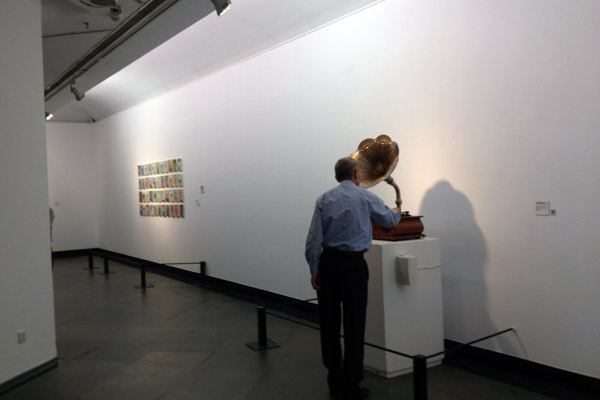
Yesterday, I visited The Unseen, the GZ Triennial exhibition and spent a pleasant 1/2 day engaging the works of 61 artists from China and the world, including Korea, Russia, India, and Indonesia, a diversity of representation much larger than the usual “global” expositions.

Curators JIANG Jiehong and Jonathan WATKINS have selected works in which what is seen directs the viewer’s attention to what is not. Sometimes the unseen referent is concrete, like the crank that twists a rope in XIAO Yu’s piece of twisting rope, Popularity 1. Sometimes the absent referent is more ephemeral, like the possible corpses buried beneath KAN Xuan’s Millet Mounds (大谷子堆). Sometimes, the unseen is a clever joke – Tim Johnson’s never seen flying saucers, for example. Nevertheless, as a viewer engages more works, the accumulation of unseen referents blurs the artificial division between concrete and ephemeral references, directing the viewer’s imagination instead to the illusive yet invisible worlds in which objects can come to signify relentless social pressure, cultural continuity, and comic book fantasy. So yes, it’s worth making the trip to the Guangdong Museum of Art (广州市二沙岛烟雨路38号广东美术馆) to see what else is there.

The Unseen will run until December 16. Impressions, below.

This slideshow requires JavaScript.

afternoon tea

Playing bridge at a late 80s teahouse in Shekou’s Sihai Park is a welcome alternative to hanging at a coffee chain or one of Shenzhen’s luxury teahouses, if for no other reason than because there is enough room between the tables to create a sense of privacy. For those interested in social history, however, the teahouse also provides visceral insight into how consumption standards have changed in Shenzhen. Nostalgic impressions, below:

This slideshow requires JavaScript.

time zoned urbanization

The walk from Central Walk Mall to the Civic Center by way of Central Park suggests the contradictory temporalities of Shenzhen speed, which was set when Guomao went up — one story every three days. Shenzhen Speed is time zoned urbanization, where architecture appears as a function of place X project-time subdivided by GDP expectations and the inevitable algorithm of actual buildings + entropy gains momentum in the absence of mindful inhabitation. Impressions from yesterday’s walk:

This slideshow requires JavaScript.

coastal walk, anchorage

This slideshow requires JavaScript.

spiderwebs

This slideshow requires JavaScript.

day tripping: deception pass

This slideshow requires JavaScript.

seattle color

This slideshow requires JavaScript.