mapping the southern block, hubei old village

Students of Hong Kong artist, Momo Leung Meiping created a series of interventions in Old Hubei Village. Projects included making pillows out of old clothing, poetry painted onto the walls, a balloon release, an exhibition of portraits, planters made out of old bricks, and a map of the area with renamed streets. We followed their tracks and discovered the joy public art can bring.

This slideshow requires JavaScript.

on shenzhen speed

When I’m free associating about the dovetail between addictions to pharmaceutical and economic speed, the problems of capitalism make uncanny sense.

Deng Xiaoping first used the term “Shenzhen Speed” during his 1984 tour to describe the construction of Shenzhen University, where students designed and built their own campus. During his second tour in 1992, Deng was taken to the revolving restaurant at the top of the the International Trade Building (国贸大厦), which went up one floor every three days. Just recently, the KK 100 Plaza broke that record, going up one floor every two days.

Today, most Shenzhen workers and leaders, in both the public and private sectors need to produce “results” at Shenzhen Speed. In addition to construction times, for example, students are expected to learn more Chinese characters in less time than students in other cities; workers are expected to fill orders as quickly as possibly; and leaders are expected to continue to grow the economy faster than other cities both in China and abroad.

All this speed, of course, is about competative advantage. If a student knows more characters than another, she gets a higher grade and more social status. If workers fill orders faster than in other companies, they get more orders and earn more money for their company. If leaders grow the economy, they get promoted from sub-provincial positions (like mayor) to provincial positions (like minister of transportation, Guangdong Government). And yes, all that social status feels good and is precisely why we push ourselves into the future — we win. If we learn more faster, we become valedictorian. If we make more faster, we get on the Forbes 500 honor roll of largest companies. If we grow the largest economy, we can start interferring in the economies of neighboring countries to our own benefit.

Shenzhen residents are justifiably proud of all they have accomplished in just over thirty years. The Municipality has become not only one of the most important cities in China, but also changed how the developing world thinks about development and how the developed world thinks about China. Sometimes, however, when I think about Shenzhen speed, my mind wanders off the question of rising gross domestic product (GDP) free associates to questions of drug addition and how good a rush can feel, even as it fries our brain.

Speed is the street name of
amphetamine, a psychostimulant drug that produces increased wakefulness and focus in association with decreased fatigue and appetite, which is to say amphetamine makes us feel more awake, happy, and sexy, without giving us the munchies. We feel like we’re moving. Fast. It turns out that Methamphetamine or ice or crystal meth is basically amphetamine squared, which is to say that meth does everything that amphetamine does and then metabolizes into amphetamine and so the body gets to go through the whole process again. Faster and faster and faster and faster. And moving fast can be fun.

One of the earliest uses of methamphetamine was to keep soldiers awake and fighting during WWII. In fact, it went under the names Pilot’s chocolate and tankers’ chocolate. After WW II, Japanese companies used meth to keep workers awake, while the United States and Western European countries imported methaphetamine to treat narcolepsy, Parkinsons, alcoholism, depression, and obesity. Methamphetamine was also marketed for sinus inflammation or for non-medicinal purposes as “pep pills” — and there’s the connection between pharmaceutical and economic speed. “Speeding up” feels good and enables us to achieve what we otherwise couldn’t. Indeed, students and workers take amphetamines to gain momentary competative advantage, while leaders constantly stimulate the economy.

Downside to amphetamine? It’s highly addictive and if we keep taking amphetamine we experience delusions and paranoia that are indistinguishable from a schizophrenic psychotic episodes. The crash and burn that comes from amphetamine abuse happens faster on meth. Unfortunately, the downsides of meth and regular amphetamine addiction can also metaphorically describe the downsides of cram schools, forced overtime, and urban planning that emphasizes real estate development rather than social wellbeing. Students are worried about getting good grades, workers are deluded into thinking that overtime will get them out of debt, and our leaders are paranoid about the aims and intentions of neighboring countries. Meanwhile, environmental deterioration continues accelerate.

Thought du jour: to the extent that profit under global capitalism is a function of time, we are all on speed. Moreover, that rush is about ranking and inequality and ultimately about how we define membership in world organizations. If nothing else, Shenzhen Speed set the pace for development in the Post Cold War order and it would behoove us to think about whose pushing the drug and why.

more on smog

Previously, sections of the Municipality had reported dangerous levels of carbon diaoxide, but on April 15, 2013 and for the first time in its history, Shenzhen recorded dangerous levels of air pollution in every part of the city.

Shenzhen is not alone in its unhealthy rush to a narrowly defined standard of wealth. Indeed, concern in Shenzhen follows upon the outrageous levels of pollution that were reported in Beijing. But as David Roberts reminds us, this level of pollution is just one example of a worldwide trend:

The Economics of Ecosystems and Biodiversity (TEEB) program sponsored by United Nations Environmental Program asked environmental consultancy, Trucost to tally up the total “unpriced natural capital” consumed by the world’s top industrial sectors. (“Natural capital” refers to ecological materials and services like, say, clean water or a stable atmosphere; “unpriced” means that businesses don’t pay to consume them.) …The biggest single environmental cost? Greenhouse gases from coal burning in China. The fifth biggest? Greenhouse gases from coal burning in North America.

Moreover, our respective industrial sectors thrive on coal:

unep-top-five-industrial-sectors-by-environmental-impactsjpg

I feel like I parrot myself at every opportunity: the United States and China are the same country. Really. The similarities are of kind, while our differences are merely of scale. And so the question remains: how do we fix shared problems, rather than getting settling for the politics of blame?

click this

The internet confuses us into thinking that everything we need to know can be found in one place, such as the Shenzhen Life Net (深圳生活王), where all sorts of information and experiences are just a click away. Questions about public welfare? Click 社保. Want to watch whatever is currently being broadcast on Shenzhen’s television 16 television channels? Click 电视. You can also find out about traffic conditions, confirm important dates on the lunar calendar almanac, and figure out how much tax you owe: click, click, and click!

In fact, Shenzhen’s ongoing efforts to modernize by becoming one of the most inter-connected cities on the planet continue to fill virtual space with all sorts of information. The government is online. The library is online. The museum is online. And the historical archives are online. Moreover, Tencent, one of the key Chinese companies inter-connecting us through qq and we chat is a Shenzhen company.

At the same time that Shenzhen builds its virtual world, China’s great firewall continues to make it difficult to click to the New York Times, or Facebook, or Youtube without a tunnel. Ineed, just the other day, China banned its media from quoting foreign news articles without permission. In this sense, Shenzhen’s vast internet culture is itself the form of a pervasive inequality and the ideological expression of this inequality. The point as Global Voices co-founder and author of Consent of the Networked, Rebecca McKinnon has argued:

A substantial body of previous work has been produced over the past two decades on human rights risks in sectors such as extractives or labor services. Much less work has been done on business and human rights in the ICT sector – particularly on free expression and privacy rights. The novelty of the technology requires a translation exercise of existing human rights principles, policy, and law to ICT platforms and services.

In practical terms, however, surfing the internet often seems less about human connection and building more just worlds (as in the human writes discussion) as it does a question of our tendency to mental addictions. On the bus and subway, in meetings and movie theaters, we click, click, click through life. There is a compelling distraction to click culture. At times, I find myself simply clicking to visit sites that I have just left. I click away not because I think I may discover another post, but because the repetive action distracts me from the fact that all I’m doing is procastinating. I have have found myself fascinated by the number of visitors and clicks that Noted receives; confirmation that I have an audience. So pernicious is my click addiction that sometimes I even confuse the number of clicks with the value of my research.

I also am wondering how much of my online dependency is an expression of other forms of alienation in everyday life. My friends, for example, work long hours across town. It is difficult to arrange time together simply to hang out and chat without internet access. Likewise, the extent of urbanization in Shenzhen means that I can’t simply walk outside and enjoy fresh air and mountains. Instead, I have to navigate a six-lane road to jump on a bus, which then trundles off toward a central hub. In other words, I’m not sure how much of my online life is an attempt to heal virtually problems that can only be solved through realworld communities and life changes.

So today, I’m thinking about questions of scale and what manageable communities might look like, on the ground, here in Shenzhen, where popoulation density is over 5,500 per square kilometer and we still haven’t figured out how to plan and manage integrated communities.

life is elsewhere

These past few days back in Shenzhen, I have had several conversations about the fact that so many Chinese families are sending their children abroad to study. Moreover, since the point is to get the children out of China, the consensus seems to be, the sooner the children leave, the better and so more and more families are sending their only children to boarding schools.

The reasons are many — better education, better job opportunities, better environment, healthier food, more access to information — but all boil down to the perception that life is better in the United States than it is in China. This is also a sentiment I’ve heard from thoughtful American friends, who are frustrated by the lack of public accountability and trust in public projects (mostly overbuilding for profit) in both Shenzhen and the interior.

By sending their children abroad, friends and colleagues make a clear statement about their confidence in Shenzhen’s future. The situation has me wondering whether or not it is wise to remain in China. What’s more, these doubts seem more pervasive than previously. Cetainly it’s ironic that just as Shenzhen seems to have made the international headlines, the elite — both economic and academic — are opting out of the Shenzhen dream.

cold war ghosts in shenkong

For those inquiring minds that wonder, what was Shenzhen before it was Shenzhen, the opening scene from the 1963 classic Tracking Threats (跟踪追) reveals a threatened border and enemies whose souls have been twisted through betrayal. After the credits, the film opens with a scene of soldiers guarding the border and the Luohu bridge opening to allow peasants (and a spy) enter the country. From the filming, it is difficult to see immediately who the heroes and villains are. Instead, we find ourselves faced with a narrative tradition that begins with a social situation which the narrative gradually analyzes.

At the border, the guard opens an old woman’s bag, in which he finds a carton of cigarettes and candies. Suspicious, he opens the carton and discovers gunpowder hidden inside. Similarly, the candies also turn out to be decoys. The old woman protests that she’s never seen these items before. Her story is confirmed when another guard discovers an unclaimed bag, which includes toy cars that have been used to smuggle gunpowder

The security officer, Li Minggang leads a team to discover what’s happening. They follow the clues to the toy factory, where old Lin Dexiang works loyally. It turns out his nephew, Lin Yonggui was the spy who replaced the goods in the old woman’s bag. Li Minggang turns Lin Yonggui, who is used as a double agent to uncover the net of spies. This network includes refugees who try to escape to Hong Kong, smugglers of commercial goods, and of course, the evil chief spy, Xu Ying.

Tracking Threats was one of a series of movies that reflected the militarization of the Sino-British border during the 1950s. Indeed, between 1956 through 1958, the Guangzhou Security Department cracked several cases of Taiwanese incursions into Guangdong, and also discovered weapon stockpiles. During the 1960s, the Pearl River Delta Studio produced a series of red spy movies. The earliest, Secret Map (秘密图纸,1960) also filmed at the Shenzhen-Hong Kong border, but did not actually name the border crossing.

In retrospect, the Shenzhen-Hong Kong border in Tracking Threats seems claustrophobic and artificially patriotic à la contemporary North Korea. There is heroic music. There are poor but honest peasants. The military is distinctly noble. However, we know that by the mid 60s, China had already suffered famine and that Hong Kong had begun its economic reconstruction. Thus, during production filmmakers were not allowed to film the Hong Kong side of the border. Moreover, several peasants tried to take advantage of the filming and cross the border. They were, however, caught.

And yet. In Tracking Threats, the ideal of patriotism as a source of ethical thinking appears as pure and noble and good and far, far away from where we find ourselves in the post Cold War world.

In 2009, the earliest of the 1960s spy films, Secret Map was remade into a 30 episode television series (秘密图纸). Unlike the original movie, the television series opens with the spy murdering his godfather, who is portrayed as a Japanified elderly gentleman. The historic link, of course, was the Japanese colonization of Taiwan. In this way, the television series Secret Maps recodes race betrayals of Tracking Threats  as a question of generational betrayals (the godfather raising his godson to hate the Communists). In scene two, the spy, now a sympathetic anti-hero, washes up on the Shenzhen coast, where he is immediately captured by a beautiful revolutionary, a gaggle of peasants, and a noble peasant-soldier.

And there’s the interesting neoliberal rub: in the transition from 1960s Guangdong to new millennium Shenzhen, the Mainland-Taiwan conflict has been recoded as a story of misplaced love, rather than misplaced patriotism, while the desire for forbidden consumer goods has been naturalized. Indeed, that naturalization is precisely what makes the anti-hero sympathetic; he may have loved wrongly, but he knew what the fight was about. However, as in any good neoliberal bromance, love conquers all just before the anti-hero dies.

gentle reminder from the folks at tencent

Like many population questions in China, the actual population of We Chat users is guestimated but unconfirmed. According to its app page, We Chat boasts over 300 million users or the population of the United States and growing. In news reports, the population has been posted at 200 million users.

Throughout this trip to the US, I have maintained my links with Shenzhen friends via We Chat. This makes me one of a fast growing — what? — group? Community? Chinese speaking chatty Kathies? If it were a country, the We Chat app population would be the 6th most populous country in the world (population clock). The app would have 2/3 the population of the United States, 1/6 the population of India, and 1/7 the population of China. And here’s the rub: the We Chat population is mediated by one company in Shenzhen.

All this information came to a head because yesterday the We Chat Product Team at Tencent gently reminded me and over  that:

Recently, the message that “We Chat will charge its users” has circulated on weibo. This is malicious gossip. We ask everyone not to believe these rumors. The We Chat Product Team states that it will not charge users, more we are currently developing new functions, hoping that We Chat will be more user-friendly and more fun.

近期在微博上流传的“微信要对用户收费”,纯属有人恶意造谣,请大家不要相信谣言。微信产品团队表示,微信绝不会对用户收费,并称正在开发下一版本的新功能,希望可以让微信更好用,也更好玩。

The team sent the message to me via the We Chat app. I also receive news casts via We Chat. Each message includes a main article with a large image, and three small articles with a thumbnail. Headlines du moment are:

  1. A Bali Plane with 101 passengers sinks into the sea;
  2. Xi Jinping will see American Secretary of State, John Kerry, the Americans call the North Korean question the key issue;
  3. The husband of a Shanghai woman with Avian flu catches it, however its still not clear if people can transmit the disease to each other;
  4. Geng Yanbo was selected Mayor of Taiyuan City, Shandong, he was once known unofficially as “the Mayor who builds cities”.

Now We Chat has a smaller population than Microsoftlandia, which has boasted 750 million users worldwide. However, unlike Mircrosoft, We Chat as actual access to every user through their phones. Mine chimes and I know I have received a message. Moreover, this app is being used to feed me information and news. Thus, today, I’m wondering what it means that (a) I received this message while traveling in the States — indeed, these few weeks We Chat has my primary form of communication with Chinese friends, and (b) given the number of users, the message is itself news — in other words, We Chat has a “private” line to its 300 million users that sidesteps Government oversight.

轮侯制: economizing moralities

In the United States, we make an economic distinction between “needs” and “wants”. We teach children (here, here, and here, for example) to recognize and manage the difference between their needs and wants. Subsequently, we re-code these management skills in terms of individual ethics — good people recognize their needs and wants, and then make rational choices to live within their means. In contrast, bad people make irrational choices based on uncontrolled desires that lead to debt and bankruptcy.

e9ec64bb5bcb

The flip response — “one girl’s need is an aging man’s want” — to this statement merely confirms the underlying double bind of this economizing morality. In this financial literacy exercise, for example, only the social facts of suburban car culture, supermarkets, and fast food restaurants conspire to make white bread, bottled water, and a tent vacation “needs” in contrast to the “wants” of a bicycle and a pizza. What if our built environment depended on bikes for transportation? What if we were homeless and the best we could cobble together was a tent made of discarded plastic and corrugated steel? In these situations, the economizing morality is to recalibrate our personal needs and wants rather than to challenge the inequality that poses this choice as reflecting real world conditions.

All this to say: the economizing morality of individual needs and wants is the elementary school version of neoliberal ethics.

I’m thinking about individual needs and wants and neoliberal immorality for two interrelated reasons. At the level of urban planning, given the prime location of urban villages and the lack of developable plats in Shenzhen, the villages were targeted for redevelopment (or renovation — 更新 as a verb). In turn, the need for neighborhoods for the working poor has been recoded as the need for individuals with Shenzhen hukou to find affordable housing. A shift of hand, and the debate ceases to be about communities and becomes one of individual economies. Moreover, convenience, access to schools and social infrastructure, as well as economic opportunities are concomitantly transvalued as wants to be satisfied through economizing.

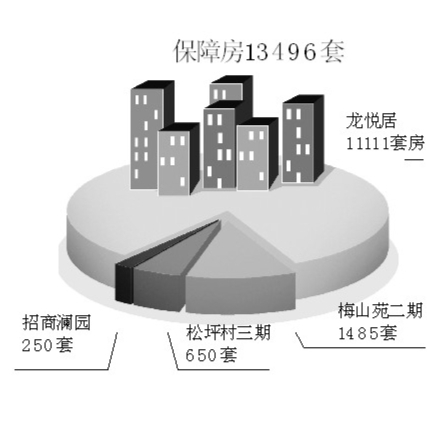
res01_attpic_briefOn January 31, 2013 for example, the Municipality made available 13,496 units of public housing. Of that total, all are located in the outer districts (guanwai) and the majority (11,111) are located in Longgang, roughly 35 kms from the city center. To allocate these units, Shenzhen will be testing what is known as the 轮侯制 or “revolving wait system”. Basically, this system entails meeting conditions, including hukou status, time in Shenzhen, and maximum income to apply for a residence. When any of these conditions change, the family has to move out of the unit, thus opening it for another. The family also has to find another place to live.

In Shenzhen, those opposed to urban renovation projects have been reminding the Municipality out that urban villages like Baishizhou already provide low-cost housing and small scale economic opportunities for working poor families. Moreover, the given the Municipality’s demographics 13,496 housing units are sufficient to absorb displaced populations only when those with hukou may apply. Point du jour: locating public housing far from urban centers only makes moral sense (cents!) in a world in which individual economizing ideologically justifies disrupting neighborhoods for the working poor in order to pave the way for developers. And yes, this is just more evidence that China and the United States really are the same country.

situated knowledge, strategic investments, and avian flu [again]

More evidence that China and the United States really are the same country; my husband wants to invest in the US, while my father wants to invest in China because [drum roll, please] both believe that the local economy may be alright for short-term investments, but long-term it would be best to have one’s money elsewhere. My Chinese husband sees stability in the US. My US American father sees potential in China’s emerging market; neither sees their country strong and vibrant and leading the international pack twenty years down the road. That said, when I noted that my husband wasn’t confident about keeping money in China, my father suggested that perhaps I should consider moving my money to India.

On the face of it, my father and my husband have different approaches to life. When playing cards, for example, my father tends to play the odds, while my husband tests his luck. When reading, my father enjoys detective novels, while my husband appreciates literary experimentation. When keeping fit, my father keeps a strict schedule, while my husband takes the occasional stroll after dinner. My father is a stock broker; my husband is a playwright. Here’s the thing, though. Both men are savvy, concerned and engaged citizens.  And this past week, both have looked out their respective windows (in small town North Carolina and boomtown Shenzhen) only to see chaos and insecurity.

In my parents’ hometown, I was warned about certain parts of town — in a suburb near Ft. Bragg, home to the Airborne and Special Operations Forces. So it seems, we’re not only flaying about with misguided visions of keeping peace through military means, but also in need of peace keeping at home.  Visiting friends in Georgia, I was informed that it was easy to order common rape drugs (GHB, rohypnol and ketamine) online, while teen alcohol abuse has become even more prevalent than it was when I could drive to the lake and party with high school friends. Indeed, I had a disturbing that was then moment just yesterday. I watched Julie Brown’s “Homecoming Queen’s Got a Gun” video. In 1984, when the song came out, I found it a funny parody; thirty years later it seems  both macabre and cruel to profit from the violence in our schools. My mother succinctly summed up the situation with the comment, “I’m happy to be an old hen because today’s chicks have it tough.”

Meanwhile, back in China, avian flu has reappeared in the unsettling wake of pig and bird die-offs. Xi Jinping and Li Keqiang have made such a fanfare of calling for prompt and effective response that the opposite has happened: many are worried precisely because they don’t trust the government. Indeed, navigating Chinese news reports seems almost like navigating around icebergs. There is a sense that the Center only ever shows “10%”of the danger. Consequently, when high-ranking leaders express concern, savvy netizens see flashing warning lights: Xi Jinping has asked vice premier Liu Yanzhong (刘延东) to take charge of this latest public health campaign戴旭 has weibo-ed that too much coverage will cause panic and help the US propaganda machine, and; my husband has warned me — take precautions when returning to China and, if necessary, delay your trip until we have more reliable information.

And at that moment, I realized just how similar US American and Chinese citizens have become in our belief that the insecurity is escalating. Moreover, trepidation has become common sense. In the States, we’re hunkering down because partying leads to rape and schools have become kill zones. In China, we’re hunkering down because eating causes illness and political privilege excuses murder. Sigh du jour: how safe can Indian investments be if they’re also writing off inequality, violence, and eco-cide as the cost of doing business?

laying siege to the villages: baishizhou

A FIVE-PART ESSAY, “LAYING SIEGE TO THE VILLAGES” HAS BEEN PUBLISHED ONLINE AT OPEN DEMOCRACY. HERE’S PART FIVE, WHICH DISCUSSES INFORMAL URBANIZATION AND THE CREATION OF NEIGHBORHOODS FOR AND BY THE WORKING POOR.

5. Baishizhou: Neighborhoods for the Working Poor

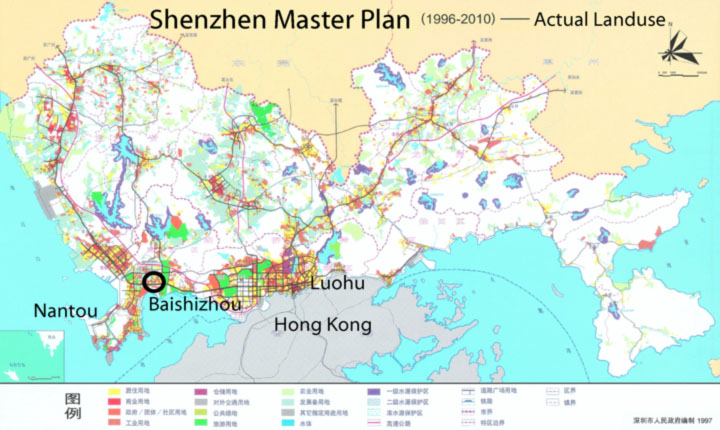
As of 2013, Baishizhou was the largest of the so-called urban villages in Shenzhen’s inner districts. With respect to the overall layout of Shenzhen, Baishizhou occupied both the southern and northern sides of Shennan Middle Road, at peripheries of both Luohu (moving west) and the Nantou Peninsula (moving north), making it one of the most centrally located transit centers in the inner districts (map 8). As of 2013, Baishizhou had a total area of 7.4 km2 and an estimated population of 140,000 residents, of whom roughly 20,000 held Shenzhen hukou and 1,880 were locals. The population density of Baishizhou had breached 18,900 people per square kilometer, more twice that of municipal average of 7,500 people per square kilometer, a statistic which in 2012 had made Shenzhen the fifth most densely populated city on the planet. There were 2,340 low and mid-rise buildings in the area, with an estimated 35,000 units. Monthly rents ranged from 700 to 3,000 rmb, which were significantly cheaper than in neighboring Overseas Chinese Town (OCT) or nearby housing estates, where a “cheap” apartment could rent for 4,000 rmb.

master plan

Map 8: Location of Baishizhou, 1996 Master Plan

Many of the garbage collectors for the area live in the cheapest rentals, rural Mao-era dormitories where it is possible for three workers to share a 30 m2 dorm room for 200 rmb a head, plus electricity and water. Old Cai, for example, was 65 years old, when interviewed. He came to Shenzhen after retirement because his monthly pension is 40 rmb per month, but he and his wife need 20,000 rmb annually, or about 1,700 a month to meet their expenses. In Baishizhou, he makes a living collecting and reselling cardboard boxes and other garbage. He says he can save money this way because although there’s no real profit, he makes enough to support himself and to bring a little home for Chinese New Year. However, the diversity of Baishizhou residents also includes working families who have lived in the area since migrating to Shenzhen over twenty years ago and young professionals who are sharing their first flat independent of their families. One family from Sichuan, for example, rents a 60 m2 two bedroom apartment for 1,700 rmb a month, which the husband, his wife, her mother-in-law, and their two children share. During the day, the parents work at one of the OCT themeparks, while the mother-in-law takes care of the children and housework. In addition, many of Shenzhen’s young designers and architects who work in the OCT Loft, a renovated factory area for creative industry live in higher-end handshake buildings, which sometimes include parking space for a car.

In addition to rental properties, the first floor of most Baishizhou buildings was used for commercial purposes and the area boasted several commercial streets, at least two night markets and entertainment areas, in addition to independent vendors and office space for independent carpenters, builders, and handymen. There was an elementary school and several nursery schools. Moreover, in between two of the abandoned factories of the Shahe Industrial Park enterprising migrants have set up the Baishizhou Pedestrian Street, which mimics the Dongmen Walking Street. There are food stalls and toy vendors, and several juvenile rides.

Clearly, using the term “village” to describe this level of settlement density and diversity is misleading – Baishizhou is a vibrant urban area composed of five neighborhoods – Baishizhou, Shangbaishi, Xiabaishi, Xintang and Tangtou, which under Mao had been organized into a state-owned agricultural collective, Shahe Farm. In the early 1980s, 12.5 km2 area of the Shahe Farm was partitioned into two enterprise areas – Overseas Chinese Town in the eastern section and Shahe Enterprises in the western section. In the mid-1980s, both OCT and Shahe built factories for assembly manufacturing. However, the management teams and access to investment capital were significantly different. OCT was a state-owned enterprise and its management team educated professionals from China’s major cities. In contrast, the former collective leaders managed Shahe and its development. In the post Tian’anmen era when Shenzhen’s low-tech low cost manufacturing had ceased to be as profitable as during the 1980s, OCT developed themeparks – Splendid China, Window of the World, and Happy Valley – to stimulate the economy. In turn, this investment also enhanced the rental value of the area and drove the redevelopment of the former industrial park into a Soho like creative area.