gentrification with shenzhen characteristics

So hukou remains an ongoing problem. According to Dec 2012 Sanitation Bureau statistics, Shenzhen has a long term resident population of over 10 million and resident (hukou) population of 3.05 million. In order to bring some balance to the demographic, a 2014 regulation has dropped the education requirement from college graduate to associate’s degree. Apparently, they’ve also simplified the process.

The measures come about as both the rates of population growth AND turnover has slowed. It used to be that every Chinese New Year millions left, while after New Year a different batch of more millions returned. Now more and more temporary residents are making Shenzhen their primary home. These new migrants are different from earlier migrants in that they tend to be better educated, and have come to participate in Shenzhen’s new core industries–finance, logistics, culture, and high-tech, as well as the city’s strategic industries–bio-tech, internet, and alternative energy. So they are settling in and raising families without hukou.

In addition, the City’s second generation is starting to participate in Shenzhen society, and many are not actually legal residents. Along with new migrants, they are giving birth to the City’s third generation. In fact, there are so many children in the SEZ, the ongoing Shenzhen baby boom has become something of a marketing niche, despite the fact that young parents must return to their legal residence in order to receive subsidized neonatal care. In fact, Shenzhen has the highest birth rate in the country. The biggest economic beneficiaries of the boom are owners of homes with seats (学位) in the top schools. And real estate websites happily speculate (all puns intended) on the price of those houses over the next decade.

Inquiring minds want to know–what about the illegal floating population? And this is one of the interesting aspects of Shenzhen’s shifting demographic. As factory jobs have been moved elsewhere, we see a corresponding social restructuring–more white collar technocrats, fewer blue collar workers. At the same time, the City seems willing to formally claim these new migrants, even as requirements continue to exclude manual laborers, sanitation workers, and other low-end migrants from transferring their hukou to Shenzhen. Importantly, the social eugenics of this process dovetail with and reinforce the gentrification that the demolition of centrally located urban villages has brought about (Laying Siege to the Villages).

Dongguan is passing similar laws to manage its disproportionately large floating population, and one assumes its highly visible sex industry.

next to go: huanggang

The plans for renovating Huanggang have been released–just in case you were wondering, “How quickly can Shenzhen remake itself in its own ever shifting image?” That said, Tianmian has also evicted the design companies and is gearing up to raze and renovate its former industrial park. In fact some areas of the city–looking at you OCT–are preparing the fourth generation of urban plan. Below, the maps and images of Huanggang 3.0, urbanized villages vanishing except as real estate companies.

This slideshow requires JavaScript.

books and aftershocks

In the aftermath of Kunming, the military armed and in groups of three can be seen at the odd subway station. The machine guns and bullet proof vests are disconcerting and, given the extreme lack of news, feel like overcompensation. If the situation really is this fraught, why haven’t we heard anything? And if it’s not, why the anti-terrorist performance?

In less distressing news, I finally got a copy of 深圳记忆 (Shenzhen Memory) by Nan Zhaoxu (南兆旭). It is an archive of Shenzhen pictures and stories from Liberation to the present. It’s organized by theme, such as “love” and then offers a selection of materials that highlight the vast transformation that has occurred. Under “love”, for example, Nan Zhaoxu has filed a 1954 article from the Bao’an Daily on the topic “How to find a spouse”. In contrast, in 2006 the Shenzhen Women’s Federation confirmed that Shenzhen had the highest number of divorces in the country.

I also snagged a copy of 深圳拓荒人 (Shenzhen Pioneers), which tells the story of the engineering corps that put in most of the City’s basic infrastructure. This history interests for many reasons, but also because I hadn’t realized that when the 20,000 odd strong brigades of engineering soldiers came in, the doubled the population in the Luohu area. Interesting way to think of demilitarizing the border by having soldiers dig trenches for civilian use. In this sense, the book also introduces the companies that arose out of the restructured military, including the rise of Huawei and it’s links to this transformation.

fuhua south road

Impressions of a walk along Fuhua South Road. This is one of the oldest areas in the city. Of note, the street is busy and vibrant and runs parallel to Shennan Road, which is wide and long and filled with vehicular traffic, but few pedestrians.

This slideshow requires JavaScript.

baishizhou officially slated for renewal

Yesterday, the Shenzhen Government online portal announced that Baishizhou is on the list of areas designated for urban renewal.

The plan to renew “the five Shahe villages” was submitted by the Shenzhen Baishizhou Investment Company Ltd. It calls for razing 459,000 square meters of built area. The area has been zoned for residential and commerce, with at least 135,857 square meters of public space.

Baishizhou is one of 18 projects announced. All plans take place at the street level, and all target communities and/or early industrial areas. All emphasize the planned public area, but do not mention plans for evicted residents or scheduled construction.

Of note, the urban renewal announcements were tucked away in the Bureau of Land, but the announcement of Shenzhen’s plans for its first village preservation project, Shayu (沙鱼涌古村保护项目) made the front page.

model minority with chinese characteristics

As China recovers from what General Secretary Xi Jinping has called a terrorist attack in Kunming, just a note on the weixin posts that have been forwarded within my circle. Much fear of Muslims and people from Xinjiang, even as stories of happy Tibetans also circulate. The discourse is distressing not only for its stereotypes, but also for its identification of China with Han people. There is no place for China’s ethnic minorities within the Han nation, but there is no place outside either. The have been included in the state so as to be more effectively excluded from the nation. Sigh.

garden city

Spring in Shenzhen brings memories of dustier grasses and bluer skies. 18 years ago, I lived next to a construction site, and the low cost local ornamentals and creepers flourished in moderation. We breathed construction dust and navigated street floods (or “accumulated water” as I have learned to say in Mandarin). But the skies, if organic and digitalized memory serve, we’re blue and vast and clear.

Yesterday I ate brunch on the Intercontinental patio and had an afternoon tea-becomes-dinner meeting at 1 Haiguan Rd. Once upon a developmental time, both were located near Shenzhen Bay. When built in 1982, the Intercontinental perched near coastal oyster beds and provided visitors and investors in the OCT and Shahe Industrial Parks with simple accommodations. That same year, there was no restaurant at the top of “Microwave Hill” as the site of 1 Haiguan Rd is known. Instead, it was the site of the first local (difang) broadcast tower in post Mao China. The tower broke through tree cover to send and receive signals from Hong Kong, which was just across the water. It symbolized a new communication independence from Beijing, but not too much independence; the simple two-story border guard tower still stands.

The original Intercontinental has been razed and in its place a 5-star Spaish-themed hotel stands. Outside is a galleon, while inside the male staff wear bull fighter costumes and the restaurant hostesses sashay in modified flamenco dresses. The patio area has imported flora, a black marble pool with multi-color goldfish, and a break in the lush green buffer that opens to a virtual beach area. The coastline, of course, is now pushed back, placed on the southern edge of the Binhe Expressway and the narrow Shenzhen Bay Park, which stretches along the reconstituted coastline. 1 Haiguan Rd is the physical realization of another chapter in the same history, albeit land reclamation-in-progress to accommodate a larger port area and a yacht marina. The interior of the border tower has been fitted with stage lights that create the nostalgic centerpiece of an elaborate and fragrant garden.

I enjoyed both outings. I was with generous and creative friends, with whom I often collaborate. All have helped with 302, and all are interested in contributing to the cultural life of the city. Moreover, they are truly willing to share what they have. It is a joy to be with them.

And yet.

Our friend dropped us off at our late 80s compound of boxy concrete low rises, crumbling compound floor, local plants, and ordinary pavilion with tacky pseudo-imperial glazed tiles. The combined cost of yesterday’s two meals was more than my monthly rent. Sometimes, my increasing sense of distance from ever-growing areas of the city provokes anxiety. Sometimes it hooks into my sadness about the forms of social segregation that are being built into the city. Last night, the contrast made me nostalgic for a dustier, more industrial Shenzhen, when large tracts of undeveloped land were still accessible for exploration and amenable to common dreams.

Photos taken at 1 Haiguan Rd, where the changing Shekou coastline is visible from the third floor gardens.

This slideshow requires JavaScript.

shekou relaunch

So the Biennale has been extended two weeks. Good news and great press for the curators, the SZ Center for Design, and China Merchants. And that–generating a Shekou Buzz–has been the point of all this productivity, or as the current campaign is called “Shekou Relaunch”.

This afternoon, I attended one of the final scheduled events, a forum on how to renovate the Dacheng Flour Mill, which has been designated the site of the future Shekou a Industrial Culture Center. The program included repurposing the buildings and designing more public space, a visual culture center, a theater, and an office building. The responses hinged on determining the purpose of the renovated buildings; just what does China Merchants hope to accomplish through these renovations? Just what is being launched again? And why?

Indeed, there is both something primal about the campaign; we are setting off, again (再出发), and yet something equally unsettling; again? How many times do we need to remake society? Or is it just the persistent dissatisfaction of capitalism and vague anxiety that we may never get it right?

I actually believe that creative activity makes people happy, but not redundant assembly line production. I have experienced happiness in creative activity that nourishes my connections with others. I am particularly enjoying 302 because it brings together research interests, social commitments and friendships. I also really, really like working with my hands. This seems to me the goal of social transformation; improving the quality of life of family, friends and neighbors, and not just achieving higher economic indicators.

Today, I’m thinking that to the extent that traditional socialist industrial culture aimed to improve the lives of worker, it offers inspiration for possible renovations and building. However, without a discussion about what’s being relaunched and why, another round of pretty and smart and interesting construction seems to me to be beside the point.

weixin etiquette

Who knew? It’s possible to not view someone’s general weixin posts and to block them from seeing your posts. This way one can accept friend requests, engage in one-to-one texts, and keep a definite distance. This discovery led to a discussion of all the kindly people who are spending too much time forwarding “must reads” and cluttering up virtual space. The conclusion? Don’t become one of those people who get passively blocked by limiting the number of cat photos you upload.

baishizhou: intervention and experience

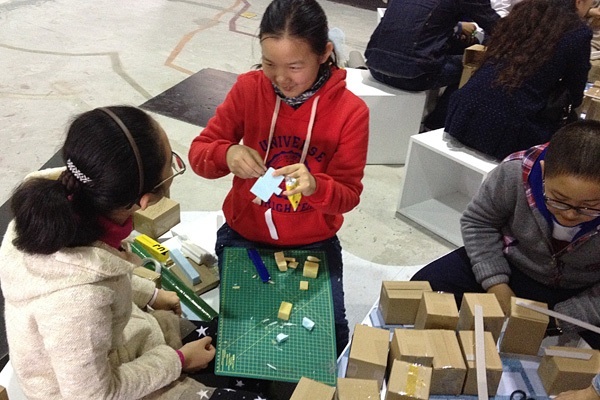
This weekend (Feb 22-23), two events organized for Shenzhen children focused on Baishizhou. On Saturday, ATU/观筑 held a “Young Architects” program in Venue B of the Biennale. On Sunday, CZC Special Forces and Ya Ya Theatre co-produced “Baishizhou Theme Park”, a 20-minute play that was written, directed, and performed by six of Baishizhou’s youngest residents in Venue A.

For the past two years, ATU has run the Young Architects program to teach architectural literacy through experience. They have intervened in the Baishizhou Tangtou row houses, building chairs and also built small spaces to spec, for example, a study room for one person that connects to another, but remains private. Saturday’s program was a urban renewal workshop for Baishizhou. Led by architects, Huang Jingjie and Feng Guochuan, six groups of pre- and teenagers took responsibility for one area. The requirements were, the total building area cannot change and improvements must be affordable so that rents will not increase dramatically. Each group had a professional consultant and 90 minutes to rethink urban renovation.

For over four years, Ya Ya Theatre has developed intimate performances that express unique experiences. Earlier in this year’s Biennale they produced a version of “One Person, One Story” in which members performed autobiographical and biographical monologues about a life-changing event. Lora Wang and Chen Lihua ran the two-month workshop that included exploration of Baishizhou and then developing a series of autobiographical vignettes. Sites visited included a dry swimming fountain, the Jiangnan Department Store plaza, and a video arcade.

So, the during the last official weekend of the Biennale, we had two events that developed the theme of the relationship that Shenzhen children have to Baishizhou, and by extension other urbanized villages. This in itself indicates that interest in the urbanized villages is spreading beyond commercial and academic enclaves. Moreover, we also saw community projects that assume urbanized villages as an important component of Shenzhen as an imagined community. This marks an important shift in the public awareness. Previously, urbanized villages existed outside Shenzhen representations of the city. The villages were (and to a large extent remain) glaringly absent from urban plans. Suddenly, the villages have emerged in public discussions about wither urban development and renewal?

These questions were at the heart of the post performance discussion “Learning from the Urban Villages” with Lora, Feng Guochuan and Zeng Guansheng. Audience members were not only interested in where the working class and young migrants would first settle in Shenzhen, but also in questions about the social value of street life and neighbors. This kind of conversation provided a glimpse into a larger, more general search for Shenzhen identity. This new identity reworks the version of high-speed development and red heroes that has been the previously ignored but not challenged vision of who Shenzheners are and what the city might be.

This slideshow requires JavaScript.