gentrification with shenzhen characteristics

So hukou remains an ongoing problem. According to Dec 2012 Sanitation Bureau statistics, Shenzhen has a long term resident population of over 10 million and resident (hukou) population of 3.05 million. In order to bring some balance to the demographic, a 2014 regulation has dropped the education requirement from college graduate to associate’s degree. Apparently, they’ve also simplified the process.

The measures come about as both the rates of population growth AND turnover has slowed. It used to be that every Chinese New Year millions left, while after New Year a different batch of more millions returned. Now more and more temporary residents are making Shenzhen their primary home. These new migrants are different from earlier migrants in that they tend to be better educated, and have come to participate in Shenzhen’s new core industries–finance, logistics, culture, and high-tech, as well as the city’s strategic industries–bio-tech, internet, and alternative energy. So they are settling in and raising families without hukou.

In addition, the City’s second generation is starting to participate in Shenzhen society, and many are not actually legal residents. Along with new migrants, they are giving birth to the City’s third generation. In fact, there are so many children in the SEZ, the ongoing Shenzhen baby boom has become something of a marketing niche, despite the fact that young parents must return to their legal residence in order to receive subsidized neonatal care. In fact, Shenzhen has the highest birth rate in the country. The biggest economic beneficiaries of the boom are owners of homes with seats (学位) in the top schools. And real estate websites happily speculate (all puns intended) on the price of those houses over the next decade.

Inquiring minds want to know–what about the illegal floating population? And this is one of the interesting aspects of Shenzhen’s shifting demographic. As factory jobs have been moved elsewhere, we see a corresponding social restructuring–more white collar technocrats, fewer blue collar workers. At the same time, the City seems willing to formally claim these new migrants, even as requirements continue to exclude manual laborers, sanitation workers, and other low-end migrants from transferring their hukou to Shenzhen. Importantly, the social eugenics of this process dovetail with and reinforce the gentrification that the demolition of centrally located urban villages has brought about (Laying Siege to the Villages).

Dongguan is passing similar laws to manage its disproportionately large floating population, and one assumes its highly visible sex industry.

next to go: huanggang

The plans for renovating Huanggang have been released–just in case you were wondering, “How quickly can Shenzhen remake itself in its own ever shifting image?” That said, Tianmian has also evicted the design companies and is gearing up to raze and renovate its former industrial park. In fact some areas of the city–looking at you OCT–are preparing the fourth generation of urban plan. Below, the maps and images of Huanggang 3.0, urbanized villages vanishing except as real estate companies.

This slideshow requires JavaScript.

paper crane tea

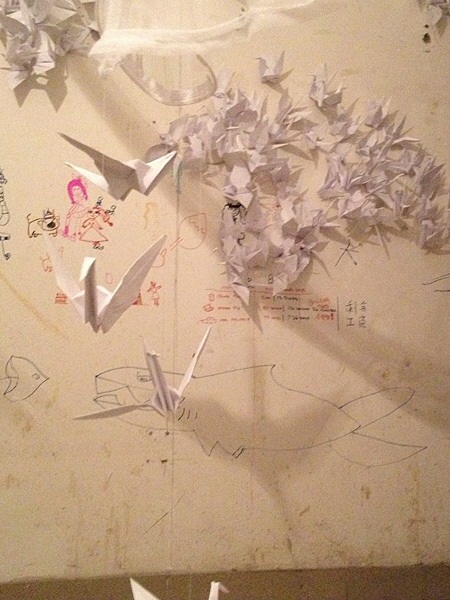
Today, we had the first tea at 302. The conversation ranged from why urban villages through the muddled terms–city in village, farmer laborer–of contemporary urbanization to the ubiquity of urban villages throughout China. We also laughed. A lot. Impressions below.

This slideshow requires JavaScript.

baishizhou officially slated for renewal

Yesterday, the Shenzhen Government online portal announced that Baishizhou is on the list of areas designated for urban renewal.

The plan to renew “the five Shahe villages” was submitted by the Shenzhen Baishizhou Investment Company Ltd. It calls for razing 459,000 square meters of built area. The area has been zoned for residential and commerce, with at least 135,857 square meters of public space.

Baishizhou is one of 18 projects announced. All plans take place at the street level, and all target communities and/or early industrial areas. All emphasize the planned public area, but do not mention plans for evicted residents or scheduled construction.

Of note, the urban renewal announcements were tucked away in the Bureau of Land, but the announcement of Shenzhen’s plans for its first village preservation project, Shayu (沙鱼涌古村保护项目) made the front page.

shekou relaunch

So the Biennale has been extended two weeks. Good news and great press for the curators, the SZ Center for Design, and China Merchants. And that–generating a Shekou Buzz–has been the point of all this productivity, or as the current campaign is called “Shekou Relaunch”.

This afternoon, I attended one of the final scheduled events, a forum on how to renovate the Dacheng Flour Mill, which has been designated the site of the future Shekou a Industrial Culture Center. The program included repurposing the buildings and designing more public space, a visual culture center, a theater, and an office building. The responses hinged on determining the purpose of the renovated buildings; just what does China Merchants hope to accomplish through these renovations? Just what is being launched again? And why?

Indeed, there is both something primal about the campaign; we are setting off, again (再出发), and yet something equally unsettling; again? How many times do we need to remake society? Or is it just the persistent dissatisfaction of capitalism and vague anxiety that we may never get it right?

I actually believe that creative activity makes people happy, but not redundant assembly line production. I have experienced happiness in creative activity that nourishes my connections with others. I am particularly enjoying 302 because it brings together research interests, social commitments and friendships. I also really, really like working with my hands. This seems to me the goal of social transformation; improving the quality of life of family, friends and neighbors, and not just achieving higher economic indicators.

Today, I’m thinking that to the extent that traditional socialist industrial culture aimed to improve the lives of worker, it offers inspiration for possible renovations and building. However, without a discussion about what’s being relaunched and why, another round of pretty and smart and interesting construction seems to me to be beside the point.

baishizhou: intervention and experience

This weekend (Feb 22-23), two events organized for Shenzhen children focused on Baishizhou. On Saturday, ATU/观筑 held a “Young Architects” program in Venue B of the Biennale. On Sunday, CZC Special Forces and Ya Ya Theatre co-produced “Baishizhou Theme Park”, a 20-minute play that was written, directed, and performed by six of Baishizhou’s youngest residents in Venue A.

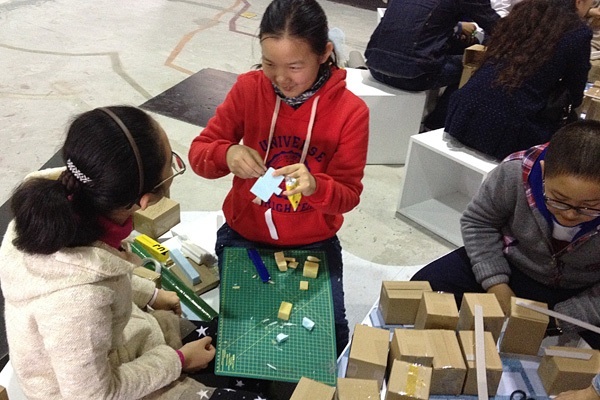
For the past two years, ATU has run the Young Architects program to teach architectural literacy through experience. They have intervened in the Baishizhou Tangtou row houses, building chairs and also built small spaces to spec, for example, a study room for one person that connects to another, but remains private. Saturday’s program was a urban renewal workshop for Baishizhou. Led by architects, Huang Jingjie and Feng Guochuan, six groups of pre- and teenagers took responsibility for one area. The requirements were, the total building area cannot change and improvements must be affordable so that rents will not increase dramatically. Each group had a professional consultant and 90 minutes to rethink urban renovation.

For over four years, Ya Ya Theatre has developed intimate performances that express unique experiences. Earlier in this year’s Biennale they produced a version of “One Person, One Story” in which members performed autobiographical and biographical monologues about a life-changing event. Lora Wang and Chen Lihua ran the two-month workshop that included exploration of Baishizhou and then developing a series of autobiographical vignettes. Sites visited included a dry swimming fountain, the Jiangnan Department Store plaza, and a video arcade.

So, the during the last official weekend of the Biennale, we had two events that developed the theme of the relationship that Shenzhen children have to Baishizhou, and by extension other urbanized villages. This in itself indicates that interest in the urbanized villages is spreading beyond commercial and academic enclaves. Moreover, we also saw community projects that assume urbanized villages as an important component of Shenzhen as an imagined community. This marks an important shift in the public awareness. Previously, urbanized villages existed outside Shenzhen representations of the city. The villages were (and to a large extent remain) glaringly absent from urban plans. Suddenly, the villages have emerged in public discussions about wither urban development and renewal?

These questions were at the heart of the post performance discussion “Learning from the Urban Villages” with Lora, Feng Guochuan and Zeng Guansheng. Audience members were not only interested in where the working class and young migrants would first settle in Shenzhen, but also in questions about the social value of street life and neighbors. This kind of conversation provided a glimpse into a larger, more general search for Shenzhen identity. This new identity reworks the version of high-speed development and red heroes that has been the previously ignored but not challenged vision of who Shenzheners are and what the city might be.

This slideshow requires JavaScript.

children’s baishizhou

As part of the Hanshake 302 program, Lora and Lihua have been running a theatre workshop at the Mingzhu culture station in Baishizhou. Workshop content has included games, narrative structure, and exploring Baishizhou. The children developed short pieces about their lives in a Baishizhou. A few observations:

1) Baishizhou (and other urban villages) are home to two generations of Shenzhen youth–the children of migrants and recent high school and college graduates who have migrated to the SEZ. The urbanized villages shelter Shenzhen’s future;

2) The young children have grown up in Baishizhou. They have improvised playgrounds and special places. Of note, they don’t actually know where Baishizhou’s boundaries are, and they have also figured out how to sneak into neighboring gated communities;

3) The children run relatively freely in Baishizhou. Unlike highly protected children in upscale communities, in Baishizhou the children mingle more widely and I am reminded of studies about US suburbs, where community friendships grew out of children’s play.

Today, we ran a dress rehearsal in Baishizhou. On Feb 23 at 2:30 pm we will bring Baishizhou children to perform at the Biennale Venue A. The performance will help us think through the question, what can we learn from the urban villages? Impressions of dress rehearsal, below.

This slideshow requires JavaScript.

thinking density, shenzhen population of, 2013

The day before yesterday I participated in a Biennale forum on high density living. I thought high density living referred to number of people living in so much space. Rumor has it, for example, that there are roughly 19.5 million people living in Shenzhen — a mere 4 million over the official unofficial population count (read generally accepted and quoted). Shenzhen has an official area of 1,952 square kilometers, which would make the SEZ’s estimated actual population density to be around 10,000 people per square kilometer. The population density of people with hukou would be significantly less dense, around 1,300 people per square kilometer, but no one believes that figure. On the recently updated Chinese Wikipedia the population density is given as being 5,201 per square kilometer.

Population density can be appropriated to give us a sense of forms of social inequality. Baishizhou, for example, is located in Shahe Street Office, which has an area of approximately 25 square kilometers. The estimated population is around 260,000, giving us an average population density of 10,400 people per square kilometer, which is close to the guesstimated municipal average above. However, when we account for Baishizhou, we see an interesting realignment.

Baishizhou occupies an area of .6 square kilometers (the rest of the area’s original holdings has already been annexed by the state). It has a guesstimated population of 140,000 people. This means that Baishizhou has a population density of 23,333 people per square kilometer, while the rest of Shahe, which includes Overseas Chinese Town and Mangrove Bay estates has a population density of 4,898 people per square kilometer. So Baishizhou has a population density which is over twice the municipal average and OCT and Mangrove Bay areas have a population density that is less than half the city average.

I was wrong in thinking that population density is the only way to operationalize unequal access to space. In archi-parlance (that’s a personal neologism for “how architects and urban planners talk about the world and stuff they’re building), there are two more definitions of density that they’re interested in measuring– floor area ratio (FAR) and dwelling unit density (DU). And if you’re wondering do they further abstract these descriptions of the built environment by using acronyms, the answer is a resounding yes! The density atlas provides an illustrated explanation of terms. Below, I try to work through what these terms might tell us about the spatialization of unequal access to space through and within Shenzhen’s urbanized villages.

FAR density refers to how much building occupies the space. And it’s three-dimensional. So floor area ratio means the total area on all floors of all buildings on a certain plot. Thus, a FAR of 2 would indicate that the total floor area of a building is two times the gross area of the plot on which it is constructed, as in a multi-story building. So, a FAR of 10 would be ten stories, if the base was consistent (as in a box). (And yes, I’m grappling to get my mind around this kind of abstraction so I think in simple terms, or word problems if you will.)

In order to calculate DU density, you posit so many square meters per person. A 100 square meter building with a FAR of 6 would have 600 square meters. If we then posit 20 square meters per person, our 600 square meter building could shelter 30 people. In other words, if we were to take standard person to space ratio used by many Shenzhen urban planners, then 30 people could comfortably live in one handshake building.

But clearly that’s a calculation for one, single purpose building. Once we start allocating space for functions, we need to make value judgments. How much space for business? For women’s restrooms in public spaces? For sleeping? In other words, to allocate spaces within the built environment we need to make decisions that will reveal and confirm our sense of what is the good life and how we will share that life and it’s material components. To return to our hypothetical 6-story handshake building, if we give the first floor to business and then build subdivide a floor into (3.5 X 6) 21 sq meter efficiencies (still above the magic 20), three on one side of the hallway and one on the other, we would get four rooms. However, if we further subdivide those rooms, we could get eight even smaller rooms (leaving space for hallway and stairs).

In practice, design is not that simple. But the numbers do begin to operationalize inequality in terms that resonate the ethical discourse modern education has equipped us with. For example, the layout of Handshake 302 shows a living space of (4.335 X 3.06) = 13.2651 square meters. There is a small cooking space and toilet which also allows for standing baths. Our neighbors live in similar sized rooms, and share the space and rent among two or three roommates. This suggests that the actual DU in a Baishizhou handshake efficiency can be as low as 4.4 square meters per person. At 850 per month, wear talking a rental cost of 64.1 yuan per meter.

In contrast, it costs 18,600 to rent a condo at neighboring Zhongxin Mangrove Bay, for example. The flat has four bedrooms, two living rooms, and three bathrooms that take up a total of 265 square meters, or slightly less than half a handshake building. It is a family home, so let’s guesstimate a pair of grandparents, a set of parents and one kid, totaling five people. Each of them enjoys 53 square meters of living space. Each square meter has a rental cost of approximately 70 yuan, which is not that much higher than Baishizhou.

Admittedly, one can tell many stories with statistics, but the square meter story of Baishizhou and its neighbors is one of gross inequality. Mangrove Bay residents can occupy anywhere from 15 to roughly 18 times the space of Baishizhou renters, and pay about 22 times the cost for that privilege. At this scale, one can begin to imagine what razing Baishizhou means in terms of affordable housing on the one hand and potential profit on the other. Point du jour, however, is that there is no “standard” square meter per person ratio, just expanding levels of inequality.

So, some stats du jour that should give us pause to reflect on the values we are constructing into the built environment.

updates…

Yesterday, Baishizhou Superhero opened at Handshake 302. Impressions from the opening, below:

This slideshow requires JavaScript.

Also, the latest weixin meme: the next US Ambassador to China, Max Baucus is looking for a Chinese name. On offer: 没咳死-包咳死, or “Have not yet coughed to death, but coughing to death guaranteed”! — hee.

And an interview with moi at the Nanfang daily.

handshake 302 opening

Handshake 302 opened yesterday! We held our opening at the Baishizhou Cultural Plaza, where we distributed 1,000 balloons to neighborhood children. People chatted at our information table while waiting to be guided to the art space. For over 3 hours, Kaiqin dialogued with visitors about the installation, Special Forces, and the importance of public art. At 5, the second part of the day began, with a workshop led by Pete Moser. More Music Baishizhou brought together 20 members of CZC special forces to workshop a song about Baishizhou and plastic stool percussion. Then Pete shared his fabulous one-man show with residents. Impressions, below:

This slideshow requires JavaScript.