neo-confucianist administration in guangming?

Today, I’m translating an open apology from Liao Tianye, a young official in the Guangming New District Management Committee (新区管委会) to his parents. In the letter, Liao Tianye expresses his remorse for abusing his parents. Frankly, the letter seemed to me a strange twist on Shenzhen’s ongoing Neo-confucian propaganda campaign; yes, the Municipality is striving to cultivate Neo-confucian ethics in officials and businessmen. But, public apologies for unfilial behavior? Caught me off guard. More prosaically, I’m wondering at the level of abuse, the context in which “abuse” was identified, and how it came to the attention of the Management Committee. Also, in the ongoing turmoil of Chongqing revelations, I’m also wondering about the political culture of holding meetings for self-criticism, which we all remember was one of the key features of Cultural Revolutionary tactics.

Letter of Regret

First, I want to use this letter to express my deep regret to the parents who raised me under such difficult conditions! To the school that formed me and the work unit that has consistently cared for me, I also apologize for any negative effects from my actions! At the same time, I also sincerely apologize for the emotional pain that my actions have caused the public!

I was born into a farmer household, but lived for many years outside the village to complete my studies. After graduating college, I immediately married and our child is now 9 months old. Pregnancy and birth debilitated my wife’s body and she became depressed. During the day, I went to work and at night I came home and still had to care for our child, exhausting both body and mind. In addition, my parents’ traditional ideas of childcare and my own are very different, and I don’t have enough experience handling family conflicts. Nor was I prepared for the contradictions between wives and mother-in-laws. Together it resulted in disputes with and anger at my parents, leading to serious consequences.

These past days, I have consistently engaged in deep reflection and self-criticism. This event has been a deeply painful life lesson, which also negatively impacted my household, work united and society. I will learn from my mistakes and become a citizen who takes responsibility at work and in society.

I hope that everyone will give me a chance to turn over a new leaf!


gu kailai: he made me do it!

As Chongqing Turns takes no prisoners, literally.

According to Mirror News (明镜新闻网), Gu Kailai claims she had nothing to do with the alleged murder of Neil Heywood. Instead, she says that Bo Xilai’s secretary acted on the former Mayor of Chongqing’s orders to kill the British businessman. Her role in all of this was simply to invite Heywood to Chongqing. Moreover, she couldn’t refuse to help Bo Xilai because he frequently beat and sexually abused her.

It seems that Hu Jintao may have successfully arranged for Chongqing’s former power couple to receive the death sentence for their role in Heywood’s death. Or at least that’s cliff-hanger du jour, not to be confused with anything like verifiable news.

Meanwhile, there are reports (here, here, and here) that two days ago several thousand took to the streets of Chongqing to protest the government by singing red, a direct challenge to Bo Xilai’s administration and a call for change a la Mao. They also sang the national anthem: “Ten thousand hearts as one, braving the enemies canons — forward march!” In response, the government ordered the police disperse the protestors using teargas yesterday.

Online, extreme left websites such as “乌有之乡”, “毛泽东旗帜网”, “民声网” and “红色中国” have been closed down, although it is still possible to find their site addresses in Baidu’s cache and the British speculate about how Heywood’s Chinese wife is “suffering“, quote unquote.

旧楼村: alleyways and crumbling bricks

This slideshow requires JavaScript.

Images from Old Loucun (旧楼村), a large swathe of crumbling tile homes, traditional brick homes, narrow roads and alleys, and mid 80s 2 and 3-storey homes. Handshakes on horizon.

Shajing Wanfeng Community learns from Wukan

Weibo reports that on the afternoon of April 8, 5-600 Wanfeng (万丰社区) community members/ villagers took to the street to protest Community Secretary and  Wanfeng Ltd CEO, Pan Qiang’en selling off collective lands for private profit. The protests began February 17, when 20-30 elder villagers gathered outside village offices and have continued until today.This afternoon, Epoch Times reported on the event, noting that villagers are calling for an accounting of the past twenty years. Currently, Wanfeng Community has an area of 6.8 sq km and a population of 2,067. Most are surnamed Pan. It is estimated that over 50,000 migrant workers also live in Wanfeng.

gu kailai arrested: “as chongqing turns” really is one of the best shows on the worldwide web

In today’s episode of As Chongqing Turns, Bo Xilai’s wife, Gu Kailai has been arrested for the murder of Neil Heywood, a Beijing-based British businessman.

When we last visited Chongqing, Guagua had been urging his father to truly reform Chongqing’s political-economic system instead of singing Cultural Revolution karaoke and cracking down on “black” activities. One of Bo Xilai’s patrons, Noodle Master Kang (played by Zhou Yongkang) had been fighting with Direct Line to Heaven (played by Wen Jiabao) and Tire (Hu Jintao) for control of the Center. There were rumors of bullets having been fired in Beijing, rumors which increased levels of paranoia because of the administrative separation between control of the military and control of the police. Remember, the military is controlled by, well, the military and in the hands of Tire. The police, however, report to Noodle Master Kang and although the military is larger than the police force, nevertheless the police have more ground forces than the military, who serve and protect Chinese people in the air and at sea, in addition to on land…

Flashback to November, 2011, place: a fancy Chongqing hotel room. Neil Heywood is found dead. Representatives of the Chongqing government tell Heywood’s family that he died of a heart attack. They tell the British Embassy that he died of an overdose of alcohol poisoning. Strange, someone says, I never knew him to drink…

Flashback to Wang Lijun’s mad dash to the US Consulate in Chengdu. Close up of the Chongqing police surrounding the building, demanding that the Americans release Wang Lijun. We jump to a reconstruction of what the New York Times says took place: Wang Lijun telling the Americans (large and in blue suits) all sorts of things about the inner workings of the Center. He lowers his voice and accuses Gu Kailai of poisoning Heywood and to force the Center to reopen the case. Wang Lijun begs the US officials for asylum, but it is not granted. Instead, 30 hours after he entered the Chengdu Consulate, he leaves “of his own accord”, which is what was said at the time and we now know not to be true…

Meanwhile, the Chinese internet pulses and throbs with speculation and analysis. If Gu Kailai did poison Heywood and if hubby, Bo Xilai did cover up the murder, then speculations about the absolute lack of any moral restraints in Chinese leadership seem confirmed. If, however, Wang Lijun lied and now Bo Xilai’s enemies are using the case to end his political career, then speculations about the absolute lack of any moral restraints in Chinese leadership also seem confirmed. And what is to be done when there are two separate armed forces — the military and the police –reporting to (at least two) amoral leaders engaged in a power struggle?

This episode leaves us in Shenzhen to ponder appropriate levels of paranoia. Suddenly, for example, I’m recalling that after the recent Politics and Law Committee Training (政法委书记培训) in Beijing, I’ve notice increased police presence throughout Shenzhen. What’s the reason? I’m reconsidering Bo Xilai’s earlier trip to Kunming Military museum in terms of internal divisions. As Mayor of Chongqing, Bo Xilai had police, his chief supporter, Zhou Yongkang is head of the Politics and Law Committee and  and thus can deploy police from any part of the country anywhere else. Was Bo Xilai actually cultivating military support from his father’s old friends in preparation for a worst case scenario?

And yet. I’m also thinking that the mountain is high and the emperor far away (山高皇帝远) and most of the people in the hot and heavy pursuit of Chongqing rumors tend to be either newspaper reporters, who pursue these sorts of stories for a living and friends from Beijing, who actually identify with whatever the Center is up to and spend time online tracking the rumors. Many of my southern friends don’t seem so interested, except to wonder how the political maneuvering will or will not impact manufacturing, financial services, and summer vacation plans.

That said, I may re-read my Machiavelli just to remind myself that any act by a leader should be interpreted as a power play and not within the rhetoric of serve the people. And sadly, I’m looking at you, too, American politicians who might use this fiasco to pander to anti-Chinese sentiments and American media personalities who would use anti-Chinese sentiments to increase ratings in my homeland. Unfortunately, As Chongqing Turns isn’t a telenovela. It’s what’s happening instead of necessary work to improve the lives of millions of Chinese people, which in a shared world means improving all of our lives.

Impressions of Guangming New District

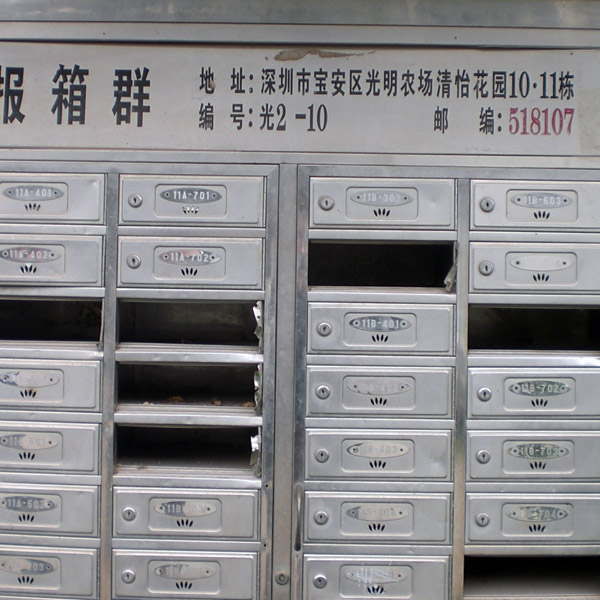
Located at the Dongguan border in the middle of Baoan District, Guangming New District (光明新区) remains surprisingly (within Shenzhen) agrarian. The settlement layout at the District center feels like a small market town and still runs along village paths, even though trucks rumble over the newly imposed traffic grid. The New District’s development has lurched along, hindered by its distance from both the Guangshen Highway and the Kowloon-Guangzhou Railway. In fact, according to a local villager, until the 1970s, no actual road connected the area to Shajing (in the west) and Loucun (in the east). Instead, villagers pushed wheelbarrows on a network of paths that threaded through lizhi orchards, around vegetable gardens, and into rural settlements.

Under Mao, Guangming was a farm (农场), a non-rural designation which had the same administrative rank as a commune (公社), but a different personal policy. Like a commune, farms were responsible for agrarian production. In contrast to commune farmers (农民), however, farm workers were state employees, receiving a monthly rice ration, food coupons, and housing. Practically speaking, farm workers were farmers with socialist benefits. In the Reform era, as Guangming was gradually integrated into the state apparatus, the farm remained not only the most organized institution in the area, but also the one with the most direct access to government monies, which could be redirected for capitalist purposes. Today, Guangming Farm is a tourist destination/ agrarian themepark/ playground (光明农场).

In addition, Guangming was a designated settlement first for Indonesian returned Chinese in the 60s and then for Vietnamese returned Chinese in the 80s (Wang Caibai provides a history of 归侨 as an official designation in the Chinese polity). This meant that the Returnees were integrated into the local work plan as farm labor, but were not given land rights, which have remained in either village or state hands. Indeed, even as late as 1990, then Guangming Market was posting laws pertaining only to Returnees. Nevertheless, the Returnees were often familiar with capitalism in ways that the local villagers were not and also, through family outside China had access to some investment capital. This is important because Guangming is not considered an Overseas Chinese Hometown. Moreover, as a remote part of Shenzhen, the area did not have immediate access to the early Hong Kong investment that went to border villages, even when there were no direct kin relations.

Today Guangming remains relatively clean and naturally beautiful. The local government is pushing renewable energy and resource development as well as suburban life styles in modern high rise developments. With the laying of new roads and the creation of an express bus route from the Shenzhen Bay border to Guangming, Shenzhen has made it easy for Hong Kong people to visit or move to these new developments. In addition, highways now make Guangming a short ride from the airport.

Due to its remote location and special designation, Guangming’s recent history is complicated and has produced a landscape that juxtaposes late Qing and Republican flat homes, Mao-era tile homes, handshakes, mid80s official housing, lizhi fields, mountains, several industrial parks, and construction sites, not only providing scenes for imagining what pre-reform Shenzhen was like, but also offering a space where another, more sustainable form of development might be pursued. Or so I hope. A walk through the center of Guangming New District, below.

This slideshow requires JavaScript.

An Egg Bot Easter

Today good friend, Lyn Jeffrey brought me to the First Shenzhen Maker Faire, which was organized by Eric Pan. I experienced the enthusiasm of open source creativity and entrepreneurship, albeit of a strongly electronic variety. Of particular note this Happy Easter, the Egg Bot, which could be programmed to color patterns on eggs.

This slideshow requires JavaScript.

unsafe worlds: of gutter oil and loaded guns

Today, I’m thinking that there’s a perversity to the way in which our highest values come back to haunt us. Consider for example, the functional analogies between feeding the people in China and protecting one’s rights in the United States.

In Shenzhen, for example, ingesting gutter oil (地沟油) symbolizes all that might go wrong when interacting with unknown persons in the big bad city. Likewise, back in Southern Pines, all sorts of bodily harm might happen because “the wrong people” get guns and go off half-cocked.

Life is hard, they say in China. Here, there’s no guarantee that you’ll eat your fill. Instead, you not only have to take great precautions to make sure you get enough to eat, but also to work diligently just to ensure that what you do eat is healthy, let alone being able to truly eat as much of whatever you want. Moreover, just when you think you’ve made it, some greedy bastard serves you a portion of gutter oil, ruining your digestion and damning you to a life of porridge and bland vegetables.

Life is hard, they also tell us in the US. But here, there’s no guarantee that you’ll get a fair deal. Instead, you not only have to be vigilant to make sure you can make a life for yourself, but also to ensure that what you do end up doing is what you want, never mind having a chance to truly enjoy the pleasures of freedom. What’s more, just when you think it’s going your way, some nutcase shows up on your porch, forcing you to pull the trigger or suffer the consequences.

I concede that Chinese cuisine and American independence organize desire differently. Indeed, on the face of it, Chinese preoccupations with food seem radically different from American obsessions with self-realization. Nevertheless, today I suspect that the differences between Chinese celebrations of fine food and American glorifications of independence merely muddy the cross-cultural waters. Rumors of gutter oil and loaded guns remind us that no matter how different Chinese tones and American syntaxt may be, nevertheless they tell the same story — we have constructed unsafe worlds for ourselves and our loved ones.

六四 can be baidu’ed!

Ironies of the great firewall continue: We can now access information about Tian’anmen, but still can not directly get onto wordpress. Does this mean that whatever else he has done with or without Jiang Zemin’s blessing, Wen Jiabao looks good in Tian’anmen press? Or perhaps Tibet and Hu Jintao’s role in the March 5 Lhasa crackdown (also in 1989) remains more sensitive than Jiang Zemin’s role in the June 4 crackdown because so many leaders and members of the Han public continue to refuse to discuss 1959?

That said, nevertheless, today I’m feeling hopeful: we can baidu 六四!

the second line: nantou checkpoint to zhongshan park

Walked with Emma Ma and her father, Mike along Shenzhen’s northern loop expressway (北环大道) from the Nantou Checkpoint to the northern entrance of Zhongshan Park. Our path followed the remains of the second line (二线), the boundary that once divided Shenzhen into the SEZ and New Bao’an County. Cobbled together out of debris and plastic poster banners, a makeshift tent settlement hovers atop the obsolescent wall and a border guard platform falls apart. A section of the former border zone has been converted to a logistics depot for the Nanshan Oil company. Ironic, of course. Across the street in Zhongshan Park, the Ming Dynasty remains of the Nantou City wall have been designated cultural heritage. Impressions of the second line, below.

This slideshow requires JavaScript.