the u.s. election and the 18th npc

I have recently hooked into “we chat (微信)”, Tencent’s latest social networking app. Point du jour is simple: Tencent regularly bleeps me news updates, so I can follow world headlines at a glance. These past few days, the juxtaposition of the US election and the 18th National People’s Congress has offered lessons in misreading and irony.

For example: On the eve of the US election, I received the following three headlines:

  1. Today’s topic: does the election divide or unite Americans? to be followed by
  2. The 38 delegations arrived for the 18th NPC and first in line were the farmer-workers (meaning farmers who are migrant workers) delegation, and then, just so you don’t forget that the US and China are not two sides of the same coin
  3. Microsoft will use Skype instead of MSN everywhere but the Mainland.

Now, I’m not sure how direct the comparison between the US election and the 18th NPC were to be. Clearly, while both are domestic rituals, they will impact people through out the world. After all, international chains of production and consumption (of say computers and software) have made the US and PRC not only important trade partners, but also jointly influential over the global distribution of production and consumption in disturbing ways. However, that direction of thought was not picked up by the news editors at Tencent. Instead, the implicit comparison was between the “divisiveness” of the US election system and the “harmony” of the NPC.

Here’s the telling moment: this series of headlines could as easily fit into a Fox Network summary as an explicit (and self-congratulatory) comparison between the “democratic” structure of American politics in contrast to the “homogenized” politics of China.

As any structural anthropologist could tell you, when symbolic systems are this easily converted, there’s a good chance we’re talking about moieties, a form of unilineal descent that involves the occurrence of descent groups in linked pairs which assume complementary positions and functions. In more traditional moieties, marriage is exogamous and involves women and men marrying exclusively from the matching group. However, moieties also engage in trade and other activities, providing the larger social context of extra- and intra-moiety relations.

This is me thinking about the growing interdependence, not simply material, but also ideological between the US and PRC. Our co-dependence is deep and worrisome because we’ve yet to see any evidence that we do anything but reinforce our own and each other’s blind spots.

Sigh.

historic echoes: the gang of four and bo xilai’s upcoming trial

On November 4, 2012, the ruling black box Chinese Communist Party Central Committee bleeped that Bo Xilai would be tried in criminal court, neatly removing the last obstacle to the opening of the 18th National People’s Conference.

Bo Xilai’s dramatic fall began on February 6, 2012, when Chongqing’s “attack the black” hero, Vice Mayor Wang Lijun sought asylum in the US Consulate in Chengdu. At the time, it was thought that Bo Xilai might actually join China’s highest organ of power, becoming a Member of the Standing Committee of the Political Bureau, of the Chinese Communist Party Central Committee (政治局常委). On September 28, 2012, Bo Xilai lost his Party status. Indeed, the black box released an official missive, The Chinese Communist Party Central Committee Decides to Revoke Bo Xilai’s Party Status and Dismiss Him from Office  (中共中央决定给予薄熙来开除党籍、开除公职处分).

We now know about the murder of Neil Heywood, the trial and sentencing of Bo Xilai’s wife, Gu Kailai and the FBI’s help in repatriating his son, Bo Guagua. We have replayed the soap operatic laments of his first wife, Li Danyu and the Ivy league graduations and beef mogul career of their son, Li Wangzhi. Inquiring minds want to know: what else is there to learn from the Bo Xilai incident?

According to a post by Canadian Home (加拿大家园) Bo Xilai’s trial matters because it is not simply a corruption case, but also a political case. Moreover, the “Sing the Red, Attack the Black” campaign explicitly invoked the Cultural Revolution. Consequently, in preparation for Bo Xilai’s trial, Hu Jintao, Wen Jiabao, and Xi Jinping re-established the precedent of the Gang of Four trial. Thus, the Bo Xilai incident illuminates the contours of a neat (if unsuccessful) reversal of history. Deng Xiaoping came to power by sentencing Jiang Qing, Zhang Chunqiao, Yao Wenyuan, and Wang Hongwen. Likewise, Bo Xilai attempted to grab power from the reformers with a strong return to Maoism.

Yet another echo of the Cultural Revolution: In 1981, “the conscious of Chinese law”, Zhang Sizhi (张思之) represented the Deng’s political rivals, the demonized Gang of Four. Over the next decades, Zhang Sizhi has represented some of China’s most famous dissidents, including democracy activist Wei Jingsheng, sociologist Wang Juntao who advised students during the Tian’anmen Square incident, and Zhao Ziyang’s secretary, Bao Tong. Several days ago, Zhang Sizhi gave an interview, asserting Bo Xilai’s right to defend himself and to have an attorney. However, Zhang Sizhi also said that even with a proper defense, Bo Xilai would be convicted, the question of this “legal show” is simply: will Bo Xilai receive the death penalty?

All this anti-Cultural Revolution positioning reminds us of the extent to which the legitimacy of Reform and Opening has been based on the delegitimization of the Cultural Revolution, even as the heroic status of Deng Xiaoping was also very much based on his status as a PLA general. It also reminds us how seriously Standing Members take their absolute authority and why Bo Xilai did what he did in a gesture to join the black box club at China’s center. After all, the PRC is a mere 63 years old and thus for many Chinese the relevant and only political question remains: who is the true heir to Mao Zedong’s legacy?

tangtou research begins!

After many months of waiting and hoping and wishing (and yes research is often an overplayed love song), the CZC Special Forces have begun our research in Tangtou, Baishizhou. Yesterday morning and afternoon, we began a survey of the buildings.

This slideshow requires JavaScript.

the politics of backbiting

By now you have probably read that Shenzhen passed a new law that makes it more difficult to avoid the one-child policy by giving birth to a second child outside the country.

Between 2000-2009, it is estimated that the number of Chinese citizens having children in Hong Kong went from 709 to 29,766 annually and was still rising in 2010 and 2011. Indeed, some claim that today almost half of the children born in Hong Kong are born to Mainland families. Of this total, over 25% had Shenzhen hukou. Their children have Hong Kong identity cards, and although the parents must pay extra fees for schooling and medical care, nevertheless, they have avoided “second child fines (二胎罚款)” and other more drastic measures of enforcing the one child policy.

As of January 1, 2013, Shenzhen parents who have a second child abroad and then bring the child back to Shenzhen to raise for more than 1.5 years will be fined up to 219,000 rmb (US $35,000), which is roughly the current fine for second children born to parents with Shenzhen hukou. The fine is set each year by multiplying the average annual salary of the year before by 6 to 8 times. In 2011, the average salary was 36,505 rmb. This means that the 2012 Shenzhen penalties for second children are between 219,030 to 438,060 rmb.

This past spring, the Chinese news was full of speculation about how the government would handle the case of Olympic gold medalist Tian Liang, whose wife gave birth to a second child in Hong Kong. People wondered if Tian Liang would be fined as much as 2 million rmb and, more to the point, if he would loose his job, which is representing China in international track and field events. After all, ordinary government workers are not only fined for having a second child, but also loose their jobs. Thus, the Tian Liang case illuminated how it was possible for the wealthy and influential to avoid the consequences meted out to “common people” who gave birth to a second child in the Mainland.

Today, a friend told me about this new law as an example of the politics of backbiting, after all, it has been the rich and powerful who have taken advantage of Hong Kong hospitals to give birth to second children. Moreover, these are precisely the people who are targeted by ambitious underlings. He asked me to imagine how someone advanced within the government bureaucracy. Not on talent, but guanxi. However, when guanxi failed, it was possible to hire a private detective for 20,000 rmb to follow someone and document when and how they broke a law. He estimated that the first half of 2013 would be interesting to see how the newly pregnant rich and powerful handled the births of their second children; ordinary families became pregnant already prepared to pay second child fines.

Clearly my friend moves in nervous circles, where the law is used as a weapon of political infighting. This was, in fact, his point. Human rights and rule of law will not be established in China, he concluded, as long as careers were advanced and derailed through guanxi and/or backbiting.

“But people still accept this situation,” I commented.

He sighed, before saying, “China isn’t yet so corrupt that the people will risk their lives to overthrow the Party. There are still enough talented people in the government that society works. At some point, the balance will tip and we’ll be in revolt.”

“But now?”

“Now I’m just frustrated. I want out. But there’s nowhere to go.”

A catch-22, in fact. My friend plans to send his daughter to school abroad with the understanding that she not come back, unless it is to work for a foreign company; he believes she will be happier abroad than she could be in Shenzhen. He is not jumping, however, because he also knows the only place to earn the money necessary to launch his daughter abroad is his current, relatively high ranking position within a work unit of trusted guanxi and potential backbiters.

maillen hotel and apartments

The Architectural Review has published my review of the Maillen Hotel and Apartments by Urbanus. In the published review, I look at China Merchants’ recent push to gentrify Shekou in terms of gated communities for Shenzhen’s expatriate community. As designed by Urbanus, the Maillen Hotel and Apartments suggest the role of traditional Chinese gardens in the ideological transformation of Maoism into neoliberalism. A synopsis of the review, below; full article, here (with pictures by Sarah Cain).

Urbanus’ stated intention was to design the Maillen Hotel and Apartment with respect to both extant geographic conditions and the traditional Chinese ideas about landscape and garden design, incorporating Nan Shan Mountain into its design with an eye to realizing the aesthetic ideal of “bu yi jing yi”, a four-character expression which literally translates as “step moves landscape moves” and refers to the experience of enjoying new garden scenes with each step taken.

By incorporating the hill into its design, Urbanus took advantage of the section of Nan Shan that remains standing. Historically mountains and hills defined the South China landscape, and Shekou was no exception. However, during the first two decades of development in Shenzhen, urban planning and design prioritized speed and price over any other value, including environmental impact. The Chinese expression for land reclamation, “yi shan tian hai” or “move mountains and fill the sea” literally describes the step-by-step transformation of the Shenzhen Bay coastline. First, raze a mountain – and many Shenzhen hills no longer exist except as place names – and, second, reclaim coastal land, creating flat, relatively inexpensive building sites. The point, of course, is that as the city has prospered and natural features such as Nan Shan have been restructured, their market value has increased exponentially.

The Maillen design also invokes traditional garden design through landscape. Elegant courtyards, perennial bamboo clusters, and delicate plum blossoms evoke literati lives in Suzhou, which during the Song dynasty codified the defining features of a traditional garden. In a classical Chinese garden, stylized elements – ponds, a rock garden, trees and flowers, as well as built structures, for example – symbolized the larger world. The key point, of course, is that the garden allowed members of the Emperor’s court, classical scholars and wealthy merchants to experience themselves as being one with nature without actually having to go into a forest or sail on the ocean.

It is at the moment of exclusivity, or rather the potential to market and sell privatized pleasure that we see the appeal of classical Chinese gardens to contemporary real estate developers. Classical gardens were restricted spaces of elite pleasure, where scholarly achievement and social rank determined who was or was not permited to enjoy the elegant topiary and tranquil spaces. Today, money and status rather than scholarly achievement or social rank might determine who crosses the threshhold, but the effect is the same, the creation of a fashionable space for a select minority. With the Maillen Hotel and Apartment, Urbanus has designed a witty, elegant, and self-enclosed space of privileged consumption.

Indeed, when we architecturally cite China’s classical past, it is important to remember that we are also invoking the feudal hierarchy that the Revolution aimed to overcome.

shenzhen government online

Many readers come to this site looking for resources to learn about Shenzhen. In fact, as part of its efforts to make government more transparent, the Municipality has uploaded many of the key documents, which can be downloaded. The government’s main site is 深圳政府在线. Two of the sites that I find useful are:

深圳市规划和国土资源委员会 (for urban plans, including city and district level)

深圳统计局 (for statistics)

Also, to get a sense of what’s happening closer to ground level, the District governments all have virtual portals, which are differently helpful.

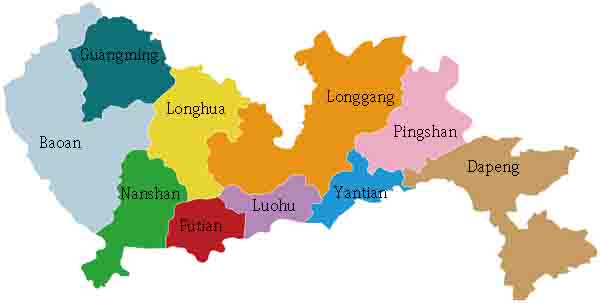
The six districts are: 盐田罗湖福田南山龙岗、and 宝安. The new districts (defined) are 大鹏坪山龙华、and 光明.

And a map of the territory:

demise of the shenzhen youth herald

In April this year, Cao Changqing (曹长青 who now operates an influential Chinese language news source) posted “Bo Xilai’s Father Destroyed the Shenzhen Youth Herald (薄熙来父亲灭掉《深圳青年报》)” to commemorate the 25th Anniversary of the closing of the Shenzhen newspaper, where he began his career in journalism. The post was prompted by a conversations with Yan Jiaqi (严家其), who had been the Head of the Politics Department, the Chinese Academy of Social Sciences (中国社科院政治所长) during the 1986-87 student movement and was an advisor to both Hu Yaobang and his successor, Zhao Ziyang. Indeed, Yan Jiaqi himself would flee to Paris after his support of student protests in the 1989 democracy movement.

In the early years of reform, the Shenzhen Youth Herald was, along with Shanghai’s World Economic Herald (世界经济导报), one of the two most independent newspapers in China. Consequently, despite being a small newspaper, the Youth Herald had a national subscription base, providing Chinese intellectuals a platform for debating progressive ideas and evaluating ongoing experiments in reform Chinese society. On October 21, 1986, for example, the newspaper printed Qian Chaoying (钱超英)’s contraversial opinion piece, “I Support Commerade Xiaoping’s Decision to Retire (我赞成小平同志退休)”.

In the manner of traditional intellectuals, Shenzhen University professor of literature, Qian Chaoying’s writing style was sincere and humble, but the content was unmistakably radical. Moreover, the piece drew directly on and from Shenzhen’s experience, asking: Why must the People show our sincere and deep feelings for Deng Xiaoping by sacrificing further reform of the political system (为什么表达人民对小平同志纯朴深挚的普遍感情,就非要以延缓政治体制改革的进程为代价不可呢)? On Qian’s reading, Deng’s retirement would allow China to reflect on and establish a more just political system, a system that was more in keeping with the needs of reform, rather than a return to the cult politics, which had characterized the Cultural Revolution glorification of Mao Zedong.

Yan told Cao that Bo Yibo (薄一波, Bo Xilai’s father and one of the Eight Elders of the CCP) was not only furious about the opinion piece, but had also approached it as an attack the power of older and already retired leaders. During a meeting on political reform, Bo Yibo participated as a consultant. Zhao Ziyang was talking about the opinion piece with Peng Chong (彭冲). Upon overhearing the conversation, Bo Yibo became livid and is reported to have screamed at the younger leaders, “You are already fifty, sixty and seventy years old. We won’t die and you won’t rise (你们也五十六、七岁了吧?我们不死,你们也上不来).” Hu Qili (胡启立) was apparently so frightened that he immediately showed his support for the elders, wishing that the the old leaders of the proletarian revolution would live to a healthy old age (我们希望老一代的无产阶级革命家健康长寿). Importantly, at that closed meeting, Bo Yibo called for the Party to investigate who had written and the newspaper that had published the opinion piece. The word used, zhuicha (追查) meant to find out who Qian Chaoying was speaking for. Bo Yibo assumed that neither Qian Chaoying, nor the Youth Herald was acting as an independent voice, but rather was acting on behalf of one of the young reformers, most likely Hu Yaobang.

The opinion piece was published at a critical time in Central politics. Hu Yaobang and Zhao Ziyang, Deng Xiaoping’s “right and left hands” were pushing for further political liberalization. Less, than two months after the letter was published, students organized public protests across over a dozen cities in support of political and economic liberalization. Astrophysicist, Fang Lizhi (方励之) led the protests, calling for introducing political reforms that would ultimately end the one-Party system and the continuing use of government as an instrument of Party policy. Two other intellectuals, Wang Ruowang (王若望) and Liu Binyan (刘宾雁) also led the intellectuals. It is said that Deng disliked Fang, Wang, and Liu, directing Hu to dismiss them from the Party, but Hu refused. In the fallout, Hu was forced into retirement because it was said he had been too lenient with student protestors. The Shenzhen Youth Herald was also one of the victims of the 1987 crackdown. The Shenzhen Youth Herald was closed and Cao Changqing banned for life from working in journalism at the same time that Hu Yaobang was forced into retirement. Two years later, the Tian’anmen protests would begin when students gathered to eulogize Hu Yaobang. The now defunct World Economic Herald published an article supporting the students’ call to re-evaluate Hu’s legacy.

shenzhen bay coastline, oct 27, 2012

I wandered to the Shenzhen Bay Park, tracking the construction and commodification of the new coastline. Land reclamation has brought views and parks, but I noticed that children and dogs still want to get their feet wet. Impressions, below.

This slideshow requires JavaScript.

the back side of the eye

It is one of the ironies of a human life that we experience history not chronologically, but through the cultural present. This is especially true in the arts, where although painting had historically preceded photography, nevertheless most of us saw and took photographs before having seen a painting, whether oil or ink.

Moreover, with the increasing availability of digital images, there is now a generation who has probably first encountered photographic images on a cellphone or computer screen, before contemplating an actual, printed photograph, let alone having viewed a painting. Irrespective of the fact that in point of fact ink painting preceded oil painting, which in turn arose before the invention of photography, in my personal experience, the history of the image has been: photograph, oil painting, ink painting, and then digital image. Other experiential histories are also possible: digital image, photograph, ink painting, and then oil painting.

The Back Side of the Eye, a creative collaboration between photographer Martin Zeller and painter Vai Keng Sou (苏惠琼) reproduces and challenges our experiential history and culture of the image. On the one hand, the production of the images for the series reproduces experiential history, moving from the most recent image technologies toward increasingly distant (and thus increasingly shocking) techniques. Zeller’s digital photographs of Berlin winter landscapes were first viewed on a small camera screen and manipulated on a computer before being printed on rice paper; only then Sou added interpretive brushstrokes. Thus, their creative process itself formulates a question for the era: how do we bring cultural tradition into dialogue with industrial modernity?

On the other hand, viewing the images requires that the photographic and ink elements be engaged concurrently, as elements of a given whole, such that the object itself holds in tension two different aesthetics, which in turn, point to the ways in which human consciousness fabricates past and present out of experience. Indeed, the simultaneous presentation of a past created through digital photography and a past created through ink painting interrupts our appreciation of the image as an example of photography or ink painting. Consequently the result of Sou and Zeller’s collaboration reframes the question of productive process into one of receptive consumption, allowing us to ask: how might bringing cultural tradition into dialogue with industrial modernity enable viewer’s to otherwise engage what-has-been?

Consider, for example, the image “Uncertain Extension”. The underlying photograph is of a swathe of snow-covered trees and, in the background, a line of boxy housing, which evokes the streamlined precision of Cold War modernism. On top of this bleak stillness, Sou has overlaid a clouded spirit, muffled ink smear and trapped purple cloud. The image forces us to engage two past moments simultaneously, the hyper detailed what-has-been of the photograph and the ephemeral what-has-been of Chinese ink painting.

The enigma of a photograph is that a past moment – ‘captured’ on film, we say – is a product of a technological intervention, but is treated as a replica of what-has-been. In fact, no human eye sees the world with the same precision as revealed in a photograph, where details retrospectively emerge to be seen and having-been-seen, to be contemplated. Thus, in “Uncertain Extension”, as viewers note the pattern formed through the delicate wrap of snow on every branch and the rigid precision of housing blocks, we become increasingly sensitive to the atomized materiality of a winter’s day. At the same time, however, Sou’s boneless brushstrokes blur and activate the immobility imposed by photographic accuracy, enabling us to reconsider the psychological what-has-been of winter, not as snow white austerity, but rather as a time of dark sedimentation, of thick ink absorbed by paper already reshaped by printing.

Walter Benjamin asserts that the dialectical value of images, especially photographic images is that they create an analytic space in which to reconsider what has happened, “For while the relation of the present to the past is a purely temporal, continuous one, the relation of what-has-been to the now is dialectical: is not progression but image, suddenly emergent.” In contrast, Zhang Daqian scholar, Pai Tsung Jen (白宗仁) defines the yixiang (意象) of an ink painting outside of history, in terms of the intersection between interior and exterior realities, “創作者主觀意識(意),與外在客觀物象(象)”. In other words, the photographic what-has-been intentionally distances the viewer from the past, while the ink what-has-been purposefully sutures the viewer to the past.

Within their respective traditions, both photography and ink painting denote a particular moment in space and time. However, they emphasize different aspects of that moment. Photography makes the what-has-been relentlessly material, flattened into surfaces that can be endlessly reconsidered. In contrast, ink painting creates yixiang (意象), a sense of being in the world that is shared by both the artist and the viewer. Consequently, the juxtaposition of artistic techniques destabilizes the viewer’s culturally intuitive sense of the nature of what-has-been. Is what-has-been as meticulously concrete as represented in Zeller’s photography? Or is what-has-been as fluidly transient as realized through Sou’s brushstrokes?

The Sou and Zeller collaboration reminds us that although the dialectical contours of the what-has-been may be created and experienced through techniques such as photography and ink painting, nevertheless we use these techniques to make value judgments about what it means to contemplate the past. This is important because how we create the past and its relationship to the present defines who we are as historically and culturally situated people. For Benjamin, photographic pasts were deployed to critique an unjust present. For the ancient literati, ink brushed pasts recorded continuities between external and internal worlds, past and present.

Unlike Benjamin or Pai Tsung Ren, however, we live in an era where although digital images have gone global, nevertheless aesthetic conventions for understanding the relationship between the what-has-been and the present are radically different between  historical generations, let alone different cultures. We need different ways of thinking about the past in order to create a common present. The images brought together in The Back of the Eye beautifully hold the contradictory tension between pasts we create through modern technology and the pasts we create through more ancient forms of human creativity, offering one model for using art to bridge our different approaches to the past.

Their most recent collaboration New Gardens will be exhibited at the Goethe Institut Hong Kong, November 13 through December 18, 2012.

architectural thinking — from the nanjing sun yat-sen memorial to luohu train station

One of the highlights of the XLarch Masterplanning the Future Conference was Wang Yun (王昀)’s keynote speech that periodized the development of Chinese style architecture, arguing for an internationalist approach to architecture, rather than an ideologically charged use of architectural symbols.

As an architectural style, Chinese classicism was invented by western trained architects who upon returning to Nationalist China received commissions to build “Chinese style (中华风格)” buildings during the decade of 1927-1937. These buildings had large, Chinese style roofs, windows and decorative details, and sometimes included stylized gardens. The Nationalist capital, Nanjing was the location of some of the most important examples of this style as well because commissions not only represented individual client preferences, but also the determination of government leaders to create a recognizable Chinese public architecture.

One of the most important examples of Chinese classicism is the Nanjing Sun Yat-sen Memorial, which was designed by one of China’s first starchitects, Lv Yanzhi (吕彦直). Lv also also designed the Guangzhou Sun Yat-Sen Memorial before his untimely death in 1929. The Nanjing Memorial reinterprets traditional themes through choice of material (reinforced concrete and mosaic tiles) and through the secularization of traditional symbols (animals become geometric shapes, for example). In addition, the Memorial layout abstracts and represents Nationalist China as the difficult realization of Dr. Sun Yat-sen’s three principles of the people (三民主义) — nationalism, democracy, and public welfare. To reach the Memorial proper, for example, there are 392 steps going upward, each step representing one million Chinese, and together representing the population of nationalist China. These steps are broken by eight flat platforms, which represent the fragmentation of China by warlords and civil war. However, when one looks back on the stairs, all one sees is a flat surface, an optical illusion that promises national unification.

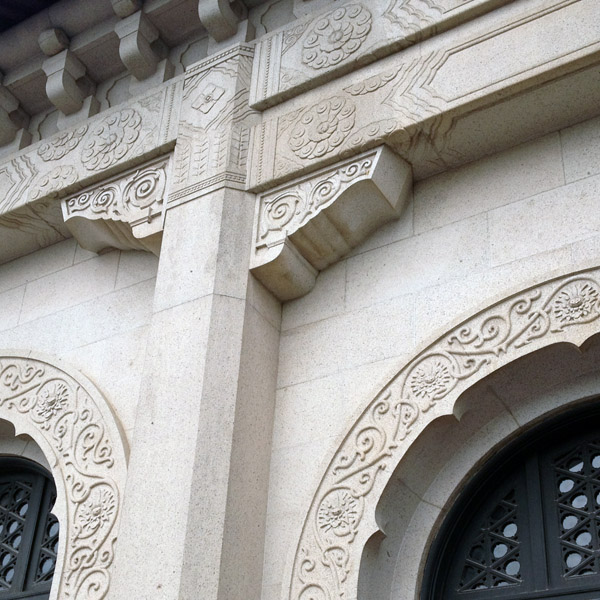
The Nanjing Sun Yat-Sen Memorial provides a lexicon for understanding Chinese Classicism during the Nationalist era, including the reference to the Lincoln Memorial (1920) by way of the seated figure of Dr. Sun (1926-29). Not unsurprisingly, perhaps, the Lincoln statue also dominates a neo-classical building, albeit through references to Greek architecture. Indeed, both the Sun Yat-sen and Lincoln Memorials use the respective classicism of their countries to assert timeless governance, even as they commemorate leaders who governed countries divided by civil war.  I show the following images of the Nanjing Memorial with the caveat that they are not architectural — an architectural photo has amazing resolution, geometric composition, and absolutely no people, unless, of course, the figure contributes to architectural exegesis. My snaps, however, aim to emphasize just how popular this site is and thus how it continues to shape the visceral experience of being in “China” through a particular architectural style.

This slideshow requires JavaScript.

How does the Nanjing Memorial relate to Shenzhen?

This architectural lexicon has been picked up, tweaked and redeployed throughout Shenzhen, but as a private rather than public source of architectural symbols. The Luohu Train Station is the only exemplar of public Chinese Classicism that has been built in Shenzhen in the Reform Era. The other large example of post Reform classicism is the Hongfa Temple in Fairy Park, which is arguably political in its adamant denial of any political message. Certainly, in its assertion of the reintroduction of official religion to civic life, Fahong was as ideologically charged as the train station, which signaled China’s opening to capitalist countries. However, with the exception of these two buildings, Chinese Classicism in Shenzhen is limited to decoration in urban villages, where many handshakes have tiled roofs, restaurants, and the odd sculpture, such as Nvwa Holding up the Sky in Shekou, which is a socialist realist rendering of a mythic theme.

All this is interesting because given the explicit modernism of Shenzhen’s public architecture, the rediscovery or explicit use of Chinese tradition and roots are often used in neoliberal arguments for alternative forms of architecture and historic preservation. Chiwan comes to mind as do struggles for some form of preservation in urban villages. These efforts contextualize the design and construction of key civic architecture, including the Civic Center and central axis, which has the ideological expression of Reform and Opening (here, here, and here). Importantly, both the relentless modernization of Reform era public buildings and the alternative movement to construct a classical past for Shenzhen ignore Maoism, which nevertheless continues to inform the built environment.