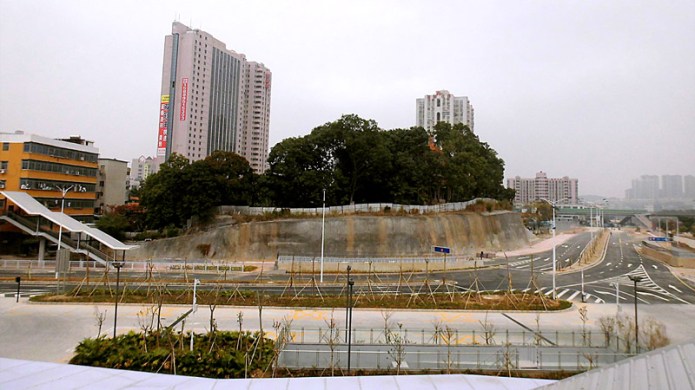
On May 6, 2009, Deng Fei (邓飞) published the “Cancer Village Map” which documented reports on villages where cancer rates were significantly higher than elsewhere in the country. Three days ago, the Chinese government officially acknowledged the existance of cancer villages. Not surprisingly, most of the villages are located in in the prosperous areas of the country. Moreover, as in Shenzhen, these villages occuppy a grey area regulated and unregulated space. Below, I have translated the orginal post.
Cancer Village Map

Jiangsu Province
Yangqiao Village, Guhe Township, Funing Coungy, Yancheng City (盐城市阜宁县古河镇洋桥村). According to a 2004 report in Jiannan Daily, between 2001-2004 more than 20 villagers died of cancer caused by a nearby pharmeceutical and two chemical factories. At night, villagers slept with a wet cloth covering their mouths and noses. The did not feed ducks near the water, but in the pigsties.
Dongjin Vllage, Yangji Township, Funing County, Yancheng City (盐城市阜宁县杨集镇东进村). According to a 2008 report in China Economic Report, between 2001-2006 over 100 villagers died of cancer because of pollution from a nearby chemical factory. All villegers took liver medicine. The villagers sued the factory, but were only given 70 rmb (a little over $US 10.00 today) per person compensation.
Xingang Village, Longgang Township, Yandu District, Yancheng City (盐城市盐都区龙冈镇新岗村). According to a 2009 China Youth Daily report, over the past 7 or 8 years, there were 57 reported cancer cases. All of those who died from cancer were between the ages of 50 to 60 years old.
Guangfeng Village, Guangyi Zhen, Wuxi City (无锡市广益镇广丰村). According to a 2003 China Consumer Report, the village was surrounded by liquid gas and chemical factories. Between 1999-2003, 24 people or more than one-third of village deaths were cancer related. Toxic gas and powder filled the small alleys and emited a strange oder, which fumigated relatives who visited for Chinese New Year.
Gaoqiao Village, Gaoqiao Township and Tumen Village, Huangxu Township in Dancong District, Zhenjiang City (镇江市丹徒区高桥镇高桥村、黄墟镇土门村). According to a 2004 China Environmental Report, beginning in 1997 the area showed a significant increase in tumors, with 71% of cases located in the relatively prosperous southern areas of Zhenjiang. Cases were attributed to a contamination of the groundwater system.
Jiangxi Province
Huangxiken Nursery, Wangcheng Township, Xinjian County, Nanchang City (南昌市新建县望城镇璜溪垦殖场). According to a 2004 Jiangnan Metropolitan Daily, runoff from a chemical factory contaminated rice paddies, where the seedlings were covered in black liquid. That year, out of a total of 80 village deaths, close to 20 died of throat and lung cancer.
Guanshanqiao Village, Yanrui Township, Yushan County (玉山县岩瑞镇关山桥村). According to a 2006 People’s Daily report, 6 lime kilns located near the village emited grey powder and smoke that negatively affected over 100 mu of arable land. After a rain, vegetable leaves turned pale grey. That year of 60 village deaths, over ten were due to cancer.
Baiyefang Village, Xinsheng Xiang, Yugan County (余干县新生乡柏叶房村). According to a 2004 People’s Daily (Eastern China Edition), mercury in drinking water was 3 times greater than standard. Over ten years, at least 45 people died of mercury poisoning, while another 20 surffered from related dementia. Baiyefang is the most famous of China’s cancer villages.
Sichuan
Minwang Village, Jiancheng Township, Jianyang City (简阳市简城镇民旺村). According to a 2004 report in Democracy and the Legal System, the N-nitroso compounds of ammonia in drinking water was 30 times higher than allowed by law. The source of contamination were chemical factories that did not process runoff befor discharging into the Tuo River. Historically, Minwang was known as a Longlife village, however recently 5 beople died of cancer.
Tingjiang Village, Shuangsheng Township, Deyang Shenfang City (德阳什邡市双盛镇亭江村). According to a 2008 report in China Economic Daily, the village escaped the ravages of earthquakes but not contamination. As of 2008, fifty or sixty people had died of cancer. The mother of Yang Jia, one of the youth heroes of the Wenchuan Earthquake, committed suiced because of the pain from throat cancer.
Henan Province
21 villages including Huangmengying Village in Zhouying Xiang, Shenqiu County (沈丘县周营乡黄孟营村等21个村庄). According to a 2004 Xi’an Evening Report between 1990 through 2004, over one hundred people died of cancer, almost half of total deaths for the same period. Industrial and residential contamination of the upper reaches of the Shaying River seriously contaminated the groundwater system. Residents of all 21 villages in the area need to buy purified water.
Old North Guanzui Village, Ling County (浚县北老观嘴村). According to a 2002 report in Southern Weekend, since the 1980s, the fast development of paper factories resulted in extensive water contamination and rivers that looked like black ink. In a period of four years, 79 people died of cancer.
Qiancun East Village, Changcun Township, Changheng County (长垣县常村镇前孙东村). According to a 2007 Guangzhou Daily report, serious water contamination resulted in numerous deaths due to cancer over a period of five years. All of the fish and shrimp in the river died off and it became impossible to use river water to irrigate fields. The cause of the contamination was 21CN Science and Technology Company.
Guangdong Province
Five villages including Shangbei Village, Xinjiang Township, Wengyuan County, Shaoguan City (韶关翁源县新江镇(上坝村等5个村庄). According to a 2001 report in Legal Daily, runoff from mineral extraction contaminated the “fish and rice country” of Shangbei and Xiaozhen Villages. Arable land became a deep red color. Villagers report increasing cases of skin and liver cancer, if ducks went into the water they died within four or five hours, although some lived as long as three or four days after exposure.
Hubei Province
Cuiwan Village, Zhuji Township, Nangpan City (襄樊市朱集镇翟湾村). According to a 2006 Yangzte River Commercial Report, within a three year period, over 100 people out of 3,000 villagers died of cancer. Of these, the majority were aged 30-50 years old. Villagers claimed that deaths were due to industrial contamination of their river.
Hebei Province
Guxin Village and at least 6 or 7 other villages in She County(涉县固新村等至少6、7个村庄). According to a 2004 report in Xinmin Evening Report, since the early 1970s, this area of the Shannanpan and Ganhe river systems had higher cancer rates than other parts of the country. Statistics from the 80s, show rates of esophagus and stomach cancer 20 times higher than other parts of the country.
Xinanliu Village and 7 other villages along the banks of the Ci River (磁河两岸诸多村庄西南留村等8个村庄). According to a 2007 report by Law and Life, the eight rivers along the banks of the Ci River, the water system of over 20,000 villagers had been contaminated. Cancer related deaths accounted for almost half the deaths in the area.
Wuzhuang Village, Qianxi County, Tangshan City (唐山市迁西县吴庄村). According to a 2009 report in Science News, over a five year period, 10 members of this village with a population of less than 700 residents had cancer. All ten of the cancer patients lived within a 100 meter radius of a smelting factory.
Anhui Province
Liuzhuang Village, Shitai Township, Sheji District, Huaibei City (淮北市杜集区石台镇刘庄). According to a 2001 People’s Net report, this was a famous cancer village. In 2001, over 66 people died of cancer, and the water was as “yellow as cow piss”, earning it the name “killer water”.
Hunan Province
Quangu Village, Guangjiao Township, Nan County, Yiyang City (益阳市南县厂窖镇全固村). According to a 2008 report on China News Net, water quality in the village was so low that it would ignite when lit. It was a former bomb testing site and for over 10 years grass hadn’t grown in the area. It was suspected that chemical weapons were also tested there.
Jinhu Village, Longhui County (隆回县金湖村). According to a 2006 news report on Changsha Political Television, over a period of 20 years, that 29 members of the 285 member village died of sudden deaths, primarily spleen and lung cancer. Villagers suspect the cause was chemical fertilizers.
Hainan Province
Yinggehai New Village, Ledong Li Nationality Autonomous County (乐东黎族自治县莺歌海新村). According to a 2008 Hannan Daily report, as of 2008 118 villagers had died of cancer, resulting in high levels of concern from the Provincial Public Health Ministry and Center for Disease Control.
Xinqun Village, Wanning City (万宁市新群村). According to a 2008 by Nanhai Economic Report, rates of lung cancer death in Xinqun were 9 times greater than in other developed areas. Village drinking water was already seriously contaminated.
Shaanxi Province
Longling Village, Guapo Township, Hua County (华县瓜坡镇龙岭村). According to an undated report from Beijing Youth Weekly, since 1974, of 58 villager deaths, 29 were due to cancer. Professor Lin Jingxing and other researchers and the Chinese Geological Research Institute confirmed that flour and vegetables from this village were contaminated.
Hezuitou Village, Shangluo City (商洛市贺嘴头村). According to a 2003 Xi’an Evening News report, between 1991 and 2003, 46 villagers died of cancer, and during the highest point, there was one death a month. Before the factories were built in 1991, only one villager died from cancer ever two or three years.
Zhejiang Province
Wuli and Zhushanjie Villages, Nanyang Township, Xiaoshan District (萧山区南阳镇(坞里村、赭山街村). According to a 2004 Daily Business report, 80% of villagers had died from cancer. The 26 chemical factories had an estimated daily discharge of 2,000 tons of liquid waste.
Shandong Province
Xiaojiadian Village, Feicheng City (肥城市肖家店村). According to a 2007 report in the Chongqing Morning Report and a broadcast of the Central Economic Half Hour in 2006, 1/3 of the 90 deaths in this village were due to cancer. The average age was 48 years old, with one cancer death of a 4 year old. Dr. Wang reported these deaths, all cancer deaths were confirmed by County and higher level hospital personnel. Dr. Wang also said that these rates of cancer were definitely related to water contamination.
Inner Mongolia Province
Latehai, Baotou (包头打拉亥). According to a 2006 report from New People Weekly, hospital records show cancer deaths accounted for 70.9% of all deaths. Public documents classified water quality as level five, with particulates, sulphates, hardness, and chlorine all exceeded national standards. Further investigation linked cancer deaths to radiation contamination of water from Baotou steel production. In addition, runoff contaminated fields in neighboring villages which no longer could grow wheat. In a ten year period, 77 people had died of cancer.
Yunnan Province
Hutou Village, Laibin Township, Xuanwei City (宣威市来宾镇虎头村). According to an undated Xinhua Net “Focus Discussion” Column, since the 1970s, 6.5% of the population has lung cancer, which is over 1,000 times that of global average.
Tianjin Independent City
Xidi Village and Liukuaizhuang Village(西堤头镇西堤头村和刘快庄村). According to a 2009 China Quality 10,000 li Walk Report, in a period of five years, over 200 people developed cancer, reducing a “fish and rice” village to a cancer village. According to an investigation, over 100 large and small chemical companies surround the villages, discharging black smoke and water discharge, and toxic odors and loud noises permeate the area.
Chongqing Independent City
Huangqiao Village, Bishan Township, Liangping County (重庆市梁平县碧山镇黄桥村). According to a 2006 report in the Chongqing Daily, it seems that the villagers have been visited by the “Illness Devil”. Between 2003 and 2006, out of 500 villagers, 20 died of cancer, but know one knows what caused the deaths.
Taiwan
Wangtian Village, Dadu, Taichong County (台中县大肚乡王田村). Through 2007, since telecommunication wires were put in five years previously, over 100 villagers died of cancer, and villagers were in a panic. Villagers suspected that electro-magnetic currents had turned their village into a cancer village.



 Shenzhen Noted