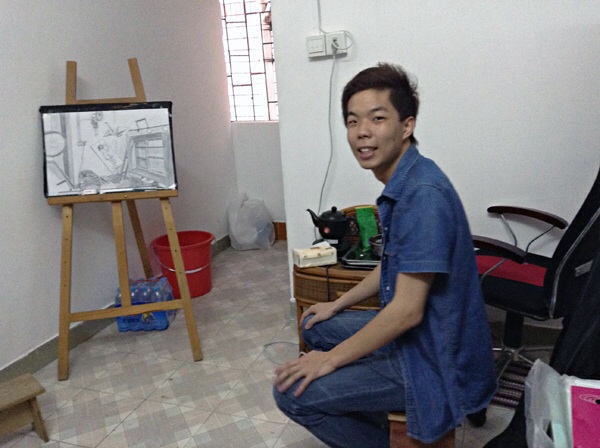
village hack: Tadeas

Tadeas had a lovely sharing, and his engagement with Baishizhou is fun and real. Honestly joyfully playfully real. He commented, for example, that the dark brought out all sorts of imaginary monosters, such as a ten meter snake and rats so sick they had gone bald. He then handed over the key to Huihui and Qiangqiang, who will partner up for their hack. Check out Tadeas’ colorful notes at 白鼠笔记/Village Hack. Below, impressions from the afternoon.

This slideshow requires JavaScript.

LSC874—Bamboo DiRT: StoryMapJS

Tools of the trade and fun to use!

zephyr42's avatarmoar coffee plz

So, Northwestern’s KnightLab has a lot of awesome tools, and I might as well get their logo tattooed over my heart, ’cause I sort of love them. StoryMapJS is a way to show a story in text and image while also displaying the relevant location on a map. As the story progresses, the map moves around and allows you to interact with the story differently. For this project, I used largely the same data as for TimeLineJS, using strategic copy/pasting. The result, as you’ll see, is somewhat different.

Screenshot 2014-05-08 14.49.45

Unlike TimelineJS, this tool does not require use of a spreadsheet but rather is built in a manner resembling a presentation. Each event is a slide, and for every slide you have the option to manually place the geomarker or to search for a location and have it automatically placed accordingly. As I was mistakenly under the hopeful belief that I could import from…

View original post 263 more words

落地: mapping Chinese creativity

So a few brief thoughts about Innovation Week.

First, many young people want to make the world better. They inspire and encourage and constitute hope.

Second, organizers brought in musicians, dancers, and screened documentary films to round out the conversation.

Third, the idea of “smart cities” resonated. Last night at dinner, for example, friends from Dali and Yunnan told the same story–explosive housing and building construction coupled with spiraling rent increases (as much as 30% in Dali and 15% in Beijing) has meant that even the upper middle class is being pushed out of central city districts. And here’s the rub, these new and improved spaces are neither new or improved. So as in Shenzhen and Hong Kong and London, New York, LA and Tokyo, we’re looking at the ongoing construction of stratified cities which exclude young people and working class families from participating and sharing in what our societies consider to be “good”. So we need to build smarter, so to improve the quality of life of every resident. Here, Citymart’s commitment to connecting municipalities and social entrepreneurs inspires.

Fourth, Shenzhen was well represented. Three Shenzhen projects were recognized for creatively engaging a constantly shifting world. In addition to Handshake 302 (current project 白鼠笔记/ Village Hack), which was included in the segment on how art is helping us rethink the social, the Green Tomato In Library (青番茄) and the Vizdan (维吉达尼联合) projects were both recognized. Zhang Lijuan started Green Tomato in order to bring library resources into coffee shops, train stations, and other public spaces. Instead of borrowing a book from a library, members can borrow a book at their nearest coffee shop. Or, they can borrow a book at their point of departure and return it when they reach their destination. Liu Jingwen initiated Vizdan in order to open Chinese markets to Xinjiang communities. Many of these villages and towns are located on part of the Silk Road, reconnecting what socialist plans severed. Both Zhang Lijuan and Liu Jingwen are 30 something Shenzheners whose social innovations exemplify the way young Shenzhen is searching for ways to redefine the economy of special economics.

Finally, in his Keynote speech Ashoka CEO Felix Oldenburg reminded us that we may be entering a world in which change is the issue–the ability to compassionately create, respond to, and understand change may be the most important skill we teach our children.

mapping Chinese creativity–shenzhen vis-a-vis beijing

Several weeks ago, Shenzhen hosted the Maker Faire, bringing tech savvy makers together to explore, discuss and extend hardwire creativity and innovation. This past week, Beijing has hosted Social Innovation Week, bringing changemakers together to explore, discuss and extend social creativity and innovation. In Chinese one character separated the two events. The Shenzhen hosted 创客 or “maker guests” while in Beijing the guest list comprised 创变客 or “make change guests”.

Inquiring minds might paraphrase Gregory Bateson and ask: is this a difference that marks an important cultural difference between the two cities?

As in English, the Chinese shift from the vocabulary of “hacker” to “maker” has signaled the increasing respectability of the techno-nerds. The Chinese is even more explicit in this respect. To my knowledge, the earliest translation of “hacker” was 黑客, literally “black guest”. The term highlighted the outlaw romance of hacking at (at least) two levels. First the obvious 黑 which describes renegades and their possibly illegal activities as in the expressions “mafia (黑社会)”, “no hukou child (黑户)”, and “black heart (黑心)”. Second, 客 refers not only to guests in the modern sense of the term, but also clients in the medieval sense of the term, the dependents on a lord who would provide service in return for protection. Unlike, the English, however, the expression “changemaker” is more obviously related to the hacker movement because the word is made (!) by inserting the character 变 or change into the net-popularized expression 创客.

The more pertinent question, however, seems to be: Almost a decade after China began promoting creative industries, do the respective localizations of these two events tell us anything interesting about how Beijing and Shenzhen function within the Chinese cognitive mapping of creativity and innovation?

The pomp and circumstances of the two events did not differ radically–both were located in marginal spaces (Anhuili and Shekou, respectively) that are nevertheless within the city center, broadly defined. The demographic of the organizers was similar, with generations 80 and 90 running the show, and a shared emphasis on networking nationally and globally. The staging of talks was different. Beijing opted for TED style talks, with speakers having 15 minutes to share their projects. This was supplemented by round table discussions. In contrast, Shenzhen opted for more traditional keynotes, with salon style question and answer sessions.

The important difference seems to coalesce around funding sources and industry support. Beijing garnered support from not-for-profits and international foundations. In contrast, Shenzhen had industry support, generally through China Merchants, which is rebranding Shekou and specifically through Shenzhen based companies and international think tanks that focus on techno innovation. In other words, while young people of both cities deployed creativity to claim a space for and to legitimate the status of Generations 80 and 90, the Beijing event constituted itself with respect to society broadly defined, while Shenzhen defined society with respect to entrepreneurship narrowly defined.

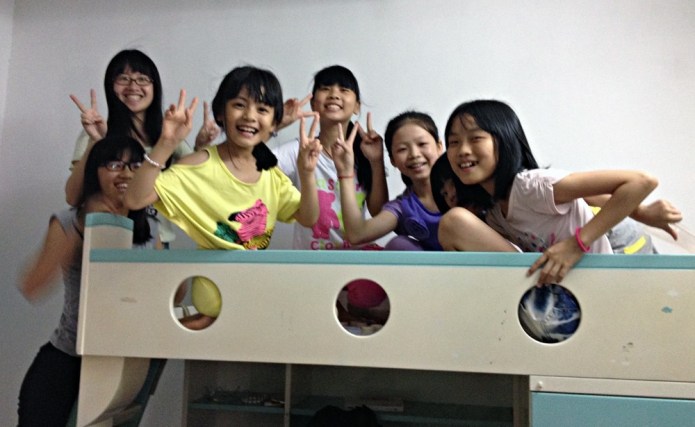
Impressions from opening events, below.

This slideshow requires JavaScript.
voice of the people?

It’s been a while since I’ve had an interesting conversation with a cabbie, but this morning Song Shifu impressed with his convictions, social analysis, and desire to share. 

On the reason for China’s environmental problems: Song Shifu hails from Zhejiang, one of the core industrial areas. Throughout his home county, the rivers stink and smoke clogs the sky. These factories produce goods for European and North American countries. These countries have taken advantage of their strength to unload the contaminating industries on China.

When I asked about Mao Zedong and if there was a need for Revolution, Song Shifu had mixed feelings. The destruction of traditional values has not been good for the country. However, under Mao China stood up for itself. Now China doesn’t dare use it’s army because all the US has to do to influence China’s foreign policy would be to freeze the bank accounts of the Princelings and their children. Moreover, he wouldn’t fight against the United States, after all there was no animosity between the US and China. Contaminating industries notwithstanding. But Japan. He would volunteer to fight Japan. 

the first hack

image

Liu He took up the challenge of hacking Baishizhou, April 27- May 3. Although raised in Shenzhen, Liu He has never lived in an urbanized village. Instead, his parents came from Dongbei to join a Shenzhen work unit, and so he lived in subsidized housing that his family subsequently bought.

Liu He asked: what would it take to move into Baishizhou? He discovered that contrary to his expectation of chaos, danger, and inconvenience, Baishizhou was easy to settle into. At 8 a.m. Liu Hu joined the morning rush to the subway station, stayed at work all day, and ate dinner at his office canteen before returning home at 9ish. He played his guitar or sketched at night, leaving the door open, but no one poked their head through the door. The only problem was finding parking. So after receiving his first ticket, he left his car at home. In fact, should his parents ever kick him out of their downtown condo, he’ll simply move to Baishizhou.

Over the course of the residency, Liu He grew increasingly curious about other residents. He noticed the rotation of street hawkers and their carts. In the late morning through the afternoon, vegetable and small goods vendors occupied the alley. Then from 5 to 10, the stir fry and steamed clay pot vendors took over the space. Lamb kabob and beer vendors took the last shift, from 10 pm to 2 or 3 am. Liu He wanted to follow pet owners home to see their living conditions because he saw several expensive and pedigreed animals. Moreover, many people walked more than one dog, and seemed to have them regularly groomed in a pet salon. The number of couples also intrigued Liu He. He wondered if they had hooked up in Baishizhou or if they had come as couples. Monthly wages in service seemed to average around 1,200 yuan a month, while clerical jobs were around 3,500 and high end salaries reached 6,000.

Liu He observed a smooth curtesy between residents in the building and throughout Baishizhou. People could stand shoulder to shoulder watching a television program, for example, but not acknowledge each other. If he asked directions, his interlocutor responded to the question, but didn’t ask anything personal. Indeed, Liu He mentioned that the happiest residents were the children who played together or came up to the room to hang out because they made friends.

Liu He concluded that Baishizhou was just a place to sleep, unless you had a family. His main social life unfolded outside Baishizhou. In contrast, the neighborhood schools provided children and their families with a social structure through which they were integrated into the community. Moreover, children needed care, which created networks among caregivers who regularly frequented the same public areas. Liu He attributed the lack of deeper conversation and community feeling in Baishizhou to temporary inhabitation. People come and go, so there was no motivation to make friends. But this kind of in habitation was only suitable for singletons moving through; families and long-term residents would need a social network.

For more images and to read Liu He’s journal, please visit the 白鼠笔记/ Village Hack blog.

czc: six months in baishizhou

Here’s the link to CZC–Six Months in Baishizhou, an introduction to Handshake 302 and our projects there. The pamphlet includes a brief cultural history of the relationship between Baishizhou and Overseas Chinese Town.

revved up and ready…

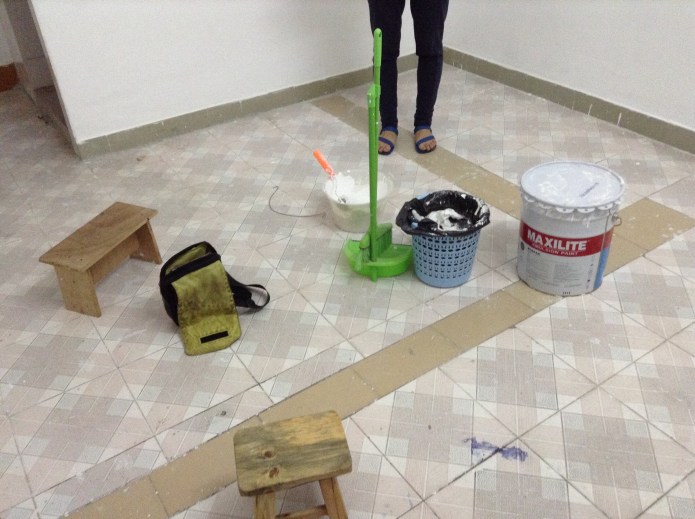
Handshake 302 has been transformed into a dormitory for the Village Hack Artist Residency. Tomorrow, our first hacker Liu He moves in for a week of exploring architectural forms in Baishizhou. Below, impressions of the new room.

This slideshow requires JavaScript.
Exit A Baishizhou Station, Luobao Metro Line

51 seconds in Baishizhou.

Handshake 302 “Village Hack” Artist Residency

The Handshake 302 “Village Hack” residency program invites artists, writers, scholars, and curious citizens to explore Baishizhou, a large, centrally located urban village in Shenzhen.

We’re calling this program “Village Hack” because we hope to encourage a fresh group of artists and scholars to take a new look at how Baishizhou lives and works and even plays.

Each resident asks and answers a simple question over the course of their one- or two-week stay in Handshake 302. For example, a Village Hacker might ask the question, “What do my neighbors do for fun?” or “Can I live in Baishizhou without air conditioning?” Each day, the “village hacker” post the results of their experiment on the group blog “白鼠笔记 / Village Hack”. The last day of their stay, the resident holds an open house, when friends and guests can learn see, hear, smell, touch and perhaps taste the results of hacking Baishizhou. The findings might be a series of photographs, a poem, or a reading of a stream of consciousness free write.

The initial period of the experiment is May through June. If you are interested in signing up for a one or two week residency, please contact me to discuss your particular hack.

We look forward to learning what your hack reveals about everyday life in Baishizhou!