what are the forces of dark evil?

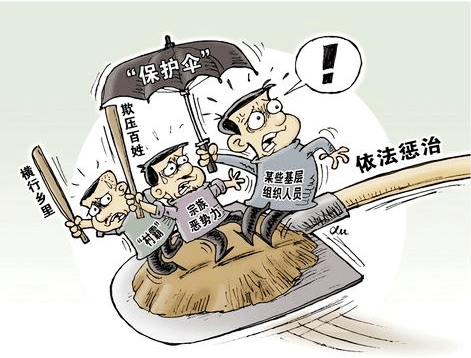
So there actually is an office dedicated to “sweeping away black and removing evil (扫黑除恶办)” office in the Shenzhen Government and they’re sending text messages to my phone. The program aims to forward the spirit of Xi Jinping’s vision for society. My problem is that I don’t actually know what groups and or behaviors the phrase “黑恶势力 (forces of dark evil?!)” refers to. On the face of it, it might be corruption, but then again, the full title of the program is “扫黑除恶专项斗争 (a special struggle to sweep away black and remove evil)” which, of course, gives rise to all sorts of CR alarm bells, especially because we’ve been given telephone numbers to report on the evil forces in our midst. But who are they? In the cartoon, for example, the target seem to be village heads and rooting out traditional alliances. According to Baidu, the project is targeting gangs and triads. And if this is in fact the case, what are they doing in my middle class neighborhood? Am I living next to gang members? So its hard not to feel that the program seems less about “using law to govern (依法治国)” than it does about the increasing militarization of society.
return of the repressed

Trite but true: if we don’t come to terms with our history it just keeps recycling without decomposing. This headline from a shenzhen newspaper reproduces the spirit (if not every letter) of a Cultural Revolution article encouraging the Chinese people to “inscribe Chairman Mao’s directives in their minds and dissolve it into their blood, manifesting it in every action.” Sigh.

shenzhen+ savannah

I visited Marco in Savannah and we thought about the trade that binds…

crazy rich asians / material girl mix-mash

So I watched Crazy Rich Asians online and came away thinking: billionaire rom-com with Asian-American characteristics. If you like billionaire fantasies and think money grows on Chinese trees, its a fun escape with a light-hearted soundtrack. However, if you know some of the soundtrack references, a bit of cultural dissonance threads uneasily throughout. The one song that I found particularly disconcerting was the use of Sally Yeh’s “200 Degrees,” a canto-pop interpretation of Material Girl, which was played during a shopping scene. These two songs have the same tune but actually locate female agency in different spaces. Madonna embraced pay as you go sexuality–“Only men who save their pennies make my rainy day…,” while Sally Yeh seemed more interested in celebrating female sexuality– “If you want to hold me tightly, love replaces words…” Anyway, today’s takeaway is a question: is the difference between Madonna’s cheerful cynicism about sex and Sally Yeh’s cheerful sincerity about love the difference between a failed and successful rom-com?

Madonna’s version of the song didn’t fit the movie precisely because Rachel Chu isn’t a material girl. As the massive romantic fiction market teaches us, it doesn’t pay to be cynical about love. At any rate, check out Madonna (1986) and Sally Ye’s (1985) live performances of Material Girl and 200 Degrees. FYI, the Sally Yeh version is during an awards ceremony and follows the introduction to the song.


大材小用: rumors from angola

So here’s a story about a young Chinese man in Angola. I heard it from a 30-something deliveryman, who currently makes his living delivering express letters and packages in and around Shenzhen. He is dissatisfied with this job because although he is the number one deliveryman in his unit, he feels that his potential is being wasted. He said that after facing down gunmen three (!) times in the streets of Luanda, delivering packages in a rainstorm, which many other deliverymen refuse to do is child’s play, implying, of course, that what he really wants to do is play with the big boys. Continue reading

hairballs: who’s the favorite?

I’ve just returned from time in North Carolina and what have I learned? In addition to realizing that Donald Trump and Xi Jinping both have distinctive and easily mocked hairstyles, I also learned that ordinary US Americans are as worried about the trade war as are ordinary Chinese citizens. Indeed, in both countries I’ve been advised to invest my money “over there.” Chinese friends encourage me to take the money and run back to a US bank, while American friends tried to convince me to invest more in the Chinese stock market. In both Shenzhen and NC, there is a sense of frustration and defeat over the antics of leaders who are not leading, but rather seem to be wandering aimless instead of dealing with real problems and the well-being of ordinary people.

(cartoon from scmp editorial)

late arrivals: thoughts on catch-up urbanism

I came to Shenzhen by way of Houston circa 1995. It was a time when the boom had fizzled and young developers were just rediscovering the downtown. The city I inhabited was proud to live like a suburb with its lamentable public transportation, its ethnic strip malls and its destination malls like the Galleria. For street life, most of us bypassed the Montrose area, choosing instead to drive to Austin or San Antonio, which were further along in their urban renewals.

Continue reading

opium

Caught up in the world of cheerfully sexy pirates, I waded through the trials and tribulations of Eitel’s heroic Free Traders to his chapter on “The Opium Question and the Exodus from Canton, 1839” (75-95). Now, the opening chapters of Europe in Asia had prepared me for his ‘blame the addict’ explanation for the opium trade, but I’d be lying if I claimed that I had anticipated the Alice in Wonderland moment which opened his discussion:

“The taste for opium is a congenital disease of the Chinese race. At the beginning of the Christian era, the uses and effects of opium were the secret of the Buddhist priesthood in China. Priests from India secured for themselves divine honours by performing feats of ascetic discipline, fasting and mental absorption, sitting for instance motionless for months at a time indolently gazing at a black wall. These feats were performed by means of opium.”

Continue reading

a general history of shenzhen

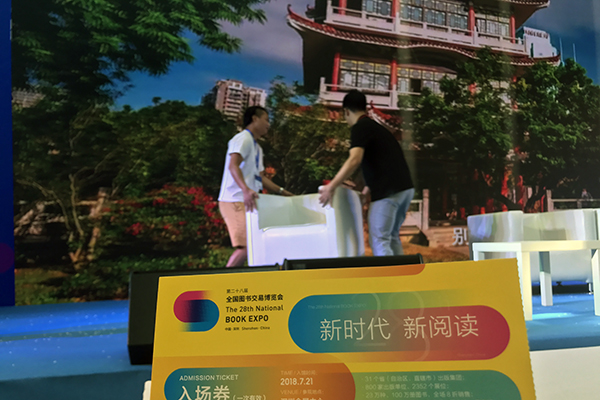
On Saturday, July 21, I participated in the launch of A General History of Shenzhen (深圳通史) at China’s 28th National Book Expo. We gathered to honor archeologist Zhang Yibin, who has spent over thirty years of his life documenting the shards and towers of Shenzhen. He has contextualized these bits and pieces of material culture within and against local gazetteers and academic research, providing us with a rough timeline of the past 7,000 years. So, now we have an official history that we can begin deconstructing. Who knows? We may actually move beyond the fishing myth and our investment in imagining “normal history” as the history of boomtowns and capitalist accumulation.

This slideshow requires JavaScript.

and more from shenzhen book of changes

Help us make more and better episodes of Shenzhen Book of Changes!