huidong: impressions of the edge

A week or so ago, we went to Huidong (惠东), one of the poorer counties in Huizhou City (惠州市). Huidong is located within the valleys of the mountain range that runs parallel to the eastern coast of Guangdong. Via mountain paths, it is a four-hour hike from Huidong to Haifeng (海丰县).

Continue reading

Chinese translation of “Learning from Shenzhen” is out!

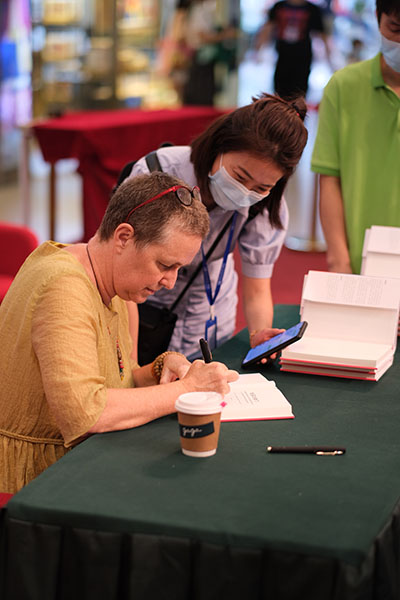
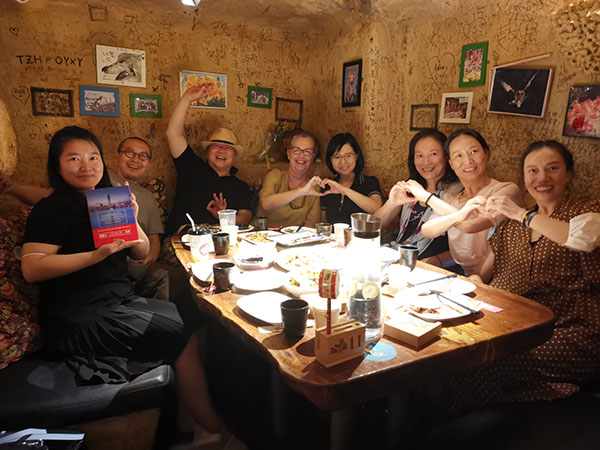
The launch for the Chinese translation of “Learning from Shenzhen” was held at the Central Book City public area. There were several hundred in attendance and young children came up to meet the author and get an autograph. It was an exciting–and let’s be frank–unexpected reception for the translation of an academic book.

from bamboo curtain to the silicon valley of hardware

For the 2019 edition of the Shenzhen Hong Kong Bi-City Biennale of Urbanism/Architecture (UABB), Handshake 302 installed Electronic Lifestyles at the Futian Station Main Venue. To situate the installation with respect to Shenzhen’s cultural geography, I wrote From Bamboo Curtain to the Silicon Valley of Hardware, which was published at as part of e-flux architecture‘s Software as Infrastructure project.

From the essay:

Located on the “bamboo curtain” at the Sino-British border, Shenzhen’s spatial liminality facilitated national political and economic restructuring, which ultimately had international effects. In the ordinary order of things, liminal spaces have recognizable thresholds and boundaries; one crosses from one side to the next. Most liminal spaces are located at the edges of mainstream society. In contrast, the geopolitical logic of Shenzhen has been to place liminal spaces at the center of society, making perpetual transformation—of the self, the nation, and the world—a key feature of the model. The transformation of Luohu-Shangbu from a riparian society into the earliest iteration of the Shenzhen Special Economic Zone (SEZ) can give a sense of how liminality was deployed to as metaphor and strategy. Today, the Luohu area is known as Dongmen, a bustling cross-border shopping district, and Shangbu is known as Huaqiangbei, the world’s “Silicon Valley of Hardware.”

Curious? Please give it a read.

unmasked in shenzhen

The following post was first published on Pandemic Discourses, a blog curated by the India China Institute at the New School. The goal of the blog is to bring differently situated perspectives on the COVID-19 pandemic into conversation with each other. The purpose of my post was to provide impressions of the first six months of the pandemic and responses in Shenzhen.

It’s been roughly six months since Shenzhen introduced measures to control the spread of COVID-19. Statistics from the Shenzhen Health Commission 卫健委 show that the highest number of cases occurred at the end of January and early February. There was a second wave that coincided with the return of residents after the Chinese New Year’s holiday. Indeed, the city has emphasized the difference between “locally transmitted” and “imported” cases. As of July 19, 2020, the city had a confirmed total of 462 cases, while the most recent case was reported on April 28, 2020. Continue reading

where to go for information on shenzhen?

If you are interested in government approved daily updates on what’s happening with the coronavirus in Shenzhen, you could do worse than visiting EYESHENZHEN, which provides translations of city briefings. The site also includes a comprehensive introduction to the city’s mainstream art scene.

the digital divide, coronavirus @sz

When the New Year’s holiday began, much of the sociality that characterizes everyday life in our housing estate ended. There were no more early morning exercise groups, mid-morning dancing Aunties, and afternoon gamers. We have several groups who play cards, Chinese chess, and mah jong in the compound. However, children are still riding bikes, playing badminton, and dribbling basketballs. It is also possible to visit friends within the estate, and so the other night, we had friends over for dinner and a game of cribbage. What I learned from my friends is that they aren’t missing face-to-face interaction as much as someone of my generation might think because young people have been proactive in organizing even more online social events than usual. There have been online photo-galleries, where people upload images on a shared theme, online talks, where people listen to and interact with a guest speaker, and even more online gaming than usual. In other words, my younger friends have experienced the delay in returning to work and school as a chance to intensify their online friendships, which they agree, are often less stressful and more rewarding than face-to-face interactions.

are we all living in xinjiang?

Anyway, I’ve been thinking about why the quarantine in Shenzhen has been so smooth and this is what I’ve come up with: the state is using its anti-terrorist infrastructure to control population movement and combat the spread 2019-nCoV. Continue reading

voices from coronavirus@sz

A poem from a friend:

WechatIMG1122

Screen Shot 2020-02-10 at 7.51.12 PM


And two other posts: Continue reading

ghosts of the second line

It’s true: nothing’s every really over. I’ve realized why these past few days quarantine restrictions seem so familiar: it’s as if both the SARS precautions and the second line have been reactivated. From SARS: we can freely leave our estate, but only residents can enter. From days of the second line: we can freely move about the city, but residents need to be registered to return, while non-residents must prove they have jobs to return to. At present it seems like some jobs will begin again on the 17th and others are scheduled for the 24th. Perhaps schools will be up and running in March.

Here’s the rub: Management protocols that have limited the movement of people still linger. The gates of Shenzhen University, for example, became operationalized during the student quarantine, and afterwards the guards continued to control access to the campus. Inspections in the metro became operationalized during the Universidade and continue to structure access in and out of the system. It remains to be seen how many of these extreme measures will be incorporated into our post 2019 n-CoV normal.

li wenliang: the heroic intellectual

One of the eight Wuhan whistleblowers, Li Wenliang (李文亮) died on February 7, Chinese time. Most of the posts to my friends’ circle (朋友圈) are memorials to him. In addition to pictures of Li Wenliang wearing a face mask, these posts include images of his police file for creating rumors about a SARS-like virus and screenshots of relevant posts, including international posts in English and German. In addition, essays about his life and the meaning of his death are starting to appear. The more ‘viral’ of these essays emphasize the fact that he was an ordinary person doing his job and that he had the courage to speak truth to power. These posts imply a relationship between Li Wenliang’s status and his courage; only the ordinary, it would seem, are able to tell the truth, affirming both the need for public intellectuals to watchdog the public realm and the public’s right to have intellectual watchdogs looking out for their interests. Continue reading