moving on up…shenzhen identity and urban villages

Urban villages inform and shape popular understandings of Shenzhen, both domestically and abroad. Intellectuals, also here and elsewhere, have decried the decision to raze villages and put up new and improved postmodern housing estates, offices and shopping malls as it short-sighted and violently anti-working class. However, in Shenzhen, there has been no street level organizing as such to stop the razing; a decision is made, plans approved, people moved.

In this context, it is interesting to note the temporary nature of Shenzhen patterns of inhabitation. Even before settling in to their first dorm room or urban village share, migrants intend to move. This intention might be vague — I’ll move when I get a better job, or buy my house — but “moving on up” is one of the reasons people migrate to the city. Moreover, in practice, people move when they change jobs, they move when they get a raise, they move when they have a partner, they move when their parents come to live with them. They also move as investment strategies, from one home to the next. Indeed, as far as I can tell, people only seem to stop moving (for the time being), when their child is at a desirable school. If the school is undesirable, changing school district zones or moving to parts of the country where gaokao competition is less fierce.

In other words, inhabitation patterns seem to preclude the time necessary to grow attached to neighborhoods. The current fondness for urban villages seems overwhelming is often nostalgic (missing the challenge of first coming to Shenzhen) or political (we need housing for the working poor), but it is rarely the result of long-term living in a village. Many of the people I have interviewed who do live in a village want to leave. They want their own home (not a rental), or if they are a landlord who lives in a handshake, they want to live in a modern high-rise.

All this to say that the lack of grassroots resistance to razing urban villages in Shenzhen isn’t as counter-intuitive as it may seem from the outside. Those who want to keep the villages don’t actually live there, and those who live there are anticipating moving out. Indeed, I have come to believe that the social questions posed by urban villages have less to do with preserving these neighborhoods, as they do with making long-term inhabitation possible. If the villages were places that people actually wanted to live, raise their child, and retire, then there would be a very different political and economic response to the ongoing demolitions.

NOTE: Handshake buildings as a form of local real estate development were an artifact of the 1992 decision to transfer inner district village lands to the city. In the 1980s, villagers built free-standing homes for themselves, and some collective rental properties and dormitories. However, once the 1992 policy limited village land resources, villagers stopped building individual free-standing homes and built multi-story rental buildings. In the outer districts, where land remained under village control until 2004, villagers built neighborhoods of free-standing homes for themselves, and multi-story rental properties next door.

even maoist spaces crumble and fade…

Only eleven houses remain occupied in Baishizhou’s Tangtou row houses.

Nanshan District tacitly condemned these houses several years ago, but did not become serious about evictions until the Universidade (Summer 2011). As inhabitants were evicted, the District padlocked the doors, so that the buildings could not be reoccupied. However, as the saying goes, “Those on top have policies, those on the bottom have countermeasures (上有政策,下有对策)”. When houses weren’t immediately padlocked, another family or worker or group of friends moved in. The owners continued to collect rent. When enforcers from the Urban Management Bureau (城管) came by either the inhabitants moved, or made friends with them and stayed, waiting for the final eviction.

This wait and see attitude has been much more successful for inhabitants of houses where the landlord is either in Hong Kong or further abroad. As a 4-year resident said, “Property managers don’t care what we do because the absent landlords are legally responsible. All they have to do is collect rents and their paychecks. I’m polite to urban management and they leave me alone. We’re all human, and when it’s time to move, they’ll tell me.”

Nanshan District has decided to close down the area completely because the summer rains further weakened the structures. These buildings from rural collectivism are no longer simply considered an eyesore, but also dangerously unsound. The vanishing of Maoist economic legacies was, of course, one of Shenzhen’s raison d’etre. However, Maoism lingered in the nooks and crannies of previously built spaces, such as Tangtou. Indeed, the Tangtou row houses are one of the few remaining examples of Maoist architecture in Shenzhen’s inner districts and once they have been razed, Maoism will become more of a spectre than it already is.

Thought du jour: in Shenzhen, even crumbling, Maoist dormitories can no longer safely shelter the city’s poorest workers and their families. Wither the left, indeed.

Impressions of Tangtou wet and sunny, and still occupied interior.

This slideshow requires JavaScript.

futian village

After several months, I return to my synopsis of The Great Transformation (沧海桑田:深圳村庄三十年). This episode is about Futian Village (富田村), which begins raising the counterintuitive question of why Walmart would build a megastore in Futian Village. The underlying message of the episode might be half-facetiously summarized as “location, location, location”.

The story of how Futian Village became known as Futian suggests the shifting contours of village lands. 田 (tian) of course meant “paddy” or “fields” and has been constant over history. Over 900 years ago. One went to Futian, one settled in Shangsha, and the third went to Yuanlang in what today is known as the Hong Kong New Territories. However, the village was originally called “Getian (隔田)” because it was separated from the mainland by a stretch of seawater that extended to Tianmian. Over time, sedimentation filled the marshy areas between the coast and the separate fields. This new agricultural land was called Futian (幅田). When the name was formalized during the Mao era, the village was named Futian (福田), which included the character 福 (fu – prosperity), a homophone for 幅 (fu -meaning landfill). According to an old villager, “real Shenzheners” call him “Getian person (隔田佬)”.

In fact, the history of the area is the transformation of the status of fields. Before 1980, Futian villagers cultivated grain, sugar cane, and peanuts. The village itself was defined in terms of these land holdings. They were organized as one brigade, which was further organized into two work teams – total population 1,000 people. However, according to the old Village Party Secretary Huang many more villagers escaped to Hong Kong before reform. At the establishment of the SEZ, the village occupied had strategically located land holdings, at the edge of the Luohu downtown area. In 1992, when inner district villages transferred historic land rights to Shenzhen Municipality, the village developed rental property and commercial areas. There were two key developments that went on to have national impact. Firstly, in 1998, Walmart opted to open its first megastore in Futian Village. In turn, the Futian megastore became the model of how to operate a Walmart in China. Secondly, the Venice Hotel chain also opened its first hotel in the village.

1990s and early turn of the millennium corporate village development emphasized profit rather than public space. Importantly, however, Futian Village was located directly adjacent to the new central axis area. However, when the new Civic Center opened, Futian Village was required to upgrade accordingly. In 2007, when Futian decided to build a new culture plaza, then Futian District Party Secretary, Lv Reifeng reputedly said, “I can’t give you funding to build the plaza, but I can give you a policy.” The policy was quite simple: Futian District gave 30% of the total cost to build the plaza.

To recap: The Great Transformation tells the story of thirty Shenzhen villages. Importantly, the idea of “village resident” in the series constantly shifts between “indigenous villagers” and “migrants who live in the village”. This slippage is subtle but hinges on the way in which urbanization has not only transformed fields, but more importantly restructured property rights. For example, when the narrator says “villager/s (村民)”, he clearly means “local villager/s”, referring to those who own buildings and have stock in the collective holdings. However, when he speaks of “urban villages (城中村)”, he means the urban neighborhoods that evolved out of the previous village. More tellingly, the slippage between “villages” and “urban villages” structures rhetorical questions throughout the series. The episode, “Futian Village”, for example, opens with the rhetorical question, “Many wonder why one of the world’s 500 richest companies would choose to open their first megastore in an urban village.” Clearly, the intended audience of the serial documentary continue to view urban villages as rural villages rather than urban neighborhoods.

are there any shenzheners?

The Shenzhen Volunteer Association claims that “If you come, you are a Shenzhener (来了,就是深圳人). The claim itself is fascinating because it not only flies in the face of traditional hometown identities, but also because it implies that those who were already here aren’t Shenzheners.

There are three main labels for people in Shenzhen: 深圳人 (Shenzhener),本地人 (local),and 外地人 (outsider). As a general rule of thumb, Shenzheners are as much a construction of ongoing municipal campaigns to generate identification with the city as they are the rich second generation who grew up here. The point is that in addition to refering to an individual’s hukou status, the label “Shenzhener” also and importantly refers to a recognizable lifestyle and aesthetic that in the US we would call “middle class consumer”.

In contrast, locals and outsiders refer to the hometowns of people who live in Shenzhen. Locals have traditional roots here (through a historic village), while outsiders came from elsewhere to live and work in Shenzhen. Technically, everyone in Shenzhen is either a local or an outsider. However, as indicated above, the category of “Shenzhener” is an ongoing social construction that transvalues local and outsider identities, usually by smoothing out differences in the second generation. Thus, the children of both locals and outsiders frequently identify as Shenzheners, even when their parents have Shenzhen household residency but continue to identify with their hometown.

The distinction between Shenzheners, locals, and outsiders points to the overlap between traditional Chinese hometown identities and the reform policies that created Shenzhen. On the one hand, Chinese people identify with their hometowns, creating identity out shared language, food, and customs, such as Shanghai or Hakka people. On the other hand, Shenzhen identity has been constructed out of the transformation of Bao’an, environmentally, socially, politically, and culturally. Shenzheners are the people who have participated in and/or benefited from that process. In contrast, locals remain identified with their natal villages, while outsiders continue to identify with theirs.

The symbols through which individuals craft Shenzhener identities are vexed by contradiction and uncertainties for three reasons. First, less than 3 million people (or 1/6) of the total population have Shenzhen hukou, which means legally most inhabitants are not Shenzheners. Second, if locals are not considered Shenzheners, it is because identity remains rooted in policy, rather than history. And third, even second generation Shenzhen residents remain emotionally embedded in hometown relationships elsewhere because their were raised by outsider grandparents.

Of course, therein lays the rub. The debate about who is a Shenzhener not only raises the question of who has rights to the city, but also the question of who is willing to be responsible for the city. To date, these questions have not been explicitly addressed, begging the question: is it enough to define a Shenzhener through how an individual has used the city (to achieve political and/or economic goals), or do we need to re-imagine the Shenzhener identity in terms of contributions to society?

laying siege to the villages: baishizhou

A FIVE-PART ESSAY, “LAYING SIEGE TO THE VILLAGES” HAS BEEN PUBLISHED ONLINE AT OPEN DEMOCRACY. HERE’S PART FIVE, WHICH DISCUSSES INFORMAL URBANIZATION AND THE CREATION OF NEIGHBORHOODS FOR AND BY THE WORKING POOR.

5. Baishizhou: Neighborhoods for the Working Poor

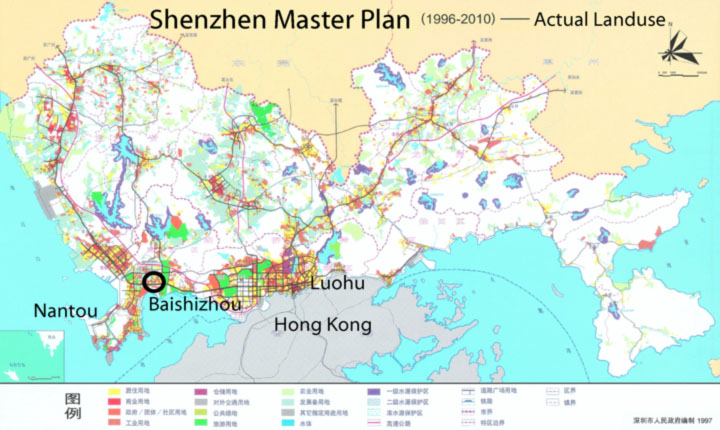
As of 2013, Baishizhou was the largest of the so-called urban villages in Shenzhen’s inner districts. With respect to the overall layout of Shenzhen, Baishizhou occupied both the southern and northern sides of Shennan Middle Road, at peripheries of both Luohu (moving west) and the Nantou Peninsula (moving north), making it one of the most centrally located transit centers in the inner districts (map 8). As of 2013, Baishizhou had a total area of 7.4 km2 and an estimated population of 140,000 residents, of whom roughly 20,000 held Shenzhen hukou and 1,880 were locals. The population density of Baishizhou had breached 18,900 people per square kilometer, more twice that of municipal average of 7,500 people per square kilometer, a statistic which in 2012 had made Shenzhen the fifth most densely populated city on the planet. There were 2,340 low and mid-rise buildings in the area, with an estimated 35,000 units. Monthly rents ranged from 700 to 3,000 rmb, which were significantly cheaper than in neighboring Overseas Chinese Town (OCT) or nearby housing estates, where a “cheap” apartment could rent for 4,000 rmb.

master plan

Map 8: Location of Baishizhou, 1996 Master Plan

Many of the garbage collectors for the area live in the cheapest rentals, rural Mao-era dormitories where it is possible for three workers to share a 30 m2 dorm room for 200 rmb a head, plus electricity and water. Old Cai, for example, was 65 years old, when interviewed. He came to Shenzhen after retirement because his monthly pension is 40 rmb per month, but he and his wife need 20,000 rmb annually, or about 1,700 a month to meet their expenses. In Baishizhou, he makes a living collecting and reselling cardboard boxes and other garbage. He says he can save money this way because although there’s no real profit, he makes enough to support himself and to bring a little home for Chinese New Year. However, the diversity of Baishizhou residents also includes working families who have lived in the area since migrating to Shenzhen over twenty years ago and young professionals who are sharing their first flat independent of their families. One family from Sichuan, for example, rents a 60 m2 two bedroom apartment for 1,700 rmb a month, which the husband, his wife, her mother-in-law, and their two children share. During the day, the parents work at one of the OCT themeparks, while the mother-in-law takes care of the children and housework. In addition, many of Shenzhen’s young designers and architects who work in the OCT Loft, a renovated factory area for creative industry live in higher-end handshake buildings, which sometimes include parking space for a car.

In addition to rental properties, the first floor of most Baishizhou buildings was used for commercial purposes and the area boasted several commercial streets, at least two night markets and entertainment areas, in addition to independent vendors and office space for independent carpenters, builders, and handymen. There was an elementary school and several nursery schools. Moreover, in between two of the abandoned factories of the Shahe Industrial Park enterprising migrants have set up the Baishizhou Pedestrian Street, which mimics the Dongmen Walking Street. There are food stalls and toy vendors, and several juvenile rides.

Clearly, using the term “village” to describe this level of settlement density and diversity is misleading – Baishizhou is a vibrant urban area composed of five neighborhoods – Baishizhou, Shangbaishi, Xiabaishi, Xintang and Tangtou, which under Mao had been organized into a state-owned agricultural collective, Shahe Farm. In the early 1980s, 12.5 km2 area of the Shahe Farm was partitioned into two enterprise areas – Overseas Chinese Town in the eastern section and Shahe Enterprises in the western section. In the mid-1980s, both OCT and Shahe built factories for assembly manufacturing. However, the management teams and access to investment capital were significantly different. OCT was a state-owned enterprise and its management team educated professionals from China’s major cities. In contrast, the former collective leaders managed Shahe and its development. In the post Tian’anmen era when Shenzhen’s low-tech low cost manufacturing had ceased to be as profitable as during the 1980s, OCT developed themeparks – Splendid China, Window of the World, and Happy Valley – to stimulate the economy. In turn, this investment also enhanced the rental value of the area and drove the redevelopment of the former industrial park into a Soho like creative area.

laying siege to the villages: xixiang and fuyong

A five-part essay, “Laying Siege to the Villages” has been published online at Open Democracy. Here’s part four, which discusses informal urbanization beyond the Second Line (erxian).

4. Informal Urbanization in the Outer Districts: National Highway 107

Shenzhen township and village enterprises (TVEs) in the outer districts (formerly New Bao’an County) were quick to take advantage of reform policies. By 1985, village-teams, township brigades, and the recently re-established Bao’an County government had already registered over 50 industrial parks (Map 6).

national highway 107

Map 6: Industrial Urbanization in New Bao’an County, 1985

Nevertheless, this massive social restructuring occurred outside and despite municipal urban planning (Map 7). A comparison of these two maps reveals three important features of informal urbanization in Shenzhen. First, the total area of Shenzhen’s informal industrial urbanization was over four times greater than planned urbanization in inner districts (original SEZ). Second, urbanization in the outer districts occurred outside official urban planning. Moreover, the density of industrialization along National Highway 107 becomes on the 1986 Plan an incomplete red thread. Indeed, as targets of urban planning, the outer districts did not appear in official maps until the release of the 1996 Shenzhen Comprehensive Plan. Third, the scale of development in the outer districts indicates the high level of informal organization in the villages. Informal urbanization did not arise sui generis, but through the redeployment of TVEs, which did not only represent the economic interests of the collective but also traditional identities and social constituencies.

guannei-wai

Map 7: 1986 Master Plan for the Shenzhen Special Economic Zone Transposed onto the 2013 Shenzhen Municipal Map

In addition to the New Bao’an County TVEs, the outer districts also saw the development of private stock companies formed by alliances between individual villagers and investors, often from Hong Kong or an Overseas Chinese community. The diversity of ownership, notwithstanding, all of these enterprises engaged in low-tech labor-intensive assembly manufacturing. The factories themselves were long, concrete buildings, usually 4-6 stories in height. These buildings usually had electricity and water hook-ups, and depending on the complexity of assembly, individual tables for detail work. Outside firms contracted a TVE to assemble a product according to spec. Earliest manufactured goods included textiles, toys, and cheap electronics. These early industrial parks also included 4-6 story dormitories for migrant workers. Dorm rooms were narrow, and fitted with four bunk beds. Opposite the door was a small window, while along the remaining walls two bunk beds were placed back-to-back. There was enough space between the bunk beds for residents to walk to their bed. Consequently, most conversations occurred sitting on a bed or outside on the lawn. Importantly, these factory complexes were built either along National Road 107 or the railway, along which goods were transported to the port of Hong Kong, where in turn the goods were shipped overseas.

In the early 1980s, when the Shenzhen TVEs opened, there were no other manufacturing jobs available to rural workers, who were still tied to collectives and mandatory agricultural production quotas through hukou status. This meant that the Shenzhen TVEs had labor reserves throughout Guangdong and neighboring provinces, where rural workers who were effectively excluded from wage labor. The number of migrants who took advantage of these opportunities constituted the Shenzhen population boom, transforming the landscape in three important ways. First, more people came than there were jobs and by extension, dormitory space. This created an immediate need for rental properties. Second, the increasing population also needed food and social services, which in turn created more jobs for migrants across sectors, but primarily in construction and service industries. Third, urban construction this area was largely informal. By the time that Shenzhen Municipality had annexed New Bao’an County in 1990, local collectives had emerged as the de facto urban planners in the outer districts. Moreover, when considered in terms of population and territory, urbanization in the outer districts constituted the primary form of urbanization in Shenzhen. Moreover, by the mid-1990s, many domestic and international companies chose to rent use rights from the collectives and build campuses in the other Districts, especially Longgang near the railway. As of 2013, high profile electronics manufacturers in Shenzhen included Foxconn, Tencent, and Huawei.

The fuzzy nature of ownership rights over-determined the haphazard direction of urbanization in the outer districts. Indeed, throughout Shenzhen, the foresight of a collective leader and the willingness of members to coordinate development has shaped the quality of life in specific villages. In the post Mao era, land ownership rights belonged to the collective, while “use rights” were delegated to members of the community. This slippage provide a brief window of opportunity for individual villagers to engage in individual profit-seeking activities, however, the most successful enterprises belonged to the county, townships, and villages that expropriated use rights by exerting their ownership rights. Indeed, conflicts between Shenzhen Municipality and its “urban villages” have also arisen due to the distinction between ownership and use rights. As of 1992 in the inner districts and 2004 in the outer districts, Shenzhen Municipality owned all land within its borders. However, through housing and industrial parks, the collectives continued to exercise use rights. Indeed, since 1992 and 2004, villages and developers have been negotiating compensation for transferring these rights; Shenzhen Municipality has mediated these transfers through its Master Plans.

…a village by any other name…

Huaxin Village is not a village. Located at the intersection of Huaqiang and Hongli Roads, Huaxin was one of the earliest residential areas built in Shenzhen. It boasted 30 lowrise apartment buildings, a business office, and an office for neighborhood offices. In total, the neighborhood had 1007 homes. Walking west, the neigborhood abutted Fuhua Village and then opened into the northern section of Shenzhen’s Central Park.

To walk this area is to get a sense of the excitement and utopian discourse that permeated early Shenzhen. Huaxin literally means “China New (华新)”, Fuhua means “Prosperous China (福华)”, and Huaqiang means “China Strong (华强)”. Moreover, in the 1980s, the area north of Hongli Road was considered suburban with respect to the Dongmen and Luohu areas near the train station. Consequently, planning in this area primarily included factories and residential neighborhoods, such as Huaxin.

The layout of Huaxin  illustrates early understandings of public space and semi-public spaces. In addition to a public garden, the residential area also had a soccer field and areas for sitting and chatting. Moreover, along walkways, designers had included planters. When Huaxin housed the young SEZ’s managerial class, the ornamentals filled the planters. Over the past decade, the value of the housing stock has declined, even as property values have increased dramatically leading to a typical “urban village” phenomena: the owners have moved out and rented their homes to working families. In turn, these farmer-migrants have converted the planters to urban vegetable gardens, while first floor homes have been repurposed as shops.

Despite the value of the land, it’s not easy to raze rennovate these old, centrally located neighborhoods because the housing belongs to old Shenzheners, who — again like local villagers — are in negotiation with developers and the city to transfer the property rights. Again, compensation buy-outs are figured by square meter of housing. As early as April 15, 2009 — almost four years ago — there was news that Huaxin would be razed and the area upgraded. By 2011, DZT had published a feasibility study of how to upgrade the area inline with its position next to Shenzhen’s large electronics market, Huaqiangbei.

Of note du jour, in order to make these plans profitable, the new plans cannot include the same amount of space for urban gardening and semi-public gathering. Impressions of yesterdays walk from China Strong through China New past Prosperous China and into the northern section of Central Park, from where skyline views suggest the contours of thirty years of architectural and urban planning.

This slideshow requires JavaScript.

czc entr’acte

The entr’acte between a thriving urban village and its gentrification into mall-burbia occurs as developers scramble to get the last hold outs to sign compensation packages. To ensure that noone moves into buildings that have already been acquired by the developer, windows and doors are often cemented over and 拆 the character for “raze” is painted in bright red stencil.

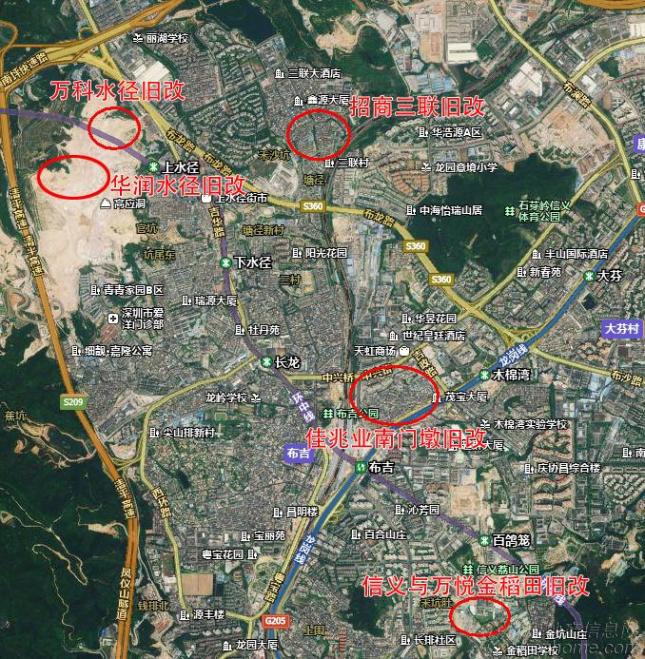
In Nanmendun, Buji (布吉南门墩), for example, the entr’acte has been in progress since May 26, 2011, when the Kaisa Group announced that it had begun the renovation project. According to the announcement, 18,879 people lived in 479 buildings (mostly handshakes, but some early 80’s and Mao era dormitories). Of this population, roughly 10% were Nanmendun residents and entitled to relocation and compensation. Roughly two years later, the process of getting holdouts to sign and stragglers to move on is still in progress.

This slideshow requires JavaScript.

Nanmendun is one of five renovation projects in Buji and the usual suspects — Vanke, China Merchants, Huarun, and Xinyi are also busy gentrifying the area. What the map below makes clear, however, is how extensive rural urbanization has been in Buji. Indeed, it is hard to speak of an “urban village” when handshake buildings and unregulated development have been the dominant form of urbanization for over thirty years.

Lay of the land:

4 renovationsin buji

old trees

It’s true, there’s a category of cultural relic known as “old tree (古树)”. These old trees root the community in histories that stretch back to the late Ming Dynasty (early 1600s). Moreover, their beautiful limbs create poetic interludes throughout the remnants of Shenzhen’s old village homesteads. Buildings may decay through lack of care, but the trees grow despite threat of urban renewal.

This slideshow requires JavaScript.

the difficulty of representing shenzhen’s urban “villages”

Talking about Shenzhen’s urban villages is difficult because legally they are not villages, but “communities (社区)” that have been integrated into the urban state apparatus. Moreover, depending on their location, these neighborhoods have different social functions — slums, gateway communities, and affordable housing for both the working poor and recent college graduates.

Mark Leung‘s photo essay,  Welcome to Wuwucun, a Village in the City offers a detailed and sympathetic look at life in Wuwucun, a Shenzhen urban village and is well worth checking out. However, the images beg contextualization, illustrating the difficulty of interpreting images  in the absence of historical knowledge. Is Wuwucun poor? Are these villagers? Is manufacturing a good thing?  On the one hand, a shorter version of the same essay, for example, explained that these images showed how manufacturing in Shenzhen was providing small steps forward to improve the lives of China’s rural millions. On the other hand, these images depict one of the more peripheral villages in Shenzhen, where the level of poverty depicted justifies ongoing campaigns to raze working class neighborhoods in other parts of the city. In other words, these images can be used either to show that industrial manufacturing in Shenzhen has been good for the country or to justify the Municipality’s ongoing program of razing urban villages in the inner districts. Continue reading